
A recent segment on the CBS network program 60 Minutes focused on brain-computer interface. It was utterly amazing.
A neuro-scientist named Scott Mackler suffering from an awful disease known as ALS (amyotrophic lateral syndrome, also known as Lou Gehrig’s Disease, after the Jewish New York Yankees baseball star who died from it) was completely paralyzed, except for eye movements. He was shown using only his brain waves (hooked up to an electro-encephelogram (EEG) contraption that read tiny electronic signals fired by neurons in his brain) to answer the interviewer’s questions. By thinking of individual letters, and then thinking “yes” when the computer flashed them on the screen, the ALS sufferer composed responses to the interviewer’s questions. Then, the interviewer himself Scott Pelley put on the EEG cap – and remarkably, managed to write the word THOUGHT on the computer screen with only his thoughts – and with no errors!
The segment showed Cathy Hutchinson, paralyed completely by stroke, who used a system called Braingate to guide a mouse cursor on a computer screen solely with her brain waves! Cathy can control an electric wheelchair with her thoughts, too.
And finally, University of Pennsylvania researchers showed how they had implanted electrodes in the brain of a monkey, who had learned how to control a robotic arm with only his thoughts and use it to place food in his mouth.
Someday, perhaps soon, those with paralysis or who have lost limbs may be able to move bionic limbs with only their thoughts.
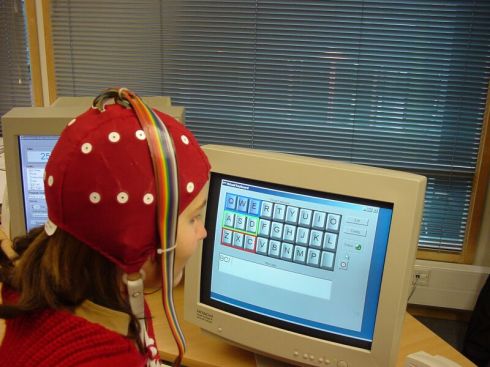
Brain-computer interface
 TIMnovate
1 comment
Comments feed for this article
January 4, 2009 at 2:46 pm
Nathan Zeldes
Oh yes… this is incredibly important research, with huge benefit to the handicapped.
What has always amazed me is how little focus (relatively speaking) is put into bringing these products to market. You’d think people with severe handicaps would pay anything for such a solution; apparently they are either too few, or too poor. Or I’m missing something.