
Governments all over the world are faced with challenges not seen since 1929: Dealing with a global depression whose dimensions match or even exceed those of 1929-39 (Eichengreen and O’Rourke, 2009; see Appendix), without creating mountains of debt that will threaten stability when the crisis ends and the upturn begins.
One of the fiercest dilemmas concerns taxation. As tax revenues plummet in the face of economic decline, governments debate whether to cut taxes (to stimulate spending) or raise taxes (to reduce ballooning deficits). Liberals like Nobel Laureate Paul Krugman claim:
“…people who think fiscal expansion today is bad for future generations have got it exactly wrong. The best course of action both for today’s workers and for their children is to do whatever it takes to get this economy on the road to recovery.”*
Meanwhile, national governments like that of Ireland encounter a different reality:
“…Asserting Ireland must restore international confidence in its debt-laden economy, Finance Minister Brian Lenihan announced an emergency budget plan [that included] higher taxes and lower government spending to bring the deficit in line.” **
Are there basic principles, anchored in those of management, that can guide policymakers as they grapple with hugely difficult problems (unemployment, deflation, bankruptcy, rescue of failed firms and banks)?
As a beginning to this discussion, here are 10 principles that serve as policy criteria. For each policy plan or program, each criterion should be evaluated and quantified. Weights should be provided, so that alternate programs can be compared and evaluated, and trade-offs optimized. A methodology developed at Harvard Business Review by Prof. Howard Raiffa (“even swaps”) can also be employed to this end. (Raiffa, 1998).
1. Speed. The rate at which jobs are being lost in the U.S., Europe and Asia is alarming. Programs should be evaluated on the speed with which they begin to impact jobs, income and the economy in general. For example, many infrastructure programs seem attractive but require long months to be felt, owing to requirements of planning, and authorization.
2. Employment. The global financial crisis became a global economic crisis, and now a global employment crisis, with some 250 m. unemployed expected worldwide by the end of 2009. Programs must be evaluated primarily with regard to their impact on jobs — each job created results in several more, owing to indirect ‘multiplier’ effects.
3. Asset yield: Most programs increase budget deficits, already large and alarming. This can be justified, if the program creates ‘yielding assets’ that will generate income in future that can pay for debt redemption.
4. Periphery: In the global depression, proportionally more jobs are lost in outlying areas than in cities. Programs should be judged in part on their impact on the periphery. A common failing of many programs is that they tend to benefit primarily cities and urban areas.
5. Fairness and distribution: A related criterion is that of fairness — How does the program impact lower and middle income groups, and does it appreciably benefit them and improve their wellbeing? This criterion is often crucial in building public support for such programs.
6. Experimentation and Trial & Error: A well-known management innovation principle states: Fail often to succeed faster. Innovative fiscal-stimulus experiments should be attempted, because there is no proven theory that can state in advance with certainty which programs will succeed (even though the 10 principles stated here are a rudimentary attempt to shape such a theory). Governments, as well as scientists, can and should experiment.
7. Efficiency: Programs should be evaluated on cost-benefit criteria — direct and indirect costs, relative to direct and indirect benefits, including hidden ones.
8. Long-run competitiveness: The correlation between GDP per capita and competitiveness in global markets, as measured by the IMD, is 0.6; this means that programs should in part be evaluated according to their contribution to making the nation more globally competitive, toward the day that global markets and trade recover and create new opportunities.
9. Legislative smoothness: Programs generally are part of a political process, involving governments, ministries and legislatures. Some programs are politically divisive and stall as a result. Others are inherently part of a wide consensus. This criterion is an aspect of the first criterion, speed, but is important enough to stand on its own.
10. Perception and public comprehension: Programs require public understanding and support in order to fully succeed. How will the public perceive the program? How will it be marketed, motivated and ‘sold’? When public money is used, and when taxpayers’ funds are increasingly scarce and highly sensitive, there is growing importance attached to how ordinary people perceive programs and whether they will support them.
Fiscal stimulus packages should be competitive in nature. Ministries should be asked to propose a package of such proposals. Each proposal should include a quantitative evaluation of each of the 10 criteria. The resulting fiscal stimulus package should comprise a winning set of the proposals from various ministries, evaluating objectively according to the 10 criteria, and perhaps using ‘even swap’ methodology in the evaluation. There should always be ‘second-place’ programs in readiness, in the event that the global downturn proves longer and deeper than anticipated. There should be an ongoing process for evaluating existing programs, and a continual flexible process for monitoring them.
Barry Eichengreen and Kevin O’Rourke, “A Tale of Two Depressions”, www.voxeu.org, 2009.
John Hammond, Ralph Keeney and Howard Raiffa. “Even Swaps: A Rational Method for Making Trade-Offs”, Harvard Business Review, 1998.
Appendix: “It’s A Depression, All Right”
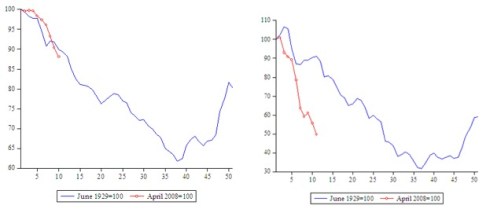
Fig. 1. Global Industrial Production, Fig. 2. Global Stock Prices, Months
Months After Peak: 1929 and 2008 After Peak: 1929 and 2008
(Peak = 100) (Peak = 100)
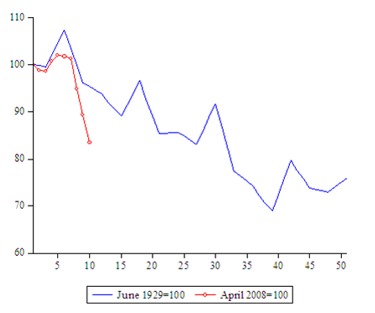
Fig. 3. World Trade, Months
After Peak: 1929 and 2008
(Peak = 100)
Source: Eichengreen and O’Rourke, 2009.
____________
*International Herald Tribune, Dec. 2, 2008, p. 9
**”Income taxes would rise under Irish budget plan”, Eamon Quinn, International Herald Tribune, April 8, 2009, p. 15

 TIMnovate
2 comments
Comments feed for this article
May 2, 2009 at 4:13 pm
yoav
http://www.ted.com/index.php/talks/alex_tabarrok_foresees_economic_growth.html
February 21, 2013 at 10:58 pm
Lilia Herbers
Critical to any society is maintaining good health care for all. Imagine a society where illness is rampant. The cost to government for negligently ignoring the sick, dying and those who will become ill due to lack of proper health care will necessarily be borne by taxpayers in one form or another. Originally, health care was provided in the US by employers because many workplace environments were dangerous. Employers worried about lawsuits from improper adherence to worker safety. ‘
Most recent posting straight from our new blog
<'http://www.caramoantourpackage.com/