
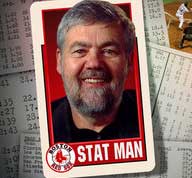
 Meet Bill James. Bill is currently Senior Advisor to the Boston Red Sox baseball team. He is credited in part with helping Boston win two World Series championships, after failing to win one since 1919. James invented “Sabermetrics” (acronym for the Society for American Baseball Research). His innovation: Use statistical analysis, i.e. facts, to analyze why teams win and lose, instead of just believing in age-old truisms everybody knows are true, because, well — everybody believes them and repeats them.
James crunched a batch of numbers, and put out (in mimeograph form, the early version of photocopying) The Bill James Baseball Abstract in 1977. In it he began to make keen observations puncturing long-held beliefs in baseball. He persisted, and in a few years a major publisher agreed to publish his Abstract annually.
James is an improbable revolutionary. While working on his ‘stats’, he was a watchman in a pork-and-beans factory (Stokely – Van Camp).
Here is what James found, in opposition to what highly knowledgeable experienced players, managers and coaches believed:
* Don’t evaluate pitchers according to their wins and losses. This is highly misleading.
* Don’t evaluate hitters by their batting average. Instead use “percentage of at-bats when the hitter reaches base” (because good hitters get walks, get on base and tire pitchers), and “slugging percentage”:

where 1B, 2B, 3B and HR are singles, doubles, triples and home-runs, respectively, and AB is number of at-bats. Babe Ruth holds the record slugging percentage: 0.690.
* “Closers” (pitchers brought in, in the late innings, when a lead is threatened) are misused. Bring in ‘closers’ much much earlier, before you get in trouble.
All of James’ iconoclastic observations are based on extensive data, compiled game-by-game.
What can managers learn from Bill James and his analysis of baseball?
“Bring me data”. When innovations are proposed, when claims are made — ask for data. Ask for evidence. Bill James produced it. When he did, the way the experts strategized baseball changed completely.
___________________________
George William “Bill” James (born October 5, 1949, in Holton, Kansas) is a baseball writer, historian, and statistician whose work has been widely influential. Since 1977, James has written more than two dozen books devoted to baseball history and statistics. His approach, which he termed sabermetrics in reference to the Society for American Baseball Research (SABR), scientifically analyzes and studies baseball, often through the use of statistical data, in an attempt to determine why teams win and lose. In 2006, Time named him in the Time 100 as one of the most influential people in the world. [1] He is currently a Senior Advisor on Baseball Operations for the Boston Red Sox.
An aspiring writer and obsessive fan, James began writing baseball articles after leaving the United States Army in his mid-twenties. Many of his first baseball writings came while he was doing night shifts as a security guard at the Stokely Van Camp pork and beans factory. Unlike most writers, his pieces did not recount games in epic terms or offer insights gleaned from interviews with players. A typical James piece posed a question (e.g., “Which pitchers and catchers allow runners to steal the most bases?”), and then presented data and analysis written in a lively, insightful, and witty style that offered an answer.
Editors considered James’ pieces so unusual that few believed them suitable for their readers. In an effort to reach a wider audience, James self-published an annual book titled The Bill James Baseball Abstract beginning in 1977. The first edition of the book presented 80 pages of in-depth statistics compiled from James’ study of box scores from the preceding season.
Over the next three years James’ work won respect, including a very favorable review by Daniel Okrent in Sports Illustrated.[2] New annual editions added essays on teams and players. By 1982 sales had increased tenfold, and a media conglomerate agreed to publish and distribute future editions.
While writers had published books about baseball statistics before (most notably Earnshaw Cook’s Percentage Baseball, in the 1960s), few had ever reached a mass audience. Attempts to imitate James’ work spawned a flood of books and articles that continue to this day.
In 1988, James ceased writing the Abstract, citing workload-related burnout and concern about the volume of statistics on the market. He has continued to publish hardcover books about baseball history, which have sold well and received admiring reviews; these books include two editions of The Bill James Historical Baseball Abstract.
During the years after the annual Abstract ceased publication, James has published several series of new annuals:
• The Baseball Book (1990–1992) was a loosely-organized collection of commentary, profiles, historical articles, and occasional pieces of research.
• The Player Ratings Book (1993–95) offered statistics and 50-word profiles aimed at the fantasy baseball enthusiast.
• The Bill James Handbook (2003-present) provides past-season statistics and next-season projections for Major League players and teams, and career data for all current Major League players.
• The Bill James Gold Mine (2008-present) is a collection of new essays and never-before-seen statistics, as well as profiles of players and teams.
In 2008, James launched Bill James Online. Subscribers can read James’ new, original writing and interact with one another—as well as with James—in a question-and-answer format. The web site also offers new “profiles” of teams and players full of facts and statistics that hope to one day map what James has termed “the lost island of baseball statistics.”
Among the statistical innovations attributable to James are:
• Runs Created. A statistic intended to quantify a player’s contribution to runs scored, as well as a team’s expected number of runs scored. Runs created is calculated from other offensive statistics. James’ first version of it: Runs Created = (Total Bases * (Hits + Walks))/(Plate Appearances). Applied to an entire team or league, the statistic correlates closely to that team’s or league’s actual runs scored. Since James first created the statistic, sabermetricians have refined it to make it more accurate, and it is now used in many different variations.
• Range Factor. A statistic that quantifies the defensive contribution of a player, calculated in its simplest form as RF = (Assists + Put Outs)/(Games Played). The statistic is premised on the notion that the total number of outs that a player participates in is more relevant in evaluating his defensive play than the percentage of cleanly handled chances as calculated by the conventional statistic Fielding Percentage.
• Defensive Efficiency Rating. A statistic that shows the percentage of balls in play a defense turns into an out. It is used to help determine a team’s defensive ability. Calculated by: 1 – ((Opp. Hits + Reached on Error – Opp. Home runs) / (Plate appearances – Walks – Strikeouts – HitByPitch – Opp. Home runs)).
• Win Shares. A unifying statistic intended to allow the comparison of players at different positions, as well as players of different eras. Win Shares incorporates a variety of pitching, hitting and fielding statistics. One drawback of Win Shares is the difficulty of computing it.[3]
• Pythagorean Winning Percentage. A statistic explaining the relationship of wins and losses to runs scored and runs allowed. In its simplest form: Winning Percentage equals Runs squared divided by the square of Runs plus the square of Runs Allowed. The statistic correlates closely to a team’s actual winning percentage.
• Game Score is a metric to determine the strength of a pitcher in any particular baseball game.
• Major League Equivalency. A metric that uses minor league statistics to predict how a player is likely to perform at the major league level.
• The Brock2 System. A system for projecting a player’s performance over the remainder of his career based on past performance and the aging process.
• Similarity scores. Scoring a player’s statistical similarity to other players, providing a frame of reference for players of the distant past. Examples: Lou Gehrig comparable to Don Mattingly; Joe Jackson to Tony Oliva.
• Secondary Average. A statistic that attempts to measure a player’s contribution to an offense in ways not reflected in batting average. The formula is (Extra bases on hits+Walks+Stolen Bases)/At bats. Secondary averages tend to be similar to batting averages, but can vary widely, from less than .100 to more than .500 in extreme cases. Extra bases on hits is calculated with the formula (Doubles)+(Triplesx2)+(Homerunsx3) or more easily, (Total Bases)-(Hits).
• Power/Speed Number. A statistic that attempts to consolidate the various “clubs” of players with impressive numbers of both home runs and stolen bases (e.g., the “30/30” club (Bobby Bonds was well known for being a member), the “40/40” club (José Canseco was the first to perform this feat), and even the “25/65” club (Joe Morgan in the ’70s)). The formula: (2x(Home Runs)x(Stolen Bases))/(Home Runs + Stolen Bases).
• Approximate Value. A system of cutoffs designed to estimate the value a player contributed to various category groups (including his team) to study broad questions such as “how do players age over time”.

 TIMnovate
Leave a comment
Comments feed for this article