
Having defeated prostate cancer, I have a strong personal interest in progress toward finding a cure for all types of cancer. Despite new drugs, 560,000 Americans died of cancer in 2006. Imagine the entire population of Helsinki, Finland, dying in one year.
Writing in The New York Times, biologist and Nobel Laureate James Watson (co-discoverer of the double-helix structure of DNA) decries the current lack of strong leadership in cancer research. He proposes a Kennedy-like “we shall go to the moon in this decade” vision:
The National Cancer Institute, which has overseen American efforts on researching and combating cancers since 1971, should take on an ambitious new goal for the next decade: the development of new drugs that will provide lifelong cures for many, if not all, major cancers. Beating cancer now is a realistic ambition because, at long last, we largely know its true genetic and chemical characteristics.
But how should this be done? Watson notes that most cancers are caused not by a single gene but by combinations of them. And he has some interesting ideas.
The metabolism of cancer cells, and indeed of all proliferating cells, is largely directed toward the synthesis of cellular building blocks from the breakdown products of glucose. To make this glucose breakdown run even faster in growing cells than in differentiated cells (that is, cells that have stopped growing and taken on their specialized functions in the body), the growth-promoting signal molecules turn up the levels of the “transporter” proteins that move glucose molecules into cells. This discovery indicates that we need bold new efforts to see if drugs that specifically inhibit the key enzymes involved in this glucose breakdown have anti-cancer activity.
In other words: find blocking molecules that empty the glucose ‘fuel tanks’ of cancer cells.
This makes a lot of sense.
Another researcher, Dr. Judah Folkman, had a similar idea to Watson’s. Why not deprive cancer tumors of their blood supplies? As a surgeon who removed many cancerous tumors, Folkman saw how those tumors employed ‘angiogenesis’ — the process whereby cancer tumors pull blood supplies to themselves. Anti-angiogenesis drugs cut off this supply. Several cancer drugs that work in this fashion are now available. Cutting off glucose could be even more powerful.
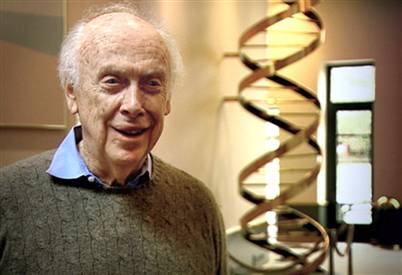
James Watson and the double helix

 TIMnovate
2 comments
Comments feed for this article
March 23, 2010 at 10:57 pm
kether1985
There is a doctor already curing cancer his name is Dr. Leonard Coldwell he has a %92.3 success cure rate out of 35,000 patients.
http://simranjeet.com/2010/03/04/drcoldwell/
and here is an interview with Kevin Trudeau & Dr. Coldwell
Take Care,
-Simranjeet Singh
December 11, 2011 at 7:44 am
Brendan G.
“The National Cancer Institute, which has overseen American efforts on researching and combating cancers since 1971, should take on an ambitious new goal for the next decade: the development of new drugs that will provide lifelong cures for many, if not all, major cancers.”
-Surely a man as intelligent as James Watson would know by now, that the drug companies DON’T WANT real cancer cures; they want TREATMENTS that the afflicted person has to receive for the rest of their lives. We may indeed see a number of these “crutches” by 2020, but neither you, me (or our great-geandchildren for that matter) will see any real cancer cures (and any that emerge will be quickly suppressed.) Cancer is too big a business, for the businessmen to pass up a humongous captive market for their products… simple human greed, no more (and no less!)