
 Global Crisis Blog
Fall of the Wall: 20 Years Later
By Shlomo Maital
As I write this, I am watching German Chancellor Angela Merkel on CNN, in a sea of Germans, speaking informally about the extraordinary events two decades ago — events she personally witnessed and took part in, when she, then a young scientist crossed from East to West. Merkel chose not to create a formal diplomatic event with stuffy speeches, but simply stood elbow-to-elbow with thousands of Germans, some of whom had crossed with her on Nov. 9, 1989, after symbolically crossing from East to West again, as she did in 1989. Merkel thanked Mikhail Gorbachev, who was with her, for his policies that made the Fall of the Wall possible and eventually, on Dec. 25, 1991, led to the dissolution of the Soviet Union. When Poland’s Solidarity movement won the June 4, 1989, election, the Russian ambassador to Poland called the Kremlin in panic and asked, what shall I do? what shall we do? Gorbachev had a simple answer. Do nothing. Let the election stand. It was in part Gorbachev’s non-intervention policy that enabled the Wall to fall.
The Berlin Wall was erected in June 1961, after some 3.5 million Germans fled East Germany to the West. The Wall had concrete walls, barbed wire, guard towers and a death strip that had anti-vehicle trenches, spikes and other types of defense. Between 1961 and 1989 some 5,000 people tried to escape over the Wall; an estimated 150 people died.
Those most surprised at the fall of the Wall were the Germans themselves. Most of them who witnessed the dramatic events of Nov. 9, 1989, said they never believed the monolithic German Democratic Republic would crumble so rapidly.
Today we know that British Prime Minister Margaret Thatcher and French Prime Minister Francois Mitterand were both worried and displeased by the fall of the Wall, understanding that it would bring German reunification and create Europe’s largest and most powerful economy. Indeed, unification came quickly. On Oct. 30, 1990, the new reunited Germany was announced. West Germany was in such a rush to implement the unification, that it offered to buy East German marks at a price of one such mark for a West German mark — at a time when the buying power was about eight to one. The resulting flood of marks into the system caused inflation, led the Bundesbank to raise interest rates — and ultimately, caused Britain to leave the European Monetary System, as the British wanted to free themselves from the straitjacket of high European interest rates and float the pound. (On Sept. 16, 1992, George Soros’ massive sales of pounds caused Britain to leave the European Exchange Rate Mechanism). So ironically, the fall of the Wall may have ultimately been responsible for keeping Britain out of the euro system.
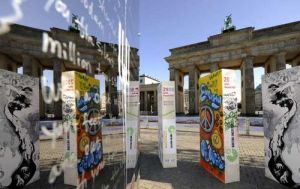
These events, from 1989 through 1992 and beyond, show how appropriate is the initiative taken by German students to visually demonstrate the impact of the fall of the Wall. The students created 1,000 styrofoam dominos, each three meters high, and placed them along the path of those who fled from East to West. As one domino toppled another, we saw clearly how the Fall of the Wall led to a chain of remarkable events that forever changed history.
Congratulations to those innovative German students!
 TIMnovate
Leave a comment
Comments feed for this article