
Hope for Innovators: You Do Not Need a Brain To be Inventive
The Case of the Einstein Octopus
By Shlomo Maital
A report on the BBC today captured headlines all over the world:
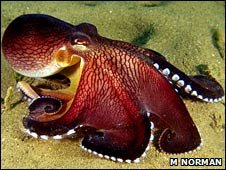
An octopus and its coconut-carrying antics have surprised scientists. Underwater footage reveals that the creatures scoop up halved coconut shells before scampering away with them so they can later use them as shelters. Writing in the journal Current Biology, the team says it is the first example of tool use in octopuses.
Tool use was once thought to be an exclusively human skill, but this behavior has now been observed in a growing list of primates, mammals and birds. They do things which, normally, you’d only expect vertebrates to do.
Vertebrates? Do all vertebrates come up with inventive ways to adapt to their surroundings, breaking the rules and tradition??? Alas, all too few. Witness Copenhagen — perhaps if the octopuses were gathering in Denmark, rather than world leaders, we might have a chance of reducing atmospheric carbon to survivable levels of 350 ppm, compared with 390 ppm at present. But, regrettably, our leaders have two arms, rather than eight, and human brains (an hypothesis still to be proved) rather than those of octopuses.
Apparently, the veined octopuses (Amphioctopus marginatus) used to use empty clam shells for their homes. With a growing scarcity of clam shells, the clever octopuses (whose brains are very very tiny) have adapted to using half coconut shells discarded by humans. The process through which this happened was probably fairly rapid, but nonetheless evolutionary. These octopuses are tasty morsels for fish. Only those smart enough to hide under coconut shells survive to reproduce, as Darwin explained.
Dr Mark Norman, head of science at Museum Victoria, Melbourne, and one of the authors of the paper, said: “It is amazing watching them excavate one of these shells. They probe their arms down to loosen the mud, then they rotate them out.”
After turning the shells so the open side faces upwards, the octopuses blow jets of mud out of the bowl before extending their arms around the shell – or if they have two halves, stacking them first, one inside the other – before stiffening their legs and tip-toeing away.
If only humans could speak ‘octupese’ (the language of octupuses). We could ask them, how can we solve the problem of growing acidity of the oceans, due to water absorbing concentrations of atmospheric carbon which become carbonic acid?
Count on them to have better answers than Obama, Brown, Ban Ki Moon or Sarkozy.

 TIMnovate
Leave a comment
Comments feed for this article