
Battle of the Titans: Jobs vs. Schmidt — A Case of Collabo-WAR
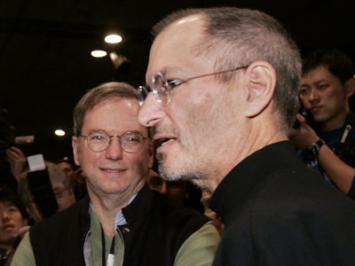 Eric Schmidt and Steve Jobs
Boxing fans know that in heavyweight prize fight history, the two bouts between Joe Louis, an American, and Max Schmeling, a German, were among the greatest in history. I am reminded of these two bouts while reading “A fierce clash of computing titans” — the prize fight between Google’s CEO Eric Schmidt and Apple’s CEO Steve Jobs. [1]
Some of us anticipated a different prize fight — between the Wintel (Windows + Intel) partners. A beautiful loving relationship between Microsoft’s Windows operating system and Intel’s microprocessors soured somewhat, as Intel began putting growing amounts of software onto its chips. (Many Intel development engineers are in fact software engineers). But real warfare never developed.
A similar honeymoon existed between Apple and Google. Three years ago, Schmidt shook hands with jobs on a San Francisco state and helped Jobs unveil the iPhone. “This product is going to be hot!” Schmidt said. Some suggested merging the two firms, into AppleGoo.
No longer. Harvard Business School’s Adam Brandenburger once wrote a book titled Coopetition, a term he coined, signifying how companies cooperate at one level (e.g. development), then compete at another (e.g. in the marketplace). Today we have examples of what I would call Collabo-WAR: Initial collaboration between giant firms that turns into World War III. Apple and Google form an example.
What is the source of conflict? Both Jobs and Schmidt are tough and intensely competitive. Apple and Google are now warring over controlling the future of mobile computing and cellphones. Apple has sued HTC, the mobile phone maker that runs Google’s Androir operating system; this is seen as the start of Apple’s legal assault on Google’s plans to dominate mobile devices just as it dominates web search and web advertising.
Apparently, Apple (true to form) wants smartphones to have tightly controlled proprietary standards, with customers buying applications from Apple’s App Store. Google, true to form, wants smartphones to have open nonproprietary platforms so users can freely roam the Web for applications.
Like the Louis-Schmeling fight, the battle is both ideological (Germany vs. US, white vs. black) and deeply personal. Jobs thinks Google broke the alliance between the two companies by producing cellphones that resemble iPhones. Jobs even disparaged Google’s famous mantra, saying ironically, “Don’t be #$%#@@#$% (expletive) evil!”. As always, strong egos are involved.
Who will win? Well, in the past Apple tried hard to close their systems and capture all the value, and ultimately lost to the more open PC standard. But, anticipate more than one prize fight between the two. In the first Louis-Schmeling fight, on June 19, 1936, at Yankee Stadium, Schmeling used a jab and right cross to baffle Louis, then knocked him out in the 12th round — Louis’s only knockout defeat in his prime. In the second fight, on June 22, 1938, Schmeling tried the same tactics. But Joe Louis, the Brown Bomber, was ready. He knocked Schmeling out after only two minutes of the first round.
Apple may win early rounds in the law courts, to ‘close’ its system. But ultimately such efforts to monopolize an industry fail, as ‘barbarians’ climb the walls or batter them down and open the system.
In this Collabo-WAR, Apple is likely to lose, just as they did in the 1980’s.
[1] By Brad Stone and Miguel Helft, Global New York Times, March 15, 2010, p. 13.

 TIMnovate
2 comments
Comments feed for this article
June 21, 2010 at 12:44 am
Roger Mercer
Are you kidding. Monopoly is the antithesis of Apple’s ethos. They just don’t like people stealing their ideas in order to take money they otherwise would make.
October 27, 2010 at 12:00 am
Stephen W
I think that google is incorrectly painted as the white witch. Which company has been bust violating privacy, collecting usernames and passwords? Google’s mantra will decay with the pressures of capitalistic commerce. You also have to ask yourself why jobs wants a closed system? to promote his vision of the world? Or just so that buggy or harmful apps don’t make their way onto the iPhone and degrade the user experience? Remember it is always the OS which gets the blame when it crashes, not that bit of software that was free and ‘uncertified’. Jobs wants to democratise technology, he wants a product which ‘just works’ and the ‘closed system’ is a way of achieving this. I rather Apple be responsible for my operating system than to throw their hands in the air with ‘well, it could be anything that crashed it’