
Innovation Blog
Happy Birthday, Laser!
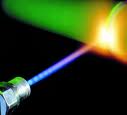
Exactly 50 years ago, a scientist named Theodore Maiman demonstrated the first functional laser (Light Amplification by Stimulated Emission of Radiation). We take lasers for granted, but they are ubiquitous, everywhere. And they are destined to do even bigger things, like solve the energy crisis.
America’s National Ignition Laboratory uses 192 powerful laser beams to create plasma (hot gas), in turn useful for creating fusion-based energy (the same process that occurs in hydrogen bombs, fusing two atoms together, with some energy left over). Meanwhile, expectedly, lasers are being perfected for military use. Soon a 100 KW laser will be ready, able to knock missiles out of the sky.
Albert Einstein could be credited with the invention of lasers. In his 1917 paper, On the Quantum Theory of Radiation, Einstein used Planck’s law of radiation to discuss stimulated emission of electromagnetic radiation. David Sarnoff (RCA) asked his scientists to find a way to create a maser “microwave amplication by stimulated emission of radiation), a precursor of lasers. And in 1950 Albert Kastler proposed “optical pumping”, which later won him a Nobel Prize.
The gestation period for lasers has been long. From theory (1917) to first prototype: 43 years, and then a few more decades for commercial widespread use. One lesson is that new technologies rarely surprise us. By tracking theory, it is possible to accurately road-map technology well in advance — something great companies and leading countries do regularly. Japan is the leader in technology road-mapping, investing millions of dollars yearly to keep tabs on the latest scientific developments that may lead to new technologies.

 TIMnovate
Leave a comment
Comments feed for this article