
Innovation Blog
Nature Innovates #3: The Octopus & Jet Fuel, The iPad and Darwin
By Shlomo Maital
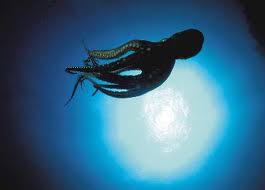
Octopus: Jet Propulsion
Nature yet again inspires human innovation, to help save Nature itself. A Georgia Tech researcher named Arie Glazer studied so-called “boundary layer” effects on the upper edges of aircraft wings. As air passes over the wing, in flight, turbulence develops. This causes drag and reduces fuel efficiency greatly. And combustion of jet fuel is a major cause of carbon emissions and global warming. Basically, the longer air molecules travel over the wing, the more they become ‘fatigued’, and began to ‘misbehave’. Glazer thought that counter-intuitively, by disturbing the air flow somewhat, you could get the air molecules to ‘forget’ they’ve been smooth for too long, and begin the smooth flow again. But, how to do this?
Why not create tiny microjets that expel air onto the wing surface, especially near the trailing edge? But this will use fuel, not save it! What can we learn from Nature, Glazer asked? Who inhales and exhales jet? Octopi. They suck in water, they expel it to propel themselves very rapidly through the water. Glazer (along with researchers at Australia’s University of New South Wales) designed tiny 1 mm. microjets that, like octopi, suck in air, and then expel it again. The result dramatically reduces boundary layer effects and improves the smoothness of air flow over the wing, thus improving jet fuel mileage and reducing carbon emissions.
And, while we’re praising Nature, why not use Nature to help save Nature itself? Apple, after announcing Steve Jobs’ medical leave, now announces the 10 billionth (!) download of iPhone and iPad apps. There are 350,000 such apps, created by a storm of innovative energy by enthusiastic users. Did Apple learn its lessons well? By closing its Mac operating system in the 1980’s, Apple managed to transform a winning product (the world’s best operating system and world’s best personal computer) into products defeated by inferior Microsoft and IBM products. By opening its software to all developers, IBM enlisted massive creative energy and made its PC the global standard. Apple lots tens of billions of dollars in market value. But Steve Jobs learned. Today the open Apple system enjoys the vigor, creativity and innovative skill of many thousands of developers. In doing so, Apple emulates Nature. Thousands of mutations, or “natural experiments”, occur in Nature, as Nature tries to improve. Most of those experiments fail and disappear, because they do not help living things to survive to reproduce. But a tiny fraction do succeed, and they prosper, procreate and eventually dominate. Same with apps. Most are not successful and sell very few copies. A few are highly successful and find wide use. And the only way to find out which is which, is to toss 350,000 apps up into the air, put them into the apps stores, and see what happens – just like Nature’s evolutionary process.
Innovator: Can you build an innovation system that emulates evolution? If so, you can massively change the world for the better!

 TIMnovate
Leave a comment
Comments feed for this article