
You are currently browsing the monthly archive for January 2011.
Global Crisis Blog
Ragged Recovery – Where’s Waldo? by Shlomo Maital

Where’s Waldo (Recovery?)
A wonderful book titled Where’s Waldo? challenges us to find Waldo in a hugely detailed graphic. Today we play Where’s Waldo? with the American economy. Where is the recovery? Where is the opportunity? The answer is: It is there, but takes a powerful electronic microscope to spot it.
The reason stems from the title of our new book Global Risk/Global Opportunity: In every global crisis and downturn, there are opportunities; this requires managers and investors, first, to think in terms of finding opportunities, and second, to know where to find them.
Here are the latest data for fourth quarter 2010 revenues per share, for key American economy sectors, showing the per cent change relative to the same quarter in 2009. These data are from Howard Silverblatt’s blog in Bloomberg Business Week (Jan. 12).
Consumer discretionary 0.53 %
Consumer staples 5.46
Energy 22.88
Financials – 10.94
Health Care 6.5
Industrials 9.8
IT 11.97
Materials 3.66
Telecom 1.64
Utilities 16.65
S&P 500 Av. 5.96
Some sectors are still doing terribly (financials), having failed to find replacements for the immensely profitable nostrum trading now very limited. Consumer spending has not really recovered, but staples (the basics) are doing great, because consumers are spending mainly on ‘necessities’. Energy, utilities, both are doing very well. IT is doing well, I think mainly because companies desperately seek productivity tools. Telecom is flat. Health care is up, because, well, health gets high priority and has endemic cost inflation. But my main Where’s Waldo? point is this: The standard deviation of earnings per share growth is 9.33 per cent ! Look only at the simple average, 6.8 per cent, or the S&P 500 average, 5.96 per cent, and miss the opportunities.
So where are the opportunities? In times of uncertainty and pessimism, what will people buy, where will they allocate spending to things they perceive as essential? How can you position your product as essential? How can you rebrand it with a value-for-money proposition? Never believe the economists’ tales about a one-size-fits-all economy. No single phrase describing the economy (“weak recovery”) ever fits any single industry. Dig deeper, find the real story about each industry, and remember that there is exceptionally high variance in the year-to-year percent change in earnings per share, especially during transition periods.
Innovation Blog
No-Huddle Offense in Oregon: ‘Subtraction’ Wins Again
By Shlomo Maital

Chip Kelly, Oregon Ducks Coach
For years, in college football, University of Oregon was a laughingstock, playing in the tough Pac-10 conference against superior teams with winning records and even national championships. Even its name arouses laughter: The Ducks. Ducks??? The fighting (quacking) ducks? Pit a ‘duck’ mascot against, say, an Indian warrior mounted on a Palomino pony, or a bulldog?
What do you do to create a winning team? Well – innovate. But how? Football is a century-old game with a lot of proven rules. Why not try breaking a rule? Perhaps a key one? Let’s say – the rule that the quarterback calls the offensive plays in a ‘huddle’.
One of the proven principles of innovation is ‘subtraction’ – take the key ingredients of a product or service, then remove one of them, and see what happens. OK – let’s take away the huddle and see what happens, said innovative Oregon Coach Chip Kelly. Take away the huddle??? How then can the quarterback call plays? Perhaps – just audibly, right at the line of scrimmage.
Kelly’s innovative, spread-option, no-huddle offense thrives on speed. Run a play. Race to the ball. Run another play. And so forth. No huddle. You only wait for the referee to ‘spot’ the ball…and off we go. Give the opposition no time to gather their thoughts and organize defense. Start the offensive play quickly, before the defenders can even figure out what play you’re likely to run.
At times Oregon takes only nine seconds from the end of the previous play to the snap of the new one. National Football League teams have used no-huddle offense, mainly toward the end of the game, when they lack time-outs and have to race against the clock to score. But Oregon, under coach Chip Kelly, uses it all the time, every time, every offensive play. It has even led opponents to feign injuries, just to stop the clock and slow down the superfast Oregon juggernaut.
According to USAToday: “They are so good at it, and so fast at it, that a typical game sees them run about 80 plays and score about 50 points, which is the biggest reason the Ducks are playing for a national championship.”
And play they did. Improbably, Oregon played in the Bowl Championship Game against Auburn, for the title of National US #1 College Team.
They lost. But so what? They made it to the championship for the first time, they played well in a hard-fought close game. And they proved that creativity and innovation, through ‘subtraction’, can offset other disadvantages and create competitive advantages that can take you (almost) to the top.
Look for Chip Kelly to make it to the NFL as head coach. And look for other teams to emulate Oregon’s amazing innovation.
Innovation Blog
Wikipedia – 10 Years Old! When Vision Defeats Greed
By Shlomo Maital
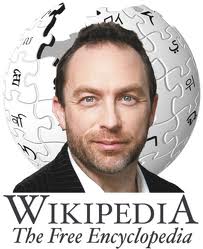
Jimmy Wales
On Jan. 15, Wikipedia, the on-line encyclopedia whose entries are written by the users and readers themselves, celebrates its 10th anniversary. What can we learn from Wikipedia’s decade of innovation?
An entire new discipline known as wikinomics has sprung up, based on the notion of products and services created and developed by the users themselves. Many companies, notably Procter & Gamble and Lego, have enlisted users successfully as an integral part of their product development, and MIT Professor Eric von Hippel has written a book about democratizing innovation (to be consistent, he offers free downloads). Lately, IBM and other global firms have implemented versions of this idea.
Founder (co-founder?) Jimmy Wales could have made a huge fortune from Wikipedia, because it is one of the websites that attracts the most eyeballs, and that could easily be transformed into advertising revenues. But he refuses. His vision is to retain the popular open flavor of Wikipedia and stay away from revenue, bottom-line and money-making and wealth creation. I salute him. There aren’t many entrepreneurs who willingly turn down a check for $1 billion.
Wikipedia has many many flaws. Some of its material has clear biases, written by those pushing a special interest. Some of its material is inaccurate. Political wars are fought in Wikipedia. Yet for sheer ease in getting basic facts about almost anything, Wikipedia is unrivalled. It has changed the way I work and write, and I am sure has changed the world for millions of others.
Wikipedia has some 3.5 million articles in English alone. According to one of its principals, Susan Gardner, Wikipedia’s vision is “to offer “the sum total of all human knowledge” in the native language of all of Wikipedia’s users. This vision reminds me of Google. Google’s founders, Larry Page and Sergei Brin, sought to bring all the information in any language to any person, at any time. But Google took a commercial route, with advertising revenue and an IPO. It reportedly has over $30 b. in cash stashed away, waiting for its next strategic play.
In contrast, Wikipedia relies on contributions, struggles to raise money, depends on hard-working volunteers, and steadfastly refuses to play the capitalist game. Instead it wants to implement its vision, bringing all the knowledge to everyone, anywhere, in any language.
The big question is, can Wikipedia triumph and implement its vision without resources, without a true business model? Would it serve its users better with an advertising business model? Jimmy Wales is steadfast. Let’s wish him well, and follow this wonderful experiment with interest and affection.
Global Crisis Blog
How to Distort History: Pohl Points Europe toward Fracture
By Shlomo Maital
A newsletter called CESifo (from IFO, a research institute in Munich, Germany) contains an interview with former Bundesbank head Karl Otto Pohl, at one time the dominant figure in European monetary policy.
Pohl blasts the European rescue program paid for in large measure by Germany, that bailed out Greece and Ireland, and perhaps, eventually Portugal and even Spain: “I put no stock in the rescue programme for the euro area. It gives the countries the wrong incentives and violates the spirit and letter of the monetary union.” Policy is often the choice of less-bad alternatives. Not bailing out nations in trouble could have led to a euro collapse. Is this what Pohl thinks is desirable?
Pohl thinks Greece should have been allowed to sink and leave the euro. “Greece should never have been accepted into the monetary union. But it was. Now it must be possible to leave the union. Then, a haircut should have been carried out (partial debt forgiveness by the creditors), the Greeks would have devalued in order to improve their competitiveness.”
America fought a bloody Civil War partly over states’ rights, the right to secede from the Union. Pohl is unwilling to commit a small fraction of Germany’s resources to save the European Union.
What would Pohl recommend? For starters, appoint Axel Weber head of the European Central Bank, when the current head Trichet retires. Weber, of course, is a conservative, and also dislikes the bailout program. Pohl recommends changing the voting rules, weighting votes with the country’s size. “It is not acceptable for the central banks of Malta or Cyprus to have the same voting power in the ECB as the Bundesbank. This waters down the decisions of the European Central Bank. Voting rights in the ECB should be changed and weighted votes should be assigned according to the strength of the countries. This would help the ECB manage future crises more convincingly.” Such a voting scheme, of course, would also weaken or ruin the European Union, by telling small countries that they had no say in shaping key monetary policies.
Pohl was asked about Keynesianism and fiscal policy. He responded: “I don’t think that the return to Keynesianism in economic policy will be permanent. At least not to the simple state dirigisme of his time. Just image, in my final examination at the University of Göttingen in 1955 I defended the thesis that the amount of indebtedness is limited by tax revenue.”
The only thing holding up America’s economy at the moment is deficit spending – other demand components are very weak. Many experts believe the U.S. is on a knife edge, growing at 2.5 per cent, just enough to keep unemployment from soaring, not enough to reduce it. A radical cut in public spending would push the economy over the edge, perhaps toward renewed recession.
Pohl’s views are widely held in Europe. Appointing Weber as ECB head would push the central bank toward monetary conservatism and seriously weaken the European union. This cannot be good news for the world.
Innovation Blog
Oh, Say, Can YOU See? Innovating the EyeGym
By Shlomo Maital
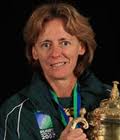
Sherylle Calder
A former South African women’s hockey team member, Sherylle Calder, has made a breakthrough innovation in performance enhancement in sport. She did it by introspection – by understanding her own special gift, then developing methods to help others acquire it. And she has proven results: She helped coach two World Cup rugby champions, South Africa and England to world titles.
The basic idea is simple. Athletes need superb eye-hand coordination, and eye-feet coordination. Training methods focus on the hands, the feet, the body – strengthening muscles, and making them quicker and more resilient and durable. But what about the ‘eye’, a heretofore neglected aspect of physical ability? Is vision simply a ‘given’, determined by DNA? Nothing, in fact, is wholly determined by DNA – everything can be improved, by hard work.
Calder developed a series of pathbreaking eye exercises, in what she calls the EyeGym, to improve what players see on the field. I imagine she works on peripheral vision, and on quickening reaction time to what the eye sees, and in particular, to anticipating where the play will move to, on the field. “You have eyes in the back of your head”, she was told, when she played field hockey. And that is literally true. The brain can cooperate with the eyes, to translate what the eyes see into a near-term scenario, what will happen a second from now, or a split-second.
Introspection and empathy are powerful tools for innovators. First introspection. What do you do well, or what do you know, or what skill do you have, that are distinct and special? What is special about them? Second, empathy. How can you apply those skills, to help those who may not have them? Can you teach them? Can they be developed? How did YOU acquire them? Can others follow suit? And can you apply Malcolm Gladwell’s approach – 10,000 hours – can you invest 10,000 hours to sharpen a skill, insight or competency, and transform it from something unusual to truly extraordinary? And, can you make a living doing it?
- Developing a better eye for the game, by Emma Stoney. Global New York Times, Tuesday Jan. 11, 2011.
Innovation Blog
The Moomins: Can YOU Invent a Whole New World?
By Shlomo Maital
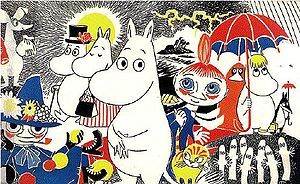
A wonderful new translation (into Hebrew) of Tove Jansson’s book The Moomins: The Story of the Magic Hat, brought back wonderful memories of reading The Moomins to our children and watching the superb animated TV series with them. To this day, one of our four children identifies himself with Snufkin, a sometime-Moomin family character. There are 9 Moomin books in all, along with a Moomin theme park in Western Finland and a Moomin Museum in Tampere, Finland, which my wife visited and loved.
The Moomins are trolls, with rounded snouts, and they live in Moominvalley, somewhere in Finland. (Tove Jansson, their creator, was ethnic Swedish but lived in Finland, where there is a substantial Swedish-speaking group). There is a father, mother, children, and sometimes, an unwanted visitor or an unexpected event.
Jansson invents a magical world for the Moomins, and sets them off on wonderful adventures. By creating non-human creatures, she is able to describe human characteristics and family interactions incisively, perhaps more sharply than she could if her heroes were truly human. By creating a whole new world, Jansson makes us accept her premise, that we must set aside all our assumptions and preconceptions, and frolic with her, leaping and diving into the world she has created.
Here is a small test to see how innovative you truly are, reader.
Create a new world. Start with “zoom out” – the physical place. Describe it. Draw a map, showing where your main characters live. Then “zoom in”. Create your characters. Notice how hard this is – we tend to ‘invent’ things that are familiar. Jansson’s Moomins are just human enough to be likeable, but non-human enough to be very interesting and draw our curiosity.
Now, after zoom in and zoom out, lights! Action! Set your characters in motion. What sort of adventures will they have? What kinds of conflict will they encounter? Will they have their own internal conflicts? External ones? How fanciful will your world be? Will it have gravity, night, day, time? Will you manage to persuade your readers to engage in what a famous writer called “the willing suspension of disbelief” – not an easy task, especially in the age of video.
There are numerous brain exercises that have proven helpful with creativity. I think that ‘invent a world’ is one of them.
Try it. See if you can draw your characters and their surroundings. Don’t assume you cannot draw, like me and many others. Just do it. Find your own style, perhaps simple or stylized. You will be surprised.
Innovation Blog
Goldman Sachs: Again, an End Run Around the Rules
Are the Regulators Impotent?
By Shlomo Maital
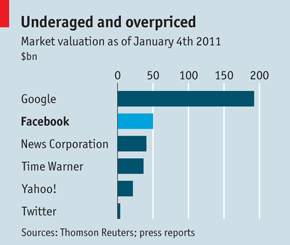
A report in The Economist, Jan. 6 issue, describes the following: Facebook is not a publicly-listed company, all its shares are privately held, by (allegedly) fewer than 500 investors, so it is not required to disclose any financial information. No-one knows for sure what its revenues or profits are. There are great competitive advantages Facebook enjoys, behind this veil of secrecy. But there is enormous interest in Facebook shares; Growing numbers of investors want to buy them. But Facebook CEO and founder Mark Zuckerberg do not want to do an initial public offering (IPO) of shares yet. They want to wait until Facebook’s soaring valuation peaks, perhaps at over $100 b. Yet Zuckerberg needs money, to expand his operations. How can you square the circle, sell shares without actually selling them?
Goldman Sachs to the rescue! This investment bank has valued Facebook at $50 b., and has set up an investment fund, investing $500 m. in Facebook and creating a fund that may invest another $1.5 b. Its partner in this venture is the Russian company DST. According to The Economist, “Clients considering signing up to its proposed Facebook fund are reportedly being asked to commit at least $2m each to it and to hold on to any shares they receive until at least 2013.”
This action clearly circumvents the intention of the regulators, that once there is wider public ownership of shares in a company, even if the shares are not publicly listed the company must begin to disclose financial information.
Is Facebook worth $50 b.? No-one knows. Certainly there is great value to having over 500 m. subscribers. But what is Facebook’s revenue model? Can it support as high a valuation as $50 b.? And what are Goldman Sachs’ motives? Are they, perhaps, interested, in setting up an inside track for underwriting Facebook’s IPO, a deal that could bring them many billions of dollars in fees?
And again, where are the regulators? Is Goldman Sachs and its Russian partner, along with Facebook itself, making a terrific speedy end run around the regulations, within the law but with dubious ethics? And have we seen this movie before, in 2005-9?
The Economist concludes: “ Regulators have a duty to protect investors and weigh the concerns of companies that wish to remain private. It is a delicate balancing act. But anyone who invests in a market this frothy must surely realize it is also risky. Meanwhile, Goldman and the other banks which hope to turn these vehicles into a big business should consider friending some good lawyers.”
**** postscript: Facebook, under pressure, has announced it will disclose financial results by April 2012 (probably a runup to an IPO), and the U.S. Securities and Exchange Commission has announced it will investigate Goldman Sachs’ “end run”.
Innovation Blog
Nature as the Great(est) Innovator
By Shlomo Maital

HORNET and its “photovoltaic” cell
The stories I recount below confirm, I believe, that the greatest innovator remains…Nature. Nature, and the enormous power of natural selection, have the patience to try experiments and select only those that work. And some of the results are quite incredible. The free-market paradigm of economics is only a weak imitation of Nature’s innate innovation process.
* Gulf oil spill: Enormous quantities of methane spilled into the Gulf of Mexico, after the BP Deepwater oil spill, because methane is a major component of natural gas. Now, scientists find, most of it has disappeared. Where did it go?
Apparently, there are microbes that feast on methane. They are mainly dormant in the oceans, because they have no food supply. But suddenly, when the Good Fairy arrives with millions of tons of methane, they feast, reproduce, feast…and so on. A Christian Science Monitor report reveals that “bacteria took fewer than four months to finish off the methane, and it appears that at no time did oxygen levels in the area the team studied fall to levels dangerous to marine organisms there.” Hey – chalk one up for Nature.
* Carmel Forest fire: A disastrous fire destroyed many acres of lovely forest in Israel’s Carmel Forest. A walk through the area reveals that after winter rains, green shoots are everywhere, as the forest struggles to renew itself. It will take years – but it will happen. A type of orange mold has been discovered, which feasts on charcoal, created by the forest fire. Another one for Nature.
* A team of Texas A&M scientists has studied leaf-eating farmer ants, which chew up leaves, make a paste, use it to grow fungus, then eat the fungus. They found that when the ants whose job it is to cut leaves find their mandibles have grown dull, too dull to effectively cut leaves, they simply switch jobs, and become carrier ants – ants whose job it is to transport the leaves cut by younger ‘sharper’ ants. Remember how Prussian diplomat Bismarck, who invented the Old Age pension system, picked the age of retirement as 65? It was an age so old, then, he felt very few would live to collect their pensions. Today, nearly everyone does. So in many nations pension funds are actuarially bankrupt. Solution? Follow the ant, as the Bible says. Abolish retirement. Simply reorganize to shift careers – as the ants do. Ever heard of an ant on pension? Yet another for Nature.
* Hornet’s nest: A study described in ScienceDaily, done by a team of Tel Aviv U. interdisciplinary researchers, has discovered that the hornet’s striped body captures and transforms solar energy, much as plants do in photosynthesis. In the course of their research, the Tel Aviv University team also found that the yellow and brown stripes on the hornet abdomen enable a photo-voltaic effect: the brown and yellow stripes on the hornet abdomen can absorb solar radiation, and the yellow pigment transforms that into electric power. “The team determined that the brown shell of the hornet was made from grooves that split light into diverging beams. The yellow stripe on the abdomen is made from pinhole depressions, and contains a pigment called xanthopterin. Together, the light diverging grooves, pinhole depressions and xanthopterin change light into electrical energy. The shell traps the light and the pigment does the conversion. The researchers also found a number of energy processes unique to the insect. Like air conditioners and refrigerators, the hornet has a well-developed heat pump system in its body which keeps it cooler than the outside temperature while it forages in the sun.” The team is now trying to mimic the hornet’s energy innovation with ‘bio-engineering’.
Innovation Blog
Religion, Meaning and Innovation: The God Factor
By Shlomo Maital
“Make meaning, not money,” says Guy Kawasaki, former Apple and garage.com guru and an entrepreneurial educator. What he means is this: Find people with unmet needs, find an innovative way to satisfy those needs, create meaning for your life and your work – and chances are, you will make money. If you focus solely on making money, without making meaning – chances are, says Kawasaki, you will fail. Ever heard of Lehman Brothers?
Now comes interesting evidence that religion can play a role in innovation. A cover article in APA Monitor by Beth Azar * reviews evidence that believing in God can strongly contribute to ‘making meaning’, by making us more caring toward others. She cites a study from Science (vol. 327, March), by Joseph Henrich, who found that across 15 diverse societies, people who participated in a world religion were more fair toward strangers (when playing economic games) than those who were not religious.
In other words, belief in God, whether or not in the framework of an organized religion, can help us focus on helping others, which in turn is crucial to successful innovation. Contrary to the often-quoted passage from Adam Smith’s Wealth of Nations (about how selfishness drives behavior), it is this quality of empathy, sensitivity to others, that drives innovation and entrepreneurial success.
This principle is not always true. There are world religions that foster hatred to those who are not co-religionists. Check it out – those religions that build on hate have zero entrepreneurship or innovative activity.
Azar cites studies showing that one key purpose of religion is to allow people to live in large cooperative societies – in other words, to get along well with others. “Religion is one of the big ways that human societies have hit on as a solution to induce unrelated individuals to be nice to one other,” notes researcher Ara Norenzayan. And a great way to be nice to others is to find innovative ways to meet their often-unspoken needs. As our planet becomes increasingly crowded, and as we compete with increasing ferocity for scarce resources (fossil fuels, water), this aspect of religion will become increasingly important.
It is often assumed that great innovations come from science and engineering, and that scientists and engineers tend to be agnostics or non-believers, since rational science contradicts the tenets of faith. I think this is simply not true. Many great scientists are deeply religious. And even those innovators who eschew organized religion are in my view religious, because in battling stiff odds with heroic persistence to develop new ideas, they seek to help others in meaningful ways – in other words, to chance the world for the better, which is the ultimate goal of those who believe in a Divine Presence.
- Beth Azar, “A Reason to Believe”, APA Monitor, December 2010.
Innovation Blog
By Shlomo Maital
 Innovation, Absolute Truth and The Broken Workings of Scientific Research
After 40 years of academic research, writing and publishing close to 100 papers published in refereed journals, I believe I know something about the ‘scientific method’. Here are two things I’ve learned – a) the ‘scientific method’ is seriously flawed, and b) it is not appropriate for research on companies, management, leadership and organizations.
A recent article by Jonah Lehrer in The New Yorker supports my (a) claim.* Lehrer documents how even rigidly-run scientific clinical studies that ‘proved’ a drug was effective, now show that similarly rigid studies show the drug is ineffective. This is happening increasingly often. And it is hard to explain. What is very easy to explain is the ‘paradigm bias’ Lehrer mentions, in refereed scientific journals, the journals whose ‘yes’ or ‘no’ is a matter of life and death for young researchers. If you write an article attacking an ‘old’ scientific paradigm or theory, you increase your chances of getting it accepted. But if you write an article attacking a relatively new paradigm, chances are it will be rejected. And worst of all, researchers ignore negative results (“this drug doesn’t work”) and report only favorable results (smoking was correlated with alcoholism, at a 95% significance level), often with correlations that are statistically significant but in practice meaningless. (A large sample, which many journals favor, can generate “significant” correlation coefficients that are only 0.05). So researchers dig, and dig, and dig, until they find something ‘significant’, and with enough digging you always find something…even though failure to report negative results indicates what you found is really just random noise (enough monkeys typing on typewriters will….)
But what about (b)? I have argued, after long experience, that survey data, statistics, correlations, all the social science voodoo methodology, are effective in obscuring the truth about organizations and management, rather than revealing it. Rather than build hypotheses and models in advance, why not get out into the field, work with companies and managers, ask them a ton of questions, and only then, when you think you really know what is going on, sit down and build a theory or framework. This is known as grounded theory, and it is the only effective way to research issues that are highly complex, with interactions among the players.** It is why business schools must liberate themselves from the terrible tyranny of the scientific method, and build their own integrated approach, which links consulting with research and teaching. (“I consulted in project management at Hi-Teck Inc., and here, students, is what I learned, in this and other companies, about the role of stage-gate planning in project management”). Alas, qualitative research is very hard to publish, and very very few journals accept such work. So, in future, I fear management faculty will continue to play by the rules of the scientific method, as set by the science faculties, and management research will continue to be of little value, for this reason.
* Jonah Lehrer, “The Truth Wears Off”, The New Yorker, Dec. 13, 2010.
** Shlomo Maital, Srinivas Prakhya, and DVR Seshadri, “Bridging the Chasm between Management Education, Research, and Practice: Moving Towards the Grounded Theory Approach”. Vikalpa-Indian Management Journal, Jan-March 2008.
 TIMnovate