
Innovation Blog
Innovations That Don’t Create Jobs: A Global Social Dilemma
By Shlomo Maital
Tyler Cowen: The Great Stagnation
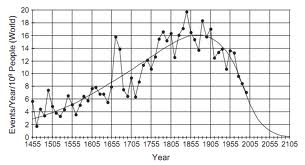
Innovations have been declining!
Here is the list of the world’s top 20 innovating organizations, from the magazine Fast Company, for the year 2010. (See below).
Company Rank* Revenue Profit ($ billion) *rank in Global Fortune 1000, 2010
1. Facebook –
2. Amazon #340 $24.5 $0.901
3. Apple #197 $36.5 $5.7
4. Google #355 $23.7 $ 6.5
5. Huawei #397 $21.8 $2.7
6. First Solar –
7. PG&E –
8. Novartis #160 $45.1 $8.4
9. Walmart #1 $408 $14.3
10. HP #26 $115 $ 7.7
11. Hulu –
12. Netflix –
13. Nike #453 $19.2 $ 1.5
14. Intel #209 $35 $ 4.4
15. Spotify –
16. BYD –
17. Cisco #200 $36.1 $ 6.1
18. IBM #48 $96 $13.4
19. GE #13 $157 $11.0
20. Disney #199 $36.1 $ 3.3
Several interesting conclusions emerge.
* First, very few of the great innovators are big, in global size (ranked by revenues, from the Global Fortune 1000, 2010). Walmart is an exception (#1). So is GE (#13) and HP (#26).
* Second, the hottest of the new innovators are pure Internet companies (Facebook, Hulu, Netflix, Spotify) that create massive amounts of wealth but very few jobs, because when your product is bits and bytes, you do not need assembly-line workers.
* Third, the list of Top 20 innovators from 2005 (Bloomberg/Business Week) is very different. A great many innovators have fallen off the list,
In his best-selling new eBook, The Great Stagnation, Tyler Cowen notes that the automobile industry generated millions of good-paying jobs, but Facebook employs 2,000, Twitter 300 and eBay about 17,000. Only 14,000 people make and sell iPods, but iPods eliminate other jobs (CD manufacturing, etc.) and anyway most of those iPod-based jobs are outside the U.S. Cowen notes that this current era’s technological breakthroughs generate great gains for society but very little added economic activity.
Can we imagine a futuristic economy, in which a majority of the population does not work at all, and in which the privilege of working goes to only an elite handful with high-level skills? A society in which innovation benefits humanity, takes brains, but requires no hands to generate those benefits?
Recall that Henry Ford complained he got an (un-needed) brain every time he hired a pair of hands. Perhaps in future, his innovative industrial descendants will complain that they get (un-needed) hands along with the brain. Perhaps that future is already here.

 TIMnovate
Leave a comment
Comments feed for this article