
You are currently browsing the monthly archive for February 2011.
Global Crisis/ Innovation Blog
Key Results of the Global Crisis: Martin Wolf’s Midstream Analysis
By Shlomo Maital
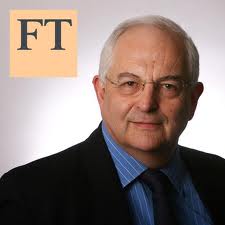
Martin Wolf, FT
Financial Times columnist Martin Wolf * runs the FT Economists’ Forum (www.ft.com/econforum), and his regular FT column is worth tracking carefully. In his latest column, Wolf reviews the key results of the global crisis 2007-9. Here is a brief summary.
1. Financial regulation has tightened. At last, the trend direction is toward tightened regulation, rather than loosened, for the first time in 30 years.
2. Private leverage declines. In America, private gross debt, as a per cent of GDP, rose from 123 per cent in 1981 to a peak of 293 per cent in 2009. (Why did we economists not treat this as a signal of looming crisis?). That ratio has now fallen to 263 percent, a shedding of some $5 trillion in private debt in just a year. The financial sector also deleveraged debt worth 20 per cent of GDP in just a year.
3. Global imbalance (saving in Asia, dissaving in mainly the U.S.) is being reversed, though very slowly.
4. Euro zone deleveraging is occurring, but slowly, imperfectly and bodes ill for the future.
5. G7 nations have taken on huge debt owing to fiscal deficits, their net govt. debt will soar from 52 percent of GDP in 2007 to 90 per cent in 2015. So basically, private debt has become public debt, partly as governments bailed out failed banks and presented the bill to the public.
6. Global power shift from the West to the East, toward China and India, and toward Brazil. The IMF says the share of advanced countries in global GDP was 63 per cent in 2000, but will be less than 50 per cent in 2013; China and India account for 80 per cent of the rising share of the developing world.
These six key trends all present major opportunities for investors, entrepreneurs and managers who are able to spot such opportunities, when others see only crisis and uncertainty.
* Martin Wolf, “How the crisis catapulted us into the future”. FT, Feb. 2, 2011, p. 11.
Innovation Blog
The REAL Margin: Customer Value Margin
By Shlomo Maital
Innovators are taught to think about profit margins, even before they launch their businesses. They are led to believe that to survive, they must make a profit and satisfy their shareholders. The key is ‘margin’, can you make ‘margin’?, operating margin (operating profit/revenue) or net margin (net profit/revenue).
I believe this is wrong. In the next edition of our book Innovation Management, we will try to change this way of thinking. The most important stakeholder for you, the innovator, is your customers, not your shareholders. If you satisfy them, you will also satisfy your shareholders. And there is a way to measure customer value. It is called ‘customer value margin’, and it is defined as the difference between the maximum your customer would pay for your product or service, and the price they actually pay. As a rule of thumb, your customer value margin should be as large as your net margin. MBA students insist this is dumb, that it is leaving ‘money on the table’. I believe it is wise, the way to long-term sustainable profit. And it is consistent with what CEO’s used to believe, that pleasing their customers came before pleasing their shareholders.
Can you measure ‘customer value margin’? You can. Pick a typical customer. By empathy, or direct questioning, find out the maximum they would pay for your product. Of course this varies across customers. But it is powerfully influenced by differential value – the price of the closest substitute. If you have no close substitutes, then you are generating strong customer margin. This is what you must shoot for. Customer value margin is equal to V, the most the customer would pay, minus P, the price they actually pay. Profit margin is equal to P, price, minus C, unit cost. Total social value is the sum of customer value margin and profit margin, or V – C. This is how innovation creates social value and divides it fairly between those who fund the innovation and those who buy it and benefit from it. The bigger V-C, the bigger the social value. [See Figure]
If you think in terms of customer value margin, primarily, you cannot go wrong. In doing so, you are making meaning, not just money. Innovators once thought that way. They should do so once again.
#……………………#…………………………..#
V P C
.cust.marg….. ………..prof marg…….
…… total social margin…………………
Innovation Blog
Innovation in Fifth Grade – Over My Dead Body: Literally!
By Shlomo Maital

“crime scene”

Singapore fifth grade
Writing in his regular New York Times column (Jan. 29), Tom Friedman recounts an innovation he observed, in a fifth grade class in Singapore, in the Gan Eng Seng Primary School. Here is what he writes:
All the 11-year-old boys and girls are wearing junior white lab coats with their names on them. Outside in the hall, yellow police tape has blocked off a “crime scene” and lying on a floor, bloodied, is a fake body that has been murdered. The class is learning about DNA through the use of fingerprints, and their science teacher has turned the students into little C.S.I. detectives. They have to collect fingerprints from the scene and then break them down. … When I asked the principal whether this was part of the national curriculum, she said no. She just had a great science teacher, she said, and was aware that Singapore was making a big push to expand its biotech industries and thought it would be good to push her students in the same direction early. A couple of them checked my fingerprints. I was innocent — but impressed. This was just an average public school, but the principal had made her own connections between “what world am I living in,” “where is my country trying to go in that world” and, therefore, “what should I teach in fifth-grade science.”
All over the world, we hear rabble-rousing speeches from political and business leaders. Most recently, we heard them at Davos, where Russian President Medvedev spoke about innovation. This reminds me of how businesses shape competitive strategy – top down strategy “Bibles” written by the CEO and top management, which somehow are supposed to trickle down to the ‘foot soldiers’ in the field, who do the real work. It never happens.
Singapore has a national strategy to build up its biotech industry. Somehow, a school teacher at a middle-class school listened, got it, and acted. The result: A brilliant innovation for teaching genetics and DNA to fifth-graders, one that involves memorable action learning.
We can learn much from Singapore. As Friedman notes: “Singapore has something to teach us about “attitude” — about taking governing seriously and thinking strategically. We [America] used to do that and must again because our little brick house with central heating is not going to be resistant to the storms much longer.”
How can we inspire fifth-grade teachers in America, Europe and Israel to do the same? What will it take? How can we think strategically, and then see school teachers implement the strategic vision with their kids. And why, if Singapore is so undemocratic, reviled by American politicians for that reason, does the essence of democracy happen there, more than elsewhere: Ordinary working people get the message from the top, and put it into practice with creativity and energy somewhere near the bottom.

 TIMnovate