
Innovation Blog
The Bigger the Bonus (Reward), The Lower the Performance:
Why Innovators Can “Choke” When Stakes are High
By Shlomo Maital
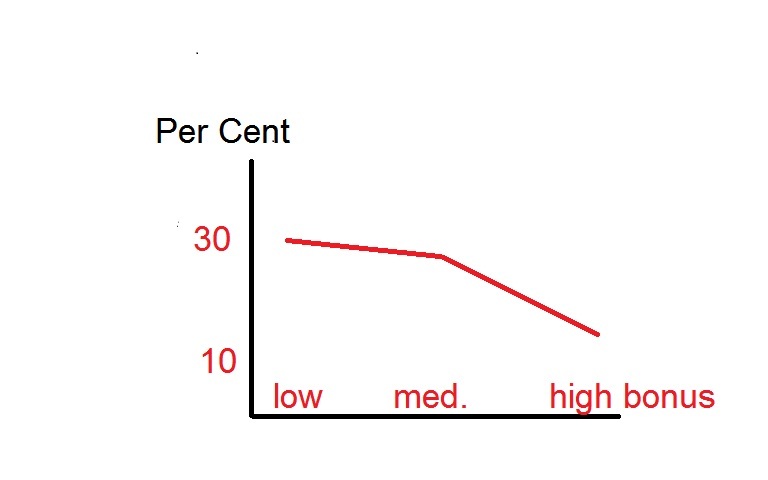
High bonuses cause lower % to attain
“very good” performance
Dan Ariely’s wonderful new sequel to Predictably Irrational is called The Upside of Rationality: The Unexpected Benefits of Defying Logic at Work and at Home.
As the title suggests, Ariely describes a variety of ingenious experiments he and his colleagues and students ran, to explore how we can actually gain from non-rational behavior.
In one of his experiments, conducted in India (because to do so in America would have been prohibitively expensive), he gave groups of villagers challenging tasks (Packing Quarters, Recall Last Three Numbers, Labyrinth, Dart Ball, Roll-Up), offering them low, medium and high bonuses for performance. In “Recall”, for instance, participants were given random numbers, stopped randomly and asked to recall the last three. Participants were given bonuses based on performance. The high bonus amounted to 2,400 rupees, a sum equal to about five months of the villagers’ regular pay. Medium bonuses were 240 rupees, and small ones, 24 rupees.
The graph shows the per cent of participants who reached “very good” performance levels, for each type of bonus.
It is interesting that performance dropped significantly for those who got the “high bonus”. Why? “The experience was so stressful to those in the very-large-bonus condition that they choked under the pressure”, note the researchers.
Bankers insist they have to have super bonuses in order to perform well. Ariely does not agree. All the bonuses seem to do is create risky short-term-profit seeking behavior, inimical to the bank and to society.
Economists are rational, Ariely notes wryly (and ironically); they know which incentives help improve performance and which do not. So do boards of directors and shareholders. Do they really? Are these super-bonuses truly rational? Or are they irrational? When you watch your favorite sport and team, do they play better when the stakes are super-high? Or do they get tense and play worse? And do wise coaches try to relax their players, rather than stress them out, in the dressing room? Innovators would do well to avoid over-stressing themselves and their colleagues, and avoid stressing how high the stakes are – focus on the task, on the process, and keep people laughing. You don’t want to be on the negative slope in Ariely’s curve.

 TIMnovate
Leave a comment
Comments feed for this article