
Global Crisis/Innovation Blog
“Deleveraging”: It’s Really Happening! But: A Long Way to Go
By Shlomo Maital
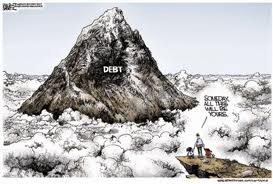
“Someday, children, all this will be yours!”
Earlier, in this blog, I noted why we should all read economist Martin Wolf, Financial Times columnist, carefully and regularly. To that, I would like to add New York Times business columnist Floyd Norris, who writes “Off the Chart”. Unlike most of us journalists, Norris does his homework thoroughly. He crunches data most of us shun.
In his March 19-20 column, Norris documents the remarkable deleveraging (debt reduction) process now going on in America. He does this by digging through Federal Reserve “Flow of Funds” statements going back to 1990.
He finds that the debt of the financial services sector, which grew by 600 per cent between 1990 ($2.6 trillion) and 2008 ($16 trillion), has fallen sharply, to about $14.2 trillion in 2010. Household debt also soared from 1990-2008, but has fallen sharply as well, for two reasons: a) debt holders are writing off bad loans, and b) households are borrowing less and are paying off old loans. The only institution that is still ‘leveraging’ is the federal government, whose outstanding debt is now $9.4 trillion.
Here are the underlying figures: (Total outstanding debt at year end, $ trillion)
1990 2010
Fed. Govt. 2.5 9.4
Households 3.6 13.4
Nonfinancial bus. 3.8 11.1
Financial 2.6 14.2
State & Local Govt. 1.0 2.5
TOTAL: 13.5 50 .6
% of GDP 169 % 385 %
Deleveraging still has a long way to go. Total debt in America in 2010 is nearly four times GDP, compared with less than twice GDP in 1990.
Had we tracked the Fed Flow of Funds data carefully, and observed the ballooning amounts of debt (especially in financial services), we would have realized that systemic risk has ballooned as well, and that the system is headed for a crash.
For brave souls willing to try crunching the numbers (they are presented simply and clearly), the URL is: http://www.federalreserve.gov/releases/z1/Current/z1.pdf
The data are updated every quarter.

 TIMnovate
Leave a comment
Comments feed for this article