
Innovation Blog
Hope for Alzheimer’s: Simply Collaborating Can Become Radical Innovation!
By Shlomo Maital
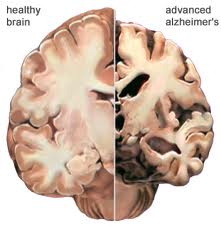
Left: normal brain. Right: Alzheimer’s
As populations age in Europe, America and Japan, Alzheimer’s becomes a problem of immense dimensions. Some 5 million Americans suffer from Alzheimer’s, many over the age of 75. The growth rate is 10 per cent, meaning the number of those with Alzheimer’s doubles every seven years! Japan has relatively fewer cases, but Europe may soon rival America.
So far, research on Alzheimer’s has followed the standard scientific research model – small teams of scholars apply for competitive grants, and seek the genome evidence linking certain genes with Alzheimer’s. This model has produced relatively disappointing results.
Three years ago, according to the New York Times, Gerald D. Schellenberg, U. of Pennsylvania, went to the National Institutes of Health (main funding agency for medical research) with a major complaint. He said: Genome-wide association studies or GWAS’s (associating genes with Alzheimer’s) are not getting results, because each study does not have enough subjects. To establish that a certain gene leads to a, say, 10-15 per cent predisposition to Alzheimer’s requires a big sample. GWAS’s don’t have that.
Schellenberg acted. He started to gather data, painstakingly calling up all those who had done small-scale GWAS’s, asking for the data. “I spent a lot of time being nice to people on the phone”, he recalls. He wanted data for 50,000 people. The magnitude of Schellenberg’s research is staggering: A million genetic scans on every person in the sample, times some 50,000 people, or 50 trillion genetic scans! He got what he wanted. Nearly every Alzheimer’s researcher in the U.S. cooperated. (A similar effort was underway in Europe, led by Dr. Julie Williams, at Cardiff Univ., Wales). The American and European groups are now about to pool their data.
Results? Five new genes have been shown to cause a small predisposition to Alzheimer’s. The significant is not in early testing for those genes, but rather, what those genes do can lead to clues about the biological causes of Alzheimer’s – apparently, related to cholesterol.
Does cholesterol gum up our brains, like it gums up our arteries? Stay tuned!
Meanwhile, Schellenberg has shown that those who integrate existing knowledge can be radical innovators, just like individuals who make breakthrough discoveries.
* Gina Kolata, “New studies identify genes tied to Alzheimer’s”, Global NYTimes, April 4, 2011, p. 7.
 TIMnovate
Leave a comment
Comments feed for this article