
Innovation Blog
Putting Capitalism Into Orbit: Can Private Enterprise Put Americans Back Into Space?
By Shlomo Maital
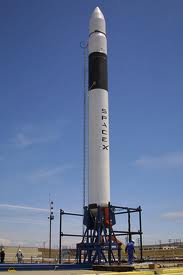 Falcon 1 Rocket (SpaceX)
A decision by President Barack Obama, desperately strapped for cash, has ended the NASA space shuttle program. The flight of Discovery this month , and a last flight in June, will mark the last time Americans will go into orbit in an American space vehicle. From now on, Americans will reach the ISS (International Space Station) on Russian Soyuz rockets. Last month, the U.S. House and Senate approved a spending plan for the remainder of the 2011 fiscal year that cuts NASA’s total budget by $241 million from 2010 levels, to $18.48 billion. Meanwhile, America continues to build costly aircraft carriers, at $6 b. a pop. Why does America need more aircraft carriers? Is this truly a good use of America’s now-scarce resources? Are Americans pleased that they need Russian help to get their astronauts onto the Space Station?
The theory is that the gap will be filled by private enterprise and innovation, driven by the profit motive. But it is an open question whether space can truly be profitable, in the near term. Many believe space is a public good – one governments must provide, because the spillover benefits, hard to capture by private capital, are very large.
One of the most interesting private initiatives is that of Elon Musk, PayPal entrepreneur, who is using his billions earned from PayPal (on-line payment by credit card) to launch SpaceX, a startup that is building space rockets. The launch of Falcon 1 last year was a big success, and showed Musk’s ability to put half a ton into space orbit. Eventually, Falcon 9 will be ready, and it will be capable of putting 25 tons into orbit! The key, it turns out, is saving weight. This is done by using carbon composite material, a kind of papier mache process that provides more than the strength of steel or aluminum with a fraction of the weight.
Meanwhile, Richard Branson’s Virgin Galactic is testing a vehicle aimed at putting people into space (not into orbit). It launches from a plane, at 45,000 feet, thus solving the high-risk stage of ground-based rocket launch. Already, some 400 people (including Elon Musk) have signed up for a ride into space, at $200,000 per person. Some have paid in advance, to ensure a ride on one of the earliest rockets.
Will private enterprise, capitalism and entrepreneurship keep America in space? Time will tell. Space is an expensive technology. The question is, can governments who want their nation to remain a technology leader afford not to invest in it?
 TIMnovate
Leave a comment
Comments feed for this article