
Global Risk/Innovation Blog
Systems Thinking: A Short Eulogy
By Shlomo Maital
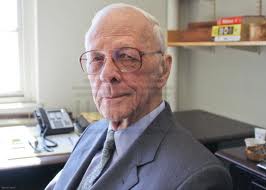
Prof. Jay Forrester, inventor of systems dynamics
You can argue that the world got into trouble for one key core reason: Lack of systems thinking. Risk managers failed to consider systemic risk. Policymakers failed to take into account systemic interaction. European officials failed to realize the euro’s rot can destroy the global economy.
The fact is, we know a lot about systems thinking. We just don’t use what we know. Here is a short history, inspired by an inspired BBC documentary, “Machines of Loving Grace”, about how humanity has been ‘colonized’ by machines.
● A British botanist, Arthur Tansley, invented the term ecosystem in 1935. He was inspired by Sigmund Freud, pioneer of psychoanalysis, and actually visited Freud, seeing an analogy between the interactive system of the brain and the interactive global ecosystem.
● Systems thinking then moved in two directions. Norbert Wiener developed ‘cybernetics’, the study of self-regulating systems. Cybernetics was embraced by the U.S.S.R. as well. And MIT Professor Jay Forrester developed the SAGE early warning system, whose early computers based on vacuum tubes had nearly zero downtime, because they were self-diagnosing (each of 80,000 vacuum tubes could signal its imminent failure, and its location). ● Forrester developed system dynamics as a discipline at MIT, when he moved from Electrical Engineering to MIT’s business school, and showed how businesses, economies, even the world, are all systems of feedback loops that can be modeled with computers.
● His pupils Denis and Danielle Meadows wrote Limits of Growth, for the Club of Rome, showing how global persistent economic growth is unfeasible (because eventually, we overpopulate ourselves, or pollute ourselves, to death, or run out of key resources and starve..there is no happy scenario with permanent growth). All we can strive for is stability, which all ecosystems seek.
● Buckminster Fuller’s 1968 book Operating Manual for Spaceship Earth makes the key point that we are all ‘astronauts’ on a spaceship (Earth) and we “must operate exclusively on our vast daily energy income from the powers of wind, tide, water, and the direct Sun radiation energy”.
If you believe the world is one big ecosystem, then you should believe a) we need to better understand all the complex interactions and feedbacks in it, b) we have to stop placing human beings at the center of the system, because we are not, and c) we must stop striving for perpetual growth, because by definition exponential growth can never be sustained in any stable system, but rather seek balance, harmony and collaboration among the parts of the global system. And this is precisely what we are NOT doing today, as segments of the world try to face up to (or escape from) the current global collapse.

 TIMnovate
2 comments
Comments feed for this article
December 4, 2011 at 5:37 pm
Ilana DeBare
Sadly, I fear it will take either an extraordinary, almost superhuman leader or some kind of cataclysm to wean people off the belief in perpetual growth. Jimmy Carter was the American politician who came closest to this viewpoint, back when Buckminster Fuller was trendy and EF Schumacher’s “Small is Beautiful” was on the bestseller list. And really, all Carter did was ask us to drive slower, turn down our thermostats, and shift to renewable energy. And he was creamed.
People don’t want “downers” (i.e. realists who will deliver tough news) as leaders. They want leaders who will tell them everything is okay, you can have your cake and eat it too, everything will get perpetually bigger and better, and you don’t need to change any of your behaviors.
Can you imagine how the stock market would view a CEO who said, “We have a great company and great products, a great workforce, and we are committed to maintaining our current revenues and market share?” (As opposed to “we are targeting growth of x% over the next year.”)
December 5, 2011 at 10:47 pm
Bala Deshpande
Great words – especially “stop striving for perpetual growth, because by definition exponential growth can never be sustained”.
Unfortunately, many emerging economies are repeating the 1st worlds mistakes and adding their own complex problems to this mix. See here for more on this http://www.simafore.com/blog/bid/58768/the-perils-of-complete-absence-of-systems-thinking-in-city-planning?utm_campaign=timnovate&utm_source=blgcmnt