
Baseball as Life: What We Learn from MLB Tampa Rays
By Shlomo Maital
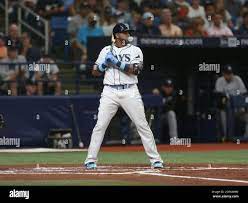
Tampa Rays Designated Hitter
I believe that sport is a metaphor for life. It’s why I think kids should play sports. They teach you teamwork, persistence, effort, and resilience. I played hockey as a kid and was a fairly good goalie. But I was no athlete. So I ended up doing distance running, where endurance trumps speed. I learned a lot about life by running two marathons, New York and Boston. In New York, 1985, I undertrained, didn’t drink during the race, and ended up cramping at the 20th mile and limping across the finish line, still under four hours. But the persistence that taught me helped later during very very difficult battles for tenure.
So, here is a small story (based on Scott Miller’s lovely NYT piece) about how today’s hottest Major League Baseball team, Tampa Bay Rays, learned from adversity, and fixed the problem. Tampa has been winning nearly every game this season, based largely on a high number of home runs. And here is why, according to Scott Miller:
“Oddly enough, Tampa Bay’s 2023 power surge relates directly to Cleveland, and last October’s A.L. wild-card round between the teams. In losing both games of the best-of-three series to the Guardians, the Rays mustered only one run in 24 innings. Most excruciating was the second game, when Tampa Bay was eliminated with a 1-0, 15-inning defeat. The Rays went 6 for 49 in that game and struck out 20 times.”
Big problem. But how to fix it?
“We sat there for four hours and really didn’t have any competitive at-bats,” Chad Mottola, Tampa Bay’s hitting coach, said. “We weren’t even close. They got humbled. I got humbled.” He added: “We had the same group returning [this season], so it was just one of those things, like, we have to make an adjustment. We can’t just do the same thing.”
”Out of that wreckage came a unique drill this spring in which Mottola asked his hitters to run through several sessions each in the batting cage, without swinging, during which they faced a pitching machine hurling a variety of pitches. The idea was to simply focus on identifying pitches and locations. As each pitch was delivered, the stationary Tampa Bay batter called out pitch type and location. “Fastball, high.” “Curveball, outside.” “Slider, over the plate.” As each did, digital tracking devices relayed pitch information to the stadium scoreboard. This allowed the hitters to confirm whether they were correct or were wrong.” The Rays never talked about home runs. That wasn’t the point. “We just wanted the quality of the at-bat to be better,” Mottola said. “We didn’t anticipate the home runs going up. We just wanted to make better decisions on pitches, get deeper into the count if the guy is not giving you drivable pitches. And still, at this point, we are not talking about home runs at all.”
“The trickiest part, Mottola said, was when the hitters went back into the cages after the pitch-watching sessions. Batters found their timing was off and their swings had to be recalibrated, even if just by a little. Six or seven Rays batters have continued the program into the season. Luke Raley, Tampa Bay’s 28-year-old designated hitter, is one of them. (See photo above). Having entered 2023 with just three career homers in 144 plate appearances, Raley had 12 in 188 plate appearances through Wednesday, tied for third on the team with Yandy Díaz and Jose Siri. Isaac Paredes had 13. Randy Arozarena, who had a breakout postseason in 2020, led the team with 14.”
So, what do we learn from Tampa Rays and their hitting? Got a problem? Zoom in and really try to understand the root of it. Do NOT try to leap to a hasty solution. First, delve into the problem, deep dive. Next, zoom out. Find possible creative solutions. Make sure you can implement the one you choose. Finally zoom in, again. Apply the solution. Stick to it. Make it work.
Will Tampa Bay win the World Series and beat the Yankees in their own division?
Stay tuned.

 TIMnovate
Leave a comment
Comments feed for this article