
Hamas Tunnels: An Expert’s Analysis
By Shlomo Maital
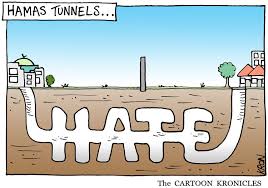
For five months, Israel has been battling Hamas, and its network of tunnels. No army has faced such an extensive array of underground tunnels, comprising hundreds of kilometers, in a strip of land only 40 kms. long.
As an Israeli, I have a rather biased view of the tunnels. So, instead of my views, here is the analysis of a fairly objective expert, John Spencer *. His essay was published in Modern Warfare on January 18.
On the massive extent of the tunnels: “New estimates also indicate the construction of this subterranean network could have cost Hamas as much as a billion dollars. The group has poured resources over fifteen years not just into constructing tunnel passages, but for blast doors, workshops, sleeping quarters, toilets, kitchens, and all the ventilation, electricity, and phone lines to support what amount to underground cities. As much as 6,000 tons of concrete and 1,800 tons of metals have been used in this subterranean construction. The sheer size of Hamas’s underground networks may, once fully discovered, be beyond anything a modern military has ever faced. The new estimates say the network may include between 350 and 450 miles of tunnels, with close to 5,700 separate shafts descending into hell.”
On the political function of the tunnels: “For the first time in the history of tunnel warfare, however, Hamas has built a tunnel network to gain not just a military advantage, but a political advantage, as well. Its underground world serves all of the military functions described above, but also an entirely different one. Hamas weaved its vast tunnel networks into the society on the surface. Destroying the tunnels is virtually impossible without adversely impacting the population living in Gaza. Consequently, they put the modern laws of war at the center of the conflict’s conduct. These laws restrict the use of military force and methods or tactics that a military can use against protected populations and sites such as hospitals, churches, schools, and United Nations facilities.
Civilian Deaths and Buying Time: “Almost all of Hamas’s tunnels are built into civilian and protected sites in densely populated urban areas. Much of the infrastructure providing access to the tunnels is in protected sites. This complicates discriminating between military targets and civilian locations—if not rendering it entirely impossible—because Hamas does not have military sites separate from civilian sites. Hamas’s strategy is also not to hold terrain or defeat an attacking force. Its strategy is about time. It is about creating time for international pressure on Israel to stop its military operation to mount.
The Huge Challenge for Israel Defense Forces: “The tactical challenges Hamas tunnels present to Israel are thereby compounded by strategic challenges. To deal with tunnels at the tactical level, Israel has demonstrated some of the world’s most advanced units, methods, and capabilities to find, exploit, and destroy tunnels. From specialized engineer capabilities and canine units to the use of robots, flooding to clear tunnels, and both aerial-delivered and ground-emplaced explosives, to include liquid explosives, to destroy them. Arguably, no military in the world is as well prepared for subterranean tactical challenges as the IDF. But the strategic challenge is entirely different. To destroy many of the deep-buried tunnels, the IDF has required bunker-busting bombs, which Israel is criticized for using. And most importantly it has required time to find and destroy the tunnels in a conflict in which Hamas’s strategy is aimed at limiting the time available to Israel to conduct its campaign. Hamas’s strategy, then, is founded on tunnels and time. This war, more so than any other, is about the underground and not the surface. It is time based rather than terrain or enemy based. Hamas is in the tunnels. Its leaders and weapons are in the tunnels. The Israeli hostages are in the tunnels. And Hamas’s strategy is founded on its conviction that, for Israel, the critical resource of time will run out in the tunnels.”
“We Are Proud to Sacrifice Martyrs”. “Hamas is globally known for using human shields, which is the practice of using civilians to restrict the attacker in a military operation. The group wants as many civilians as possible to be harmed by Israeli military action—as one of its officials put it, “We are proud to sacrifice martyrs.” It wants the world’s attention on the question of whether the IDF campaign is violating the laws of war in attacking Hamas tunnels that are tightly connected to civilian and protected sites. It wants to buy as much time as is needed to cause the international community to stop Israel. Its entire strategy is built on tunnels.”
– – – – – – – –
And my own view: The Hamas strategy is working. The US has lost patience with Israel, as Israel’s self-centered Prime Minister plays in Hamas hands by refusing to define a clear end-of-war strategy. Biden is losing the Muslim vote in Michigan. The world has lost patience. Israel is ending up facing two billion Muslims, and a Western world that is increasingly hostile to the Gaza operation by IDF.
The young Israeli generation that many of us seniors felt was hopeless, unpatriotic, selfish, has shown incredible sacrifice, motivation and heroism, fighting to save our country. When they return from months of combat, they find a gaggle of incompetent politicians maneuvering to escape the popular judgment, that they bear responsibility for the October 7 disaster and must leave office at once. Experts believe we are headed for a new civil conflict, as popular demands for the government’s resignation face the Prime Minister’s stubborn desperate efforts to stay in power and thus perhaps avoid jail.
* John Spencer is chair of urban warfare studies at the Modern War Institute, codirector of MWI’s Urban Warfare Project, and host of the Urban Warfare Project Podcast. He is also a founding member of the International Working Group on Subterranean Warfare. He served twenty-five years as an infantry soldier, which included two combat tours in Iraq. He is the author of the book Connected Soldiers: Life, Leadership, and Social Connection in Modern War and coauthor of Understanding Urban Warfare.

 TIMnovate
Leave a comment
Comments feed for this article