You are currently browsing the category archive for the ‘Global Crisis Blog’ category.
Innovation/Global Crisis Blog
“If Money Doesn’t Make You Happy, You Aren’t Spending It Right!”
By Shlomo Maital
What is happiness? And are there simple things we all can do that would indeed make the coming year happier? Innovation applies not just to gadgets, but also to the way we live.
I found some answers in an empirical study, still unpublished, by three psychologists: Elizabeth W. Dunn (U. of British Columbia), Daniel T. Gilbert (Harvard Univ.) and Timothy D. Wilson (Univ. of Virginia).
“The relationship between money and happiness is surprisingly weak,” they note. Their provocative title conveys their main finding: “If money doesn’t make you happy, then you probably aren’t spending it right”. The authors offer rules for increased happiness, based on a survey of a large literature on the link between how we spend our money and how happy we are. Here are a few.
1. Help others instead of yourself. Research shows the quality of our social relationships is a strong determinant of our happiness. Those who devote more money to ‘prosocial’ spending (for others) were happier, other things equal.
2. Pay now and consume later. There has been a huge shift in societies everywhere toward immediate enjoyment and delayed payment. The result is to rack up debts, while eliminating the pleasure of anticipation – saving up for something while imagining all the while how much we will enjoy it. Re-learning to defer gratification, as untold generations did before the age of the credit card, can greatly improve happiness. Living by values rather than by impulse is largely about deferred gratification.
3. Think about how you want to live, rather than what you want to buy. The authors note that “consumers who expect a single purchase to have a lasting impact on their happiness might make more realistic predictions if they simply thought about a typical day in their life.” I often think about people who buy expensive cars. They lose fortunes as their cars depreciate, but do they really gain vast pleasure in driving it from A to B compared to those who drive a clunker?
4. Buy experiences instead of things. “People are often happier,” note the authors, “when they spend their money on experiences rather than on things.” An experience is an event you live through, while a good is a tangible object you keep. A sample of over a thousand Americans showed that for every three respondents who reported greater happiness from buying things, five said they derived more happiness from buying experiences. And, of course, some experiences – like a walk on the beach at sunset – are free. You cannot make a 36-inch LED TV by yourself. But you can create an experience, like visiting a sick or lonely friend, or playing with a grandchild, without putting your hand into your pocket.
5. Have many small pleasures instead of a few big ones. “Happiness is more strongly associated with the frequency…of people’s positive affective experiences,” say the authors, “than with the intensity of those experiences”. Try more double lattés and warm croissants, instead of dream vacations and front-row concert tickets. A happiness score of ‘7’ six times a day beats a happiness score of ‘10’ once a month.
Dickens famously defined happiness as a ratio between what we earn and what we spend. Happiness is earning more than you spend; misery is the opposite. It turns out, the Dickensian prescription needs a codicil. How you spend is equally vital.
Innovation/Global Crisis Blog
Qatar is a Star!
By Shlomo Maital

Not many people track Qatar, a peninsula in the Persian Gulf, smaller than Connecticut, bordering Saudi Arabia, rich in oil and natural gas. Its population is only about 900,000, living on 11,000 sq. kms., ruled as a monarchy by the al-Thani family, a majority of its residents are non-Arabs, non-citizens from India and Pakistan. Qatar is home to the TV channel Al Jazeera. It will host soccer’s World Cup and it was an important player in Libya. Qatar is not a democracy. I have met Qataris; they are very well educated and very very pragmatic.
Here is what tiny Qatar has accomplished in recent months:
● An expert at Brookings’ Doha Center, on National Public Radio: “We had about five Qatari fighter jets in Libya… we helped train and arm Libyan rebels. And Qatar also played an important role in developing an Arab League support through the military intervention in Libya, which this Arab League support actually has provided the umbrella for the NATO intervention and for the military intervention and provided the legitimacy that, for example, was missing in Iraq.” Qatar’s supplies of money and arms for the Libyan rebels was, according to many experts, crucial.
● Qatar has invested heavily in Greek banks, through Paramount Services, controlled by a wealthy Qatari family. Yesterday, Qatar fostered a key merger between two troubled Greek banks, lubricating the deal with a 500 m. euro convertible bond. Greek’s stock market rose by 14 percent, as a result.
● Qatar won the right to stage the World Cup (soccer) in 2022.
● Qatar was successful in the mediating an agreement between the Yemeni government and the Houthi rebels. Prevented a civil war almost in Lebanon, brokered peace agreements between the Palestinians, Fatah and Hamas, and also intervened successfully in Sudan.
● Qatar hosts the World Trade Organization negotiations in Doha, crucial for lowering trade barriers on agricultural products.
Qatar was a British protectorate until 1971, when it declared its independence. It has over 15 % of the world’s proven gas reserves, and has a futuristic plant to convert natural gas into gasoline. Once a poor pearl-diving center, it is now exceptionally wealthy. Qatar is, according to the IMD World Competitiveness Yearbook, the 8th most competitive economy in the world (!), has GDP per capita of $88,000 (!), highest in the world; GDP growth of 16% in 2010 (highest in the world), and has no unemployment at all. It attracted inward direct foreign investment of 9 per cent of its GDP in 2009.
If I were Libya, Syria, Israel, Egypt, America, China, EU and Iceland, I would benchmark this tiny speck on the map, to learn what they do, how they do it and why. No country comes close to Qatar’s record of success. Other countries have oil and gas wealth. Few if any leverage it as cleverly as Qatar does.
And as for democracy? As with Singapore, the whole fragile system might come apart if, Qataris say, everyone had the right to protest, demonstrate and vote. There are brutal murderous dictators like Qaddafi and Assad. And then, there are benevolent monarchs like al-Thani. Why is al-Thani so unique? Why is his model not widely copied?
Innovation/Global Crisis Blog
Four Critical Ruling Bargains Come Unstuck: Can They Be Rebuilt?
By Shlomo Maital
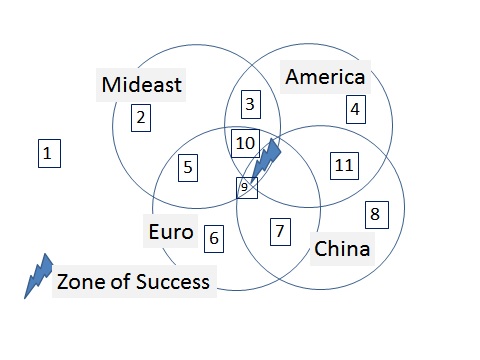
A Do-It-Yourself Tool for Forecasting Global Developments
Tom Friedman’s NYT column (Global edition, August 29) makes an insightful observation about global markets and economies, which again appear headed for crisis.
Friedman notes that there are four ‘critical ruling bargains’ that held together the global system since the end of the Cold War in 1991. They are:
● Mideast dictators supplying oil to the West in return for arms and tacit support
● Euro zone harmony
● American spending, deficits and borrowing
● China’s growth, based on an undervalued currency and high domestic saving.
All four of those ‘ruling bargains’, shown as circles above, have come unstuck, Friedman notes. The Euro bargain broke down because the PIIGS (Portugal Ireland Italy Greece and Spain) in the South strangely failed to behave like the diligent Germans in the North, and have crashed the system. Mideast dictators are falling like flies and no-one knows what or who will replace them. Americans, drowning in debt, have at last resumed saving, but only because recession has shaken their faith and confidence in holding their jobs. And China must shift from a factory-based to a knowledge-based economy with higher domestic spending – a shift easy to define, tough to do. Underlying all this is the global revolt of lower and middle classes, seeking their democratic rights.
The ‘zone of success’ occurs where all of these four ‘ruling bargains’ are somehow restored. China’s rapid growth returns and stabilizes. Mideast oil flows. American spending resumes. And the euro is rescued by a grand compromise between the puritan North and irresponsible South. (This is the ‘lightning bolt’ in the Figure, a very tiny space indeed).
Zones of failure are the 11 numbered areas, beginning with utter collapse (zone 1, none of the four bargains is rebuilt), ranging through, for instance, zone 10, where 3 of the 4 ‘bargains’ are rebuilt, but China comes unglued.
Use this tool to build your own global scenario. Which of the four ‘grand bargains’ are likely to resume, and which are not? What is the timing? Find your most likely ‘zone’. Use it to build a future scenario. What does this mean for your career? Your company? Your assets? Faced with thick global fog, Tom Friedman may have helped give us a tool that disperses at least some of it.
Innovation/Global Crisis Blog
How Long Does It Take Obama To Turn On a Light Switch?
By Shlomo Maital

I don’t know how many people it takes in the Obama Administration to change a light bulb. My guess is, about several hundred. Because in the revolving door of appointments, his experts and advisors leave before they even learn what a light bulb is. When Obama took office in early 2009, he was counseled by an all-star economic team that included Great Depression scholar Christina D. Romer, former Federal Reserve Chairman Paul A. Volcker (center) and former Treasury Secretary Lawrence H. Summers. All have since resigned. They were replaced by lightweights, precisely at a time when innovative thinking is desperately needed. Treasury Secretary Timothy Geitner has stayed on; his departure would have been very helpful. The wrong people left; the wrong people stayed.
The question now is, how long does it take the Obama Administration to turn on a light switch? The answer: Two and one-half years. Here is why.
The core problem of the U.S. economy is the construction and housing industries. The core problem of those industries is simple:
By the last quarter in 2010, about 11.1 million homeowners, or 23 percent of all owners of residential property, owed more on their mortgages than their home is worth, according to CoreLogic. The backlog of unsold foreclosed homes remains one of the biggest challenges for the administration in trying to boost a housing market still struggling to recover from its 2007 collapse. A total of 657,044 homeowners have won a permanent modified loan as of June — a fraction of the 3 million to 4 million the administration had initially forecast, according to the Treasury Department. In other words, only 6 per cent of those whose homes are “under water” have had their problem solved. Some 94 per cent have not. Great work, Obama! Great work, Tim Geitner.
In other words: Almost a quarter of all houses are ‘under water’ (worth less than what their owners owe). Many of those houses are empty, because their owners have walked away from them. The banks who foreclosed have dumped them on the market, depressing housing prices. The houses are empty, and do nobody any good. Some people have lost their homes and have nowhere to live. Entire neighborhoods in California are empty. Until this problem is solved, there will be no economic recovery in the U.S. and there will be no significant fall in the unemployment rate (construction is highly labor intensive).
The solution: A fresh start. Create a government corporation that buys all the empty houses, or ‘under water’ houses, at market prices. The cost: Say, 11.1 million homes times an average value of $300,000, or $3.3 trillion. Pay for the houses in special U.S. Goverment 30-year bonds. Gradually over time, as the housing market improves (as it will), sell the houses, and recoup the funds needed to redeem the maturing bonds. (The Government will make a substantial profit on this deal over the coming decade). Rent the homes to the people now living in them, for modest rents, and offer them the opportunity to buy back their own homes over time.
The housing market faces a “second shoe” problem (waiting for the upstairs neighbor to drop the second shoe), in the form of 11 million homes dumped on the market. By supply and demand, as long as that ‘second shoe’ of 11 million houses remains on the market, housing prices will never recover. Get them off the market. The government is the only one able to do so. Break the doom loop: No jobs, no way to pay the mortgage, foreclosure, slumping housing prices, bad economy, no jobs, no way to pay the mortgage, etc….
Why is it so hard to take decisive action to solve the under-water problem? Why does it take so very long for the Obama Administration to turn on a light bulb? Why has America been doomed to live in darkness, by an Administration that has disappointed not only Americans but people everywhere? Why are so many Americans living ‘under water’ for so long they are growing fins and gills? And why have those 11 million ‘fish’ not organized effectively to protest?
A Reuters report yesterday stated: “The Obama administration is looking at options for reviving the housing market, an Achilles heel for the struggling U.S. economic recovery.” Two-and-a-half wasted years, and Obama is still “looking at options”. He may still be “looking at options” on Tuesday November 6 2012, when angry voters send him into early retirement.
Innovation/Global Crisis Blog
Business Leadership in Troubled Times: Oxymoron?
Why Restoring Jobs Requires First Restoring Trust
By Shlomo Maital
Let us agree that the latest stage of the ongoing global crisis is the most worrisome. Bank crisis became financial crisis, became economic crisis, and now – a crisis of suspicion. People everywhere have (rightly) lost faith and trust in their political leaders. And leaders have lost trust in the people’s ability to hear the truth and accept bitter medicine. Banks have lost trust in their lenders, people have lost trust in their banks. Workers too have lost trust in senior management. A study by Maritz shows that in the U.S. “… only seven percent of employees strongly agree they trust senior leaders to look out for their best interest, and only seven percent strongly agree they trust their co-workers to do so. Approximately one-fifth of respondents disagree that their company’s leader is completely honest and ethical, and one-quarter of respondents disagree that they trust management to make the right decisions in times of uncertainty.”
We are learning that trust is the fundamental currency of global markets, not dollars. Without trust, there is neither an economy nor a society.
Facing this vacuum of trust, business leaders have utterly failed to step forward. In the U.S., facing a possible bond default, business organizations (like the Business Roundtable and U.S. Chamber of Commerce) screamed at Obama NOT to default – but offered nothing constructive on how to slash deficits and restore economic growth. An editorial in today’s Global New York Times basically called ‘business leadership’ an oxymoron (internal contradiction). And I agree.
A country is a business. I address this question to business leaders everywhere. If you were CEO of USA Inc., UK Inc., Germany Inc., Israel Inc., Greece Inc.: What would be your competitive strategy, in the face of shrinking global markets, excess debt, over-leverage and political paralysis? What would you do? And why? And how would you communicate your plan to people, so they would understand and support you, and trust you? Restoring jobs starts with restoring trust in our system. Trust requires leadership. We have neither.
Why is a nation’s turnaround plan any different from that of a business – except, it’s far more important and far more complex? And where in the world are our highly-paid business leaders — spending the vacation month of August on their yachts in the Mediterranean, replicating Obama’s ill-considered vacation, in the midst of turmoil, on Cape Cod.
Innovation/Global Crisis Blog
You’ve Just Gotta Laugh!
By Shlomo Maital
The latest issue of The Economist has three separate items that, unintentionally, bring a smile or even a belly laugh.
Here they are.
1. China Eats America’s Lunch – Literally. China has been eating America’s lunch for years. By dominating manufacturing, China has taken away well-paying jobs from middle-class Americans, who now work at Wal-Mart for near-minimum wage. Now, fittingly, China is LITERALLY eating America’s lunch. A factory in rural Georgia, U.S., Georgia Chopsticks, is making 2 million chopsticks a day out of poplar and sweet-gum wood and exporting them to China. (p. 53). The company hopes to employ 150 people. America is saying, eat our lunch China and…here, let us give you the tools with which to do it.
2. Having achieved a Guinness Book of Records astronomical inflation rate, 230,000,000 per cent (that’s not a typo), Zimbabwe ended it by abandoning its own worthless currency and adopting the dollar. Now, Zimbabwe is worried, lest America’s irresponsible Fed print excessive amounts of money and destabilize Zimbabwe. A Zimbabwean newspaper, Newsday, wondered on Aug. 10 whether “it was time for Zimbabwe to ditch the dollar, lest it import America’s macroeconomic recklessness.” Pot calling the kettle black? Well – who’s the pot anyway? Can America learn fiscal and monetary responsibility from Zimbabwe? Apparently, yes. (p. 57).
3. A special police unit in Stockholm Sweden handles protests in a unique way. They have no weapons, no water cannons, no tear gas. They are known as Dialogue Police. They engage in philosophic dialogue with protesters, discussing the Manichean Ethic, relativist morality, deontological intuitionism and utilitarianism. My hunch is, they lull protesters to sleep. (P. 45). This has huge possibilities. How about Lullaby Police, who sing protesters to sleep? How about Economist Police, who teach segments of Econ 101, guaranteed to anesthetize an elephant?
Global crisis? That’s a laugh.
Innovation/Global Crisis Blog
A Modest Proposal for Responsible Fiscal Stimulus
By Shlomo Maital
Frankly, having taught the course for 40 years, there is not much real value in Macro Economics 101. Macro-economists, even superb Nobel Laureates like Joe Stigler, have very little to say about how the world can get out of its current mess. Stiglitz, writing in the Financial Times, says the good news is…it could have been much worse. And that, my friends, is about all he has to say. The good news is, there might have been more bad news. Lovely.
Here is a modest little idea that comes straight from the pages of Macro Economics 101. It is called the Balanced Budget Multiplier. It was discovered by MIT Nobel Laureate Paul Samuelson, the greatest economist of his generation. Here is his theorem:
If governments increase their spending by $X b., and at the same time increase their tax revenue by $X b., the net effect on GDP is precisely + $X b. No deficit increase, but significant fiscal stimulus.
Why? How can this be true, if the government absorbs $X b. in taxes and then just puts it back? The reason is this: If people kept the $X b. in income, they would spend only a part of it. But the government spends ALL of it. We know there is a pass-through or multiplier effect: if people spend “c” percent of their income, the ‘multiplier’ is 1/c – i.e. $1 in stimulus creates 1/(1-c) in new GDP; if c is 0.8, then the multiplier is 1/0.2 or 5.
So the net effect of a balanced-budget stimulus is what the government spends, $X, minus what people would have spent with the $X in taxes, or (c)$X, or (1-c)$X, times the multiplier 1/(1-c), which is …. $X.
Simple?
Attention Tea Party advocates, including Rick Perry, Texas governor and probably the next Republican Presidential candidate (watch Mitt Romney fade). You CAN have your cake and eat it too. Raise govt. spending. Raise tax revenue by closing loopholes (technically, NOT a tax increase). Balance new spending with new revenue. Avoid raising the deficit. And yet, at the same time, stimulate the economy and create jobs.
This idea comes from Robert Shiller, NYT July 23. Shiller is a rarety, a truly creative macroeconomist with a great many cool ideas for resolving the current crisis. He has a new book coming out soon that is eagerly awaited.
Innovation/Global Crisis Blog
Leaders of the World: Benchmark Brazil!
By Shlomo Maital
I truly love the delicious irony in the following: For decades, America lectured Brazil and its leaders on how incompetent and worthless they were, ruining their currency with runaway inflation, incurring enormous short-term debt and generally behaving irresponsibly.
Ah, how lovely. The shoe is on the other foot. President Obama should get on the next (Air Force One) plane and visit Rio. He would learn a great deal about effective leadership from the Brazilians, and not solely from its legendary former president Lula.
Here is what he would learn:
● From Jose Graziano da Silva, now incoming head of the FAO (UN Food and Agriculture Organization), previously father of Brazil’s lauded “Zero Hunger” program: (Wall St. Journal, July 22-24, “Marketplace”): Zero Hunger integrated 50 policies, involving everything from direct financial aid for small farmers to low-cost restaurants, in order to feed the poorest and alleviate extreme poverty – the root cause of hunger. “To eradicate hunger is not a goal that a government can achieve; it is society that does this,” Mr. Graziano said. “It shows that if you have a basic society already organized, then you can organize it into communal goals.”
Zero Hunger lifted some 24 million people out of poverty since 2003. Graziano actually launched Zero Hunger, but was removed from his post after the first year. Brazil, however, under Lula persisted. According to Fox News, “President Silva launched Zero Hunger in 2003 after saying at his inauguration that ending hunger was his administration’s main goal. The effort united several social programs and introduced new measures, such as Bolsa Familia. Dozens of other initiatives fall under the plan, including support for small farmers, running restaurants serving 50-cent meals and job training for women. Brazil spends 0.4 percent of its gross domestic product on the Bolsa Familia program, yet it has a bigger impact shrinking inequality than far costlier programs, such as Brazil’s version of the U.S. Social Security effort.
Brazil’s programs, which borrow partly from a Mexican initiative, have inspired other government initiatives around the globe, including 16 conditional cash transfer programs in Latin America and at least 14 outside the region. “Brazil’s experience is hugely inspirational to a lot of developing countries that are themselves battling with a lot of issues around food security and hunger,” said Asma Lateef, director of the Washington-based anti-hunger Bread for the World Institute. “That it could be done and done so quickly is a wonderful success story and gives hope to a lot of people around the world.”
● And from Celso Amorim (Foreign Minister of Brazil from 2003-2011, and current Minister of Defence), a man who has been described as having “…masterminded a transformation of Brazil’s role in the world that is almost unprecedented in modern history…”.
Writing in the blog “thought economics”, Thoughteconomics.blogspot.com, Vikram Shah observes: Brazil’s 191 million strong population have, within their lifetimes, seen their country exit the Great Depression of the 1930’s only to end up with seemingly never-ending cycles of economic and political crises which led to a coup (in 1964), a twenty year military dictatorship and then a process of re-democratization and rapid industrialization (from 1985 to present-day). During this period, Brazil’s GDP has grown from $15.1 billion in 1960 to almost $1.6 trillion today (making Brazil the world’s seventh largest economy by purchasing power parity). “This rapid socioeconomic transformation…” says Werner Baer in his book ‘The Brazilian Economy: Growth and Development’ “…can be illustrated with a few numbers. In 1940 only 30 percent of the country’s population was urban; by 1970 this proportion had increased to 56 percent, and by 1999 to 78 percent. The contribution of agriculture to gross domestic product (GDP) declined from 28 percent in 1947 to about 10 percent in the late 1990’s (measured in current prices), whereas that of industry rose from not quite 20 percent in 1947 to about 36 percent in the late 1990s. After four decades of intense industrialization, Brazil was producing 2 million motor vehicles in 1997, 26 million tons of steel in 1997, 39 million tons of cement in 1998, about 7.8 million television sets, and 3.7 million refrigerators in 1997. It had over 58,000 megawatts of installed electric power capacity in 1998, and over 60 percent of its exports consisted of manufactured products. Its paved road network increased from 36,000 kms. in 196 to close to 150,000 kms. in 1999. ” Recent history (since 2001) has seen more than ten percent of Brazil’s population rise out of poverty – and the nation adopt a driving posture in global economics and foreign policy (having led UN peacekeeping in Haiti since 2004, and being central to missions in Liberia, the Central African republic, Cote d’Ivoire and East Timor).
Amorim says: “In the case of Brazil, one of the most important things is the huge ethnic and cultural mixture which makes us a country with dynamism, vibrancy, and the ability to understand the psychology of other nations. We have problems, of course, but this is one of our huge strengths, and a huge foreign policy asset. “
At a time when many countries are blaming immigrants on job market problems, and doing their best to keep them out or evict them once they have arrived (America’s immigration officials now call themselves Border Protection – which says it all), Brazil understands that its cultural diversity is a source of strength.
I recently visited South Africa. I learned first-hand how the incredible blend of African tribal cultural (Xhosa, Zulu, etc.), along with Afrikaans and British culture, plus Indian immigrants, has created an enormously interesting and dynamic society.
Leaders of the world: Benchmark Brazil. You have a lot to learn. Pay some homage to the country you loved to hate and criticize. America, too, has deep poverty and hunger. Perhaps it would do well to invest 0.4 per cent of its GDP, like Brazil, in a Zero Hunger program. The cost? $56 b. Not even the rounding error on the federal government budget.
Global Crisis/InnovationBlog
What is Going on? In One Short Paragraph
By Shlomo Maital
Today’s Financial Times (Saturday August 13) claims that the ‘flight to safety’ (a euphemism for panic sale of stocks and other assets) last week exceeded the panic following Lehman’s Brothers catastrophic collapse on Sept. 15/2008. Other items discuss the rioting in Britain, Greece’s deep recession, France’s crisis, Israel’s protest movement, and other types of social unrest.
What in the world is going on?
Here is a very short explanation. The financial crisis of 2007-9, beginning with the U.S. and spreading to the world, led expectedly to an economic crisis, because when people lose their savings and homes, they spend less, the economy declines and joblessness rises. Governments everywhere reacted to the economic downturn by spending more, even though tax revenues were falling. The resulting deficits created a new financial crisis, in America and in Europe, as mounting government debt panicked investors. Central banks reacted by slashing interest rates and flooding money into the market, but that did not help, because banks and companies held the money rather than spend it, fearing future crises. So the new financial crisis (just a continuation of the previous one, with govt. debt playing the role bank debt played before) led to renewed economic stagnation, which in turn has now become social unrest. Governments are powerless, because a) they are now slashing their social programs, owing to deficits, so they cannot respond with more resources, and b) money policy has no room left for maneuver. The young middle class, and the poor, are revolting, in different ways, some peacefully, some with violence – and some, as in America, with continued quiet desperation. The tragedy is, this drama unfolds predictably, because social unrest always follows economic depressions, which always follow severe financial downturns. Yet as always our leaders were taken by surprise by it. And that deepens the financial panic. It is a series of feedback loops.
It is unclear how the world can emerge from this mess. If you, dear reader, have some ideas, please pass them on.
Innovation/Global Crisis Blog
Bad Times Means Great Books: Here are the Best!
By Shlomo Maital
Bad (economic and financial) times inevitably bring a crop of great books, telling us why we got into a pickle and who is to blame. Here is this year’s batch: The partial list of books nominated for the annual FT Goldman Sachs book award.
- Entrepreneurs: No Angel, by Tom Bower (about Bernie Ecclestone, who built Formula 1 into a huge business empire); Grand Pursuit: The Story of Economic Genius, by Sylvia Nasar; also, Car Guys vs. Bean Counters, by Bob Lutz, about how the financial cost-cutters ruined America’s car industry.
- Global Crisis 2007-9: Fatal Risk: A Cautionary Tale of AIG’s Corporate Suicide, by Roddy Boyd. Exorbitant Privilege: The Rise and Fall of the Dollar, by Barry Eichengreen; Extreme Money: The Masters of the Universe and the Cult of Risk, by Satyajit Das; The Wizard of Lies: Bernie Madoff and the Death of Trust, by Diana Henriques; Wilful Blindness: Why We Ignore the Obvious at Our Peril, by Margaret Heffernan;
- Future Trends: That Used to be Us: How America Fell Behind in the World It Invented and How We can Come Back, by Thomas Friedman and Michael Mandelbaum; The Next Convergence: The Future of Economic Growth in a Multispeed World, by Michael Spence; Triumph of the City: How our Greatest Invention Makes us Richer, Smarter, Greener, Healther and Happier, by Edward Glaeser; The Quest: Energy, Security and the Remaking of the Modern World, by Daniel Yergin. Poor Economics: A Radical Rethinking of the Way to Fight Global Poverty, by Abhijit Banerjee and Esther Duflo.
- Management: Good Strategy/Bad Strategy: The Difference and Why It Matters, by Richard Rumelt.
I especially recommend the “future trends” books. The books about the scoundrels who brought us the 2007-9 global crisis, which is now fast becoming the 2007 – no-end-in-sight global crisis, will raise your blood pressure.