You are currently browsing the category archive for the ‘Global Crisis Blog’ category.
Ashley vs. Ivanka: Choose Your Role Model
By Shlomo Maital

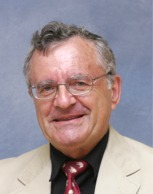
Ashley Biden & Father Joe
President Trump recently tweeted his recommendation, that people buy his daughter Ivanka’s upscale fashion designs, after retail chain Nordstrom took her clothes off its shelves. (“They don’t sell,” Nordstrom claimed).
Another famous politician has a designer-daughter – former Vice President Joe Biden and his social worker daughter Ashley. Her story, and product, are a bit different.
According to Elle Magazine: “Ashley’s new ethically produced, American-made clothing company, is a project any dad would be proud to get behind. It kicks off with a range of supersoft organic cotton hoodies on sale for just a few weeks, starting February 8, in partnership with the flash-sale behemoth Gilt: The entirety of the proceeds from the debut collection will be channeled to programs that work to alleviate poverty through education, training, and job placement.
“Ashley, 35, who is also the executive director of the Delaware Center for Justice, a nonprofit that serves children and adults impacted by the criminal justice system, had toyed with the potential nature and mission of Livelihood for years. One thing that never wavered was the idea of the hoodie. This is partly because Ashley herself—who has a stealth charisma and a fondness for phrases like “heavens to Betsy”—describes herself as a “jeans-and-T-shirt kinda gal.” It’s also because she appreciates the symbolism of an item long connected to American laborers and more recently to Black Lives Matter. “Livelihood is specifically about income inequality,” she says. “And racial inequality and income inequality are directly related.”
“By the time her parents moved into the VP’s mansion in 2009, Ashley—who did her undergrad at Tulane, then earned a master’s in social work from the University of Pennsylvania—had a job serving kids in the foster-care system. It was disorienting, to put it mildly, to travel from a juvenile detention center to, say, Air Force 2. What did become increasingly clear was how little privileged Americans understood about life below the poverty line, where 13.5 percent of the U.S. resides. “I’d hear about five siblings sharing one burger,” she says. “How does a kid do homework when there’s no desk or lamp? One of the biggest things I’ve seen in my work is that a lot of social ills directly result from poverty.”
Does it take a privileged daughter of the U.S. Vice-President, to explain to us how little we the privileged understand about the life and hardships of the one in seven who live in poverty? And will we opt for the role model of Ivanka Trump, who sells to the wealthy, or Ashley Biden, who works for the poor, and has done so for her whole career?
Snapchat: Think Differently
By Shlomo Maital
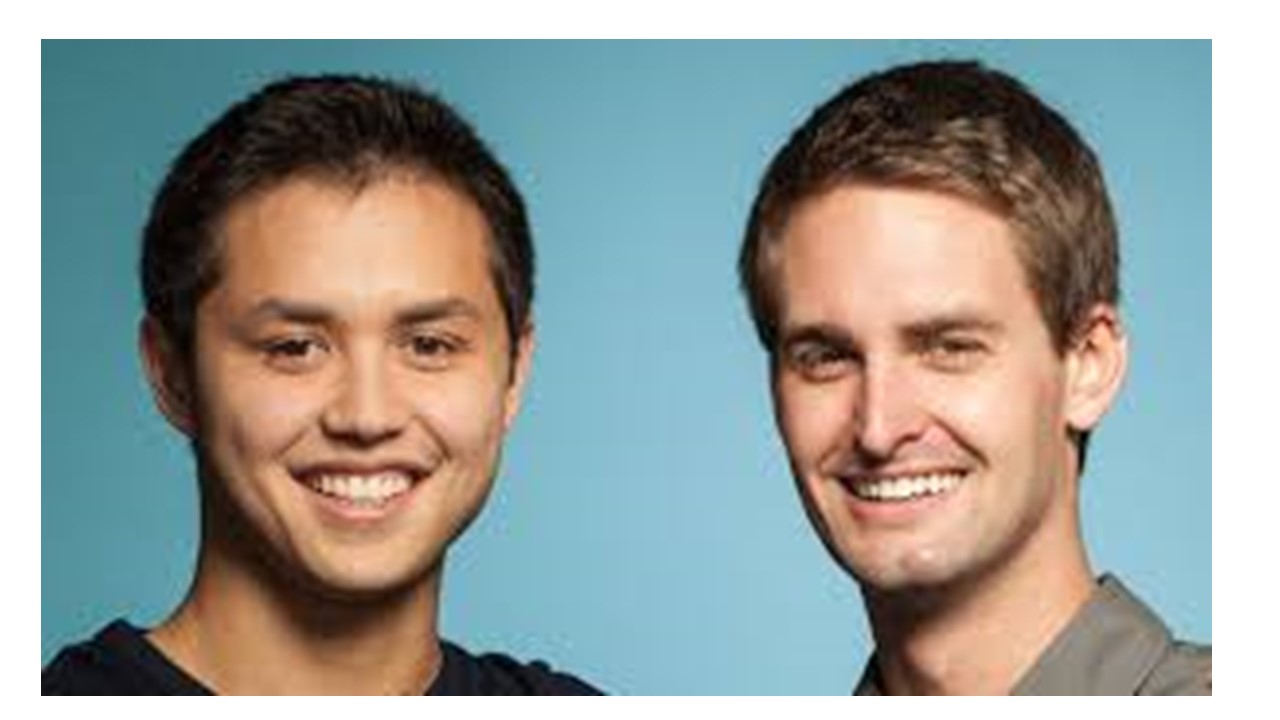
Snapchat Founders: Bobby Murphy, Evan Spiegel
Stanford University undergraduates Bobby Murphy and Evan Spiegel had an unconventional observation about social media – one that made them billionaires.
“What makes a social network valuable? In the Facebook era, everyone believed they became valuable by amassing more and more users. Obvious, right?
But Spiegel noticed, that in real life, most of us spend more of our time with just a few friends, whose value outweighs huge numbers of looser ties. So from their Stanford dorm rooms, they made Snapchat an app that would send DISAPPEARING photos and images, n a way that “more closely mimicked the dynamics of a real world conversation” (See Katie Benner, NYT, Feb 3). It would raise the appeal of Snapchat as a service that people used with a small number of good friends.
And were they ever right!! Snapchat is now close to an IPO, and it will be valued at billions of dollars.
It’s not just that the two founders practiced ‘think differently’. They did think differently, but in a way that appealed to the way we live, think, interact and chat with friends. Think differently is fine, but it has to be focused, built on solid foundations of the way people behave, and the way we observe people behave.
Innovator — check out social media, and innovations in general. Can you think different? Can you alter the basic principles, so that the device or service more closely matches the way we behave in the real non-digital world? If so, you can be the next Snapchat startup moguls.
“The Poor Should Not Be Treated Poorly”
By Shlomo Maital
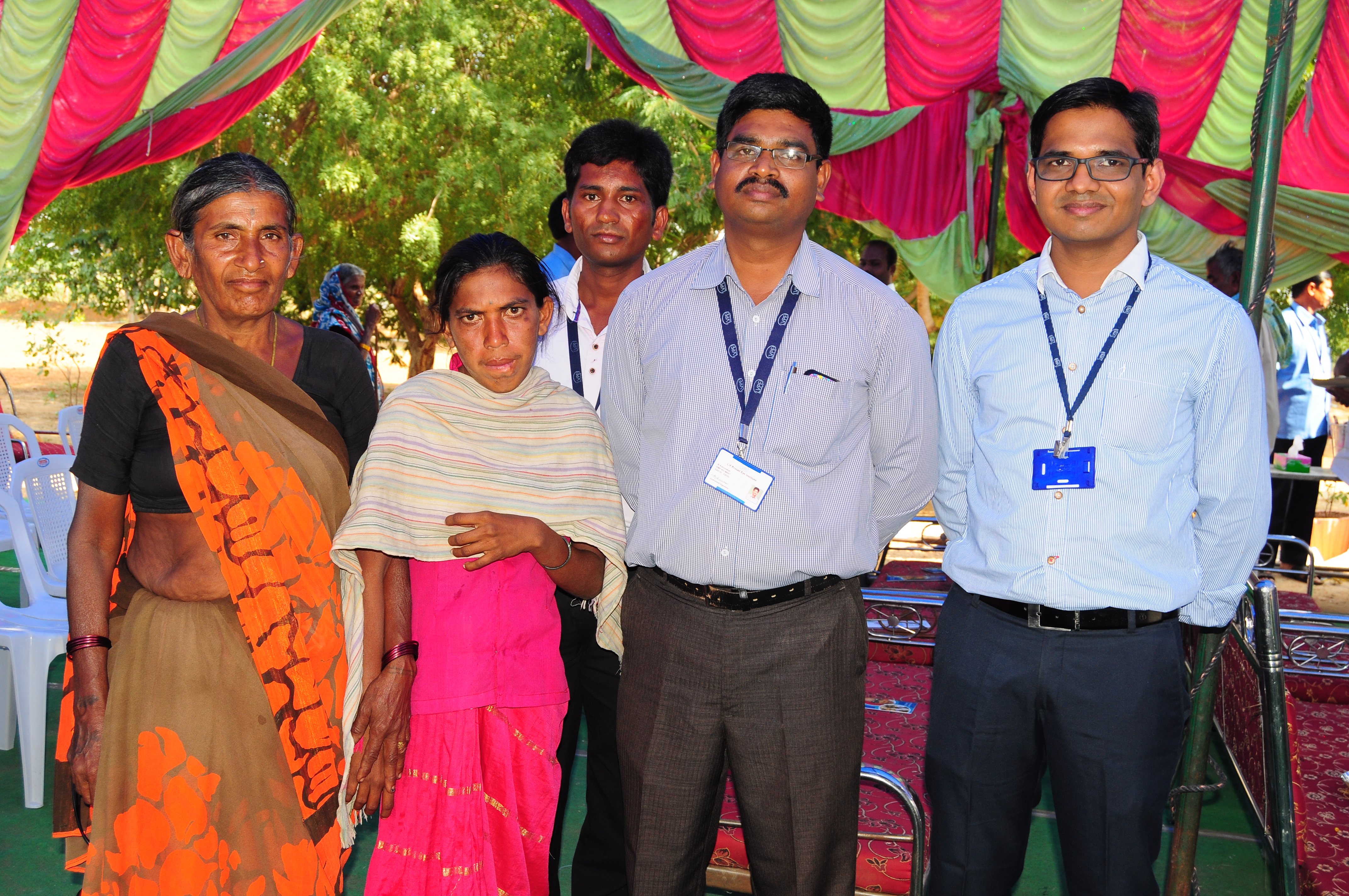
From left to right: N. Ankalamma,(mother of Chennamma), Chennamma (patient), Mr Thirumla Kondalu & Mr Karunakar (Community Based Field Staff who counselled her at her home) and Dr Nilesh Jaiswal (Ophthalmologist who performed the surgeries at the secondary centre).
– – – – – –
I’ve just returned from a short trip to Hyderabad, India, where I and my co-author Prof. D.V.R. Seshadri launched our new book Smartonomics (SAGE India). While there, Seshadri and I visited the L V Prasad Eye Institute, which has treated 21 million patients since it was founded 30 years ago by Dr. G. N. Rao. We are writing a Case Study about LVPEI.
Here in brief is the story. Dr. Rao and his wife Prattibha lived in Rochester, New York, in 1986. Dr. Rao had a comfortable prestigious position at the University Hospital there, as a top ophthalmologist. But he and his wife chose to return to their homeland, India, to found a world-class eye disease institute. A famous film producer L V Prasad donated the money for the land and building, in Hyderabad.
Dr. Rao’s vision was to provide excellent world-class eye care for all, including those who could not pay. How? Cross-subsidization. Those who could pay, would. Those who couldn’t, would not. And somehow the resources would make possible truly excellent innovative eye care, restoring vision for many many thousands. LVPEI began in 1987 with three examination rooms and 2 operating rooms, and soon expanded into 4 states, with primary, secondary and tertiary eye care reaching into the poorest rural regions.
Dr. Rao implemented his vision of the four E’s: excellence, efficiency, equity and empathic eye care. He expressed it as an Eye Health Pyramid (see figure):

In this model, state of the art eye care was provided at the LVPEI center in Hyderabad, India’s 6th largest city. Secondary and primary eye care was pushed out to the periphery, always under the watchful eye and supervision of the LVPEI center. In the past 3 decades, 21 million people have been treated. Many have had vision restored. There is no greater gift.
This model is crucial, because however excellent, the Eye Care Center in Hyderabad is of little value for the rural poor, unless there is outreach and counselling that identifies their problems and begins to treat them. All too often, health care available in big cities is far superior to that available in the poor rural regions.
Here is just one small story: Nalagati Venkata Chennamma was born with visual and intellectual impairment. At the age of 8, her vision deteriorated further. Fearing high fees and Chennamma’s difficult behaviour, doctors were never consulted by the family. At the age of 20 she underwent an eye check and was declared 100% blind. But as fate would have it, five years later, Karunakar one of LVPEI’s Field Rehabilitation Service Officers visited her and spotted symptoms of cataract. Apprehensive in the beginning, Chennamma’s mother brought her to LVPEI’s secondary centre in Markapuram on 7th November 2016. She was operated by Dr Nilesh Jaiswal for congenital cataract in both of her eyes and subsequently regained functional vision. There is a possibility that her vision can be further enhanced and she is currently undergoing treatment at LVPEI’s Hyderabad Centre of Excellence Campus. Today, her family is delighted with the outcome of the surgery and are thankful to LVPEI and its talented doctors. There is hope that with vision restored, Chennamma can make up some ground in her intellectual development.
Dr. Rao has just been selected for the American Society of Cataract and Refractive Surgery (ASCRS)’s Ophthalmology Hall Of Fame, a rare honor given to very few. He will travel to the Los Angeles for the induction ceremony on May 6.
Polar Bears – Nature’s Astounding Innovations
By Shlomo Maital

Nature is our supreme innovator. Over many thousands of years, random mutations occur, most of which fail, but a few succeed in helping species to survive to procreate – and became permanently embedded and reproduced in their genes. This evolutionary innovation is slow but highly effective. Variations of it work in human innovation, too. A study in Israel shows that of some 10,000 startups launched between 1999 and 2008, only about 4 %, or around 450, are still alive, growing and profitable. As with evolution, ideas are tossed into the air, and only a few prove truly viable. Entrepreneurs that I spoke with believe firmly that to get 440 viable firms, you do need to launch 10,000.
Consider the Polar Bear. It is currently endangered by global warming and its numbers are falling. This is a great tragedy. The polar bear is one of Nature’s supreme innovations.
How does the Polar Bear survive in the long Arctic nights, in freezing cold?
Its fur. Its fur hairs are actually not white (they just appear so, because they lack any color). Each hair is transparent, and has a key property – it reflects (rather than absorbs) all wave lengths of light, including infrared. Why is that helpful? The body of the polar bear radiates heat, as infrared radiation. But when body heat reaches the transparent hairs, it is reflected back into the body, rather than radiated off into the air and lost forever. No warmer fur coat exists.
Has anyone thought of creating a synthetic fur jacket or sweater, on this principle?
What else has Nature innovated?
Active hibernation. Bears hibernate in winter, when the food supply declines. Hibernation is a state where the body cools, heartbeat slows and energy consumption is minimal. Polar bears hibernate in summer, when food is very scarce…. But remain awake. How? Their body metabolism goes into hibernation mode, and energy is recycled to maintain muscle tone – but still the polar bears are awake, lest they miss some food, however scarce. As far as we know, this amazing stage of wakeful hibernation is unique to polar bears.
Nature indeed is an incredible innovator, and evolution is its mechanism.
If we allow polar bears to decline and perhaps become extinct, due to global warming and the melting of Arctic ice, it will be an enormous crime to future generations, who will not get to know this remarkable animal.
8 Billionaires = 3.6 Billion Poor
By Shlomo Maital

Oxfam is a British-based philanthropic organization that provides support for the poor world-wide. It is politically identified with the Left. From time to time Oxfam generates reports showing the extreme inequality of world wealth distribution. The latest report claims that only 8 billionaires, the richest people in the world, hold wealth equal to the entire holdings of wealth of the poorest 3.6 billion people, or half the world’s population.
Not long ago, this annual report claimed that 62 billionaires = half the world’s population. So the rich have grown richer, the poor have grown poorer. Indeed, half the world has little or no wealth at all, per capita. Oxfam uses Forbes Billionaire List data, and publishes its report to coincide with the Davos World Economic Forum, where the world’s makers and shakers meet.
Here are the eight super-billionaires.
1.Bill Gates, the founder of Microsoft, led the list with a net worth of $75 billion. He is scheduled to speak at the forum in Davos this year. 2. Amancio Ortega Gaona, the Spanish founder of the fashion company Inditex, best known for its oldest and biggest brand, Zara, has a net worth of $67 billion. 3. Warren E. Buffett, the chairman of Berkshire Hathaway, $60.8 billion. 4. Carlos Slim Helú, the Mexican telecommunications magnate, $50 billion. 5. Jeff Bezos, the founder of Amazon, $45.2 billion. 6. Mark Zuckerberg, Facebook’s creator, $44.6 billion. 7. Lawrence J. Ellison, the founder of Oracle, $43.6 billion. 8. Michael R. Bloomberg, the former mayor of New York and founder of the media and financial-data giant Bloomberg L.L.P., $40 billion.
What can we learn from the Oxfam report, even if it is partly inaccurate?
* None involve inherited wealth. All did it on mainly their own. * Gates and Buffett are committed to giving away all their wealth and their foundations are well on the way to doing this. * Bloomberg became a highly effective mayor of New York, and was close to running for President. * A majority built wealth in the world of high-tech. * Some have created a lot of jobs: Zara, a retailer, and even Amazon, which is now hiring.
With a billionaire now President of the United States, it is time to ponder these questions: Is it healthy for society that individuals can accumulate vast fortunes? Do they use tax avoidance to build wealth, and is their philanthropy to some degree part of tax avoidance? Should there be a strong inheritance tax, so the playing field is levelled at least once a generation?
Pinyin: The Story of Zhou Youguang
By Shlomo Maital
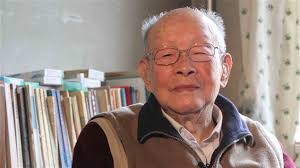
Zhou Youguang

Pinyin Alphabet
This is the story of how an “amateur” with courage and passion can change a huge nation and enhance the lives of many millions of ordinary people.
Zhou Youguang, father of Pinyin, died last Saturday in Beijing. He was 111 (one hundred and eleven)!
Here is his story. We can learn a lot from it.
But first – what is pinyin? Pinyin in Chinese means “spelled sounds” – i.e. phonetics. Pinyin is simplified Chinese, or “Romanized” Chinese. What is Romanized? It is “the conversion of writing from a different writing system to the Roman (Latin) script”. Mandarin Chinese has thousands of characters; it is a pictorial language, with a great many symbols or pictures. Learning those characters was well beyond the schooling abilities of ordinary Chinese. And using those characters, it was very hard to spell Western names, or Chinese names, or to use the computer.
There have been many “Romanized” Chinese systems. But Zhou Youguang’s system was by far the best and simplest. How did it come about? The New York Times obituary (Jan. 17) reveals a lot.
He was the son of a prominent family – his father was an official of the last imperial dynasty, the Qing, 17th c. to 1912. Zhou was born in Changzhou. He studied economics at St. John’s University and Guanghua Univ. During the war with Japan he moved to the then-capital Chongqing. There he worked for a bank, and met Zhou Enlai, a star who would become China’s long-time premier, 1949-1976. In 1946 Zhou went to New York to work with China’s Wall St. agent Irving Trust, and returned to China after the Communist take-over in 1949. He taught economics, until Zhou Enlai asked him to head a committee that would alphabetize Mandarin and boost literacy.
“I’m just an amateur,” Zhou said to Zhou Enlai. “Everyone is an amateur”, came the wise response. Pinyin, developed by Zhou, was adopted by the Chinese government in Feb. 1958. It met rapid acclaim, and brought literacy to millions. It also saved Zhou’s life. Chairman Mao was very suspicious of economists, jailed many of them, and with Zhou’s U.S. Wall St. background, would likely have been jailed for many years (a friend of his was jailed for 20 years and committed suicide), had it not been for his Pinyin fame. Zhou himself spent years in a labor camp, like many Chinese intellectuals.
Today Chinese schoolchildren first learn to read by the pinyin system before graduating to studying characters. China’s illiteracy rate is only 5 per cent! Around the world, foreigners study Chinese through the pinyin system.
What do we learn? First, Zhou was passionate about language, and curious about it. He leveraged this into an outstanding innovation, perhaps because he was not a professional linguist, and hence able to simplify. He was willing to try, despite lacking academic credentials. He pursued his passion. Second, optimism. “When you encounter difficulties, you need to be optimistic”, he told an interviewer. “Pessimists tend to die.”
This echoes the famous story about the two wolves within us: Fear and Hope. Which wolf wins? The one you feed….
Charles Feeney: James Bond of Philanthropy
By Shlomo Maital
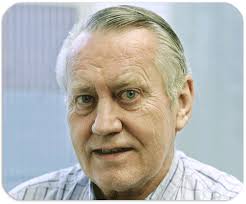
Charles Feeney
I doubt readers have ever heard of Charles Feeney. Today’s New York Times tells his amazing story. It deserves to be widely known and imitated.
Feeney will be 86 years old on April 23. Wikipedia recounts: He was born in New Jersey during the Great Depression and came from a modest background of blue collar Irish-American parents in Elizabeth, New Jersey. His ancestry traces to County Fermanagh in Northern Ireland.
He served as a U.S. Air Force radio operator during the Korean War, and began his career selling duty-free liquor to US naval personnel at Mediterranean ports in the 1950s. He attended Cornell University on the GI bill, and in 1960, based on his navy experience, set up a company that sold duty-free items to travelers. It became a booming success. He used some of his money to invest cleverly in high-tech startups, like Facebook, Priceline, E-Trade, Alibaba and Legent.
But Feeney’s story is not about another successful entrepreneur. In 1984 he founded Atlantic Philanthropies, a collection of foundations – without revealing he was the benefactor – and transferred all his billions to it, and promised to shut it down, after giving away his entire fortune, $8 billion. Five years ago, he still had $1.5 b. left. Would he succeed, before his passing? Yes. It is now officially all gone.
And Feeney? He lives modestly with his wife, in a rented New York apartment. He flies economy class. He eats in diners. He left himself $2 million.
I have a somewhat personal link to Feeney. As a Cornell alum, he gave a huge sum, $350 m., to fund the Cornell-Technion project that will create a new high-tech university on Roosevelt Island, in Manhattan.
His philanthropy has been effective. One of his grants proposed reforms to America’s healthcare system, which led to the Affordable Care Act. And Feeney has scrupulously avoided any limelight – his backing of the Atlantic Philanthropies was revealed against his wishes. His secretiveness led to the “James Bond” appellate.
The New York Times article uses the story of Feeney to provide a backhanded slap at Donald Trump, who typifies the diametric oppositse of everything Charles Feeney stands for and accomplished.
Innovate Your Business – Not Just Your Product
By Shlomo Maital

Psychologists sometimes use a ‘word association’ approach. Say a word. What comes to your mind first?
Say, “innovation”. Do you picture a gadget? A product? Most of us do.
But what about all the other areas, where fresh ideas are needed? What about the way you make things, the way you sell and market them, the way you motivate your workers – and in general, the way you design and run your business.
Business design and operations are, for many innovators, a dark corner. No light shines there.
Among experts, there is controversy. Guy Kawasaki, the marketing guru of Apple’s Macintosh, founder of garage.com, and author of Art of the Start, claims that creativity is vital for innovative products but when it comes to designing the business to implement them, stick to conventional white-sliced-bread methods.
We disagree. Business design innovation can bring bigger dividends that product innovations, which often fail. If you can build a unique innovative business design around an existing product, you can win big.
Here are four examples.
* Mobileye is a Jerusalem-based global company selling warning systems for vehicles, founded in 1999. Founders Amnon Shashua and Ziv Aviram raised money innovatively, unconventionally, by avoiding venture capital and appealing to a list of wealthy people interested in high-tech. Those investors proved far more patient than VC’s and enabled Mobileye to take nearly 8 years to develop its product, ready in 2007. Mobileye now has annual global sales of $350 m., and a profit margin of some 60 per cent.
* Netscape provided the world with one of the first browsers and its IPO in 1995 led off an enormous dot.com boom. Netscape’s business design was ‘give it away’ – charge zero for the browser. This innovation has since been widely imitated. Netscape’s browser was a powerful marketing device, used by millions, to advance sales of its software products.
* El-Op: this wholly owned subsidiary of Elbit, a market leader in electro-optics, uses a unique approach to innovation – bottom-up. Workers are encouraged to submit ideas to a website, and they are quickly passed on to mid-level managers and the head of operations. In many organizations, innovation is confined to product innovation emerging from R&D departments. This often leads to a false assumption, that ONLY the R&D department has innovation in its job description. At El-Op innovation is part of the job description of every worker. Moreover, research has shown that process innovation – innovation in operating procedures – is far more profitable and pays a far higher ROI, return on investment, than product innovation, because new products often fail when introduced to the market. At El-Op, many hundreds of ideas emerging from line workers have saved the company millions of dollars over the years.
* Toyota: This leading automobile company introduced just-in-time in its manufacturing process. Until then manufacturers stockpiled mountains of components in advance. Toyota asked, why? Why not have the components delivered just in time to use them in production? Why not eliminate costly component warehouses? The cost saving and efficiency gains were enormous. This innovation was based on challenging a conventional assumption.
What we learn from this is simple. Innovate everywhere, everything, all the time. Make fresh new ideas part of the job description of every worker. Listen carefully especially to workers who are “at the coal face” (where the coal is mined), because they are the ones who really know what is going on and what needs to be changed. Make sure that each fresh idea is acknowledged, read, studied, tested and either implemented or shelved for some future date, and that the person who proposed the idea is updated at every stage. And create an award ceremony for innovators. Just recognizing the creativity is often enough to stimulate it tenfold.
Superager: Start Now!
By Shlomo Maital
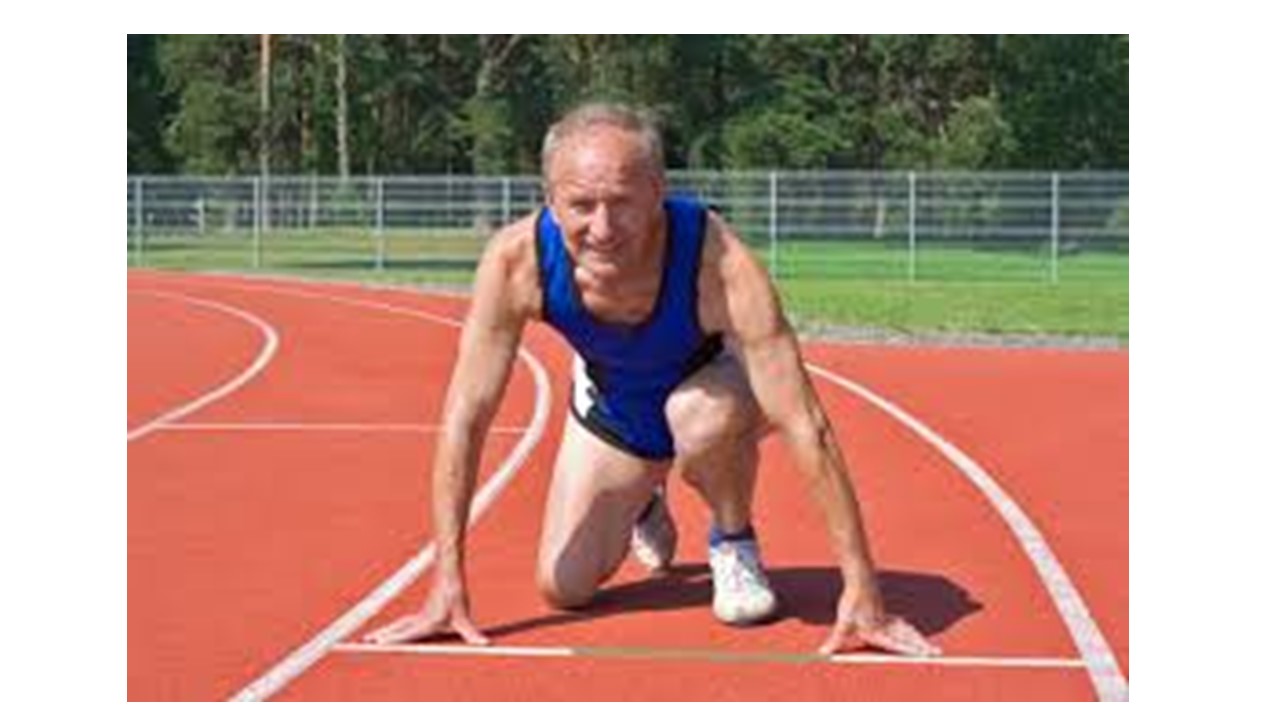
Writing in the International New York Times, Lisa Barrett draws our attention to research on “superagers” – people 65 or older who have remained mentally sharp. Her own research at Mass General defines superagers as those whose cognitive abilities “is actually on a par with healthy active 25-year-olds”. With dementia besetting up to half of those 80 and over, this is important work. And for me, 74, it is highly relevant – full of action items.
Barrett cites research by Marsel Mesulam and colleagues, at Northwestern University and University of Chicago.* Here are the main findings:
“The SuperAgers’ cerebral cortex was significantly thicker than their healthy age-matched peers and displayed no atrophy compared to the 50- to 65-year-old healthy group. Unexpectedly, a region of left anterior cingulate cortex was significantly thicker in the SuperAgers than in both elderly and middle-aged controls. Our findings identify cognitive and neuroanatomical features of a cohort that appears to resist average age-related changes of memory capacity and cortical volume.”
Barrett explains this result. The crucial regions of the brain were “in emotional regions”…not just the cognitive regions. How to stimulate them?
“These brain regions have an intriguing property. When they increase in activity, you tend to feel pretty bad – tired, symied, frustrated. …the Marine Corps has a motto that embodies this principle: ‘Pain is weakness leaving your body’. The discomfort of exertion means you’re building muscle and discipline. Superagers are like Marines. They excel at pushing past the temporary unpleasantness of intense effort. The result is a more youthful brain…”.
So here is the lesson, not only for seniors but for all of us. Engage in “intense effort”, push yourself from time to time. Do it sometime just for the exercise. Push through the discomfort. And recognize that in doing so, you’re not only building your biceps, but also your lateral prefrontal cortex (where, by the way, ideas are born, and imagination flourishes).
In short: Even if you are older, even if those around you spoil you because you have grey hair, even if young people offer you seats on the bus or train… do NOT spoil yourself. It’s so easy to do so. Do NOT pamper yourself. It’s tempting to do so. Go that extra mile, do that extra rep. And by the way – don’t just sit around doing Sudoku puzzles either. It takes more than that.
Thanks, Dr. Barrett. We’re starting right now.
“Superior Memory and Higher Cortical Volumes in Unusually Successful Cognitive Aging,” by Theresa M. Harrison, Sandra Weintraub, M.-Marsel Mesulam, and Emily Rogalski , J. Int Neuropsychol Soc. 2012 Nov; 18(6): 1081–1085.
The Mice and Rats Are Winning
By Shlomo Maital

A fierce ongoing war is being waged, between humans and rats. And guess who is winning? The rats. The animal kind, not the human kind.
Writing in The Guardian, Sept. 20, Jordan Kisner has some interesting and little-known facts about rats.
* “A male and female left to their own devices for one year – the average lifespan of a city rat – can beget 15,000 descendants.” That is partly why they are winning. The more we kill them, the more they reproduce (birth rates rise when the rat population declines)..and man, can they reproduce. And like humans, they have sex for fun, too – 10 times a day.
* “How is it that we can send robots to Mars and yet remain unable to keep rats from threatening our food supplies? Still, here they are. According to Bobby Corrigan, the world’s leading expert on rodent control, many of the world’s great cities remain totally overcome. “In New York – we’re losing that war in a big way,” he told me.”
* “Frankly, rodents are the most successful species,” Loretta Mayer told me recently. “After the next holocaust [nuclear war], rats and Twinkies will be the only things left.” Mayer is a biologist, and she contends that the rat problem is actually a human problem, a result of our foolish choices and failures of imagination. In 2007, she co-founded SenesTech, a biotech startup that offers the promise of an armistice in a conflict that has lasted thousands of years. The concept is simple: rat birth control.”
How does rat birth control work?
“SenesTech, which is based in Flagstaff, Arizona, claims to have created a liquid that will do exactly that. In tests conducted in Indonesian rice fields, South Carolina pig farms, the suburbs of Boston and the New York City subway, the product, called ContraPest, caused a drop in rat populations of roughly 40% in 12 weeks. This autumn, for the first time, the company is making ContraPest available to commercial markets in the US and Europe. The team at SenesTech believes it could be the first meaningful advance in the fight against rats in a hundred years, and the first viable alternative to poison. Mayer was blunt about the implications: “This will change the world.” “
SenesTech administers the rat birth control pill through liquid. “ After a series of tests, they quickly settled on a liquid, rather than solid, formulation. Rats have to drink 10% of their body weight every day to survive, and so are always looking out for something potable. “We compared the [two] and they peed on the solid and drank the liquid,” Dyer told me. “Rats are pretty straightforward.” “
Rats have evolved over many many thousands of years. They are perfectly designed for survival in hostile environments. They are tough as nails. And they are winning. They are, as Mayer herself put it, a more successful species than us. Long after we’re gone, they will still be here. Best we can do? Make them practice family planning….