
You are currently browsing the category archive for the ‘Global Crisis Blog’ category.
Can You Focus On This – for 8 Seconds?
By Shlomo Maital
Technology is changed and adapted by human thought. But the process is circular — technology also changes human thought and behavior. For instance, the rapid-fire images of MTV music videos, which change several times a second, caught on with young people. Same with smartphones – texting, without verbs and nouns, with emojis. Instant. Fast.
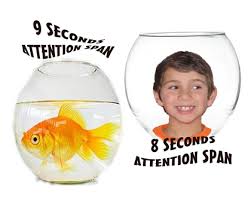
A study of Canadian media consumption by Microsoft, quoted in Timothy Egan’s New York Times Op-Ed (Jan 23-24/2016) found that the average attention span (“the amount of concentrated time on a task without becoming distracted) has declined from 12 seconds in the year 2000, to 8 seconds in 2015. “We now have a shorter attention span than goldfish”, Egan quotes the study.
Here at my university Technion, Sarah Katzir, who interacts with students daily, recently spoke about this ever-shorter attention span as a major problem for university instructors. Students simply are not able to stay focused for an entire 50 – minute class. And when instructors ban their use of smartphones in class, there is an outcry heard throughout my country.
“Our devices have rewired our brains,” Egan notes. “The trash flows, unfiltered, along with the relevant stuff, in an eternal stream. And the last hit of dopamine only accelerates the need for another one.” In other words – our ever-shorter attention spans are actually a kind of addiction, a need for a shot of ‘dopamine’ at ever-shorter intervals, from some new stimulus.
Antidotes? Egan has two. First, gardening. “Working the ground, there is no instant gratification”. Planting, he notes, forces you to think in half-year increments, at least. Second, deep reading. Curl up with an 800-page tome. Try, Gibbon’s history of the Roman empire. Will Durant’s history of the world. Or, Egan’s choice, William Manchester’s massive biography of Winston Churchill. Each of us can fight that short attention span, and at the least, become as focused as… goldfish.
Read This Blog — Tomorrow
By Shlomo Maital

There are two personality styles, for dealing with pressing tasks. One – reduce the tension, stress and anxiety they cause, by getting them done, now and quickly, and end the source of the stress. Two – reduce the tension, by putting off the task, “I’ll do it tomorrow”, procrastinate, and basically shove the task under the carpet.
Which one is you? Me? I’m the first. I do things now, quickly, often rather poorly, just to get rid of that nagging tension, that something HAS to be done, often something not pleasant. I think of myself as a creative person. But it turns out, according to U. of Pennsylvania Wharton School Professor Adam Grant, writing in The New York Times, procrastination may HELP creativity, not hinder it. Here is his argument:
So Jihae, now a professor at the University of Wisconsin, designed some experiments. She asked people to come up with new business ideas. Some were randomly assigned to start right away. Others were given five minutes to first play Minesweeper or Solitaire. Everyone submitted their ideas, and independent raters rated how original they were. The procrastinators’ ideas were 28 percent more creative. Minesweeper is awesome, but it wasn’t the driver of the effect. When people played games before being told about the task, there was no increase in creativity. It was only when they first learned about the task and then put it off that they considered more novel ideas. It turned out that procrastination encouraged divergent thinking.
Our first ideas, after all, are usually our most conventional. My senior thesis in college ended up replicating a bunch of existing ideas instead of introducing new ones. When you procrastinate, you’re more likely to let your mind wander. That gives you a better chance of stumbling onto the unusual and spotting unexpected patterns. Nearly a century ago, the psychologist Bluma Zeigarnik found that people had a better memory for incomplete tasks than for complete ones. When we finish a project, we file it away. But when it’s in limbo, it stays active in our minds.
So, hey! Why do today what you can do tomorrow? Tomorrow – you may have far better ideas for doing it. If you’re already a procrastinator… enjoy! You’re on the right track.
p.s. faithful Timnovate readers: the long silence, since Jan. 9, is not because I procrastinated. My wife and I have practiced what we preach, and have innovated in our personal lives – we’ve moved our household lock stock and barrel from Haifa, from the house we lived in for 35 years, to a community south of Haifa, where we found new friends and new adventure. So far, the leap of faith is proving to be wonderful….
2016: Two Key Inflection Points
By Shlomo Maital
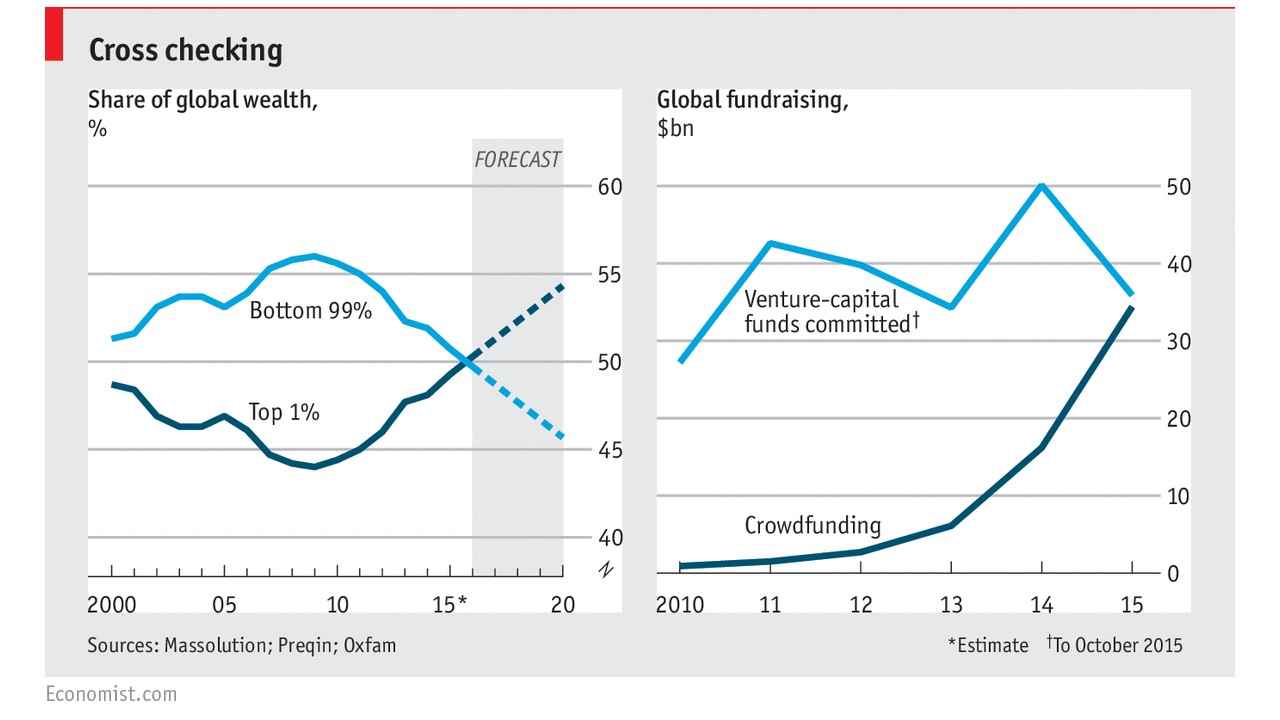
Two key inflection points (points implying major change) will occur in 2016, according to The Economist’s very interesting graphic. (see above).
First, for the first time, in a very long time, the world’s wealthiest one percent will hold a larger share of total world wealth than the bottom poorest 99 percent, and by 2020, that share of the wealthy will grow rapidly, to 55 per cent! This is a key ‘inflection point’ (point at which major changes occur), because I cannot imagine that it will bring anything but unrest and instability in the world, as the wealthy leverage their wealth to tilt political decisions and policies in their favor. Indeed the graph’s sub-text is precisely that – wealth perpetuates itself.
Second, also for the first time, crowdfunding, as a source of funds for startups and new ventures, will catch and exceed conventional venture capital. This is a major disruptive change for the large VC industry, and it is a change that has happened with incredible rapidity – from zero crowdfunding, essentially, in 2010, to $35 billion in 2015. It implies a different business model for startups, which now must tailor their messages more toward “crowds” than toward perspicacious (and sometimes, supercilious) venture investors. Along with the rise in crowd-funding comes the rise in angel investments, funded by wealthy people who are willing to take bigger risks with their money (and achieve higher returns) than with conventional financial assets.
These two changes have each occurred with great rapidity and will change our world, one perhaps for the better, one for the worse. They are worth watching closely.
What other inflection points have you noticed in 2016?
McKinsey: Testing for Innovation
By Shlomo Maital
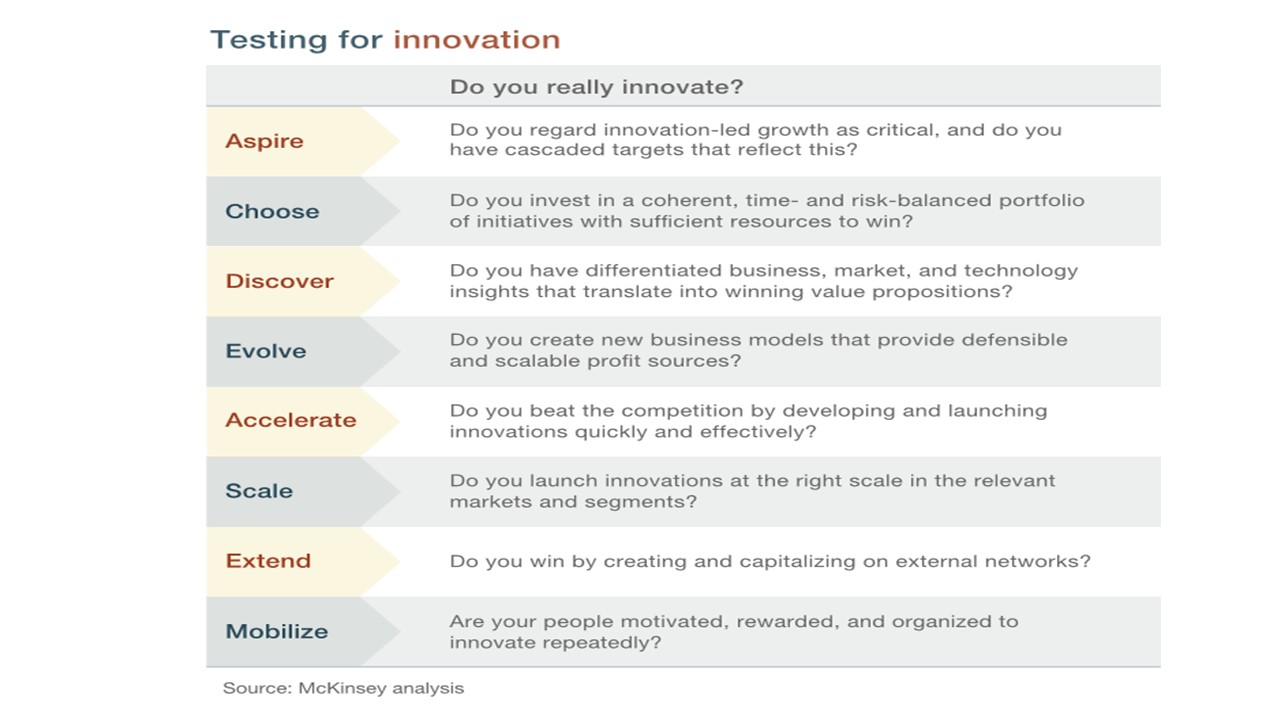
McKinsey Global Research April 2015 has circulated a lovely article on Innovation: “The eight essentials of innovation” by Marc de Jong, Nathan Marston, and Erik Roth. It includes a short self-test for you and your organization. Their key point: (often repeated in this space): “Since innovation is a complex, company-wide endeavor, it requires a set of crosscutting [and at times paradoxical] practices and processes to structure, organize, and encourage it.”
Here are the eight questions you should ask:
- ASPIRE Do you regard innovation-led growth as critical and do you have cascaded targets that reflect this? Yes/No
- CHOOSE Do you invest in a coherent time- and risk-balanced portfolio of intiatives with sufficient resources to win? Yes/No
- DISCOVER Do you have differentiated business, market and technology insights that translate into winning value propositions? Yes/No
- EVOLVE Do you create new business models that provide defensible and scalable profit sources? Yes/No
- ACCELERATE Do you beat the competition by developing and launching innovations quickly and effectively? Yes/No
- SCALE Do you launch innovations at the right scale in the relevant markets and segments? Yes/No
- EXTEND Do you win by creating and capitalizing on external networks?
- MOBILIZE Are your people motivated, rewarded, and organized to innovate repeatedly?
Score yourself and your organization. Six out of 8 or above? You’re an innovator. Five and below – you need to make some urgent changes.
Global Uncertainty: Lifting the Fog?
By Shlomo Maital

Bilahari Kausikan
When I want some help in understanding what in the world is going on, I turn to my friend Bilahari Kausikan, Ambassador at Large in the Singapore Foreign Ministry, and until recently Permanent Secretary. Bilahari has met world leaders in person, and is an independent thinker. Here is Bilahari’s ‘take’ on the global fog, in an essay for Nikkei Asian Review:
The problem: “The 21st century global order is becoming more uncertain. The Cold War of the last century had one virtue: structure. The threat of nuclear annihilation focused that structure with stark clarity. Today, we still have danger — although of a lesser magnitude — but without structure or clarity. No one really knows what will replace the Cold War as a frame of reference. More than a quarter of a century has passed since the Berlin Wall was torn down, but we still call that period the “post-Cold War era.” Ours is an age without definition. Without a global structure, there can be no leadership. Without leadership, many urgent issues will be left unresolved or dealt with unsatisfactorily, exacerbating uncertainties.”
What made it worse: “There was a brief post-Cold War unipolar moment, during which the West seemed to define the world alone. The illusions that flourished in this short period were immensely damaging, particularly in the Middle East, where the interventions that destroyed the existing regional order were justified by the illusion of the universality of certain interpretations of democracy and human rights. The disintegration of first Iraq and then Syria shattered the regional balance. Chaos in the Middle East has global ramifications that will play out for many years to come. But the illusion of universality has not yet been discredited and still contributes to the difficulties of establishing a new, stable global order. Notwithstanding loose talk about multipolarity, the U.S. is still dominant in most indices of power. But the U.S. clearly needs help to exercise leadership, as it did during the Cold War.”
So who will step up to help the U.S.? Europe? Forget it. “The region is tangled in knots of its own making” (the worst kind!). BRICS? “Not much unites the BRICS except a vague dissatisfaction with the existing order and the desire for greater recognition of their status. But they are not all equally dissatisfied, and the sources of their discontent are not identical.” China? “China has neither the capacity nor the interest to do so, even in East Asia, its backyard, where Beijing is assertively pursuing a role that is in accordance with what it believes was its historical position and what it believes are its territorial rights. President Xi Jinping’s “One Belt, One Road” strategy is an ambitious vision of a Sino-centric transcontinental order. Can the vision be fully realized? Can China be “contained”? Should it? Does the vision require the U.S. to be displaced from East Asia? There are as yet no clear answers. The fact is that neither the U.S. nor China really know what they want from each other, even as they each seek a new modus vivendi. The strategic mistrust that permeates the Sino-U.S. relationship, which is rooted in the universalist illusions of the U.S. on the one hand and Beijing’s triumphalist nationalism on the other, do not make the search for accommodation any easier.”
Confusing? Ambiguous? Uncertain? Even, dangerous? Indeed. But at least, Kausikan helps us understand why. And who will do best in this confusion?
“The successful will be those who have best learned to live with uncertainty.” And that uncertainty, globally, will be with us for a very very long time.
Creativity: Resolving 6 Paradoxes
By Shlomo Maital
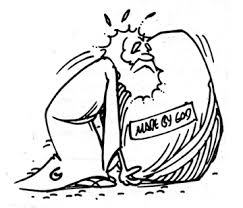
Can God make a stone so heavy God cannot lift it?
A barber shaves all those in the village who don’t shave themselves. Who shaves the barber? (Kurt Goedel).
These are examples of paradoxes: 2 propositions, sometimes wrapped into one sentence, that are internally contradictory. There is even a fifty dollar word for it: oxymoron. E.g. military intelligence.
Creativity is often a matter of two things that conflict, and a creative individual who is able to integrate and combine them. And innovation, as a process, often embodies such paradoxes. Here are six of them, drawn to my attention by a colleague, Prof. Ella Miron-Spektor.
* Passion vs. Profit: Innovation is driven by passion, as its rocket fuel. But if you focus solely on passion, ignore the hard reality of profit, you cannot build a sustained business. How to resolve?
* Huge hairy challenges vs. build self-confidence: Innovation builds on huge hairy challenges. But, frequent failure ruins self-confidence, the key resource of creative people.
* Personal empowerment, initiative, vs. Shared goals: Ideas come from individuals, who are highly motivated. Yet delivery of ideas is done by teams, who need shared goals, where the individual personality is submerged.
* Diversity vs. cohesion. Diverse teams work best. Yet cohesion is vital for delivery of ideas.
* Learn from history vs. Detach from the past. You need to learn from the past. But you also need to forget the past, in order to create the future.
* incremental vs. radical innovation: you need to make small improvements to existing things; but you also need to reinvent entire product categories or industries.
And of course, there is another paradox, that overarches the other 6: novelty vs usefulness. Creative ideas are novel, new. But they have to be useful. And what people find useful is what they know, what is familiar. This is very hard to overcome.
Innovator: How can YOU resolve these paradoxes? Find a creative way to do so, and make it a key part of your innovation process. Above all – be aware these paradoxes exist, have to be managed, and have to be somehow resolved, without destroying either of the key two propositions.
Why Migrants Are an Undervalued Resource
By Shlomo Maital
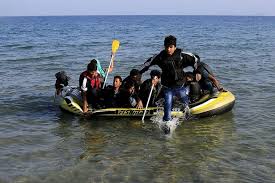
My mother and father, grandmother, aunts and uncles, all were migrants. They came from Bessarabia, now Moldova, escaping pogroms, grinding poverty, and seeking a new life in Canada and America a century ago. Canada’s relatively open policy gave them new lives and eventually made Canada prosperous, through their energy and the energy of other migrants. And their offspring have done great things for their country. My father, for instance, built low-cost houses for working people.
Today, Europe faces one million Mideast and African migrants during 2015. Public opinion has largely turned against them. The brutal homicidal use of ISIL of the Syrian migrant pipeline to smuggle in a terrorist has done enormous damage to a great many peaceful Moslems, but what does ISIL care?
What evidence is there that migrants are constructive? NYT columnist David Brooks draws our attention to an essay by Malcolm Gladwell, in the New Yorker, Aug. 24 2015 (awarded Brooks’ prize for one of the year’s best essays). It’s called Starting Over. It’s about sociologist David Kirk, driving around a very poor neighborhood in Post-Katrinia hurricane New Orleans, and wondering:
“As Kirk drove around the Lower Ninth, however, he realized that post-Katrina New Orleans [Katrina destroyed much of New Orleans in late 2005, a decade ago] provided one of those rare occasions when fate had neatly separated the two variables. In the course of bringing immeasurable suffering to the people of New Orleans, Katrina created what social scientists call a “natural experiment”: one day, people were in the neighborhoods where they had lived, sometimes for generations. The next day, they were gone—sometimes hundreds of miles away. “They had to move,” Kirk said. What, he wondered, were the implications of that?
In other words: How productive are migrants who get up and move, far away, compared to those who stay, in New Orleans? Simple answer. Migrants do far better than those who stay mired in the same poverty context.
Kirk’s idea was to look at convicted criminals from New Orleans who had been released from prison after Katrina. As a group, they were fairly homogeneous: largely black, largely poor. For years, their pattern was to return to their old neighborhoods after they were released: to their families, homes, social networks. But for some, by the most random of circumstances, that was now impossible. Their neighborhoods—the Lower Ninth, New Orleans East—had been washed away. How did the movers compare with the stayers?
Gladwell cites distressing evidence that black Americans born in poor neighborhoods are stuck there, contrary to the ‘American dream’ of upward mobility: “Over the past two generations, 48 percent of all African American families have lived in the poorest quarter of neighborhoods in each generation. The most common experience for black families since the 1970’s, by a wide margin, has been to live in the poorest American neighborhoods over consecutive generations. Only 7 percent of white families have experienced similar poverty in their neighborhood environments for consecutive generations.”
One of the researchers, named Graif, found compelling evidence that those who moved from New Orleans poverty did far better than those who stayed, despite the traumatic circumstances.
“I think that what’s happening is that a whole new world is opening up to them,” Graif said. “If these people hadn’t moved out of the metro area, they would have done the regular move—cycling from one disadvantaged area to another. The fact that they were all of a sudden thrown out of that whirlpool gives them a chance to rethink what they do. It gives them a new option—a new metro area has more neighborhoods in better shape.” That is, more neighborhoods in better shape than those of New Orleans, which is a crucial fact. For reasons of geography, politics, and fate, Katrina also happened to hit one of the most dysfunctional urban areas in the country: violent, corrupt, and desperately poor. A few years after the hurricane, researchers at the University of Texas interviewed a group of New Orleans drug addicts who had made the move to Houston, and they found that Katrina did not seem to have left the group with any discernible level of trauma. That’s because, the researchers concluded, “they had seen it all before: the indifferent authorities, loss, violence, and feelings of hopelessness and abandonment that followed in the wake of this disaster,” all of which amounted to “a microcosm of what many had experienced throughout their lives.”
Here is the surprising conclusion. We can learn about Mideast and African migrants from similar American migrants. They are resilient. They overcome the enormous trauma of their original homes. They do better than if they had stayed home, because nearly any place is better than that. And, they contribute massively to their new homes, as productive energetic families desperate to build better lives for their children. Like my family did.
In America, people can move anywhere they wish. In Syria, they risk their lives to get to Europe, where they are herded into camps for years, even though no native Europeans will do the kind of hard labor these migrants gladly seek.
Will anyone pay attention to sociological evidence? Or will Europe listen to the hate-mongerers on the right, and vote their emotions and fears. Can anyone translate Gladwell’s essay into language the Europeans will read and listen to?
Why Honey Bees Are Smarter Than People
By Shlomo Maital

My blog has been silent for some time; I was unable to upload blogs to WordPress.com during a 10-day visit to China. I’ve returned with many ideas for blogs in my suitcase, and will soon catch up and zero the deficit.
On the long flight from Hong Kong to Tel Aviv, 12 hours, I reread Thomas Seeley’s wonderful book Honeybee Democracy. Seeley is a biology professor, passionate about understanding bees, and his research has revealed startling insights into bees.
One of those insights is that bees, which have tiny tiny brains, are smarter than humans, when it comes to making decisions – because they do so cleverly, as a ‘swarm’ or group. Bees’ brains are about 20,000 times less massive compared to human brains. It is the size of one sesame seed. The honey bee brain is actually ten times denser compared to a mammal’s brain. It can do amazing things, like calculate distance and angles and direction and return to a nest site or flower site miles away.
Bees, sometimes 10,000 of them, gather in a ‘swarm’, a mass of bees hanging together in one spot. Scout bees travel far and wide, often several kilometers, and return to report to the ‘nation’ of bees on prospective sites. Seeley tells how these scouts report on their findings, by doing a dance. The dance tells the other bees whether the site is great (big, 40 liters, small entrance) or just adequate (15 liters, big entrance). If great – the dance is rapid, vigorous, compelling. If adequate – the dance is, well, a slow waltz. Several such scouts dance. The other bees watch.
Then – little by little, the other bees join the dance they favor. Eventually, and it doesn’t take long, the swarm reaches a whole-swarm consensus on the prospective site and then, as if on a signal, takes off, in just 60 seconds, and flies to the new site, where the nest is built, honeycombs erected, honey stored, and the queen bee sets up her throne and baby factory.
But why are the bees smarter than humans? Two reasons. First – dissent, then commit. That actually is a widely-used mantra at Intel Corp., where fierce debate is cultivated (like the scout bees), but then – everyone must commit to the final decision, wholeheartedly.
But even more important – the dancing scout bees convey information to the other bees, that includes intensity. That is, here is where a new site is, here is what it looks like, and here is how enthusiastic I am about it. Other bees join in, to show THEIR enthusiasm, by the rapidity of their dance. Human democracy is a zero-one process, where you vote for a candidate. But what aobut how much you like the candidate? Is it a “1”? a “5”? or a 10? Who knows? No way to tell. Bee democracy includes intensity, not just zero-one choice.
The bees use intensity of emotion. Humans do not. How many times do we vote for a candidate while holding our nose, because he or she is the best of a really bad lot of losers. What if we could indicate this in the democratic process? What if we voted for a candidate, and added 1-10 how much we liked him or her? Then added up both the intensities and the votes, perhaps by weighting?
Humans retain their views, after the election, and as the Republicans, do everything possible to sabotage the elected Democratic President and his plans. Bees always form a consensus; they have a process that usually ensures it. In rare occasions where swarms split into two, and go off to two different sites, they often don’t survive.
Seeley writes, “one valuable lesson we can learn from the bees is that holding an open and fair competition of ideas is a smart solution to the problem of making a decision, based on a pool of information dispersed across a group of individuals.”
I watched the Republican Presidential debate while in China. Open competition of ideas? Ideas? Not one. Donald Trump? Ted Cruz? Dispersed across a pool of individuals? Tea Party? Makes one yearn for the little dancing bees, waggling their behinds.
Living with Generation Y
By Shlomo Maital
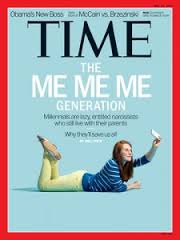
Yesterday I made a short presentation at a one-day Technion conference on Technology, Education and Society. My main thought was: How can we leverage the Internet of Everything, rapidly emerging, where everyone, everything are connected all the time, everywhere..to benefit college students?
An excellent presentation was made by the Technion’s head of student advancement, Sarah Katzir, who has been in this post for over 30 years. She recounted her experiences in dealing with Gen Y students. She had three interesting insights about Gen Y:
- Gen Y is impatient. They do not tolerate uncertainty well, and lack emotional strength to accept situations that are vague, ill-defined, or even chaotic. They seek fast solutions, a silver bullet, to situations involving discomfort. This is the generation of speed. They consume rapid MTV images, and want things to move quickly, especially, solutions to their problems.
- Multi tasking: Gen Y is perpetually multi-tasking. In the Technion computer farm, where students spend much time, it is common to see them doing homework, following news on the Internet, sending SMS messages, Tweeting, writing their blog, and more. All at the same time. Their attention span, as a result, is very short. It is hard to instructors to hold their attention for 30 minutes, let alone for 45. They read rapidly, but on the surface, lacking in – depth understanding.
- Individual learning is now group learning. Even when Gen Y studies alone, they do it ‘together’ with ours, via smartphones. Learning is done within chat forums. Being alone is no longer necessary, because through smartphones and other technologies, Gen Y is always always connected with others. SMS is their mode of choice for communicating. Their thumbs are incredibly agile as a result.
At the conference, one of my colleagues noted that Gen Y has many advantages. Their discomfort with being uncomfortable leads to rapid creative solutions to problems.
And Gen Z? The new generation coming along? What will they be like? I’m looking for some good answers.
Shape Your Child’s Future
By Shlomo Maital
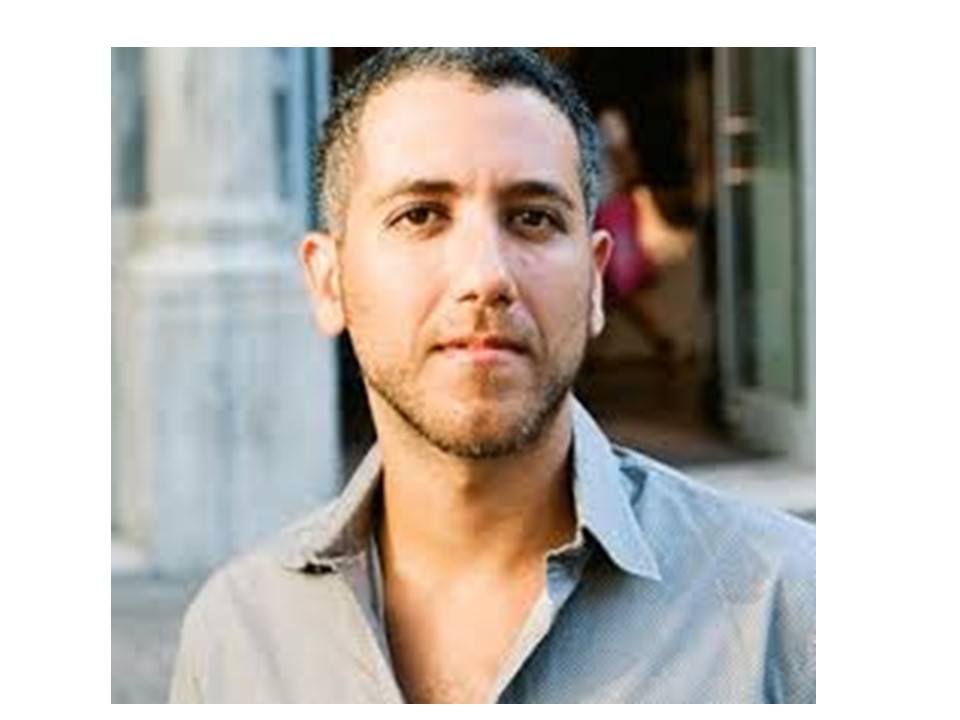 Offir Dagan
Today’s New York Times has a lovely story about Offir Dagan, a choreographer and artistic director for dance training, in Tel Aviv.
When he was 5, he recounts, his parents removed the insides from an old black and white TV set and turned the wooden case into a puppet theater for their son.
That gift, he recounts, put Offir onto a career path. He is now 36. “My parents understood what I wanted,” he recounts. Because it was inside a TV set, it was more than a puppet show, it was inside TV, people wanted to watch what was inside it.
Dagan acted out stories with puppets his grandmother made for him. One was a green cactus made from corduroy.
For his 10th birthday, Dagan got a real puppet theatre, made especially by a carpenter. He enjoyed putting on puppet shows at birthday parties.
Today he still teaches puppetry and how to manipulate puppets, sometimes in theaters.
“I thought my parents never really supported my artistic side,” Dagan says. “But now this makes me realize they did.”
We parents and grandparents need to be attentive to our children’s and grandchildren’s true interests and passions, and foster them, offer them ways to develop those talents. The result can be life-changing.


