
You are currently browsing the category archive for the ‘Global Crisis Blog’ category.
The Limitations of Ltd. Companies: An Insurgency
By Shlomo Maital

One of the great social innovations that made possible rapid economic growth and progress was that of the limited liability company. The idea began in England and spread to America. By limiting what you lose in starting a business, many were encouraged to do so. According to Wikipedia:
“By the 15th century, English law had awarded limited liability to monastic communities and trade guilds with commonly held property. In the 17th century, joint stock charters were awarded by the crown to monopolies such as the East India Company. The world’s first modern limited liability law was enacted by the state of New York in 1811. In England it became more straightforward to incorporate a joint stock company following the Joint Stock Companies Act 1844, although investors in such companies carried unlimited liability until the Limited Liability Act 1855.”
Is it possible that public companies have outlived their usefulness? An article in The Economist, “Reinventing the company”, makes this point.
“…after a century of utter dominance, the public company is showing signs of wear. One reason is that managers tend to put their own interests first. The shareholder-value revolution of the 1980s was supposed to solve this by incentivizing managers to think like owners, but it backfired. Loaded up with stock options, managers acted like hired guns instead, massaging the share price so as to boost their incomes”
“In insurgent companies, by contrast, the coupling between ownership and responsibility is. Founders, staff and backers exert control directly. It is still early days but, if this innovation spreads, it could transform the way companies work.”
Here is an example of an insurgent company – a huge one, Alibaba, founded by Jack Ma in 1999 – a Chinese public company, of all things, listed in America.
“In June, Jack Ma, the founder of Alibaba, a giant Chinese e-commerce firm, addressed the Economic Club of New York, whose members include many Manhattan luminaries and Wall Street chiefs. Mr Ma’s message was that his company exists for the long-term good of society, a far cry from the creed of shareholder value followed by many in the room.”
Run that by us again? Alibaba exists for the long-term good of society? Alibaba wants to help millions of small American businesses sell their goods globally? (How come AMERICAN companies haven’t said the same, or done the same??).
U of Chicago Professor Milton Friedman and his group of free-market economists fiercely criticized companies that donate money to charity, saying the money belongs to shareholders, and is not the company’s to give away.
We have seen where THAT kind of capitalism leads. Perhaps capitalism is evolving, in a positive direction, after all.
How to Cope with a VUCA World
By Shlomo Maital

What in the world is a VUCA world? VUCA is an acronym, standing for volatility, uncertainty, complexity, and ambiguity . And daily, the world seems determined to prove how increasingly VUCA it is!
This is why, in this blog, I write so often about discomfort, ambiguity, chaos and how we relate to them all. In the latest Scientific American, Gareth Cook interviews author Jamie Holmes about his new book Nonsense: The Upside of Ambiguity. Here are some excerpts from what Holmes observes:
Moments of confusion can be pretty memorable, and not in a good way. How is this thing supposed to work? What is the teacher’s point? Where am I, and how do I get to where I am going? But confusion is greatly underrated, argues the journalist Jamie Holmes in his new book, “Nonsense.” Naturally, it is good to understand. Yet, Holmes writes, our discomfort with not knowing can lead us astray — to bad solutions, or to brilliant options never spotted. If we could learn to embrace uncertainty, we’d all be better off — and better prepared for modern life.
In hiring, for instance, a high need for closure (a clear firm yes/no decision) leads people to put far too much weight on their first impression. It’s called the urgency effect. In making any big decision, to counteract that, it’s not enough just to know that we should take our time. We all know that important decisions shouldn’t be rushed. The problem is that we don’t keep that advice in mind when it matters. Before making important decisions, write down not just the pros and cons but what the consequences could be. Also, think about how much pressure you’re under. Are you tired or feeling rushed? If your need for closure is particularly high that day, it’s even more important to be deliberate.
I absolutely agree. Never EVER let pressure from others rush your decisions. Take a deep breath. Say to yourself, YOUR crisis is not necessarily MY problem.
Holmes: “One area where there is more and more interest in ambiguity is among entrepreneurs and businesspeople, simply because the future in many business sectors is highly ambiguous. Earlier this year, Thomas Friedman had an op-ed about disorder in the business world (“Chaos is the New World Order”, see my blog on this) where he highlighted just how disruptive the business models of Uber, Facebook, Alibaba, and Airbnb are. Uber is the biggest taxi company in the world, he pointed out, yet has no cars. Facebook doesn’t create media, Alibaba has no inventory, and Airbnb doesn’t own the real estate it uses. So the communication platforms we’re using are revolutionizing a range of industries.”
In our schools — do we equip our children to deal with a VUCA world? Or is the world we create for them one of canned tests with right and wrong answers, where you must not be wrong ever? If the world is grey, rather than black and white, why does that color never appear in our schools?
Lady Gaga – Revisited
By Shlomo Maital

In 2011 and 2012 I blogged about pop singer Lady Gaga twice. Once about her passion and connection with her fans (she records songs after long exhausting performances, capturing the intimate link with her audiences) and once about her foundation. Apparently even serious NYT columnists like Nicholas Kristof and David Brooks share my interest. Today’s International New York Times has a wonderful David Brooks column about Lady Gaga, who was given an award together with Sophia Loren, Herbie Hancock and other main-line celebs.
Lady Gaga’s speech was tearful. She recalled her childhood. “I suppose I didn’t know what I would become, but I always wantedto be extremely brave and I wanted to be a constant reminder to the universe what passions liks like. What it sounds like. What it feels like.”
Brooks expands on what it means to be passionate. “[People with passion] somehow get to the other side of fear. They get beyond that fog that is scary to approach. Once through it they have the freedom to navigate. They opt out of things that are repetitive and deadening. There’s even sometimes a constant recklessness there, a willingness to throw their imperfect selves out into public view while not really thinking beforehand how people might react.”
“Gaga is nothing if not permanently out there; the rare celebrity who is willing to portray herself as a monster, a witch or disturbing cyborg — someone prone to inflicting pain. Gaga is her own unique creature, whom no one could copy.”
I think we can all learn from this flamboyant pop singer known as Lady Gaga (whose real name is Germanotta). Be yourself. Be fearless. Try things. Get through the fog of fear and uncertainty to the otherwise, to the shores of Creativity Land. Be like Gaga. It’s worth a try.
Soft Skills Start in Pre-K
By Shlomo Maital

In 1982, engineers at Carnegie Mellon University, in Pittsburgh, Pennsylvania, built a Coke machine connected to the Internet (or the existing network – Internet did not yet exist), that could report how many Cokes had been sold and how cold they were. This was perhaps the birth of what we know now as the Internet of Everything – everything, everyone, connected, everywhere, all the time, by Internet. By 2025, only 10 years from now, some 25 to 50 billion devices will be connected – cars (self drive), fridges, people, computers, machines, virtually everything.
Great? A new 20 trillion dollar industry? Jobs? Happy people?
Perhaps. But the downside could be, a sharp decline in people’s social skills. When things talk to each other, people need not. And social skills, society, collaboration, community, friendship, helping others, this is what makes us human, what keeps the world more or less together.
Writing in the New York Times, Oct. 18, Claire Cain Miller makes a key point: “Occupations that require strong social skills have grown much more than others since 1980”. Yet cultivating those social skills is on the decline, in schools focused on homework and tests. Increasingly, worldwide, even kindergarten kids are getting homework, instead of time to play. The graph below shows how crucial social skills are in the kind of jobs that are coveted.

We recently visited Touchstone Community School in Grafton, MA. We spoke with Cheryl and Tamara, who teach young children. We shared recess with the kids, and romped in big grassy fields, threw frizbees and learned to do cartwheels. We saw how vital recess, and play, are, for young children. And above all, we saw how easily very young children related to us, strangers, called us by first names (a Touchstone touchstone), asked how we are, what we are doing, and even interviewed us. Those social skills did not just happen. They were cultivated. And they grew especially in playtime, in recess. We saw an older boy play with a wheel device, and a small child stood in front of it. The natural instinct: shove him aside. What the boy did? Gently put his hand on the small child’s shoulder, explain to him that he was in the way, and ask him if he would please move aside. THAT is a social skill. Perhaps as important as knowing 8 times 9 is 72.
Technical skills can be automated, the author notes. But social skills? We have to learn them, make them a part of our social DNA from an early age. Pre-kindergarten is crucial for this. We must do everything to preserve the ‘soft’ skills learned in school, because they are the ones that are ‘hard’ to acquire later, and make us employable.
Nothing is Rotten in Denmark
By Shlomo Maital
 Copenhagen: The Little Mermaid
Shakespeare’s famous line, “something is rotten in the state of Denmark”, from Hamlet, needs amendment. These days, very little is rotten there, and other countries can learn much from it. But are they? Paul Krugman’s latest New York Times column doubts it.
What is Denmark’s story? It is a welfare state with enormous social benefits, that takes care of its children, homeless, ill people, and others. It pays for it with heavy taxes, also on the wealthy, but at the same time maintains a vibrant economy. Here is how Krugman, a Nobel Laureate in Economics, decribes it:
Denmark maintains a welfare state — a set of government programs designed to provide economic security — that is beyond the wildest dreams of American liberals. Denmark provides universal health care; college education is free, and students receive a stipend; day care is heavily subsidized. Overall, working-age families receive more than three times as much aid, as a share of G.D.P., as their U.S. counterparts. To pay for these programs, Denmark collects a lot of taxes. The top income tax rate is 60.3 percent; there’s also a 25 percent national sales tax. Overall, Denmark’s tax take is almost half of national income, compared with 25 percent in the United States. Describe these policies to any American conservative, and he would predict ruin. Surely those generous benefits must destroy the incentive to work, while those high taxes drive job creators into hiding or exile. Strange to say, however, Denmark doesn’t look like a set from “Mad Max.” On the contrary, it’s a prosperous nation that does quite well on job creation. In fact, adults in their prime working years are substantially more likely to be employed in Denmark than they are in America. Labor productivity in Denmark is roughly the same as it is here, although G.D.P. per capita is lower, mainly because the Danes take a lot more vacation. Nor are the Danes melancholy: Denmark ranks at or near the top on international comparisons of “life satisfaction.”
How many times does this have to be said? A nation CAN take care of its people – its unemployed, jobless, skill-less, college students, children, sick, mentally ill – while paying for it through taxes (not deficits), and maintain a happy growing economy. The rich? They will pay taxes and not change their behavior on jot. There is no reason for any political system to pander to the rich, even though they use their funds to buy political influence.
Nothing is rotten in Denmark. Is anybody watching and listening? American conservatives? The last word goes to Krugman:
It’s hard to imagine a better refutation of anti-tax, anti-government economic doctrine, which insists that a system like Denmark’s would be completely unworkable.
Alone with our Phones: the Downside of Cellular
By Shlomo Maital

Will dependence on devices mean we no longer know how to engage, befriend and converse with live humans? Will IoT kill empathy?
In her latest book, Reclaiming Conversation: The Power of Talk in a Digital Age, MIT Professor Sherry Turkle, a sociologist and clinical psychologist, decries the decline of simple human contact.
“We’re talking all the time,” she writes. “We text, post and chat. …Among family and friends, we turn to our phones instead of each other.”
The result? “Our young people would rather send an electronic message than commit to a face-to-face meeting or even a telephone call.” The resulting “flight from conversation” damages what is most human about us – our ability to form relationships, empathize, sympathize, understand, collaborate.
In the world of IoT, will ‘things’ communicate in place of people? And will we as a result lose much of our essential humanity?
The 2013 movie “Her” follows Theodore Twombly, played by Joaquin Phoenix, as he falls in love with Samantha, a computer operating system, whose silky voice is that of Scarlett Johansson. Are we already falling in love with our ‘things’? I am told that depriving teenagers of their cell phones, as a punishment, is regarded by them as life-threatening.
Every new technology has its downside. Cellular technology enables us to communicate with everyone, everywhere, any time, all the time. This is a great boon. But it is also destroying our ability to relate to other human beings.
How can we reap the benefits of ubiquitous smart phones (according to TIME magazine, a year ago, most people now surf the Web with their phones, not tablets or PC’s), without the downside that Turkle depicts?
High School Tech: What Schools COULD Become
By Shlomo Maital

In another wonderful column, David Brooks (NYT Oct. 16) describes a documentary film, Most Likely to Succeed, by Greg Whiteley, in which San Diego’s High Tech High is featured, started by San Diego high tech and business leaders. I can do no better than to quote Brooks’ words:
Greg Whiteley’s documentary argues that the American school system is ultimately built on a Prussian model designed over 100 years ago. Its main activity is downloading content into students’ minds, with success or failure measured by standardized tests. This lecture and textbook method leaves many children bored and listless.
Worse, it is unsuited for the modern workplace. Information is now ubiquitous. You can look up any fact on your phone. A computer can destroy Ken Jennings, the world’s best “Jeopardy!” contestant, at a game of information retrieval. Computers can write routine news stories and do routine legal work. Our test-driven schools are training kids for exactly the rote tasks that can be done much more effectively by computers.
In High Tech High….There are no textbooks, no bells… Students are given group projects built around a driving question. One group studied why civilizations rise and fall and then built a giant wooden model, with moving gears and gizmos, to illustrate the students’ theory. Another group studied diseases transmitted through blood, and made a film. “Most Likely to Succeed” doesn’t let us see what students think causes civilizational decline, but it devotes a lot of time to how skilled they are at working in teams, demonstrating grit and developing self-confidence. There are some great emotional moments. A shy girl blossoms as a theater director. A smart but struggling boy eventually solves the problem that has stumped him all year. In the school, too, teachers cover about half as much content as in a regular school. Long stretches of history and other subject curriculums are effectively skipped. Students do not develop conventional study habits.
Brooks is not uncritical of High Tech High. In this blog, I have also made the point that in order to foster creativity, you cannot discard the hard tough discipline of mastery – mastering old knowledge, while thinking about how to create new. Brooks echoes this thought.
The cathedrals of knowledge and wisdom are based on the foundations of factual acquisition and cultural literacy. You can’t overleap that, which is what High Tech High is in danger of doing. “Most Likely to Succeed” is inspiring because it reminds us that the new technology demands new schools. But somehow relational skills have to be taught alongside factual literacy. The stairway from information to knowledge to wisdom has not changed. The rules have to be learned before they can be played with and broken.
This is worth repeating. Innovation is INTELLIGENTLY breaking the rules. In order to break the rules intelligently, creatively, first you have to learn them. You have to know physics, to engineer wonderful new devices. The key is, can we teach physics, without ruining the creative spark in those we teach?
Is America in Decline? The Economist’s View
By Shlomo Maital
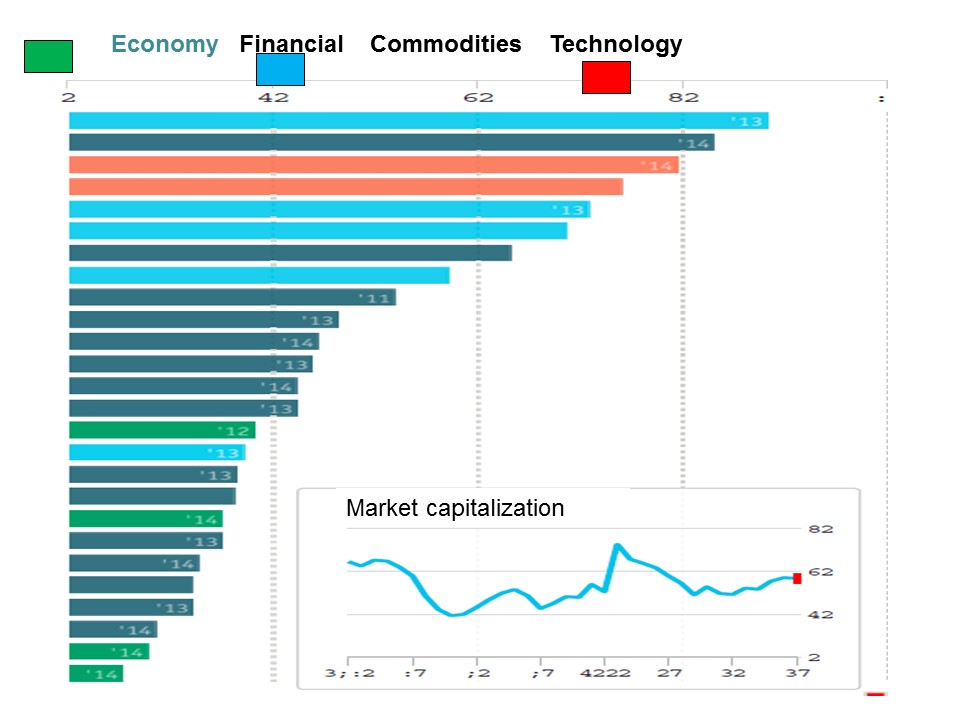
U.S. % of global total for various indicators…
Is America in decline?
An excellent graphic by The Economist (daily chart) lists a variety of economic, financial and technological indicators for the U.S. as a share of the global total. America leads firmly in venture capital investments, and the U.S. dollar is still 60 per cent of total world forex reserves. In technology, the U.S. leads firmly only in “social media’ (which does not generate jobs, only wealth for a handful) and “cloud hosting” (similar to social media). Most of the indicators in which America dominates are financial in nature. US dollar share of bonds, R&D spending, FDI stock, debt, etc.
So here we have it. The U.S. is still the financial leader of the world, but not the technology or economic leader. There is a serious mismatch.
So the question arises: Can the U.S. remain the center of financial stability of the world? Or will its flagging economy weaken the dollar and the whole world system? Are we due for another crisis?
In history, no power has remained dominant in finance without remaining dominant in economics (note the decline of the British empire and its industrial power, and the decline of the pound sterling).
Touchstone School: “Magical Moments”
By Shlomo Maital

My wife and I are visiting Touchstone Community School, here in Grafton, MA, about an hour from Boston. In this and several following blogs, I would like to recount briefly some ‘magical moments’ I experienced there, in a pre-K to Grade 8 school where children do not take formal tests and where their imaginations and social skills are fostered.
Background: Thanks to the hospitality of Touchstone, I’ve brought a Chinese family from Shantou, Guangdong (where Technion has a joint venture program), to visit the school – Jin, my former Shantou U. student, his wife Yuen, and 3-year-old daughter Yue, or Sophia. Together we’re making a documentary film, hoping to bring the message of Touchstone’s “transformative schooling” back to China and to Israel.
 Sophia and her new friend…language is no barrier!
Values: We joined a group of Grade 7-8 children discussing Touchstone core values. The class itself had earlier chosen core values: all began with “C” — Confidence, curiosity, connection, creativity. These values appeared on a ‘flag’ created by the children which included one square per child, where the square reflected the child’s own personality. This emphasis at Touchstone on being an individual is pervasive.
I asked the students about rules. If you have core values, and act on them, do you really need rules? Rules are external, externally enforced; values are internal, internally enforced. The discussion was interesting, the consensus was – values can replace rules.
There followed a discussion about table arrangements. Pairs? Fours? One big square table? The consensus was: One big table, more inclusive. Inclusiveness is a school-wide core value. I suggested, maybe a oval or round table? But there is no such table at Touchstone. However, there is an oval carpet. Let’s sit around the carpet, the students suggested. I came up with a round table that splits into four segments, so work in pairs and small teams can take place. We need to have it built.
One conversation at a time? This is an IDEO principle. It is implemented in this class with Jupiter, a soft toy, tossed from one child (the speaker) to another (who raises their hands and wishes to speak). One child was applauded, for actually catching Jupiter with one hand (apparently, a first! The students joked about it…not in a mocking manner).
I could not help but notice the huge developmental gap between the girls and the boys…the girls are way way ahead of the boys, which is common at this age.
There is a core issue here. Teachers who graduate from teachers’ colleges learn about the rules of pedagogy and the rules of schooling. They then implement those rules in the schools where they teach, and children learn about following an external set of rules, with punishments (and rewards, at times). Children who follow rules well, do well in school. Rebellious kids don’t. But creativity demands rebellion. Are we eradicating it with our rule-based system? Touchstone begins with values. Values are internal. Why not replace external rules with internal values? And make ‘confidence’, and ‘creativity’ core values?
John Maeda: Unconventional Design Thinking
By Shlomo Maital
John Maeda has had a remarkable career, in computer science at MIT, and MIT Media Lab, then as head of the famed Rhode Island School of Design, now as a partner in Kleiner Perkins. He is also a famed video artist Here are his views on design, as told to McKinsey’s Hugo Sarrazin.
Design was once largely about making products attractive. Today it’s a way of thinking, a creative process that spans entire organizations, driven by the desire to better understand and meet consumer needs. Good design is good business. This came from T.J. Watson Jr., in a 1966 memo to all of IBM. Moore’s law (computing power doubles every 18 months) is dwindling… so now we have to buy [things] because of how they make us feel.
Whenever someone has come to me asking for the ‘silver bullet’ (for great design), I say, “There’s only a silver ray…and you have to know where to point it, you might get lucky”.
I was talking to a CEO startup — I offered my opinion, “Just because you can do it doesn’t mean you should do it. If you think about design adding value, a lot of what people don’t understand is that sometimes the best design consultants will tell you NOT to design it.
[Consulting for e-Bay companies]… I observed that the designers were all spread out. …So I connected all of them together, some 380 of them, into one community that could see each other. And the CEO could see them. ..the CEO said, “oh, so design itsn’t about this pixels thing, it’s about systems thinking!” He totally got it. [Sarrazin: It’s getting the right people together, creating the sense of community. It’s also reframing what it is!].
Maeda: Reframing: Exactly!


