You are currently browsing the category archive for the ‘Innovation Blog’ category.
Innovation/Global Risk
Innovator: Can You Make It Fun?
By Shlomo Maital

VW Musical Stairs
In the Roman Senate, Cato the Elder ended every speech by insisting, Carthage must be destroyed! (“Carthago delenda est!”). He got his way in the end. In the Punic Wars, it was obliterated.
My personal equivalent is “innovate in dark corners”. Be creative in places where creativity is lacking or absent. Today’s Global New York Times * brings a great stimulating piece by behavioral economist Richard Thaler – make it fun! He shows us how to alter behavior, in the right direction, simply by creating…fun.
For instance: the Swedish division of VW gets its works to use the stairs, rather than the escalator, by making the steps into a keyboard, with each one playing a note. You make music by going up the stairs. Result: stair use rose by two-thirds. (See the viral YouTube video: http://www.facebook.com/thefuntheory, which so far has over 17 million viewers). Or – Taipei City created a lottery for dog owners who deposit their doggies’ waste in a bin; they become eligible to win gold, turning (literally) crap into gold.
Thaler says, “if governments want to encourage good citizenship, they should try making the desired behavior more fun”.
So innovator: Can you make doing dishes fun? Cleaning the house? Taking out the garbage? Going to work? Changing the baby’s diapers? Going on a diet? Working out? Studying for a test? Doing your annual tax return? This too is creativity. Try it first on yourself. Then spread the word.
* Making good citizenship fun, by Richard Thaler. Global New York Times, Op-Ed, Feb 15/2012
Innovation/Global Risk
Lovenomics, or, Not Fair! Men Are Happier, Women are Unhappier! Why?
By Shlomo Maital

Betsey, Justin and Matilda
As an economist, I am daily appalled at the bankruptcy of macro-economics (how to manage a national economy) and its inability to provide any creative solutions for Greece, Portugal, Ireland, UK or other countries in deep trouble. At the same time, I am daily amazed at the creativity of micro-economics in shedding new light on individual behavior, with the help of anthropology, sociology and psychology. And I am incredulous about the severe schizophrenia of the discipline of economics, how one half can be so awful and the other, so interesting and relevant.
Here is an example. Today’s Global New York Times reports on Betsey Stevenson and Justin Wolfers, U. of Pennsylvania economists, who are (according to Motoko Rich) the “go-to pair on the economics of marriage, divorce and child-rearing”, dubbed “lovenomics”, while they themselves are a couple, with a 2 ½ year old, named Matilda. Their research sheds light on the economics of daily living.
For example, their joint NBER paper (May 2009), “The paradox of declining female happiness” addresses the prickly question, if women have closed the gap with men in education, income, wealth and other areas, in the past few decades, why aren’t they happier? True, in the past women in the UK and US reported being happier than men, but the trend in white women’s happiness in the US is negative. In fact, note the authors, today women throughout the industrialized world now report happiness below that of men!
Any ideas, readers, why this is so? Is it because women’s increased opportunities have simply led to an increase in the amount of work women do? Women are increasingly multi-taskers, while men single-task? “Women may simply find the complexity and increased pressure in their modern livesto have come at the cost of happiness”, they conclude.
The couple have shown that people in rich countries are happier than those in poor countries (wow, surprise!), and that the divorce rate has been falling in America for decades (!), partly because fewer people are marrying in the first place, or because expectations about marriage have become more realistic.
Their child Matilda has helped shape their research worldview. Betsey Stevenson says she was put off by the fact that people with kids were less happy. But they both take real delight in their daughter, and Wolfers says, about the joys of fatherhood, “it’s visceral, it’s real, it’s hormonal, and it’s not in our economic models.”
And Matilda pipes up, at dinner, “Mama! Stop talking about work.”
By the way: They are not formally married. American income tax law punishes married couples, who pay more taxes than if they were living together and unmarried. That’s economics, too!
Innovation/Global Risk
Living On 100 Rupees a Day: Lessons Learned
By Shlomo Maital

My friend Pramod alerted me to an article on the Indian website The Hindu, about two young men from wealthy Indian families who decided to see what it is like to live, as poor Indians (on 26 rupees daily, or fifty cents) and as average Indians, on 100 rupees ($2) a day, (75 per cent of all Indians live on less).
Tushar, the son of a police officer in Haryana, studied at the University of Pennsylvania and worked for three years as an investment banker in the US and Singapore. The other, Matt, migrated as a teenager to the States with his parents, and studied in MIT. Both decided at different points to return to India, came to share a flat, and became close friends.
Here is what they learned, on 100 rupees daily: They found soy nuggets a wonder food — affordable and high on proteins, and worked on many recipes. Parle G biscuits again were cheap: 25 paise for 27 calories! They innovated a dessert of fried banana on biscuits. It was their treat each day. Living on Rs.100 made the circle of their life much smaller. They found that they could not afford to travel by bus more than five km in a day. If they needed to go further, they could only walk. They could afford electricity only five or six hours a day, therefore sparingly used lights and fans. They needed also to charge their mobiles and computers. One Lifebuoy soap cut into two. They passed by shops, gazing at things they could not buy. They could not afford the movies, and hoped they would not fall ill.
Next, they upped the stakes, and decided to live at the poverty line, 26 rupees daily.
For this, they decided to go to Matt’s ancestral village Karucachal in Kerala. They ate parboiled rice, a tuber and banana and drank black tea: a balanced diet was impossible on the Rs. 18 a day which their briefly adopted ‘poverty’ permitted. They found themselves thinking of food the whole day. They walked long distances, and saved money even on soap to wash their clothes. They could not afford communication, by mobile and internet. It would have been a disaster if they fell ill. For the two 26-year-olds, the experience of ‘official poverty’ was harrowing.
After their experience, they wrote to their friends: “Wish we could tell you that we are happy to have our ‘normal’ lives back. Wish we could say that our sumptuous celebratory feast two nights ago was as satisfying as we had been hoping for throughout our experiment. It probably was one of the best meals we’ve ever had, packed with massive amounts of love from our hosts. However, each bite was a sad reminder of the harsh reality that there are 400 million people in our country for whom such a meal will remain a dream for quite some time. That we can move on to our comfortable life, but they remain in the battlefield of survival — a life of tough choices and tall constraints. A life where freedom means little and hunger is plenty… “
What did they learn from this?
“It disturbs us to spend money on most of the things that we now consider excesses. Do we really need that hair product or that branded cologne? Is dining out at expensive restaurants necessary for a happy weekend? At a larger level, do we deserve all the riches we have around us? Is it just plain luck that we were born into circumstances that allowed us to build a life of comfort? What makes the other half any less deserving of many of these material possessions, (which many of us consider essential) or, more importantly, tools for self-development (education) or self-preservation (healthcare)?”
And finally, they learned: “That hunger can make you angry. That a food law which guarantees adequate nutrition to all is essential. That poverty does not allow you to realise even modest dreams. And above all — in Matt’s words — that empathy is essential for democracy.”
Innovation/Global Risk
The “Real McCoy” – America’s Earliest Entrepreneur
By Shlomo Maital
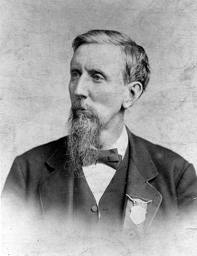
Joseph McCoy
An Illinois entrepreneur named Joseph McCoy may well be America’s first true entrepreneur, and may have given birth to the expression “the real McCoy”, which means, the true authentic thing. Born in 1837, McCoy had a business vision. At the time, the railroad had reached Kansas. Millions of cattle were raised on the lush pastures of Texas. But how can you get the beef to the meat-starved East from the Wild West, and from Texas to Kansas, where the steers can be put on cattle cars?
Not long after the Civil War ended, McCoy found a tiny town called Abilene, Kansas, on the rail line, with a population of 35. He decided that it would become his ‘rail head’. He bought land, and invested heavily to build a stockyard. But it was ‘field of dreams’. He had to convince Texas cattlemen to drive their cattle for some 150 miles, at least, to Abilene from Texas. And there was no established trail to do so. So McCoy explored and found the Chisholm Trail, that had been used in the Civil War to bring supplies to the Confederate (rebel) forces. And then? According to Wikipedia:
McCoy advertised extensively throughout Texas to encourage cattle owners to drive their cattle to market in Abilene. By 1870 thousands of Texas longhorn cattle were being driven over the Chisholm Trail to the shipping center at Abilene. By 1871 as many as 5,000 cowboys were being paid off during a single day, and Abilene became known as a rough town in the Old West. Due to their long legs and hard hoofs, Longhorns were ideal trail cattle, even gaining weight on their way to market. One story says that McCoy bragged before leaving Chicago that he would bring 200,000 head in 10 years and actually brought two million head in 4 years, leading to the phrase “It’s the Real McCoy”.
McCoy ran into trouble because he lacked strategic agility. He had become mayor of Abilene, and as such encouraged bars, saloons, and brothels, to cater to the cowboys who worked hard during the cattle drive, were paid off in Abilene and had pockets full of money to spend. But the farmers in the area objected. McCoy took the brothels and moved them to the other side of the tracks, creating a ‘red light district’. But that was not enough. The Abilene citizens forced him into exile. He launched new railheads, but the peak of his success had come and gone. He wrote a book about his life, before he died, Historic Sketches of the Cattle Trade of the West and Southwest, but it was published only in 1974, 50 years after his death.
Innovation/Global Risk
Wouldn’t It Be Great If….: WIBGI as an Innovation Tool
By Shlomo Maital

Nathan Myhrvold
RCA pioneer David Sarnoff spurred innovation among his talented engineers by building wish lists. “Would it be great if… we could produce crisp color television?” he asked, in the days of black-and-white TV. And they did. “Wouldn’t it be great if we could amplify light, like we amplify sound?” Result: microwave amplification by serial emission of radiation (maser), which ultimately became laser, light amplification by serial emission of radiation.
Now, Nathan Myhrvold, who headed R&D at Microsoft, has launched a venture called Intellectual Ventures, which invests in patents. His company holds invention sessions with experts. In one such session, Myhrvold reports (in HBR, March 2010), “we brought highly respected heart, chest, bone, and brain surgeons together with many of our staff inventors. We asked the doctors to draft ‘wouldn’t it be great if…’ or WIBGI technology wish lists, which generated exceptionally productive discussions. We came up with new designs for surgical tools that are self-sterilizing or that can snake their way around delicate areas of the brain rather than passing through them….”
This sounds to me like a method. If you have expertise in some technology or other, find someone ‘in the field’ who provides a service of some kind. Ask them for WIBGI…wouldn’t it be great if? See you if can find a way to make the future tense into present—isn’t it great that we can…? Or, make your own WIBGI list. I think a great many breakthroughs emerged from individual WIBGI exercises.
Innovation/Global Risk
Yes, Christina, You DO Have to MAKE Stuff!
By Shlomo Maital

Writing in the Global New York Times, Berkeley economist Christina Romer (until recently, head of President Obama’s Council of Economic Advisors), claims that concern about America losing its manufacturing industries is wrong. She says consumers value haircuts as much as hair dryers, and that casino chips and computer chips are, well, just the same for economists. When one of America’s top economists gets things massively wrong, the discipline of economics loses legitimacy – if any of it remains.
Responding to Romer, Clyde Prestowitz (Reagan’s chief trade negotiator) refutes her claims in his Foreign Policy blog. Here is the essence:
- The reason for the decline of the number of U.S. science and engineering graduates, is that “as a result of the decline of manufacturing, there are no jobs for these graduates.” Is America prepared to abandon its world-class science? If not, it needs manufacturing.
- Every $1 of final demand in manufacturing generates $1.41 in additional (indirect) intermediate demand, for goods and services that support the manufacturing. No other industry comes close ($1 retail generates $0.58 in indirect demand).
- “Semiconductor industries in Japan, Korea and Taiwan have been heavily subsidized and protected and have taken a large part of the world’s production away from the U.S.” It is legitimate and logical for the U.S. to take steps to offset this unfair tilted playing field. Jobs making computer chips are indeed higher-paying ones than jobs manipulating casino chips.
Of course, a modern advanced nation needs advanced services. But it also needs to make stuff – advanced manufacturing. These two are not enemies. They are friends. Why portray them otherwise? When one of America’s most influential economists gets it so wrong, probably because her entire professional career has been spent inside an office, poring over numbers and words, what possible value can the discipline of economics bring to America, its struggling middle class and its jobless?
Innovation/Global Risk
Can You Fly A House?
By Shlomo Maital

Art imitates life, but often, life imitates art. Here is a wild example.
In 2009 Pixar produced a wonderful animated movie, “Up”, about an elderly widower named Carl Fredricksen and a young Wilderness Explorer named Russell who fly to South America by floating in a house. The house is ‘flown’ by attaching helium balloons to it. The movie grossed $731 m., ranking it third for animated films, behind Finding Nemo and Toy Story 3.
A team of experts/crackpots for the National Geographic cable channel decided to create a real “Up” house. They built a 2,000-pound 16 ft. by 16 ft. two-story yellow house, attached 300 helium-filled weather balloons to it …and the 10-story structure took off from a private airfield near Los Angeles and ‘flew’ for an hour, reaching a height of 10,000 feet. And yes, it was manned; two of the channel’s producers were on it, including Paul Carson. The flight was an episode of an imaginative program, “How Hard Can It Be?”, e.g. how hard can it be to fly a house? The answer? Really hard. It took the team two weeks of trial and error to do the job.
Innovation/Global Risk
Belly Putters: Golf Innovation
By Shlomo Maital

Modern golf originated in 15th C. Scotland. Despite golf’s long white beard, there is still room for innovations. Take, for instance, the ‘belly putter’. Unlike the conventional putter, which ends at the wrist grip, the belly putter is longer and the end of the shaft ‘anchors’ against the stomach. The stomach, therefore, becomes the fulcrum, not the wrists. Under the rules of golf, belly putters are legal. Pro golfer Paul Azinger made the belly putter popular when he began using it on the PGA Tour in 1999. Now, top golfers Vijay Singh, David Love III and Fred Couples are using them. The original patent for belly putters goes back to Richard T. Parmley and Phil Rogers, issued in 1965 and called a “body pivot putter”.
Azinger reinvented the belly putter in a golf pro shop. There, he discovered a long putter that had been cut down for a shorter person. Azinger pressed it against his belly button – and started sinkins putts all over the pro shop carpet. In 2003, belly putters won eight PGA events (four to Singh, two to Couples).
The basic idea of the belly putter is to take the wrists out of the play, because wrists are inherently unstable and inconsistent, especially when the golf player has the jitters.
The cost? Steep – upwards of $120 – $150. Golf is still for the well-heeled.
What do we learn about innovation from belly putters? Azinger had an open mind, tried something, it worked – and he went with it. But there is left brain logic and analysis, too, that accompanies the right-brain “this just feels right”. A putter with a more solid fulcrum will achieve more consistent results than one with wobbly wrist actions.
And – one more thing. Older golfers do develop bulging bellies, sometimes from beer. The belly putter makes this an advantage, because the fat bellies offer a firm welcoming place to anchor the end of the shaft.
Apparently, even a game dating back to the 15th C. still leaves room for innovations, and within the rules.
Innovation/Global Risk
Alzheimer’s: Major Progress
By Shlomo Maital

Gordie Howe
Major progress has been made in diagnosing and treating the form of dementia known as Alzheimer’s. Some 26 m. people suffer from it today, worldwide, and according to Johns Hopkins Medical School, that number will rise to over 100 m. by 2050, as populations age.
The BBC, which covers Alzheimer’s research very well, just announced some major breakthroughs.
First, diagnosis. New developments in the use of MRI (magnetic resonance imaging) now enable doctors to pinpoint the presence of amyloid protein, which is thought to cause Alzheimer’s by short-circuiting the brain’s delicate wiring, years before dementia develops.
Second, disease. Columbia U. and Harvard U. researchers may have discovered how the disease progresses – almost virally, with it spreading from one brain cell to another.
“Alzheimer’s disease appears to spread like a virus from one brain cell to another, a groundbreaking discovery that could help stop the debilitating disease in its tracks, researchers say. Two independent studies by teams of Columbia and Harvard researchers looked at the brains of mice and found that the degenerative brain disease begins in one small part of the brain and spreads through an abnormal protein known as tau, which is seen in Alzheimer’s-affected brains. It’s long been known that dying, tau-filled cells are an early sign of Alzheimer’s disease. They first appear in the entorhinal cortex, a small area of the brain behind the ears that controls memory and navigation and form tangles. The disease then spreads to other areas of the brain.”
Third, treatment. Work proceeds apace on developing a drug, or vaccine, which would produce antibodies that would suck the amyloid protein out of the brain, almost like a vacuum cleaner. The leading candidate is a drug under development by Eli Lilly.
“Lilly’s latest contender, solanezumab, is designed to bind to and mop up a protein called amyloid beta, the main component of amyloid plaque deposits in the brains of patients with Alzheimer’s disease. Anticipation over the drug has built up slowly. Lilly is expected to release as soon as this summer final data from two 18-month studies of the treatment. Earlier this week, the company said an independent safety monitor had given researchers the green light to continue with the late-stage trials.” Pfizer, too, has an Alzheimer’s drug under development.
The most touching news comes from my childhood idol, Saskatchewan-born hockey player Gordie Howe. After his wife Colleen died of dementia, Howe has been raising money for a foundation that funds dementia research. He makes 4-5 appearances a month. It is rumored Howe himself, now 84, may suffer from it, although he denies it. Howe played hockey in an age when players did not wear helmets. He must have taken many blows to the head. Yet, developing dementia at his advanced age cannot be directly attributed to his hockey-playing days. Howe’s son Murray said: “As your parents age, they will almost all deal with something along these lines. It’s so important to get together as a family and have a plan to make sure your parents are taken care of. It’s really easy to ignore.”
Innovation/Global Risk
IKEA: Can You Feel Small When You’re Really Big?
Anders Dahlvig Thinks You Can’t!
By Shlomo Maital
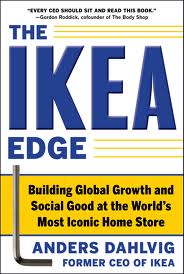
Consider IKEA. This Swedish company, founded by Inqvar Kamprad at his uncle Ernst’s table in 1943, has revolutionized the global furniture business. It is the world’s largest furniture retailer, and its innovation is its business model, not its products. We now have a new book, The IKEA Edge, by Anders Dahlvig, who rose from store manager to become Kamprad’s right-hand man. Here is what Fortune magazine said about this book:
Dahlvig does give a brief history of Ikea’s evolution into the privately held retail giant that generated $31 billion in 2009, with 125,000 employees (ran 300 stores, operated in 38 countries and was the 3rd largest buyer of wood in the world). But more often than not, the book is about management — motivating and inspiring employees, keeping an entrepreneurial streak as a company grows, creating loyalty and diversity, the role of a CEO. The book is rich in ideas about how to take a brand that has a strong regional culture and make it global. While some of these lessons are helpful and refreshing (Dahlvig suggests having numerous people report to you so you don’t have time to micromanage or hover), I wanted more of a personal story about his time at the company. Instead the book is written in the style of Ikea itself: practical and no-frills.
What is IKEA’s secret of success? Fierce supply-chain management, bulk buying and the creation of a unique customer experience. Consider IKEA’s restaurants. Their real purpose?
“Take, for example, the fact that its restaurants generate $1.5 billion in sales. But the main reason behind those 15 Swedish meatballs for $3.99 is not to make a profit — it’s to highlight the store’s low prices and get the customer to shop longer.”
Dahlvig knows clearly why IKEA and any company exists: ” A company’s reason for existence should be to contribute to a better society.”
It’s hard to imagine these words coming out of the mouths of most U.S. CEOs, says FORTUNE. But it might serve them well if they at least read the book.
IKEA’s founder is now 85, and about to retire. Dahlvig is worried. He recently told BBC’s Business Daily: “What will happen when the founder of IKEA is not around? What will happen to IKEA? The founder is 85, this transition is about to happen. He is less visible in the business. Transition is on the way. My biggest worry for the company is, the loss of the values, he is the guardian of that. This is the soul of the company. The consequence of losing the values is, the loyalty of employees declines, and we become like every other company. This is our first generational change. That’s a worry. The fact that IKEA is becoming bigger, a bureaucracy, the small company feel is declining, maybe inevitable, but, I’m worried about that, and worried about the loss of the culture and the values. And I don’t have a solution, how you can act like a small company when you are the size of IKEA.”