You are currently browsing the category archive for the ‘Innovation Blog’ category.
Innovation Blog
Happy Birthday, Laser!

Exactly 50 years ago, a scientist named Theodore Maiman demonstrated the first functional laser (Light Amplification by Stimulated Emission of Radiation). We take lasers for granted, but they are ubiquitous, everywhere. And they are destined to do even bigger things, like solve the energy crisis.
America’s National Ignition Laboratory uses 192 powerful laser beams to create plasma (hot gas), in turn useful for creating fusion-based energy (the same process that occurs in hydrogen bombs, fusing two atoms together, with some energy left over). Meanwhile, expectedly, lasers are being perfected for military use. Soon a 100 KW laser will be ready, able to knock missiles out of the sky.
Albert Einstein could be credited with the invention of lasers. In his 1917 paper, On the Quantum Theory of Radiation, Einstein used Planck’s law of radiation to discuss stimulated emission of electromagnetic radiation. David Sarnoff (RCA) asked his scientists to find a way to create a maser “microwave amplication by stimulated emission of radiation), a precursor of lasers. And in 1950 Albert Kastler proposed “optical pumping”, which later won him a Nobel Prize.
The gestation period for lasers has been long. From theory (1917) to first prototype: 43 years, and then a few more decades for commercial widespread use. One lesson is that new technologies rarely surprise us. By tracking theory, it is possible to accurately road-map technology well in advance — something great companies and leading countries do regularly. Japan is the leader in technology road-mapping, investing millions of dollars yearly to keep tabs on the latest scientific developments that may lead to new technologies.
Innovation Blog
Case Study: Pick & Light — First Doer Advantage
By Shlomo Maital
Meet Paul Hein, inventor. I met him at SiloDesa, a huge pharmaceutical warehouse in Mexico City, operated by Farmacos Especializados, a wholesale distributor. There, Hein was installing his invention — a device that doubles or triples “pick and pack” operations in warehouses. Normally, workers walk down long aisles and “pick” products from shelves to fill orders. This is the old way, as workers hold a hard-to-read paper order form in one hand and search for the products on the shelves to fill it. There are errors and the process is slow.
The new way — the Hein way — is to put LED screens on each warehouse shelf slot, link them to Oracle software, and “light up” the shelf to show the worker exactly what to take. The worker carries a tummy bag, in order to free both hands to fill the order. The LED light goess off when the right product is picked. Every product has an RFID, radio frequency identification.
Hein invented this clever system in 1982. He refused to patent it, even though he knew there would soon be many imitators. There were — 15 in all. “I refuse to spend three years of my life in court,” he told me, emphatically. Soon the 15 competitors fell to only 4 — and Paul’s firm is still the leader. “First doer advantage” is crucial. First to invent, first to install, first to learn — and most important, first to become authentic. Here he was, at SiloDesa, holding a drill and installing his system himself with two workers. There is no deeper authenticity than an inventor holding a drill.
But Hein did not want to chat with me about Pick & Light. That is the past. He wanted to talk about what is, for him, the future — his P.B. Hein Vineyards, in St. Helena, CA, where he makes prize-winning wines: “Nothing less than silver medal”, he told me proudly. Hein spoke with great passion about his wine. I learned this from him: Most of us live in the past, doing what we are comfortable doing, doing what we did before. A few of us, creative people, live in the future. They tackle new adventures rather than old ventures and they live with hope, with joy, with energy and with tremendous renewed and renewable creativity. Hein is a prime example.
Thanks, Paul, for the lesson in life!
Innovation Blog
Israel: Light Bulb Unto the Nations
By Shlomo Maital
“I will establish you as a….light unto the nations.” Isaiah 60:2-3
 illustration by Avi Katz
A recent BBC World Service poll completed in February reveals a painful fact − Israel is regarded by much of the world as illegitimate, a pariah, a social reject. The survey covered 29,000 people, interviewed by phone or face-to-face in 28 countries. The question was: For each of 17 countries, do you regard the influence of Country X in the world as mostly positive or mostly negative? Half the respondents rated Israel’s influence as negative. Only 19 per cent rated it as positive. The rest were either neutral or ‘don’t know’. Incredibly, the results for North Korea are slightly better than for Israel; Iran rates only slightly worse. In only two of 28 countries does Israel have a perceived net positive balance: America and Kenya. And in America, only 40 per cent gave Israel a “positive” rating, down from 47 per cent a year ago. There is not a shred of evidence that Israel’s leaders lose sleep over these terrible numbers, let alone take action.
Against this tsunami of anti-Israel sentiment, rises Start-up Nation, the best-selling book about Israeli innovativeness by Dan Senor and Saul Singer. Thousands are reading the book to learn how this little country invented the cell phone, Copaxone, Azilect, a kind of heart pump, drip irrigation, the Given Imaging pill that ‘broadcasts’ your intestines’ condition, the Pentium chip, and a thousand other life-changing inventions, while fending off enemies and squabbling endlessly with one another. “What is driving it,” Senor recently told the cable network CNBC, “is a national ethos, resilience, the fight for survival.”
Why not rebrand Israel as the nation where creativity lives — come see it for yourself? A first step in this direction was taken recently by Prof. Shimon Shocken, who heads the Arazi School of Computer Science at Herzliya’s Interdisciplinary Center. Shocken and a team of dynamic young people led by Maya Elhalal and Liat Aaronson organized a TEDx gathering on April 26 at a highly unusual venue near Jaffa Port called Na Laga’at (see below). TED (“ideas worth spreading”) is well-known to all those interested in innovation; TEDx conferences are TED gatherings held outside the US.
What we learned from this amazing day was that Israeli innovativeness is not confined to high-tech. It is pervasive and ubiquitous, in social action, education, therapy, music, dance. (And in politics? Alas − no creative politicians could be located). Participants ranged in age from 14-year-old Ori Sagy, who is a “scientist of the future” at Tel Aviv U., to myself (age 67), Raphael Mehoudar, who invented drip irrigation for Netafim and Anita Shkadi, who introduced horseback therapy to Israel many years ago. Here is just one of the 15 amazing brief talks we heard.
Anita Tal, who directs plays, was asked in 2001 to come to Jaffa to work with a dozen deaf and dumb actors suffering from Usher’s Syndrome, a progressive genetic disease, and until then living in darkness and silence. How in the world does one do that, she wondered? Result: The curtain rose in the Na La-ga’at (“please touch”, in Hebrew) Center on “Light Is Heard in Zig Zag”. In 2004 the unusual company toured Canada and the U.S. and won rave reviews. Today the Na Laga’at Center, where the TEDx conference was held, features the Blackout Restaurant, where dinner is served by blind waiters in complete darkness — a startling experience I strongly recommend. Tal was given the Chesed (Grace) Award at the Knesset in 2008.
It is an utter travesty for Israel to be perceived by the world as a pariah, rather than what it truly is, a light-bulb unto the nations. At a time when countries in the West are struggling to recover from the global crisis and are seeking new innovations to lead the way, they can learn much from Israel. Let every Israeli official abroad convey that message with conviction, at every opportunity.
A version of this blog will appear in the Marketplace column, Jerusalem Report
Innovation Blog
Anthora Cup: WE ARE HAPPY TO SERVE YOU!
By Shlomo Maital

You know those paper coffee cups that are ubiquitous and so taken for granted?
If they could speak, they would tell an interesting story. The inventor, Leslie Buck, has just passed away. According to the New York Times (April 28):
It was for decades the most enduring piece of ephemera in New York City and is still among the most recognizable. Trim, blue and white, it fits neatly in the hand, sized so its contents can be downed in a New York minute. It is as vivid an emblem of the city as the Statue of Liberty, beloved of property masters who need to evoke Gotham at a glance in films and on television. It is, of course, the Anthora, the cardboard cup of Grecian design that has held New Yorkers’ coffee securely for nearly half a century. ….The Anthora seems to have been here forever, as if bestowed by the gods at the city’s creation. But in fact, it was created by man — one man in particular, a refugee from Nazi Europe named Leslie Buck.
Who was Leslie Buck? He was born Laszlo Buch, in 1922, to a Jewish Czech family. His parents were killed by the Nazis during WWII. Laszlo survived Auschwitz and Buchenwald. After the war he made it to New York, and started an import-export business with his brother, Eugene, who had also survived the death camps. They started Premier Cup, a paper cup manufacturer, in the late 1950’s. Buck joined Sherri Cup, a startup company, in the 1960’s, and for a time was its entire sales force.
Sherri wanted to crack New York’s hot-cup market. At the time, many of the city’s diners were owned by Greeks. Buck had the idea of a Classical Grecian cup, with the drawing of a Greek vase called the “amphora” on it, in the colors of the Greek flag. Buck called it “Anthora”, which his son said is how “amphora” sounds when spoken with a Czech accent. Buck had no training in design — but designed the cup himself. It was a huge success. Hundreds of millions were made every year. Buck got no royalties for his design, but became wealthy through sales commissions. He retired from Sherri in 1992.
The key to the cup’s success, apart from its functionality? Its motto, written simply, in a Classical font, as:
WE ARE HAPPY
TO SERVE YOU
I have long believed that product design should be done in teams with sales persons playing a key role. They know the soul of their customers intimately, because their income depends on it. Lesley Buck/Laszlo Buch is a strong example.
Innovation Blog
Tough Mudder: You Thought Your Idea Was Wild?
By Shlomo Maital

Today’s Global New York Times (John Branch, “An idea hatched in business school takes running amok to the next level”) offers encouragement to all those who have wild ideas and despair of seeing them implemented.
A British MBA student studying at Harvard Business School named Will Dean submitted an idea to a business plan contest — persuade 500 people to run a grueling race through mud and man-made obstacles. Great idea? Sure money-maker? Professors thought not, though the plan did make it to the semi-finals.
Well, this Sunday, Tough Mudder will conduct a race for 4,500 people (!). Each participant pays about $100 for the privilege to negotiate a 7 mile course, with muddy hills, cold water and flaming bales of straw, at a ski resort near Allentown, Pennsylvania. The company Tough Mudder has six employees and two interns, all in their 20’s. It plans to hold three more races around the US this year, and 10 next year. Some will have as many as 20,000 participants.
Marketing? Advertising? Tough Mudder announced itself with $8,000 worth of Facebook advertising and a Website (toughmudder.com). The idea was imported from similar events in Great Britain (the Strongman run).
Tough Mudder has a value system. Participants recite a prerace promise to help others and not to whine.
The principle here is clear. Find an unmet need. Meet it. Don’t be afraid to think wild.
Unmet need? Running through the mud, through cold water, through burning straw ? Apparently, many people do need to do this. How do you know? Well — float it, put it up there, run it up the flagpole — and see. Tough Mudder’s founders are amazed. And frankly, so am I.
Innovation Blog
New Approach to Cure Cancer
By Shlomo Maital
A new treatment for prostate cancer has been approved by America’s FDA. Prostate cancer kills some 25,000 American men annually, the second highest death toll for cancer. Once cancer spreads beyond the prostate gland, it is virtually untreatable.
According to the BBC:
Provenge – which is designed to be used in men with advanced prostate disease – is the first of its kind to be accepted by the Food and Drug Administration. Each dose has to be individually tailored and it is an expensive treatment at $93,000 per patient.
Provenge is a kind of vaccine. White blood cells from each patient are removed, treated, and then re-injected. They are ‘persuaded’ or ‘tricked’ into attacking the prostate cancer cells all over the body.
Provenge is huge good news, but also bad news.
The good news is that this approach to treating cancer — getting our own immunity system to attack the cancer — has been studied for 50 years, and at last, scientists have managed to get it to work. It could be a promising new avenue for cancer treatment, for cancer of all kinds.
The bad news? Of course, the cost. According to the FDA, untreated men in clinical trials lived an average of 20 months. Treated men, who received Provenge, lived for an average of 24.5 months. That means that this costly drug, which cost nearly $100,000 per treatment (and whose cost cannot be reduced, because it must be tailored to each individual person), can prolong life for 4.5 months. For those with prostate cancer, these are of course precious months.
But can society afford to invest $100,000, to prolong life for 4.5 months? How much, indeed, is an added month of life worth? And what is the opportunity cost — how many lives could be saved with the resources used to prolong life for those 4.5 months?
Innovation, especially in cancer treatments, always and unavoidably confronts prickly ethical questions that cannot be evaded.
Innovation Blog
220 million websites… and growing!
By Shlomo Maital
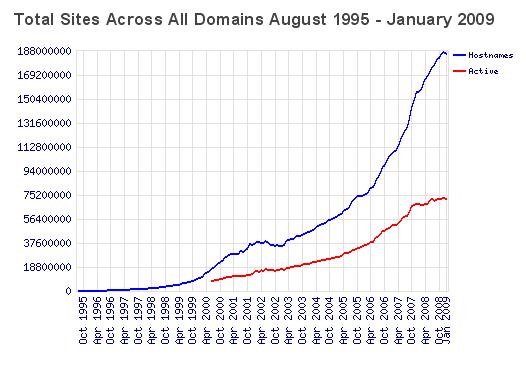 Total Number of Websites, and Total No. of ACTIVE websites, 1995-2009 (source: NETCRAFT)
In a recent interview on the BBC World Service, Yahoo CEO Carol Bartz vigorously defended her company, which is still #2 in the world in search. Yahoo has struggled, after Microsoft tried and failed to acquire it, then reached a collaborative agreement with Yahoo to work together.
In the interview, she mentioned this fact:
There are 220 million websites in the world.
(Netcraft says the number, as of 2009, is 185,497,213, of which some 75,200,000 (or about 40 percent) are active.)
This is staggering. It means that there is one website for every 30 persons in the world. Since each website contains multiple pages, there are probably far more web pages in the world than there are people. One estimate shows there are 11 billion web pages in existence, over 50 % more than the world population of 6,817,700,000.
In teaching creativity to MBA students, I often find they have serious misunderstandings about the Web. In developing creative business ideas,
* They underestimate how crowded the field is — another website? The 220,000,001th website?
* They misunderstand how the Web acts to commoditize — enabling people to search for low prices all over the world.
* They fail to grasp that the Web is not a service or a product, but an enabler, and what counts is not the enabler but the quality of the service and the experience that is enabled.
* They misunderstand that in Web-based business, it is often winner-take-all — people will choose the largest network, coming in second means leaving the game.
* Finally, if the proposed website does not meet a real unmet need — and few new websites do — it will fail.
Start not with the Web. Start with the need. And think hard about whether the Web is the best enabler. Often it is not. Often traditional localized enablers are best. The Web often is the problem, not the solution.
“To systematize is to sterilize”
By Shlomo Maital
 Nils Middleboe: Let Joy Flourish!
Today’s Global New York Times has a fine column by Rob Hughes, global soccer columnist, titled “let talent blossom”. The theme is how Spain creates enormously talented soccer players like Messi, Xavi, Iniesta, Fabregas and others. It is not just Barcelona that has a great youth school but other Spanish teams as well. China recently announced it is sending 500 youngsters abroad on a five-year program, mostly to Spain. Why Spain? As European soccer champions, Spain’s results speak for themselves.
In an era when there is a global top talent shortage in management, as baby boomers retire, much can be learned about talent development from the realm of world class football. But what?
Hughes cites an old, out-of-print book, published in 1970, by Nils Middleboe, a Danish merchant banker and amateur soccer player. The book is “Common Sense about Soccer”. Alas, common sense is often the least common quality.
According to Hughes, Middleboe implores coaches not to overload kids with theories, not to spoil their joy, and let their imagination and intuition guide the ball. Middleboe was afraid that the rule-based regimentation, discipline and rigidity of adults, and their insistence on control, would ruin the kids. And indeed, it has, not only in soccer, but in general. Bureaucratization has ruined many creative organizations, as they grow and scale up.
The last words in Middleboe’s book implore adults to give kids freedom: “to systematize is to sterilize”. Ever watch Italian football clubs like A.C. Milan? Sterile unimaginative defense. It may work, but it is ruinous for viewing and for talent. It creates unmotivated professionals who play not for the love of the game but for the paycheck, and who usually forget whom they are playing for. And sterilization is precisely what most of our schools do to our kids.
There is a fierce dilemma for innovators. To systematize may indeed be to sterilize (the creative process). But — NOT to systematize at all is to RANDOMIZE, and few great things happen randomly. A Las Vegas roulette wheel is not the best paradigm for continual creativity and innovation. This is why many startups fail. They strike it rich one time, but fail to replicate the innovation process with Version 2.0.
Here is the innovator’s dilemma, the core dilemma in a series of them: How to systematize creativity, build a creativity machine, without destroying the creative spirit by sterilizing out the spontaneity and openness, and above all, the fun. For kids, soccer is a game. It is fun. As they become professionals, a few retain the spirit of joy and run, like Messi. Most have it sterilized out of them. For innovators, a handful retain the childlike joy of creating. Most lose it.
What is your organization’s creativity machine? Is is systematic? Is is sterile? Does it replicate ideas constantly, retaining the fun, the joy, the thrill?
Every human being, every business, every organization, needs a systematic creativity machine. But it must not sterilize. Each person, each business must find its own solution to this extraordinarily difficult dilemma.
Innovation Blog
Post-Crisis VC Money: How to Find It?
By Shlomo Maital
Writing in Business Week’s “small business finance” department this week, Monica Mehta provides some bleak numbers for returns on VC investments — something many of us have suspected for a long while. According to the Boston consulting firm Cambridge Associates, $100 invested in a VC fund in the year 2000 is worth today a bit more than — $98, a rate of return of minus 2 per cent. Total VC fundraising dived in 2009, to a miniscule $13.7 b., in the U.S., down two thirds from pre-crisis 2007.
What can be done by startup hopefuls seeking to raise VC funding?
She cites a case study on HitFix, an LA-based entertainment news website. The two founders discovered that mid-sized VC funds have greatly diminished, leaving many small laser-focused funds that specialize, on one end, and huge blue-chip funds like Sand Hill Road at the other. They managed to raise a $980,000 seed round right after Lehman Brothers collapsed, then imposed drastic cost cutting and with minimum funds reached 500,000 users of their website. Later, they turned to an angel network, Golden Seeds, for Series A funding. After lining up an anchor investor, smaller VC funds were more willing to invest. They found that investors require HitFix to reach profitability with Series A funding alone. Treat Series A as if it were your last, they found. There will be no quick IPO, HitFix discovered. Experts coach them to look instead for a strategic sale.
I urge all startup hopefuls to reconsider and rethink their business model. Instead, try to bootstrap. Invent a product or service that will generate quick cash flow. It could even be a day job. Use your evenings to write code or build a prototype. It will take much longer — but you will retain control, and will not face VC’s who give you wrongheaded orders, and as Directors insist you carry them out.
Innovation Blog
Supercreativity in Teams: Find the Geniuses
By Shlomo Maital
 Do you have highly creative, supercreative, people in your organization? Are they perhaps hidden, undiscovered? Here is a way to discover them. (Faithful blog reader Yoav Medan supplied this example, from marshmallowchallenge.com). The author of the exercise is Tom Wujec, a Fellow at Autodesk.
If you need to kickstart a meeting, get a team into a creative frame of mind, or simply want to encourage your organization to think about what it takes to dramatically increase innovation, invest 45 minutes to run a marshmallow challenge.
The task is simple: in eighteen minutes, teams must build the tallest free-standing structure out of 20 sticks of spaghetti, one yard of tape, one yard of string, and one marshmallow. The marshmallow needs to be on top.
Surprising lessons emerge when you compare teams’ performance. Who tends to do the worst? Why? Who tends to do the best? Why? What improves performance? What kills it?
I suggest altering the exercise slightly. Why tallest? Why not, “most beautiful”? “strongest”? Or just — without any “most”, just build it!
Put the winning model on display in the lobby, with names of the team members.
When you run the marshmallow challenge, provide loud music in the background, and an atmosphere of fun, laughter and excitement. Allow spectators. Get the CEO to participate.