
You are currently browsing the category archive for the ‘Innovation Blog’ category.
Innovation Blog
Genius – Its Origins and How to Develop It
By Shlomo Maital
 Guus Hiddink
Two seemingly unrelated pieces in today’s Global New York Times (March 24) shed light on a key issue in innovation: How to develop genius and where genius comes from.[1]
Anne Paul reviews David Shenk’s important new book on genius, which argues that we have not a “talent scarcity” (as HR experts continually caution), but a “latent talent abundance”…our problem is not “our inadequate genetic assets” but our “inability so far to tap into what we already have…the truth is that “few of us know our true limits, that the vast majority of us have not even come close to tapping what scientists call our ‘unactualized potential’. ”
Schenk reviews a large scientific literature on this subject.
In his regular piece on global soccer, Rob Hughes discusses coach Guus Hiddink, who has developed and discovered some of world soccer’s greatest stars, such as Romario, Ronaldo, and Korean Park Ji-sung. Hiddink became coach of South Korea’s soccer team and in the 2002 World Cup took the team to the semi-finals, an amazing achievement. He used three simple principles, which apply equally to innovation talent as to soccer talent:
1. Keep the game simple. Simplifying problems, cutting through to the core, is essential in both soccer and innovation.
2. Communicate through actions, not words. Hiddink’s hard work elicited similar hard work from his players. He walked his talk.
3. Demand that others work as hard as you are prepared to do. Genius is not 1 per cent inspiration, and 99 per cent perspiration, as Edison once said; it is 100 per cent both inspiration and perspiration.
Hiddink made his South Korean players fit as Europeans. Then he made them believe they could win. The combination was powerful.
One of the core competencies of today’s global managers is skill in developing innovation talent. Since this is the core skill of sports coaches and managers, it is worth benchmarking those among the coaches that excel in this.
[1] Book review of The Genius in All of Us, by David Shenk. Anne Murphy Paul; and “Transmitting a gift that goes beyond words”, by Rob Hughes (Global Soccer).
Innovation Blog
Rwanda: Entrepreneurship, not Genocide
By Shlomo Maital
In a recent three-part episode on the BBC World Service’s Global Business program, Peter Day visited Rwanda and described its amazing renaissance, through entrepreneurship, after the horrendous genocide in which 800,000 people were slaughtered in 1994. Its driving force is President Paul Kagame, whose guerilla force entered Rwanda and is credited with stopping the slaughter, when UN and other forces were impotent to do so.
The Republic of Rwanda is a landlocked country located in the Great Lakes region of eastern-central Africa, bordered by Uganda, Burundi, the Democratic Republic of the Congo and Tanzania. It has 10 million people, and covers some 26,000 sq. kms. It achieved independence from Belgium in 1962.
Rwanda’s vision, led by Kagame, is to become a mid-income country, rather than a poor one, in 10 years. A new road leads from the capital Kigali to Nyamata. Kigali is lovely, well-run, and relatively safe. A terrible slaughter occurred in 1994 in Nyamata, in a Christian church. It is now a memorial, with the clothes of those slaughtered still on the pews. Peter Day spoke with an NGO called Rwanda Works . Officials said Rwanda’s government is covering the country with fiberoptic lines (which run under the road) and other transportation infrastructure.
Rwanda has fertile red soil. It is a country of beauty, known as the Land of the Thousand Hills, now being repopulated. Immigrants have come from overpopulated parts of Africa. New markets have sprung up along the road.
An expert told Day: “If you look off to this hillside, you’ll see a homestead here and there. This is traditional in Rwanda — outside Kigali, people lived on the land they cultivated. After the war, the thinking on the part of the government was — we won’t develop if everyone lives on their land. Too hard to get health, education, electricity, water to people dispersed. So the government built housing for several hundred thousand people in villages. When you get a village, you get specialization, and wealth and prosperity creation. For instance: here is a person on a bicycle with soda bottles on the back. This is a sign of production and wealth creation.”
A government minister spoke to Day about Vision 20/20: Where we want to see Rwanda. Key: Rwanda wants to move away from reliance on agriculture to becoming a knowledge-based economy, with human capital and high-value skills. “By 2020 we should have per capita income of $900; today we are at $400, which is double the $200 level in 2000.”
Rwanda needs foreign investment. Meanwhile, the government has installed IT infrastructure that is world class. It is well connected to the world and to friends, including the US (Costco and Starbucks). They buy Rwandan coffee.
Clair Akamanzi, of the Rwanda Development Board, says: Adding value to coffee and tea, and selling abroad, is very important for us now.
Belgium, Germany, France had important colonial roles here. But Rwanda has now cleverly joined the British Commonwealth. This makes it eligible for British aid.
“When you are innovative, you can find niche markets anywhere in the world,” said a Rwandan entrepreneur, Emmanuel Murukazi, who pioneered coffee shops in Rwanda, changing the Rwandan culture not accustomed to them. His chain called BourBon has now become global. He even has a coffee shop in Washington DC. They roast beans daily from five Rwandan regions, each type differentiated. Murukazi is selling the notion of drinking coffee to Rwandans not accustomed to it, and branding Rwandan coffee.
Rwanda has few natural resources. Transport is still difficult. Poverty is still rampant. Coffee still provides half of Rwanda’s exports by value. But led by its President’s vision, Rwanda has hope for the future. No longer is entrepreneurship a matter of Silicon Valley (California), Silicon Wadi (Israel), or Silicon Bypass (Route 128, Boston). There are hotbeds of entrepreneurship worldwide, including Africa. They merit close attention, and strong support.
Innovation Blog
Farming Atlantic Blue Fin Tuna
By Shlomo Maital
Atlantic Blue Fin Tuna A report on the BBC World Service program Discovery discusses how scientists in Malta are working on ‘farming’ Atlantic blue fin tuna. This species of tuna is very large, in high demand, and at times a single fish can bring as much as $100,000 in Japan, where it is highly prized for sashimi. But tuna is being overfished, and may be in danger; a UN sponsored conference meeting in Doha this week will try to declare the blue fin tuna ‘endangered’ in order to protect it, but many countries that profit from fishing will oppose the idea.
According to Wikipedia: “Today, the Atlantic bluefin tuna is the foundation of one of the world’s most lucrative commercial fisheries. Medium-sized and large individuals are heavily targeted for the Japanese raw fish market, where all species of bluefin are highly prized for sashimi. This commercial importance has led to severe overfishing. The International Commission for the Conservation of Atlantic Tunas (ICCAT) affirmed in October 2009 that Atlantic bluefin tuna stocks are declining dramatically, by 72% in the Eastern Atlantic, and by 82% in the Western Atlantic.”
In Malta, scientists have achieved partial success in a very difficult process: a) capture adult Atlantic blue fin tuna, in cages, b) collect their fertilized eggs, c) raise larvae (tiny hatched fish), d) grow the larvae into fingerlings, and e) grow the fingerlings into adult fish, that can be harvested. The process has been done very successfully with salmon, and now has been achieved with sea bream and with sea bass.
Atlantic blue fin tuna are huge fish that grow very rapidly. Because of their size, they could become a major source of protein worldwide. Let us hope that the Malta scientists succeed soon, in time to save the dwindling stocks of wild tuna from extinction. We know that below a certain size or number, it becomes impossible to save a species. Let us hope the Atlantic tuna have not reached that point.
Innovation Blog
DANGER: Entrepreneur Brain Drain? America’s Super Visa Act
By Shlomo Maital
Business Week: US losing startup lead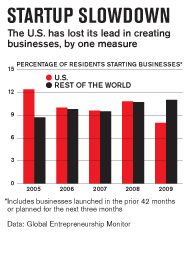 A report in Business Week suggests that America may be trying to solve its jobs crisis [President Obama announced an $18 b. jobs package this week] by exporting it to other nations. [1] Proposed legislation would offer visas to foreign entrepreneurs who succeed in raising $250,000 in capital in the US.
This proposed act raises many questions. As the fountain of entrepreneurship, why does America need to import foreign ones? As the primary ‘mother’ of entrepreneurial capitalism, why is wealthy America seeking to pull entrepreneurs away from countries that are poorer (e.g. Israel, whose per capita GDP is roughly 40 per cent less than that of the US). Why is America trying to make life even harder for its own entrepreneurs by importing competition? Why is the US acting to ruin its own entrepreneurial engine by foreign ‘imports’, just as it ruined its own industrial economy by importing nearly everything from Asia and specifically China? * Why isn’t America fostering its own homebred “necessity entrepreneurship” rather than importing it?
According to the Business Week report:
Last year 8% of U.S. residents founded companies, down from 12.4% in 2005, says the Global Entrepreneurship Monitor, a research consortium of the London Business School and Babson College. In 53 other countries that the group tracks, the percentage of residents creating companies rose to an average 11%, from an average 8.7%, over the same stretch. “The incentive for entrepreneurs to bring their ideas to the U.S. would be the prospect of becoming a resident of this country and the potential for a greater market,” said Lugar in an interview.
The legislation is the product of an unusual collaboration between arch-conservative Republican Senator Richard Lugar and liberal Democratic Senator John Kerry. They have proposed “a two-year visa for any immigrant entrepreneur who can secure $250,000 in capital from American investors. After the two years are up, the person could become a permanent resident if his or her business has created five full-time jobs in the U.S., raised an additional $1 million, or hit $1 million in revenue. The senators hope to pass the StartUp Visa Act this month as part of legislation aimed at helping small businesses add jobs.”
With partisanship reaching new heights in Washington, one wonders how this particular idea merits bipartisan support.”
How should other countries respond? * Vigorously oppose the legislation, by every possible means. *Point out to America that the last time it ‘solved’ its business problem by outsourcing, the result was the hollowed-out economy and record Chinese trade surpluses, and a collapsing dollar. * Offer generous capital (through government funds) to worthy entrepreneurs. * Persuade US VC funds that US and Europe will have slow growth, and that starting businesses there may be less worthy than in the Mideast and Asia.
[1] Visas for Foreign Entrepreneurs: The proposed StartUp Visa Act would open the door to foreign entrepreneurs who create jobs, by Douglas MacMillan: Business Week, March 11/2010.
Innovation Blog
Innovating Customer Service: The Case of USAA
By Shlomo Maital
A friend directed me to a Business Week article about innovative customer service at a bank. [1] It shows how winning businesses can emerge not just from product innovation, but innovation in key business processes.
A bank, USAA, again topped Business Week’s rankings for superior customer service. It has ranked #1 or #2 for four straight years. No other firm comes close. Surely this provides a terrific best-practice benchmark for customer service.
USAA provides financial services for U.S. military families. These families have special needs related to the fact that part of the family serves in distant parts of the world.
The article recounts:
In almost everything it does, the financial-services outfit puts itself in the spit-shined shoes of its often highly mobile customers, many of whom face unique financial challenges. USAA was the first bank to allow iPhone deposits, it routinely texts balances to soldiers in the field, and it heavily discounts customers’ car insurance while they are deployed overseas. “They do all this really creative stuff that applies to guys and gals who are in Afghanistan,” says Karen Pauli, a research director at consulting firm TowerGroup. “There is nobody on this earth who understands their customer better than USAA.”
Here are a few things USAA does to provide superior customer service:
* When Staff Sergeant Corey Mason wants to deposit a check, he doesn’t use an ATM, a teller at a branch, or even a stamped envelope and deposit slip. Rather, the 37-year-old GPS systems specialist takes a picture of the check with his iPhone, uses an app to send it to his bank, and within minutes the money shows up in his account.
* USAA was the first bank to allow iPhone deposits, it routinely texts balances to soldiers in the field, and it heavily discounts customers’ car insurance while they are deployed overseas. “They do all this really creative stuff that applies to guys and gals who are in Afghanistan,” says Karen Pauli, a research director at consulting firm TowerGroup. “There is nobody on this earth who understands their customer better than USAA.”
Here are some things USAA does to keep its employees happy and in touch with their customers:
* Customer intimacy: ” …training for USAA employees is steeped in the military experience. New reps attend sessions where they dine on MREs, or “meals ready to eat,” which troops consume in the field. They try on Kevlar vests and flak helmets. And each rep is handed a bona fide deployment letter—with the names changed, of course—to get them thinking about the financial decisions customers face at such an emotional time. Colleen Williams, a Phoenix-based service rep who joined the company in 2008, says the training clued her in to family issues that help her when answering calls. “I speak to women who haven’t talked to their husbands in six weeks,” she says. “It never really registered to me, the real disconnect” deployed soldiers have from their families.
* Training isn’t the only thing USAA lavishes on employees. After all, it takes satisfied workers to get satisfied customers. In 2009, even call center agents at USAA saw bonuses nearing 19% of their pay, up from 13.5% the year before. A new $5-an-hour concierge service lets employees outsource errands on the cheap during the workday. And when the company closed two call centers in 2009, it offered every employee a company-paid relocation package to jobs at other locations, even helping staffers burdened with underwater mortgages unload their homes. Of the 1,200 affected workers, 50% accepted move offers, far more than the fewer than 20% USAA expected.
* Staffers get time to do their jobs, too. Employees aren’t rushed through calls with customers or evaluated on how fast they handle the inquiries. “Member satisfaction trumps every single metric,” says Forrester’s Temkin. Other call centers “may relax things like average handle time, but they still measure it, and still you get in trouble if you’re out of bounds.”
* Reps are also armed with software that lets them view a history of the online screens a particular customer has viewed on USAA’s Web site, letting them know what policies or business lines the customer was perusing—and may be ready to buy.
Every business has a number of generic functions it does. Customer service is one. Even if your business is very distant from banking — study USAA. Many of their best practices can be adopted and adapted.
[1] Jena McGregor, Business Week, Feb. 18, 2010: “Customer Service Champs: USAA’s Battle Plan”
Innovation Blog
Can Countries Innovate? Case Study: Singapore’s Aerospace Industry
By Shlomo Maital
A brief study by Ron Matthews and Nellie Zhang, of Nanyang Technological University, reveals how Singapore’s rather secretive aerospace industry has become one of the global leaders.[1] What can other countries learn from Singapore’s success? Here are the key success factors, according to the authors:
* ST Aerospace, established in 1975, just a decade after Singapore’s independence (in 1965). The company began with maintenance contracts, building on Singapore’s hub airport, and grew rapidly to employing 19,000 workers. Together with Japan and South Korea, ST Aerospace is regarded as one of Asia’s top three players. It is, among other things, the world’s biggest third-party airframe MRO provider (maintenance, repair, overhaul).
* Avoid Making Complete Aircraft: ST Group avoids making complete aircraft, but instead targets high value services associated with MRO, modification, upgrade and technology insertion. ST has identified high-margin areas in the aerospace value chain and staked its claim there.
* Focus, focus: ST Aerospace is part of ST Engineering, and enjoys synergies with sister business units: Electronics, Kinetics, Marine. ST Aerospace leverages high quality engineering services available in the other divisions, focusing in particular ‘dual-use’ (civil-military) interfaces.
* Government leadership: Governments can and do pick winners, especially in Singapore. Among other things, the government transformed an old WWII air base, Seletar, into an aerospace center.
* Become part of the global aerospace ecosystem: Singapore has positioned itself to become a highly desirable site to locate production of aerospace products, building contracts as OEM. Rolls Royce, for instance, will build its first Asian facility at Seletar, where it will build engines for the 787 Dreamliner and A350 aircraft.
“The most important contributory factor, in promoting and sustaining Singapore’s aerospace competitiveness,’ note the authors, “is the island-state’s interventionist government strategy…through the pro-active …Economic Development Board.” Not every nation can follow the Singapore model. But the old assumption that governments cannot, should not, do not, pick winners, is clearly false, at least in come cases.
[1] Singapore’s Aerospace Development ‘Model’. Feb. 1, 2010.
Innovation Blog
Innovating Our Neighborhoods: Breaking the Tyranny of Cars
By Shlomo Maital  Peter Katz, The New Urbanism
“Imagine,” former Beatle John Lennon sang in his 1971 hit, “imagine all the people… sharing all the world…You may say that I’m a dreamer…but I’m not the only one.”
You’re not alone, John. Let us all imagine!
Imagine, if you will, getting up in the morning, scrambling bleary-eyed into your car and spending a frazzling hour or two in a traffic jam, arriving at work irritable and crabby, only to reverse the process at day’s end, arriving home exhausted after battling aggressive motorists for another hour or more. And then − repeat the torture again, the next day, and every weekday.
There is no need to imagine. This is the reality many face in Israel and abroad. According to the United Nations Population Fund, since 2008 a majority of the world’s population, some 3.3 billion people, live in cities. Far more people work in cities. And cities everywhere are increasingly choked by private cars.
So, let’s listen to Lennon’s words again. This time, imagine getting up in the morning, walking to work down tree-lined boulevards, stopping for coffee at an outdoor café; or walking to a railroad station and zipping by train to work, to shop, to classes or to do errands or meet friends, a half-hour away.
This is the neighborhood-sharing vision of a group of revolutionary city planners, known as the New Urbanists. They propose a new approach to urban development built around public transportation, known as transit-oriented development, or TOD. I recently interviewed Peter Katz, a leader and founder of New Urbanism in America, now a Sarasota, Florida, County urban planner, during his first visit to Israel.
TOD is defined as moderate-to-high density development, featuring a mix of residential, employment & retail uses, all in short walking distance from adjacent public transportation. The essence of TOD is making transportation (access) a vital part of every master plan. Indeed, easy access is the starting point of urban development. This is generally not the case.
Peter Katz says the new TOD approach is a three-legged stool, whose ‘legs’ are compelling urban design, effective public process, and better development regulations. For a new approach to the planning process, Katz suggests a novel idea. Mobilize neighborhood groups to say how they would like their neighborhood to look, then integrate their ideas and create winning master plans. This process is highly visual, with groups posting drawings and pictures on walls that reflect their thinking. The results are then quickly integrated and combined by experts into development plans. Katz says he and others have applied this method with success in the U.S. (See my Blog on “Vive la Charette!”). He notes that in an era when deficit-ridden central governments are slashing grants to local government, TOD is a way to enhance local property values and raise revenues.
Archaeologists and anthropologists claim that some 40,000 years ago, a wondrous thing occurred. Homo sapiens began to create things of beauty, like drawings on the walls of caves, using their imaginations. Only humans have imaginations. Animals lack them.
Why has this imaginative process seemingly halted, when it comes to planning the neighborhoods we live in? Have we lost our city planning imagination? Can we revive it? And can we enlist John Lennon, Peter Katz, the New Urbanism and TOD to unchain our lives from the tyranny of cars?
* A longer version appeared in The Jerusalem Report, “Marketplace” column
Battle of the Titans: Jobs vs. Schmidt — A Case of Collabo-WAR
 Eric Schmidt and Steve Jobs
Boxing fans know that in heavyweight prize fight history, the two bouts between Joe Louis, an American, and Max Schmeling, a German, were among the greatest in history. I am reminded of these two bouts while reading “A fierce clash of computing titans” — the prize fight between Google’s CEO Eric Schmidt and Apple’s CEO Steve Jobs. [1]
Some of us anticipated a different prize fight — between the Wintel (Windows + Intel) partners. A beautiful loving relationship between Microsoft’s Windows operating system and Intel’s microprocessors soured somewhat, as Intel began putting growing amounts of software onto its chips. (Many Intel development engineers are in fact software engineers). But real warfare never developed.
A similar honeymoon existed between Apple and Google. Three years ago, Schmidt shook hands with jobs on a San Francisco state and helped Jobs unveil the iPhone. “This product is going to be hot!” Schmidt said. Some suggested merging the two firms, into AppleGoo.
No longer. Harvard Business School’s Adam Brandenburger once wrote a book titled Coopetition, a term he coined, signifying how companies cooperate at one level (e.g. development), then compete at another (e.g. in the marketplace). Today we have examples of what I would call Collabo-WAR: Initial collaboration between giant firms that turns into World War III. Apple and Google form an example.
What is the source of conflict? Both Jobs and Schmidt are tough and intensely competitive. Apple and Google are now warring over controlling the future of mobile computing and cellphones. Apple has sued HTC, the mobile phone maker that runs Google’s Androir operating system; this is seen as the start of Apple’s legal assault on Google’s plans to dominate mobile devices just as it dominates web search and web advertising.
Apparently, Apple (true to form) wants smartphones to have tightly controlled proprietary standards, with customers buying applications from Apple’s App Store. Google, true to form, wants smartphones to have open nonproprietary platforms so users can freely roam the Web for applications.
Like the Louis-Schmeling fight, the battle is both ideological (Germany vs. US, white vs. black) and deeply personal. Jobs thinks Google broke the alliance between the two companies by producing cellphones that resemble iPhones. Jobs even disparaged Google’s famous mantra, saying ironically, “Don’t be #$%#@@#$% (expletive) evil!”. As always, strong egos are involved.
Who will win? Well, in the past Apple tried hard to close their systems and capture all the value, and ultimately lost to the more open PC standard. But, anticipate more than one prize fight between the two. In the first Louis-Schmeling fight, on June 19, 1936, at Yankee Stadium, Schmeling used a jab and right cross to baffle Louis, then knocked him out in the 12th round — Louis’s only knockout defeat in his prime. In the second fight, on June 22, 1938, Schmeling tried the same tactics. But Joe Louis, the Brown Bomber, was ready. He knocked Schmeling out after only two minutes of the first round.
Apple may win early rounds in the law courts, to ‘close’ its system. But ultimately such efforts to monopolize an industry fail, as ‘barbarians’ climb the walls or batter them down and open the system.
In this Collabo-WAR, Apple is likely to lose, just as they did in the 1980’s.
[1] By Brad Stone and Miguel Helft, Global New York Times, March 15, 2010, p. 13.
Innovation Blog
Vive La Charrette! Get Your Innovation Process “On the Wagon”
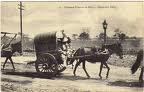
The Charrette in Paris
Innovators can profit much from a clever process finding wide use in the United States and abroad in urban planning and development. The process is known as “charrette”.
Here is how it works.
Charrettes often take place in multiple sessions in which the group divides into sub-groups. Each sub-group then presents its work to the full group as material for future dialogue. Such charrettes serve as a way of quickly generating a design solution while integrating the aptitudes and interests of a diverse group of people.
In urban planning, the charrette process is highly visual, with groups posting on walls drawings and pictures that reflect their thinking. The results are then integrated and combined. The process is not unlike that of IDEO’s “Deep Dive”.
For example:
…..the University of Virginia’s School of Architecture unofficially calls the last week before the end of classes Charrette. At the final deadline time (assigned by the school), all students must put their “pencils down” and stop working. Students then present their work to fellow-students and faculty in a critiqued presentation.
The charrette is employed by municipalities around the world to develop long-term city plans, drawing on a communal process in which ordinary citizens express their views, often by bringing pictures or drawings of neighborhoods they regard as ideal. The charrette process is time-limited — the goal is to achieve consensus on a master plan within a very short period of time, and it is collaborative, avoiding the adversial legalistic approach that can take years.
The term” charrette” comes from the French for chariot. It is said that French architecture students studying at the famous Parisian Ecole des Beaux Artes scribbled desperately to finish their final designs while riding to school “en charrette” (in a cart). An alternate explanation is this: At the end of a class in the studio, a charrette (cart) would be wheeled among the student artists to pick up their work for review while they, each working furiously to apply the finishing touch, were said to be working en charrette.
The charrette method (www.charretteinstitute.org) stresses speed and urgency, overcoming often-fatal inertia and bureaucracy. It overcomes the political obstacle of individuals pressing their own ideas by making the ultimate solution a collaborative one, to which all have contributed.
Can you build a charrette process in your organization? Why not create an actual ‘charrette’ (wagon, or ‘chariot’)? Roll it past groups, get them to place their visualizations on it, stick the results up on the wall — and then mobilize the group to integrate the ideas, back off them somewhat and create a final proposal that embodies the best features of all the various ideas. Encourage wild thinking, because ultimately, “feet-on-the-ground” wisdom will bring the ideas back to reality, in the process of integration.
Innovation Blog
The Real Truth About China’s High-Tech Industry
By Shlomo Maital
A terse and compelling background brief by Xing Yuqing, from the National University of Singapore’s East Asia Institute, reveals the truth about China’s high-tech industry. [1] Here are a few excerpts:
* China became the world’s largest high-tech exporting nation in 2006, surpassing Japan, the US and the EU-27, with 17% of global market share in high-tech products. China’s high-tech exports doubled every two years between 1995 and 2008!
* The cause of China’s high-tech export growth is “relocation of production capacities by multinational enterprises into China”; foreign MNE’s “account for 85 % of China’s high-tech exports”.
* A crucial role was played by Taiwanese-owned companies; Taiwan relocated all of its production in laptops, digital cameras, motherboards and LC monitors to China. This, despite China-Taiwan hostility. Apparently, business trumps politics.
* China “is far from being a real high-tech exporter”; so-called high-tech firms in China “are at the lowest value added segment of production chains: processing and assembling.” China imports large amounts of high-tech components.
* Despite China’s high domestic saving rate, much of China’s high-tech capacity was built and financed through FDI foreign direct investment.
* China has yet to build a true indigenous high-tech technology capacity. It is in fact an exporter of low skill labor, rather than high-tech technology.
Essentially, America and Europe have shifted their manufacturing to China. Was this wise? China leveraged its infinite labor supply to gain global competitive advantage, but is taking aim on the next stage in its long-range plan: Move up the value chain. This could be a threat to the U.S. and Europe. If it happens, it will be America and Europe that made it possible, by giving China a powerful boost up the high-tech value chain ladder.
[1] XING Yuqing, “China’s High-Tech Exports: Myth and Reality”, EAI Feb. 25 2010.



