
You are currently browsing the category archive for the ‘Innovation Blog’ category.
Cultivate More Stress! Really!
By Shlomo Maital

Tiger Woods is one of the world’s greatest golfers ever, in a league with Palmer, Niklaus, Snead, and Bobby Jones. He has had personal problems, a messy divorce, back injuries, surgery, and lately hasn’t made the first cut in tournaments.
Woods was stopped by police, in his car, near his home in Florida, and failed a breathalyzer test. But he had no alcohol in his blood. He had simply taken tranquilizers and fallen asleep; he took enough of them, so that he could not walk a straight line.
Let’s get this straight. No game has more stress than golf. That final putt? Make it and you win a major. Miss it and you finish second or third – not good. Stress? You bet. Yet doctors have doped up Tiger with Xanax (a blockbuster tranquilizer, making billions for Pfizer), Vicoden, Vioxx and who knows what else. Was he taking Xanax while playing? If so – no wonder he missed the cut.
Be clear – Xanax is a wonder drug for those who suffer extreme anxiety attacks. Yet it is according to US Food and Drug the most abused tranquilizer, prescribed for millions who do not need it. Why? Because we’ve been taught by Big Pharma and others, that stress is harmful, terrible, to be avoided at all costs, by popping a pill. So pop away…. and help that bottom line of Pfizer.
I argue here that we need more stress, not less. What is stress? Stress is “a state of mental or emotional strain or tension resulting from adverse or very demanding circumstances.” Simply put — We have an unsolved problem, and it bothers us. Let’s redefine stress. “…a challenge, that when we solve it (not if), boosts our self-esteem, self-efficacy and our sense of wellbeing”. Need a pill for that? No. You need to take on the challenge and crack it. Creativity is widening the range of choices. To meet unsolved problems, we can come up a large range of possible solutions. Zoom in, pick one – and go for it. Sometimes you will fail. That’s part of life. Sometimes you’ll succeed. But if you Xanax the stress, you’ll never get even the chance to succeed. When you tackle a stressful state, you change your mental outlook from anxiety to action….it’s that simple.
And – keep in practice. Purposely seek out hard things to do every day, and do them, and feel good about it. This is super-important for us seniors. It is so easy to pamper yourself, when you’re over 65, just because you have grey hair. Why? Take on challenges. Your body may not be as strong, but your mind sure is.
Do not be manipulated by Big Pharma. Welcome stress. Cultivate it. Tackle those big challenges – and crack them. You can do it. Popping a Xanax smothers the stress, temporarily, but doesn’t deal with it. It’s not a solution.
Murad al Katib: Entrepreneur of the Year
By Shlomo Maital
 Murad al Katib
Financial Times chose as its Ernst & Young Entrepreneur of the Year – Murad al Katib, who hails from my home town, Regina, Saskatchewan (Canada). Al Katib grew up in a small farm town, Davidson, Sask., population 1,000. Here is his story: (according to Ashley Robinson, writing in the Regina Leader-Post):
“The dinner time discussion at the Al-Katib household in Davidson would always centre around one thing — how do you create jobs on Main Street? It was a sentiment Murad Al-Katib kept with him over the years. His parents were community pillars in Davidson. The Al-Katibs immigrated to Canada in 1965 from Turkey and in 1975 settled in Davidson. His father, Fatih, was the local doctor and his mother, Feyhan, was a municipal councillor and later mayor of Davidson.”
In 2001, Katib sat in the basement of his home, in Regina, at a time when his wife was expecting the birth of their twins. He recounts that he saw that the world’s hungry billions would need a cheap source of protein, and it could not come from meat or poultry. It had to come from vegetable protein, e.g. lentils, chick peas, etc. He wrote the words Saskatchewan and Canada, formed the hybrid SaskCan – and started SaskCan Pulse Trading, a facility to clean and process crops grown in Saskatchewan before sale overseas.
Pulses are dried peas, edible beans, lentils and chickpeas, high in protein, low in fat. Katib used contacts in Turkey to sell his pulses. The company grew rapidly – in 2007 it changes its name to Alliance Grain Traders, and then, in 2014, to AGT Food and Ingredients. The goal: always: Feed the world, and create opportunities and jobs for Saskatchewan. The company today is valued at $900 m., and has 41 manufacturing plants on five continents, emplying 2,200 (of whom 650 are based in Saskatchewan). Katib travels the globe, but still resides with his family in Regina.
Murad al-Katib studied at U. of Sask. and in Arizona, worked at the Canadian embassy in Washington – and in desperation, wrote a letter to then-Sask. premier Roy Romanow. He wrote how he felt that international emerging markets was where Sask.’s future lies, and the province should focus efforts on trade development. Deputy Prime Minister Frank Hart read the letter, and hired al-Katib, bringing him home. At the time, a socialist NDP govt. had just been elected, in 1991, and Saskatchewan was undergoing hard times (partly due to the 1990-2 recession). In 2001 Katib quit his government job, and started a pulse processing company based in Regina. And the rest is history.
Katib’s twins Tariq and Serra now study at Campbell Collegiate, which has a unique business program Katib helped build.
Lentils are not high-tech. But they are highly nutritious, and can feed a hungry world in a healthy manner.
It is no accident that Katib’s parents were immigrants. Memo to President Trump: Canada has incredible energy, driven by its immigrants. My parents were immigrants. America too was built by immigrants. History will remember your folly.
Unlocking Epilepsy: Reframing the Question
By Shlomo Maital
At Davin School, in Regina, Saskatchewan (Canada), an elementary school, I had a classmate who had epilepsy. From time to time he would have a seizure. Everyone knew what to do – put a pencil between his teeth (to keep him from biting his tongue or swallowing it), and bring him to the Principal’s Office, where he could lie on a couch and sleep. I don’t know how he fared as an adult – but here is what Wikipedia tells us about epilepsy worldwide:
As of 2015 about 39 million people have epilepsy. Nearly 80% of cases occur in the developing world. In 2015 it resulted in 125,000 deaths up from 112,000 deaths in 1990. Epilepsy is more common in older people. About 5–10% of people will have an unprovoked seizure by the age of 80, and the chance of experiencing a second seizure is between 40 and 50%.
What causes epilepsy? A lot of research has been done, to answer this question, without definitive results. Sometimes, to crack a problem, you have to reframe the question. This is what a research team at the Hebrew University of Jerusalem, led by Prof. Hermona Soreq, has done. Her team included researchers from Ben Gurion University and Dalhousie University, in Canada. Soreq asked instead, why don’t more people have epilepsy? What actually prevents it?
I recalled that the discovery of an anti-Multiple Sclerosis drug, Copaxone, at Israel’s Weizmann Institute, results from similar reframing – how can we induce MS (to study it, in mice), rather how can we cure it?
Soreq’s team used rats, genetically engineered to over-produce a protein, micro RNA 211, that they suspected helped protect the brain from epilepsy. These mice were then given a chemical that lowers the concentration of this protein. Lo and behold, the mice developed epileptic tendencies.
Soreq observes: “We tend to research what causes disease and how to prevent it. We don’t ask why most people don’t get sick, though we should. Instead of finding medicines to cure conditions, it would be better to find what protects healthy brains.”
The results were published in the Proceedings of the National Academy of Sciences. The hope is, discovery of the role of microRNA 211 will lead to new treatments for epilepsy.
Forecasting Technology: Easier Than You Think
By Shlomo Maital

Many of us are bewildered, and somewhat anxious, about the speed of change in technology and the difficulty of predicting where technology is headed. Let me share a small story, that suggests technology changes predictably and much slower than we think.
At my university, Technion, at the main bus stop, there is a set of bookshelves. People bring books and magazines they want to discard; they are snapped up quickly. I’ve brought half my library there. Yesterday, I found a very old copy of Scientific American: September 1991, almost 26 years old! It was a special issue on communications, computers and networks. I read it on the bus ride home.
Here is what I found in it – 26 years ago.
* A description of High definition Television.
* An assertion that TV is migrating to cable, while telephony is migrating to ‘broadcast’ (i.e. cellular).
* a discussion of the rise of networked computing
* the transformation of education through computing and communication technologies
* the transformation of management through computers and networks
* difficult dilemmas for public policy, related to rules of the road for data highways.
* a description of tablets
I really did not cherry-pick these topics. I simply listed them.
Now, it is indeed true – there is a lot of writing out there that predicts technology that never happens. We still need to be critical, discerning readers. But the point is – if we read widely, constantly and carefully, and critically, there are enough clues to enable us to figure out the direction of future dominant technologies well in advance. So read widely, keep your eyes peeled, think critically – and you’ll have a jump on the masses of perplexed people who, perhaps, are a bit lazier.
Effective Altruism: If Only We ALL Practiced It
By Shlomo Maital
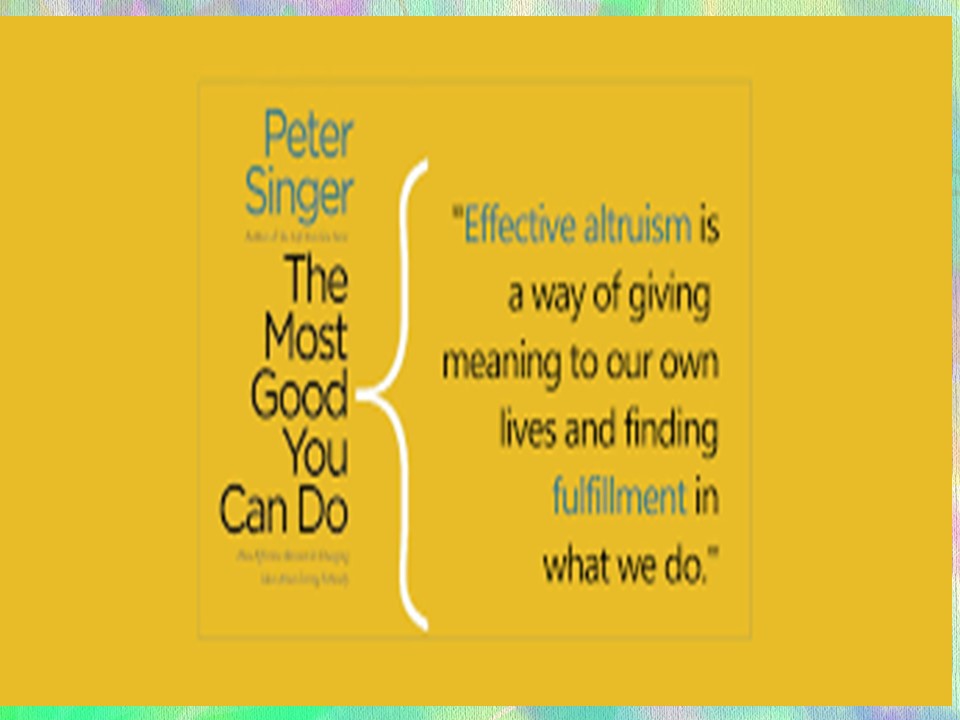
Altruism is defined as a philosophy of doing good for others. It is an admirable change-the-world framework for living. But is it enough? Philosopher Peter Singer (in a superb TED talk – you can look it up) proposes effective altruism – which applies evidence, logic and reason to find the most effective and efficient ways to help others. Yes, do good – and do it in the most powerful impactful way, by carefully planning what and how you do.
Singer’s example: a seeing eye dog costs $40,000 to train, and to teach the blind person how to make best use of it. Highly worthy. But millions in poor countries are blind, due to trachoma and cataracts – both of which are curable and fixable. You could bring sight to perhaps 200 blind people with the resources used to train one guide dog. Altruism is providing seeing eye dogs. Effective altruism is weighing the best use of those resources.
Bill Gates and Warren Buffett have given billions to medical charities. Gates’ Foundation has saved an estimated 5 million lives – and enriched the lives of millions more – by rigidly applying effective altruism to their resources and projects, focusing on illnesses that are widespread, afflict the poor, and that can be cured or mitigated. Like malaria.
What if millions of people worldwide would embrace altruism? And then, what if we could supply a very simple straightforward set of guidelines, about how to be efficient in our altruistic behavior? Our time, resources and energy are limited. How can we do the most good with them? And even before asking those questions – how can the notion of ‘effective altruism’ be ‘sold’ to the masses?
Today everything is becoming ‘evidence-based’. Perhaps doing good for others, too, should be more evidence-based. When we combine the powerful emotion of giving, and the impactful logic of rational decision-making, the result can be immensely beneficial to humanity.
Homo Prospectus: What Makes Us Human
By Shlomo Maital
Martin Seligman is one of America’s leading psychologists, and inventor of the ‘learned helplessness’ theory, which explains why we sink into despair and apathy. That theory, it turns out, is more than a little negative. So Seligman took the opposite tack, and helped invent positive psychology, which is about how to be efficacious optimistic and happy.
Seligman and a journalist, John Tierney, wrote an interesting piece in the New York Times magazine, excerpted in the global New York Times. In it they make an interesting point. Homo sapiens (wise human) is a misnomer, they say. Because – well, we humans are not that wise… Just look around the world at what we do to each other.
Instead, call us homo prospectus (future looking human). Because we, unlike animals, are able to imagine distant futures and things that do not yet exist. This makes us creative. When we make decisions, we weigh consequences, and in fractions of a second, envision future consequences of our decision and then choose or decide. Seligman and Tierney say that “the main purpose of emotions is to guide future behavior and moral judgment.” Why? You judge how you and others feel, when you ponder a behavior, and decide on that basis.
Moreover, they cite brain imaging research, showing that when we recall a past event, we combine 3 pieces of information from 3 different parts of the brain: what happened, when it happened and where it happened. Apparently, we use the same circuitry when we imagine a future event. Our hippocampus (a part of the brain) assembles these three pieces of prospective guessing, to create something new. And even when we are relaxing, our brain constantly works “to recombine information and imagine the future”.
My ‘take’ on this? We have become a myopic society, focused on present gratification and present consumption, and far less on saving and delay of gratification. Are we degrading “homo prospectus”? Are we degrading what truly makes us human, and in doing so, damaging our future and that of our children?
More on China’s New Silk Road
By Shlomo Maital

My friend Einar Tangen is an American citizen who has been living and working in China for many years, and is a commentator for Chinese English-language TV. Here is his ‘take’ on the BRI Belt Road Initiative:
By putting $124 billion on the table, towards his ambitious $5 trillion 60 country grand plan, Chinese President Xi Jinping made it to the front page of world news, politics and economics. At the Belt and Road Forum for International Cooperation (BRF), Xi made it clear that the Belt and Road Initiative (BRI) is at the center of a new Chinese soft power and trade approach, not just regionally, but globally. In all, over 100 nations sent representatives, of which over 60 have, or are in the process of signing up to the BRI. Some have nicknamed it “WTO 2.0.”
Notable was Xi’s “rising tide” exposition of inclusive predictability, contrasted sharply with Trump’s “America First” situational impulsiveness. But, as China moves into the Trump vacuum – while money talks, it also divides – so as countries are looking at the opportunities, China will need to continue shouldering the challenges and possibilities.
BRI is aimed at physically, economically and socially linking both countries and their citizens. For example: Farmers in remote parts of Thailand, Kazakhstan or Sri Lanka, might have heard of WTO, but without physical access to roads, rail or ports, it meant nothing. Under BRI, for those nations that participate, farmers will get the physical access and internet tools they need, to reach markets around the world.
But, while China is leading this bold new effort, it cannot do it alone and will need partners. Dealing with such partners will require an understanding of their political, economic, linguistic, social and cultural realities. This will require a learning curve, part of which Beijing is attempting to solve with person to person cultural and educational exchanges and scholarships.
China’s BRI is a new kind of trade initiative, one that dispenses with the post WWII ideological trade doctrines championed by the World Bank, IMF, ADB, large corporate interest and many developed nations, in favor of a non-interventionist inclusive pragmatism focused on sustainable trade and market development. The idea seems to be to figure out ways to stabilize the world by creating moderate prosperity regionally and now globally.
BRI’s ability to gather under one roof Iran and Saudi Arabia, Palestine and Israel, rivalling only the UN in this area, is a testament to the possibilities of this approach. But, the world does not change in a day, and the certitude of American exceptionalists and those who champion an inflexible version of Liberal, Democratic Capitalism, remain unconvinced.
For the developing and emerging nations it is a vital lifeline to the infrastructure they need to develop their economies and stabilize their countries. Concerns about basic human rights are essential, but there has been little progress trying to solve them using the barrel of a gun.
My own conclusion: Yesterday Donald Trump spoke in Saudi Arabia, basking in the glow of many many billions of dollars of arms sales, as the Saudis use their petrodollars to buy American support against their fanatical foes Iran. As Trump tries to organize a Sunni coalition against ISIS, and fanatical Islamic terrorism, China works to reinvent global trade.
Which do you think will benefit humanity more? Which leader has the most powerful vision?
Regional to global, “WTO 2.0”
The WTO ushered in a tide of prosperity that linked nations, but not always people; BRI takes the WTO idea one level deeper, but without the ideological baggage.
As Xi’s frequent references to the time and distance made clear, this is not a short term political feel good project to appease a restive electorate, but a carefully staged multi-level far reaching initiative. So, what was initially a response to the U.S. maritime encirclement effort, has become the focal point of China’s efforts to: change global governance and finance models away from ideological absolutes towards pragmatic consensus; modernize its economy; create new sustainable markets; and escape a looming middle income trap.
Trade and soft power
Under the BRI, if a country does not like the actions of another country, it can simply not trade with them, or put the matter before the UN, but no mandate of righteous will exist to force a solution by arms.
As such, China’s BRI is not only a trade vehicle, but a soft power initiative, one that will emphasize consensus over corporate models of interaction between countries.
100, 54 and 29
Over 100 hundred nations and international organizations attended the BRF, of which 54 have signed on in some capacity. 29 country heads attended, but, the BRI has a way to go, as not all countries, identified in the BRI, sent heads of states or senior representatives.
At the next forum, scheduled for 2019, given the amount of attention and, dependent on China’s progress, it is probable that the number will go up dramatically. For example: the presence of the ABC’s, Argentina, Brazil and Chile, all represented by their presidents, except for Brazil, makes it clear that the allure of Xi’s grand plan is now global.
In Chile’s case they cemented an agreement to join the AIIB, which now has 77 members and will be at 85 by year end. The membership of Chile, Bolivia and Brazil and possibly Argentina, in the future, is an important milestone which shows both the global attraction of Xi’s plan and the drift away from Trump’s notions.
China and the U.S.
Ironically, given the history of why the BRI was created, the U.S. sent a delegation headed by a senior member of the Trump team, which acknowledged the importance of the BRI and then lobbied for American firms to be included in future projects. Interestingly, they were welcomed, just as was the DPRK, as Beijing went to great lengths to demonstrate, that politics was not part of the BRI.
But, to the majority of the world, the take-a-way will continue to be the contrast between Trump’s Me first vs. Xi’s rising tide; a contrast which is reshaping trade and soft power, as countries like Mexico, shift their wheat and corn imports from the U.S. to Argentina and Brazil.
Money talks, money divides
The numbers immediately drew the eyes of the world, the flip side was a spirited jockeying, by those attending, for inclusion as benefactors and participants. The question is; will countries see the value in Xi’s grand plan or just fight over who gets what.
Challenges, opportunities and solutions
Xi’s BRI has a long road ahead of it, and it seems China is willing to be patient.
The main challenges will be: understanding their partners, convincing a critical mass of them to see the value of the system, a sometimes hostile or indifferent international press and ideological, spheres of influence and territorial conflicts.
On the opportunities side, it could change global governance towards a more consensus rather than corporate driven model, help China through its middle income trap period, soak up excess industrial capacity, create new markets for goods and services and politically and economically stabilize countries, by offering better economic alternative and opportunities.
On the solutions side, for Xi’s part his willingness to step forward and attach resources to his grand plan indicates a willingness to take a leader’s role; his attention to political, economic, linguistic, social and cultural understanding is a measured path to avoiding misunderstandings.
But in the end it will be the smaller, but vital pieces of roads, rails, sea ports, airports, agreements, financing and the things which make them work; like the TIR Convention China joined last summer, which allows sealed containers to pass from source to destination, without the need to have inspections or pay tariffs along the way.
It is a grand plan and one which envisions a different future, the only question is will the world react positively or be content to struggle under the system we have now.
Einar Tangen is a political and economic affairs commentator, author and columnist
Opinion articles reflect the views of their authors, not necessarily those of China.org.cn.
The World Economy: Upbeat
By Shlomo Maital
“Ifo” is a German research institute that sends out regular questionnaires to experts, with two parts: the first, about global conditions, and the second, about local (country) conditions. I respond to the questionnaire regularly.
Here is Ifo’s latest assessment:
Munich, 11 May 2017 – The ifo World Economic Climate improved markedly in the second quarter, with the indicator rising from 2.6 points to 13.0 points. Experts’ assessments of the current economic situation were considerably more positive, making their sharpest increase since January 2013.
Not only did the global economy improve, but so did expectations about the future:
Economic expectations also improved. A further recovery was seen in the world economy in the second quarter. The ifo World Economic Climate improved in nearly all regions of the world. The main drivers remained the advanced economies, and especially the European Union. Both assessments of the current economic situation and expectations continued to follow an upwards trend in most countries.
As usually happens, the upbeat outlook is not uniform. Latin America and Africa and the Mideast lag:
In Latin America assessments of the economic situation remained largely poor, but expectations brightened markedly. There was also a significant improvement in the developments and outlook for emerging and developing economies. Africa and the MiddleEast were the only regions in which the economic climate deteriorated. The outlook for Turkey also remained overcast.
The common denominator? Politics. Politics in Turkey, the Mideast and Latin America are rather chaotic (checked out Venezuela lately?) Politics in Europe seem more positive, with the voters rejecting the far right. In America, politics are chaotic but this is not new…
So, despite Trump, and an anti-globalization anti-trade sentiment sweeping the world, the world economy seems resilient. A new China-US trade deal is in the offing. One dark cloud on the horizon – Brexit. The EU seems in a vengeful mood, and some there want to teach Britain a lesson. This would be a huge mistake. Hopefully wiser heads will prevail.
North Korea: The Real Story
By Shlomo Maital
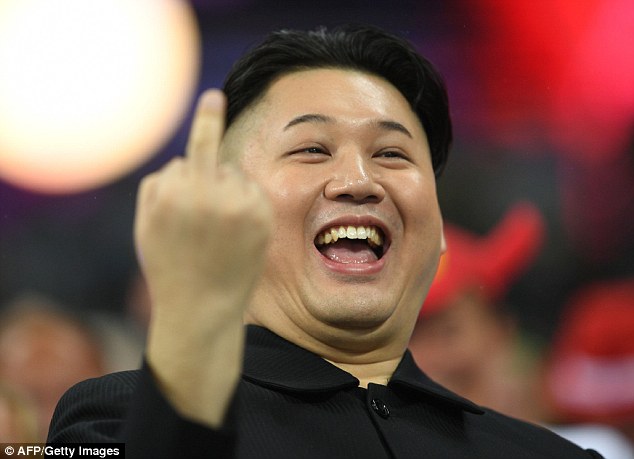
The photo is NOT Kim Jong Un, North Korean leader, but a look-alike. But it conveys what the world perceives – a crackpot leader giving the world the finger.
But New York Times journalist Choe Sang Hun, based in Seoul South Korea, brings us a different perspective. Kim’s father Kimg Jong Il, son of Kim Il Sung, was decidedly anti free-market and worked hard to suppress any free-market activity in North Korea.
His son, in contrast, Kim Jong Un, has taken another tack. Since 2010 the number of government-approved markets has doubled, to 440; the NYT reports that “satellite images show them growing in size in mot cities. “In a country of 25 million, about 1.1 million people are now employed as retailers or managers in these markets, according to the Korea Institute for National Unification.”
“At least 40 % of the population in North Korea is now engaged in some form of private enterprise, a level comparable to that of Hungary and Poland shortly after the fall of the Soviet bloc, the director of South Korea’s intelligence service, Lee Byung-ho, told lawmakers in a closed-door briefing in February”.
“This market activity is driven in part by frustration with the state’s inefficient and rigid planned economy”. The result is an economy that is not doing so badly, despite strong world sanctions.
So there is an alternate scenario to the one now causing the world to lose sleep – one in which North Korea assaults its neighbors and even the US with fearsome weapons. That scenario has North Korea shedding communism, like a snake sheds its skin, and joining the global economy and marketplace.
The reporting on North Korea, overall, shows, I believe that the problem with modern journalism is not fake news, but bad news – bad shallow reporting that fails to convey what is really going on. There are a few exceptions, including the newspaper, NYT, Trump despises. With all the noise and clutter in the Internet, it is not easy to find insightful reporting. But it is still possible, with effort.
Key Disruptive Global Trends: The View from McKinsey
By Shlomo Maital

“The trend is your friend.” Thus begins a terse McKinsey Quarterly (April) article on disruptive global trends. The trend is your friend – provided you spot it accurately. It is your enemy if you miss or misread it. Here is McKinsey’s take on the nine key disruptive global trends.
The first three: “ ● The globalization of digital products and services is surging, but traditional trade and financial flows have stalled, moving us beyond globalization. ● We’re also seeing new growth dynamics, with the mental model of BRIC (Brazil, Russia, India, and China) countries giving way to a regional emphasis on ICASA (India, China, Africa, and Southeast Asia). ● Finally, the world’s natural-resource equation is changing as technology boosts resource productivity, new bottlenecks emerge, and fresh questions arise about “resources (un)limited?”
What do these trends mean to you, to your job or business or startup? Can you find opportunity in them?
The next three tensions highlight accelerating industry disruption. “● Digitization, ● machine learning, and ● the life sciences are advancing and combining with one another to redefine what companies do and where industry boundaries lie. In the words of Alibaba’s Jack Ma, B2C is becoming “C2B,” as customers enjoy “free” goods and services, personalization, and variety. And the terms of competition are changing: as interconnected networks of partners, platforms, customers, and suppliers become more important, we are experiencing a business ecosystem revolution.”
The final three forces: “● underscore the need for cooperation to strike a new societal deal in many countries. We must cooperate to safeguard ourselves against ● a “dark side” of malevolent actors, including cybercriminals and terrorists. ● Collaboration between business and government also will be critical to spur middle-class progress and to undertake the economic experiments needed to accelerate growth. This is not just a developed-market issue; many countries must strive for a “next deal” to sustain progress.
Scary? Risky? McKinsey strikes an optimistic note: “These tensions seem acute today because of fast-moving political events and social unease. But earlier times of transition provide encouraging precedents: the Industrial Revolution gave rise to social-insurance programs in Western Europe and the Progressive movement in the United States, for example.” In other words, times of change and disruption always bring opportunities, for those who see clearly and act decisively.
Are YOU among them?

 TIMnovate