
You are currently browsing the category archive for the ‘Innovation Blog’ category.
Why You Must Listen to Sales!
By Shlomo Maital

As a management educator, I recall doing Workshops for senior management, and asking participants what their job function was. More often than not, one key position was missing – Sales. The sales personnel had no time for Workshops. They were out in the field, selling, because much of their income was based on commission…and you get no commissions sitting and listening to a professor.
Far from sight, far from mind. When sales does not sit in headquarters, it is often underused or even forgotten. Yet it is sales, not marketing, that has the key market insights.
Now comes Sony, comes an object lesson in why you must listen to sales. Sony has been struggling for years. Finally, it has a winner – Sony Interactive Entertainment (its video game division) has a winner, PlayStation VR, a virtual reality headset. Since it went on sale in October, it has been scarce in stores, especially in Japan.
Why?
Andrew House, global CEO of the division, among those inside the company advising that Sony make fewer of the headsets, explains, “it’s the classic case in any organization – the guys who are on the front end in sales are getting very excited, very hyped up….you have to temper that with other voices inside the company, myself among them, saying let’s just be a little bit careful.”
Let’s think about that. Those who make the sales, and who earn their income from them, are hyped up. They know the market. They know what they can sell and how many. But the headquarters gang, up in the corner office, on the 42nd floor, who haven’t talked to a real customer for a decade – they are cautious.
So whom to you listen to?
For innovators, and startup entrepreneurs: At the outset, forget about marketing. Focus on sales. Find a great salesperson. Get them out into the market. And consult with him or her frequently, often, and really listen, and take their advice seriously.
Lost sales due to undersupply will usually not be recovered. Sony’s VR has competitors. Four months after it went on sale, Sony’s VR headsets sold 915,0000! This is not that far from iPhone’s 1.4 million unit sales in three months, after launch in 2007. So, did Andrew House learn a lesson? I wonder.
Source: Global NYT, Int. edition, March 1/ 2017, p. 9.
Forgotten Farmers
By Shlomo Maital

Today’s New York Times has an unusual Op-Ed piece by James Rebanks, a British sheep farmer, who lives in the lovely Lake District. (I recall hiking there, when I was a student at U. of Manchester 50 years ago). He is touring the US to promote his new book, a memoir, “The Shepherd’s Life”.
Here is a key passage: “Economists say that when the world changes people will adapt, move and change to fit the new world. But of course, real human beings often don’t do that. They cling to the places they love, and their identity remains tied to the outdated or inefficient things they used to do, like being steel workers or farmers. Often, their skills are not transferable anyway, and they have no interest in the new opportunities. So, these people get left behind.”
We economists spin theories from our comfy offices, about how the force of social Darwinism (competition for resources) drives efficiency. You’re a farmer? Herd sheep? Your country imports cheap mutton? Tough for you. Find another trade. That’s life.
This is the economic theory. It’s time to rethink it.
Economic freedom should also mean the freedom to choose our livelihood, and to engage in it as long as we wish. Farmers are so few, so forgotten, and are so threatened..Rebanks writes about abandoned farms through the US, but who cares? Who even notices? America is flooded with cheap (and mostly unhealthy) food from abroad.
Rural America matters. So does rural EVERYwhere. Rebanks is right. Time to rethink the cruel free-market theory economists sold the world.
Last Saturday (shabbat), I had the privilege to read a passage from the Bible, Kings 2, in our synagogue. The passage tells how young King Joash restores the Temple, by raising crowdfund money, “everyone according to his heart” and to his soul. Money. Heart. Soul. Those three things must go together in any economic system that claims to be just and fair. An economic system without a heart or soul is unacceptable.
Mildred Dresselhaus, 1930-2017
By Shlomo Maital

Mildred Dresselhaus
On Feb. 20, MIT Professor of physics and electrical engineering, Mildred Dresselhaus, passed away at her home in Cambridge, MA. She was 86. Born Mildred Spiewak, she was the very first female Institute Professor at MIT (an Institute Professor is a super-distinguished professor).
Dresselhaus was known as the Queen of Carbon, in scientific circles. She used magnetic fields and lasers to map out the electric structure of carbon and found that by stitching in alkali materials, carbon can become a superconductor. She pioneered in researching “buckyballs” (fullerenes), soccer-ball shaped cages of carbon atoms, widely used for drug delivery, lubricants and catalysts. She also had the idea of rolling a single layer of carbon atoms into a hollow tube, the nanotube, making a structure with the strength of steel but just 1/10,000th the width of a human hair.
Dresselhaus published over 1,700 scientific papers. Her life was one of struggle and perseverance. She was the daughter of poor Jewish immigrants from Poland, and grew up in the Bronx. She went through university on scholarship.
She once recounted, according to the New York Times, “my early years were spent in a dangerous multiracial low-income neighborhood. My early elementary school memories up through ninth grade are of teachers struggling to maintain class discipline with occasional coverage of academics”. From age 6, she travelled long distances on the subway. She got in to Hunter High School, in Manhattan, and then Hunter College. Her lifelong mentor was Nobel Laureate Rosalyn Yalow, from whom she took an elementary physics course.
Why did she choose to study carbon? Because it was unpopular and considered uninteresting, she observed. She and her husband were hired by MIT in 1960, because MIT was one of the few places that would hire a husband and wife team. At Lincoln Labs, she was one of only two women, out of a scientific staff of 1,000.
She is survived by her husband Gene, and four children, Marianne, Carl, Paul and Eliot, and five grandchildren. She will be remembered as the first woman to secure a full professorship at MIT, in 1968, and she worked “very vigorously to ensure she would not be the last”, observed Natalie Angier, in the New York Times.
Why U.S. Dams (and Society) Are Crumbling
By Shlomo Maital

Two newspaper items (one in New York Times, the other, Financial Times) reveal why America is crumbling.
California’s Oroville Dam, America’s tallest, has a crumbling spillway that forces evacuation of 200,000 nearby residents. (A dam collapse in California in 1928 killed 400, as a wave of water swept over them). As early as 2005, experts spotted a design flaw in the dam – never corrected. Heavy rains filled the reservoir to capacity, and severe weather because of global warming reveals that this dam, and many others, are not up to the changing weather patterns, for which they were not designed.
There are 1,585 dams in California, notes the NYT, and 90,000 dams across the U.S. Many are in poor shape. Why? “Government is more inclined to invest money in building new projects, than in less visible and glamorous maintenance”.
America is a consumption-driven society that under-saves. A $500 b. trade deficit (imports minus exports) for nearly 3 decades is a symptom. China is not to blame. The U.S. itself is. It is comfortable to borrow money from China to buy consumer goods. Some 23 years ago, my wife Dr. Sharona Maital and I published an article, in the Journal of Socioeconomics, in which we warned about a drastic fall in savings behavior in the US and Western countries. * Nothing has changed since.
The Financial Times notes today:
“China ended a six-month streak disposing of its US Treasury holdings in December, adding to its position for the first time since last May as the country’s central bank seeks to manage capital flight. The country, which ceded its status as the world’s largest owner of haven Treasuries in October to Japan, added $9.1bn of US sovereign debt to its reserves in the final month of 2016, new data from the Treasury and Federal Reserve showed on Wednesday.”
So, in the post-Trump era, America has gone back to borrowing, to buy consumer goods rather than maintain its dams, its roads, schools and infrastructure.
And President Trump? He is rapidly running down his checklist of promises, issuing so far 11 Executive orders. But what about that trillion-dollar infrastructure plan? Dead silence. Why? Because it will take a vast plan to design and implement it. In the current chaos of the new Administration, it is unclear whether the Trump presidency is up to the challenge – or even whether it is aware of the problem.
So America – at least, its dams and roads – are crumbling. I don’t see a solution in the near term.
* Shlomo Maital and Sharone L. Maital. “Is the Future What It Used To Be? A Behavioral Theory of the Decline of Saving in the West”. Journal of Socio-Economics, vol. 23, 1,2. 1994.
Retirement Security: Not Just About Money
By Shlomo Maital
Writing in the American Psychologist (2016, no. 4.), Jacquelyn Boone James and Christina Matz-Costa, along with Michael A. Smyer, make a simple, key point. Retirement security is NOT just about having enough money. It is also about “psychological security” — the desire to stay engaged, contribute to society, and feel a sense of belonging in later life.
I am 74 and am keenly aware of this. At this age, it is a daily struggle to remain relevant for those around me. How to do it?
Find new and better ways to “create value”, the mantra of entrepreneurs. Support grandchildren (and children), and provide them with the previous-generation computer, tablet, smartphone or automobile; encourage them, give gentle advice, and just be there to listen. Be a good colleague. I regularly bake bread for my officemates; small but for them, noticed and valued.
Bring your experience to the table. Do it gently, because the world changes rapidly – but often, noting what has gone before is of value to those who are unaware of it.
Generate lots of ideas, and then give them away – let your colleagues grab them and run with them, and even own them. Giving up a child for adoption is painful, but giving up ideas for adoption can be glorious.
Give praise and encouragement generously. Often praise (when deserved) is a scarce commodity. Help even the score.
Be a good listener. Offer your ear to your colleagues and your family, and simply listen attentively. Sometimes, that’s all they want. Not solutions, or suggestions, but simply, someone to listen.
Invest time to keep up to date. A key part of relevance is knowing what is going on today. If your knowledge is dated, and it quickly becomes so, it will be less and less valuable, and you will be less and less relevant.
Work at creating value for those around you daily, make it a part of your life, and you will ultimately achieve a large measure of psychological security, because you will be needed by those you love and care about – and nothing can be more important or meaningful, for seniors.
How Technion Physicists Cracked a Mystery of Biology
By Shlomo Maital

Hydra
A team of Technion-Israel Institute of Technology physicists (led by Profs. Kinneret Keren and Erez Braun, with a group of students) has published breakthrough research in the journal Cell Reports. It is unusual for physicists to publish in a biology journal. Here is the story.
The subject of the research was the amazing ability of the “hydra”, a tiny fresh water animal, 1 cm. in size (about half an inch), to regenerate itself. The hydra’s skeleton has a built-in memory that enables it to regenerate. If you take a piece of hydra tissue, it can soon regenerate the entire animal. But how? Until now, it was thought that this worked through chemical signals that guided the tissue on how to create a head, tentacles and a foot.
But the new Technion study finds a different explanation. It is done with thin protein fibers. The skeleton of the protein fibers survive, and they instruct cells how to arrange themselves to create an adult body. First, the pieces of tissue severed from the hydra form a small ball. This forces the protein fibers to balance the preservation of the old skeleton structure and adaptation to the new ball. New body parts develop, based on the pattern information stored in the skeleton. The ball soon sprouts a mouth and a whole new animal. The physicist researchers used their science to understand the physical role of the “ball”.
Could this one day lead to a technology that enables humans to regenerate their body parts? Far fetched? Indeed. But it could happen.
The fruitful research of physicists in biology reminds me of a meeting I had with a distinguished Indian scientist, during a recent visit, who decades ago pioneered in biophysics, which has since yielded huge bounties.
Innovator – if you can link two fields that are heretofore unconnected, you may come up with change-the-world ideas.
Ashley vs. Ivanka: Choose Your Role Model
By Shlomo Maital

Ashley Biden & Father Joe
President Trump recently tweeted his recommendation, that people buy his daughter Ivanka’s upscale fashion designs, after retail chain Nordstrom took her clothes off its shelves. (“They don’t sell,” Nordstrom claimed).
Another famous politician has a designer-daughter – former Vice President Joe Biden and his social worker daughter Ashley. Her story, and product, are a bit different.
According to Elle Magazine: “Ashley’s new ethically produced, American-made clothing company, is a project any dad would be proud to get behind. It kicks off with a range of supersoft organic cotton hoodies on sale for just a few weeks, starting February 8, in partnership with the flash-sale behemoth Gilt: The entirety of the proceeds from the debut collection will be channeled to programs that work to alleviate poverty through education, training, and job placement.
“Ashley, 35, who is also the executive director of the Delaware Center for Justice, a nonprofit that serves children and adults impacted by the criminal justice system, had toyed with the potential nature and mission of Livelihood for years. One thing that never wavered was the idea of the hoodie. This is partly because Ashley herself—who has a stealth charisma and a fondness for phrases like “heavens to Betsy”—describes herself as a “jeans-and-T-shirt kinda gal.” It’s also because she appreciates the symbolism of an item long connected to American laborers and more recently to Black Lives Matter. “Livelihood is specifically about income inequality,” she says. “And racial inequality and income inequality are directly related.”
“By the time her parents moved into the VP’s mansion in 2009, Ashley—who did her undergrad at Tulane, then earned a master’s in social work from the University of Pennsylvania—had a job serving kids in the foster-care system. It was disorienting, to put it mildly, to travel from a juvenile detention center to, say, Air Force 2. What did become increasingly clear was how little privileged Americans understood about life below the poverty line, where 13.5 percent of the U.S. resides. “I’d hear about five siblings sharing one burger,” she says. “How does a kid do homework when there’s no desk or lamp? One of the biggest things I’ve seen in my work is that a lot of social ills directly result from poverty.”
Does it take a privileged daughter of the U.S. Vice-President, to explain to us how little we the privileged understand about the life and hardships of the one in seven who live in poverty? And will we opt for the role model of Ivanka Trump, who sells to the wealthy, or Ashley Biden, who works for the poor, and has done so for her whole career?
Snapchat: Think Differently
By Shlomo Maital
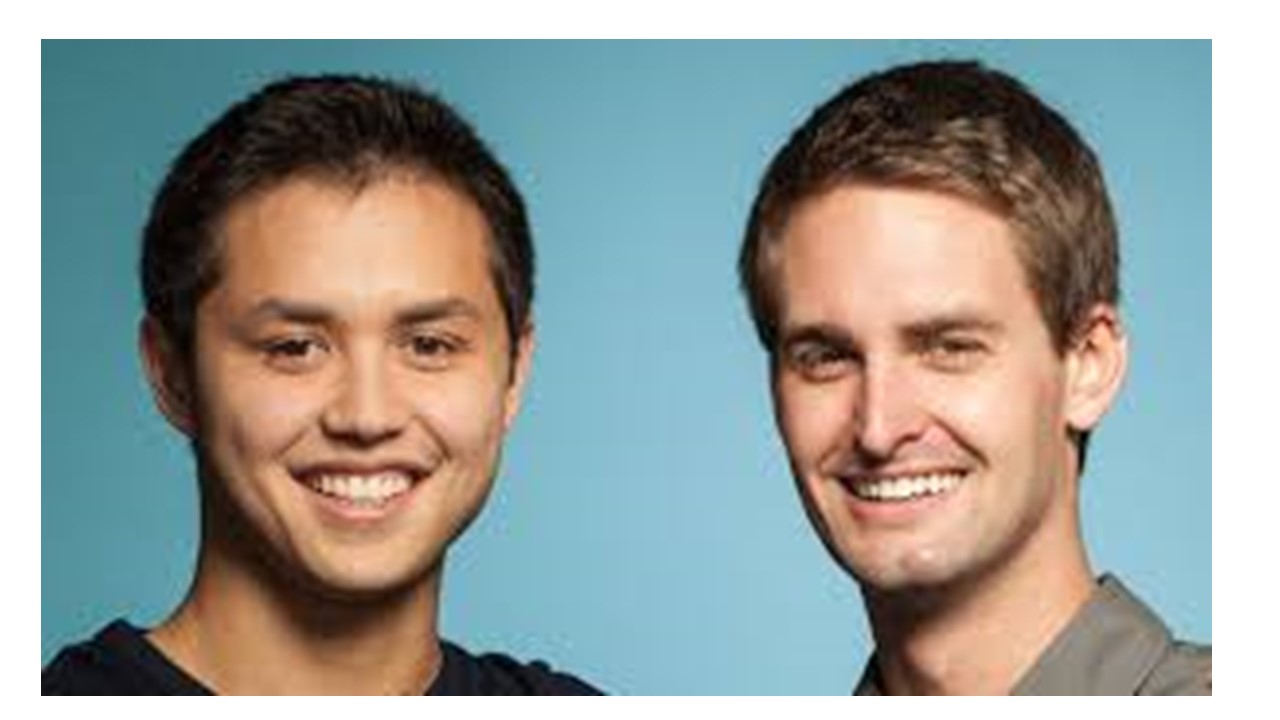
Snapchat Founders: Bobby Murphy, Evan Spiegel
Stanford University undergraduates Bobby Murphy and Evan Spiegel had an unconventional observation about social media – one that made them billionaires.
“What makes a social network valuable? In the Facebook era, everyone believed they became valuable by amassing more and more users. Obvious, right?
But Spiegel noticed, that in real life, most of us spend more of our time with just a few friends, whose value outweighs huge numbers of looser ties. So from their Stanford dorm rooms, they made Snapchat an app that would send DISAPPEARING photos and images, n a way that “more closely mimicked the dynamics of a real world conversation” (See Katie Benner, NYT, Feb 3). It would raise the appeal of Snapchat as a service that people used with a small number of good friends.
And were they ever right!! Snapchat is now close to an IPO, and it will be valued at billions of dollars.
It’s not just that the two founders practiced ‘think differently’. They did think differently, but in a way that appealed to the way we live, think, interact and chat with friends. Think differently is fine, but it has to be focused, built on solid foundations of the way people behave, and the way we observe people behave.
Innovator — check out social media, and innovations in general. Can you think different? Can you alter the basic principles, so that the device or service more closely matches the way we behave in the real non-digital world? If so, you can be the next Snapchat startup moguls.
“The Poor Should Not Be Treated Poorly”
By Shlomo Maital
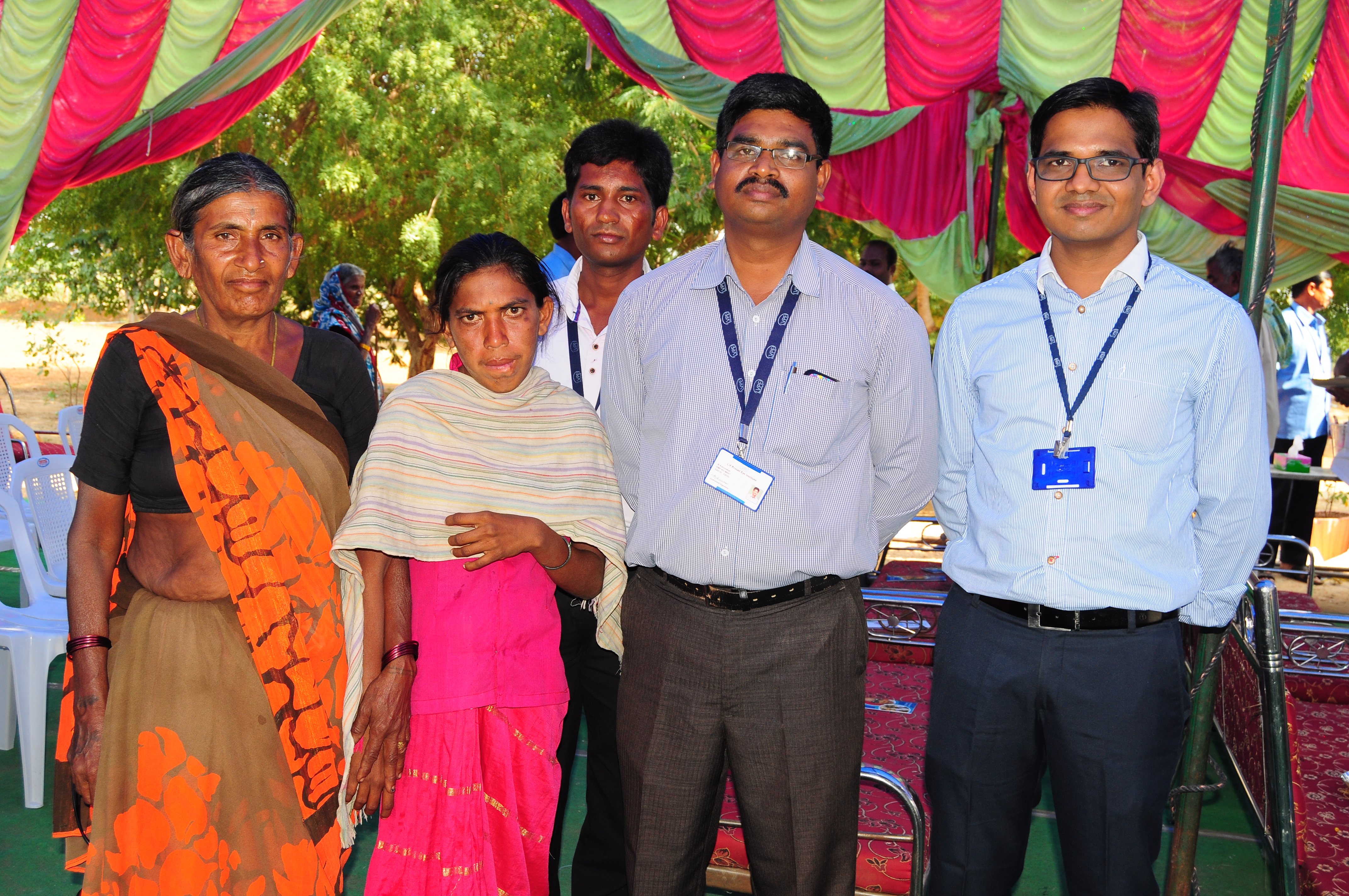
From left to right: N. Ankalamma,(mother of Chennamma), Chennamma (patient), Mr Thirumla Kondalu & Mr Karunakar (Community Based Field Staff who counselled her at her home) and Dr Nilesh Jaiswal (Ophthalmologist who performed the surgeries at the secondary centre).
– – – – – –
I’ve just returned from a short trip to Hyderabad, India, where I and my co-author Prof. D.V.R. Seshadri launched our new book Smartonomics (SAGE India). While there, Seshadri and I visited the L V Prasad Eye Institute, which has treated 21 million patients since it was founded 30 years ago by Dr. G. N. Rao. We are writing a Case Study about LVPEI.
Here in brief is the story. Dr. Rao and his wife Prattibha lived in Rochester, New York, in 1986. Dr. Rao had a comfortable prestigious position at the University Hospital there, as a top ophthalmologist. But he and his wife chose to return to their homeland, India, to found a world-class eye disease institute. A famous film producer L V Prasad donated the money for the land and building, in Hyderabad.
Dr. Rao’s vision was to provide excellent world-class eye care for all, including those who could not pay. How? Cross-subsidization. Those who could pay, would. Those who couldn’t, would not. And somehow the resources would make possible truly excellent innovative eye care, restoring vision for many many thousands. LVPEI began in 1987 with three examination rooms and 2 operating rooms, and soon expanded into 4 states, with primary, secondary and tertiary eye care reaching into the poorest rural regions.
Dr. Rao implemented his vision of the four E’s: excellence, efficiency, equity and empathic eye care. He expressed it as an Eye Health Pyramid (see figure):

In this model, state of the art eye care was provided at the LVPEI center in Hyderabad, India’s 6th largest city. Secondary and primary eye care was pushed out to the periphery, always under the watchful eye and supervision of the LVPEI center. In the past 3 decades, 21 million people have been treated. Many have had vision restored. There is no greater gift.
This model is crucial, because however excellent, the Eye Care Center in Hyderabad is of little value for the rural poor, unless there is outreach and counselling that identifies their problems and begins to treat them. All too often, health care available in big cities is far superior to that available in the poor rural regions.
Here is just one small story: Nalagati Venkata Chennamma was born with visual and intellectual impairment. At the age of 8, her vision deteriorated further. Fearing high fees and Chennamma’s difficult behaviour, doctors were never consulted by the family. At the age of 20 she underwent an eye check and was declared 100% blind. But as fate would have it, five years later, Karunakar one of LVPEI’s Field Rehabilitation Service Officers visited her and spotted symptoms of cataract. Apprehensive in the beginning, Chennamma’s mother brought her to LVPEI’s secondary centre in Markapuram on 7th November 2016. She was operated by Dr Nilesh Jaiswal for congenital cataract in both of her eyes and subsequently regained functional vision. There is a possibility that her vision can be further enhanced and she is currently undergoing treatment at LVPEI’s Hyderabad Centre of Excellence Campus. Today, her family is delighted with the outcome of the surgery and are thankful to LVPEI and its talented doctors. There is hope that with vision restored, Chennamma can make up some ground in her intellectual development.
Dr. Rao has just been selected for the American Society of Cataract and Refractive Surgery (ASCRS)’s Ophthalmology Hall Of Fame, a rare honor given to very few. He will travel to the Los Angeles for the induction ceremony on May 6.
Polar Bears – Nature’s Astounding Innovations
By Shlomo Maital

Nature is our supreme innovator. Over many thousands of years, random mutations occur, most of which fail, but a few succeed in helping species to survive to procreate – and became permanently embedded and reproduced in their genes. This evolutionary innovation is slow but highly effective. Variations of it work in human innovation, too. A study in Israel shows that of some 10,000 startups launched between 1999 and 2008, only about 4 %, or around 450, are still alive, growing and profitable. As with evolution, ideas are tossed into the air, and only a few prove truly viable. Entrepreneurs that I spoke with believe firmly that to get 440 viable firms, you do need to launch 10,000.
Consider the Polar Bear. It is currently endangered by global warming and its numbers are falling. This is a great tragedy. The polar bear is one of Nature’s supreme innovations.
How does the Polar Bear survive in the long Arctic nights, in freezing cold?
Its fur. Its fur hairs are actually not white (they just appear so, because they lack any color). Each hair is transparent, and has a key property – it reflects (rather than absorbs) all wave lengths of light, including infrared. Why is that helpful? The body of the polar bear radiates heat, as infrared radiation. But when body heat reaches the transparent hairs, it is reflected back into the body, rather than radiated off into the air and lost forever. No warmer fur coat exists.
Has anyone thought of creating a synthetic fur jacket or sweater, on this principle?
What else has Nature innovated?
Active hibernation. Bears hibernate in winter, when the food supply declines. Hibernation is a state where the body cools, heartbeat slows and energy consumption is minimal. Polar bears hibernate in summer, when food is very scarce…. But remain awake. How? Their body metabolism goes into hibernation mode, and energy is recycled to maintain muscle tone – but still the polar bears are awake, lest they miss some food, however scarce. As far as we know, this amazing stage of wakeful hibernation is unique to polar bears.
Nature indeed is an incredible innovator, and evolution is its mechanism.
If we allow polar bears to decline and perhaps become extinct, due to global warming and the melting of Arctic ice, it will be an enormous crime to future generations, who will not get to know this remarkable animal.

 TIMnovate