
You are currently browsing the category archive for the ‘Innovation Blog’ category.
8 Billionaires = 3.6 Billion Poor
By Shlomo Maital

Oxfam is a British-based philanthropic organization that provides support for the poor world-wide. It is politically identified with the Left. From time to time Oxfam generates reports showing the extreme inequality of world wealth distribution. The latest report claims that only 8 billionaires, the richest people in the world, hold wealth equal to the entire holdings of wealth of the poorest 3.6 billion people, or half the world’s population.
Not long ago, this annual report claimed that 62 billionaires = half the world’s population. So the rich have grown richer, the poor have grown poorer. Indeed, half the world has little or no wealth at all, per capita. Oxfam uses Forbes Billionaire List data, and publishes its report to coincide with the Davos World Economic Forum, where the world’s makers and shakers meet.
Here are the eight super-billionaires.
1.Bill Gates, the founder of Microsoft, led the list with a net worth of $75 billion. He is scheduled to speak at the forum in Davos this year. 2. Amancio Ortega Gaona, the Spanish founder of the fashion company Inditex, best known for its oldest and biggest brand, Zara, has a net worth of $67 billion. 3. Warren E. Buffett, the chairman of Berkshire Hathaway, $60.8 billion. 4. Carlos Slim Helú, the Mexican telecommunications magnate, $50 billion. 5. Jeff Bezos, the founder of Amazon, $45.2 billion. 6. Mark Zuckerberg, Facebook’s creator, $44.6 billion. 7. Lawrence J. Ellison, the founder of Oracle, $43.6 billion. 8. Michael R. Bloomberg, the former mayor of New York and founder of the media and financial-data giant Bloomberg L.L.P., $40 billion.
What can we learn from the Oxfam report, even if it is partly inaccurate?
* None involve inherited wealth. All did it on mainly their own. * Gates and Buffett are committed to giving away all their wealth and their foundations are well on the way to doing this. * Bloomberg became a highly effective mayor of New York, and was close to running for President. * A majority built wealth in the world of high-tech. * Some have created a lot of jobs: Zara, a retailer, and even Amazon, which is now hiring.
With a billionaire now President of the United States, it is time to ponder these questions: Is it healthy for society that individuals can accumulate vast fortunes? Do they use tax avoidance to build wealth, and is their philanthropy to some degree part of tax avoidance? Should there be a strong inheritance tax, so the playing field is levelled at least once a generation?
Pinyin: The Story of Zhou Youguang
By Shlomo Maital

Zhou Youguang

Pinyin Alphabet
This is the story of how an “amateur” with courage and passion can change a huge nation and enhance the lives of many millions of ordinary people.
Zhou Youguang, father of Pinyin, died last Saturday in Beijing. He was 111 (one hundred and eleven)!
Here is his story. We can learn a lot from it.
But first – what is pinyin? Pinyin in Chinese means “spelled sounds” – i.e. phonetics. Pinyin is simplified Chinese, or “Romanized” Chinese. What is Romanized? It is “the conversion of writing from a different writing system to the Roman (Latin) script”. Mandarin Chinese has thousands of characters; it is a pictorial language, with a great many symbols or pictures. Learning those characters was well beyond the schooling abilities of ordinary Chinese. And using those characters, it was very hard to spell Western names, or Chinese names, or to use the computer.
There have been many “Romanized” Chinese systems. But Zhou Youguang’s system was by far the best and simplest. How did it come about? The New York Times obituary (Jan. 17) reveals a lot.
He was the son of a prominent family – his father was an official of the last imperial dynasty, the Qing, 17th c. to 1912. Zhou was born in Changzhou. He studied economics at St. John’s University and Guanghua Univ. During the war with Japan he moved to the then-capital Chongqing. There he worked for a bank, and met Zhou Enlai, a star who would become China’s long-time premier, 1949-1976. In 1946 Zhou went to New York to work with China’s Wall St. agent Irving Trust, and returned to China after the Communist take-over in 1949. He taught economics, until Zhou Enlai asked him to head a committee that would alphabetize Mandarin and boost literacy.
“I’m just an amateur,” Zhou said to Zhou Enlai. “Everyone is an amateur”, came the wise response. Pinyin, developed by Zhou, was adopted by the Chinese government in Feb. 1958. It met rapid acclaim, and brought literacy to millions. It also saved Zhou’s life. Chairman Mao was very suspicious of economists, jailed many of them, and with Zhou’s U.S. Wall St. background, would likely have been jailed for many years (a friend of his was jailed for 20 years and committed suicide), had it not been for his Pinyin fame. Zhou himself spent years in a labor camp, like many Chinese intellectuals.
Today Chinese schoolchildren first learn to read by the pinyin system before graduating to studying characters. China’s illiteracy rate is only 5 per cent! Around the world, foreigners study Chinese through the pinyin system.
What do we learn? First, Zhou was passionate about language, and curious about it. He leveraged this into an outstanding innovation, perhaps because he was not a professional linguist, and hence able to simplify. He was willing to try, despite lacking academic credentials. He pursued his passion. Second, optimism. “When you encounter difficulties, you need to be optimistic”, he told an interviewer. “Pessimists tend to die.”
This echoes the famous story about the two wolves within us: Fear and Hope. Which wolf wins? The one you feed….
Charles Feeney: James Bond of Philanthropy
By Shlomo Maital
Charles Feeney
I doubt readers have ever heard of Charles Feeney. Today’s New York Times tells his amazing story. It deserves to be widely known and imitated.
Feeney will be 86 years old on April 23. Wikipedia recounts: He was born in New Jersey during the Great Depression and came from a modest background of blue collar Irish-American parents in Elizabeth, New Jersey. His ancestry traces to County Fermanagh in Northern Ireland.
He served as a U.S. Air Force radio operator during the Korean War, and began his career selling duty-free liquor to US naval personnel at Mediterranean ports in the 1950s. He attended Cornell University on the GI bill, and in 1960, based on his navy experience, set up a company that sold duty-free items to travelers. It became a booming success. He used some of his money to invest cleverly in high-tech startups, like Facebook, Priceline, E-Trade, Alibaba and Legent.
But Feeney’s story is not about another successful entrepreneur. In 1984 he founded Atlantic Philanthropies, a collection of foundations – without revealing he was the benefactor – and transferred all his billions to it, and promised to shut it down, after giving away his entire fortune, $8 billion. Five years ago, he still had $1.5 b. left. Would he succeed, before his passing? Yes. It is now officially all gone.
And Feeney? He lives modestly with his wife, in a rented New York apartment. He flies economy class. He eats in diners. He left himself $2 million.
I have a somewhat personal link to Feeney. As a Cornell alum, he gave a huge sum, $350 m., to fund the Cornell-Technion project that will create a new high-tech university on Roosevelt Island, in Manhattan.
His philanthropy has been effective. One of his grants proposed reforms to America’s healthcare system, which led to the Affordable Care Act. And Feeney has scrupulously avoided any limelight – his backing of the Atlantic Philanthropies was revealed against his wishes. His secretiveness led to the “James Bond” appellate.
The New York Times article uses the story of Feeney to provide a backhanded slap at Donald Trump, who typifies the diametric oppositse of everything Charles Feeney stands for and accomplished.
Innovate Your Business – Not Just Your Product
By Shlomo Maital

Psychologists sometimes use a ‘word association’ approach. Say a word. What comes to your mind first?
Say, “innovation”. Do you picture a gadget? A product? Most of us do.
But what about all the other areas, where fresh ideas are needed? What about the way you make things, the way you sell and market them, the way you motivate your workers – and in general, the way you design and run your business.
Business design and operations are, for many innovators, a dark corner. No light shines there.
Among experts, there is controversy. Guy Kawasaki, the marketing guru of Apple’s Macintosh, founder of garage.com, and author of Art of the Start, claims that creativity is vital for innovative products but when it comes to designing the business to implement them, stick to conventional white-sliced-bread methods.
We disagree. Business design innovation can bring bigger dividends that product innovations, which often fail. If you can build a unique innovative business design around an existing product, you can win big.
Here are four examples.
* Mobileye is a Jerusalem-based global company selling warning systems for vehicles, founded in 1999. Founders Amnon Shashua and Ziv Aviram raised money innovatively, unconventionally, by avoiding venture capital and appealing to a list of wealthy people interested in high-tech. Those investors proved far more patient than VC’s and enabled Mobileye to take nearly 8 years to develop its product, ready in 2007. Mobileye now has annual global sales of $350 m., and a profit margin of some 60 per cent.
* Netscape provided the world with one of the first browsers and its IPO in 1995 led off an enormous dot.com boom. Netscape’s business design was ‘give it away’ – charge zero for the browser. This innovation has since been widely imitated. Netscape’s browser was a powerful marketing device, used by millions, to advance sales of its software products.
* El-Op: this wholly owned subsidiary of Elbit, a market leader in electro-optics, uses a unique approach to innovation – bottom-up. Workers are encouraged to submit ideas to a website, and they are quickly passed on to mid-level managers and the head of operations. In many organizations, innovation is confined to product innovation emerging from R&D departments. This often leads to a false assumption, that ONLY the R&D department has innovation in its job description. At El-Op innovation is part of the job description of every worker. Moreover, research has shown that process innovation – innovation in operating procedures – is far more profitable and pays a far higher ROI, return on investment, than product innovation, because new products often fail when introduced to the market. At El-Op, many hundreds of ideas emerging from line workers have saved the company millions of dollars over the years.
* Toyota: This leading automobile company introduced just-in-time in its manufacturing process. Until then manufacturers stockpiled mountains of components in advance. Toyota asked, why? Why not have the components delivered just in time to use them in production? Why not eliminate costly component warehouses? The cost saving and efficiency gains were enormous. This innovation was based on challenging a conventional assumption.
What we learn from this is simple. Innovate everywhere, everything, all the time. Make fresh new ideas part of the job description of every worker. Listen carefully especially to workers who are “at the coal face” (where the coal is mined), because they are the ones who really know what is going on and what needs to be changed. Make sure that each fresh idea is acknowledged, read, studied, tested and either implemented or shelved for some future date, and that the person who proposed the idea is updated at every stage. And create an award ceremony for innovators. Just recognizing the creativity is often enough to stimulate it tenfold.
Superager: Start Now!
By Shlomo Maital

Writing in the International New York Times, Lisa Barrett draws our attention to research on “superagers” – people 65 or older who have remained mentally sharp. Her own research at Mass General defines superagers as those whose cognitive abilities “is actually on a par with healthy active 25-year-olds”. With dementia besetting up to half of those 80 and over, this is important work. And for me, 74, it is highly relevant – full of action items.
Barrett cites research by Marsel Mesulam and colleagues, at Northwestern University and University of Chicago.* Here are the main findings:
“The SuperAgers’ cerebral cortex was significantly thicker than their healthy age-matched peers and displayed no atrophy compared to the 50- to 65-year-old healthy group. Unexpectedly, a region of left anterior cingulate cortex was significantly thicker in the SuperAgers than in both elderly and middle-aged controls. Our findings identify cognitive and neuroanatomical features of a cohort that appears to resist average age-related changes of memory capacity and cortical volume.”
Barrett explains this result. The crucial regions of the brain were “in emotional regions”…not just the cognitive regions. How to stimulate them?
“These brain regions have an intriguing property. When they increase in activity, you tend to feel pretty bad – tired, symied, frustrated. …the Marine Corps has a motto that embodies this principle: ‘Pain is weakness leaving your body’. The discomfort of exertion means you’re building muscle and discipline. Superagers are like Marines. They excel at pushing past the temporary unpleasantness of intense effort. The result is a more youthful brain…”.
So here is the lesson, not only for seniors but for all of us. Engage in “intense effort”, push yourself from time to time. Do it sometime just for the exercise. Push through the discomfort. And recognize that in doing so, you’re not only building your biceps, but also your lateral prefrontal cortex (where, by the way, ideas are born, and imagination flourishes).
In short: Even if you are older, even if those around you spoil you because you have grey hair, even if young people offer you seats on the bus or train… do NOT spoil yourself. It’s so easy to do so. Do NOT pamper yourself. It’s tempting to do so. Go that extra mile, do that extra rep. And by the way – don’t just sit around doing Sudoku puzzles either. It takes more than that.
Thanks, Dr. Barrett. We’re starting right now.
“Superior Memory and Higher Cortical Volumes in Unusually Successful Cognitive Aging,” by Theresa M. Harrison, Sandra Weintraub, M.-Marsel Mesulam, and Emily Rogalski , J. Int Neuropsychol Soc. 2012 Nov; 18(6): 1081–1085.
The Mice and Rats Are Winning
By Shlomo Maital

A fierce ongoing war is being waged, between humans and rats. And guess who is winning? The rats. The animal kind, not the human kind.
Writing in The Guardian, Sept. 20, Jordan Kisner has some interesting and little-known facts about rats.
* “A male and female left to their own devices for one year – the average lifespan of a city rat – can beget 15,000 descendants.” That is partly why they are winning. The more we kill them, the more they reproduce (birth rates rise when the rat population declines)..and man, can they reproduce. And like humans, they have sex for fun, too – 10 times a day.
* “How is it that we can send robots to Mars and yet remain unable to keep rats from threatening our food supplies? Still, here they are. According to Bobby Corrigan, the world’s leading expert on rodent control, many of the world’s great cities remain totally overcome. “In New York – we’re losing that war in a big way,” he told me.”
* “Frankly, rodents are the most successful species,” Loretta Mayer told me recently. “After the next holocaust [nuclear war], rats and Twinkies will be the only things left.” Mayer is a biologist, and she contends that the rat problem is actually a human problem, a result of our foolish choices and failures of imagination. In 2007, she co-founded SenesTech, a biotech startup that offers the promise of an armistice in a conflict that has lasted thousands of years. The concept is simple: rat birth control.”
How does rat birth control work?
“SenesTech, which is based in Flagstaff, Arizona, claims to have created a liquid that will do exactly that. In tests conducted in Indonesian rice fields, South Carolina pig farms, the suburbs of Boston and the New York City subway, the product, called ContraPest, caused a drop in rat populations of roughly 40% in 12 weeks. This autumn, for the first time, the company is making ContraPest available to commercial markets in the US and Europe. The team at SenesTech believes it could be the first meaningful advance in the fight against rats in a hundred years, and the first viable alternative to poison. Mayer was blunt about the implications: “This will change the world.” “
SenesTech administers the rat birth control pill through liquid. “ After a series of tests, they quickly settled on a liquid, rather than solid, formulation. Rats have to drink 10% of their body weight every day to survive, and so are always looking out for something potable. “We compared the [two] and they peed on the solid and drank the liquid,” Dyer told me. “Rats are pretty straightforward.” “
Rats have evolved over many many thousands of years. They are perfectly designed for survival in hostile environments. They are tough as nails. And they are winning. They are, as Mayer herself put it, a more successful species than us. Long after we’re gone, they will still be here. Best we can do? Make them practice family planning….
The Analytical Geometry of a Trump Administration
By Shlomo Maital
After the pundits and experts totally missed the Trump electoral wave, they now weigh in with predictions about what Trump and his administration will do. I’ve read these carefully, and they are largely frivolous, as frivolous as the punditry that assumed a Clinton victory.
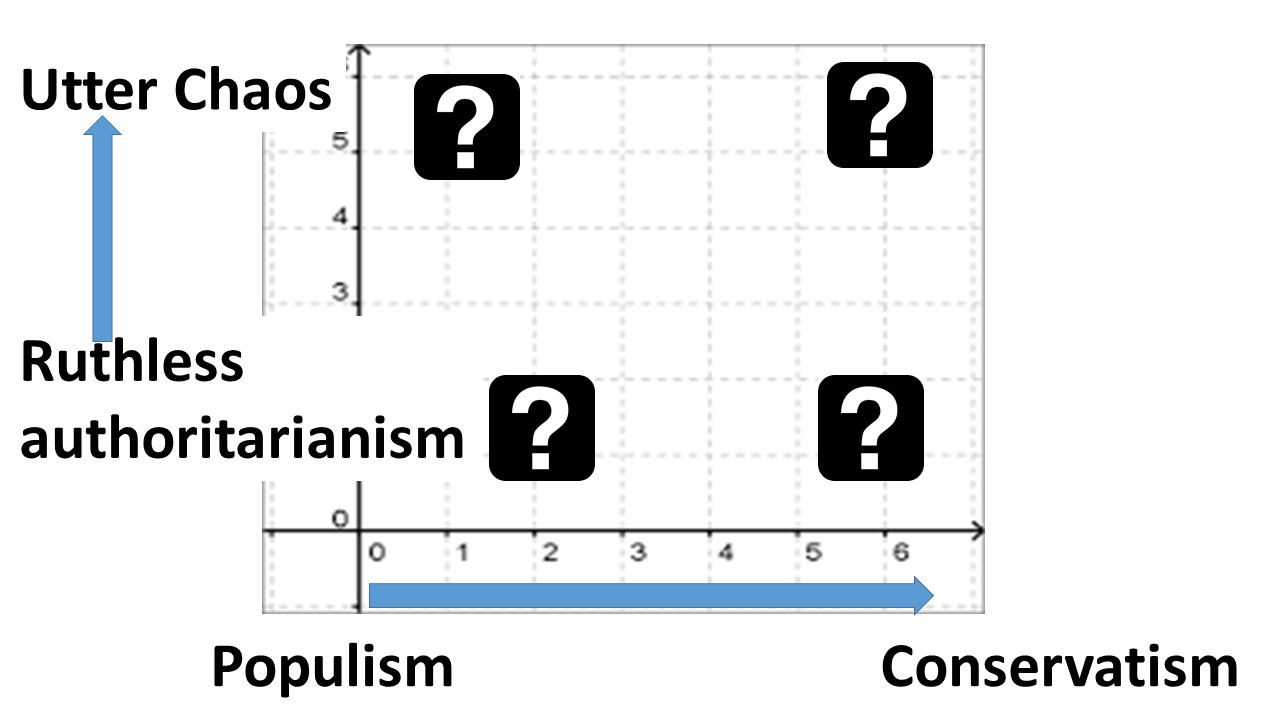
However, NYT columnist Ross Douhat weighs in today (Dec. 29), at the year end, with some wisdom, based strangely enough on analytical geometry. Consider, Douhat says, an X Y diagram.
On the X axis, place Trump’s policies. They can run from populism all the way to conservatism. Populism would involve spend-spend. Conservatism would involve cut-cut, put government at all levels on a starvation diet. Where will the Trump administration be?
On the Y axis, place Trump’s approach to governance, ranging from ruthless authoritarianism (Putin-style dictatorship) to utter chaos (an inexperienced administration rife with scandals, incompetent and unable to organize a paper bag). Except for the scandals, remind you at all of the Obama 8-year term? Where will Trump be?
Here are four possibilities, according to Douhat: 1. Authoritarian-populist: Trump panders to the masses, ignores the Congress, uses executive mandates…sort of how he ran his businesses (into the ground). 2. Chaos-populist: Trump flies around the country and the world, gets nothing done, and ultimately, lets Paul Ryan (House Speaker) become the de facto President, because, well, being President is both boring and hard work, and you need to read a lot, and Trump only reads tweets. 3. Chaotic, conservative. Congress cancels Obamacare, with no replacement and millions have no health insurance. America’s role in the world shrinks, as the U.S. deals with its own internal mess. 4. Authoritarian-conservative. Trump is ‘managed’ by his conservative appointees and the Congress. There is a fifth possibility: a Sweet Spot: X = 3, Y = 3, competence without dictatorship, moderate conservatism without cruelty.
Douhat says “this is Donald Trump we’re talking about, so a happy medium seems unlikely”.
What do YOU think? Where is America’s X and Y going to be?
5 Disrupted Industries Under Threat
By Shlomo Maital

Only older readers will recall the slide rule – the way engineers made calculations, before the calculator, based on the logarithmic rule (the product of two numbers is the anti-log of the sum of their logarithms, and a slide rule can add two numbers…). The moment the calculator appeared, the slide rule became obsolete. The leading slide rule company never saw it coming.
Déjà vu. According to the Financial Times, there are five major industries, to which this may happen, as disruptive technologies emerge. Will their leaders see the light in time? Stay tuned. Meanwhile: My advice is: While others flee these industries, as sinking ships, you, innovator, think about how you can reinvent them and revitalize them. It can be done!
Here they are:
- “Industry threatened: High-street travel agents. Reason why: More travellers booking online. Tui is the world’s largest tour operator, running high-street travel agencies under the Thomson and First Choice brands, writes Murad Ahmed. But its chief executive Fritz Joussen says the “end game” is to morph into a different kind of business — less reliant on selling package holidays and more focused on owning and operating hotels and cruise ships.
- Industry threatened: Small component manufacturers and distributors. Reason why: Growing use of on-site 3D printing to make parts. Any concertgoer knows it is easier to print tickets than pick them up or hope they arrive in the post, writes Patrick McGee. Businesses will soon realise the same applies to spare parts, equipment and electronics. The explosion of 3D printers is expected to shake up entire supply chains, allowing companies to print much of what they need rather than order it, often from overseas. Bosch Rexroth, the drive and control unit of the private German electronics group, projects that in five to 10 years up to 40 per cent of the manufacturing equipment it uses could be printed instead of purchased.
- Industry threatened: Motor insurers. Reason why Fewer vehicle collisions with increased use of driverless cars. Imagine a future in which fleets of driverless cars move quietly and carefully around our cities and countryside, seamlessly picking up and dropping off passengers. There are fewer cars on the roads, and those that are there tend to have fewer collisions. For some, this is utopia. For the world’s insurers it may be just the opposite. Motor insurance is one of the mainstays of the industry. It generates about $260bn in annual premiums for major global insurers and $17bn in profits, according to research from Morgan Stanley and Boston Consulting Group. They estimate that the motor insurance industry has a market value of about $200bn. New technology, the analysts say, puts a big chunk of that under threat in a variety of ways. First, fewer cars and fewer accidents mean less demand for insurance. In mature economies the market size could shrink by more than 80 per cent by 2040. Second, the insurance that is needed will be bought by companies such as car manufacturers, rather than by consumers. And as carmakers and tech companies get better at collecting and using data, they may be in a stronger position to sell insurance than the insurance industry itself.
- Industry threatened Financial advisers. Reason why: Growth of automated financial advice websites and tougher regulation. Traditional financial advisers have encountered a blizzard of regulation in recent years and now face being usurped by algorithms. The profession began to run into trouble in 2006 when the UK financial watchdog announced a probe into how funds were being sold to retail investors. New rules introduced in 2013 fundamentally altered advisers’ business model, banning fund houses from paying them commission and increasing the minimum level of qualifications advisers should have. Liberatum, an association for financial advisers, estimates that 13,500 advisers left the industry following the introduction of the new rules, while the UK’s Financial Conduct Authority puts the figure at 2,000.
- Industry threatened: Car repair garages. Reason why: More drivers switching to low-maintenance electric cars. Electric cars are often marketed to consumers on the basis that they are cleaner and cheaper to run than petrol or diesel rivals, writes Peter Campbell. But because they contain virtually no moving parts — other than the wheels — battery cars boast another advantage: there is almost nothing to go wrong under the bonnet. While that may be good news for motorists, it spells trouble for the thousands of garages that make a living servicing and fixing petrol or diesel cars. The aftersales sector is not only a huge source of jobs within the industry, it is also one of the most profitable parts of the motor sector. “The business of selling cars is very low margin,” says Philippe Houchois, an automotive analyst at Jefferies. “But as long as we have cars with an internal combustion engine the repairs will continue to be the main source of earnings for dealers.” While an internal combustion engine in a car sold today may have several thousands of moving parts within it, an electric Tesla contains just 18 moving pieces, according to Credit Suisse. “Electric motors need virtually nothing doing to them,” says Steve Nash, chief executive of the Institute of Motor Industry, a professional body in the UK.”
How Psychologists Define Innovation
By Shlomo Maital

“In the physical realm, a behavioral innovation is a new, useful, and potentially transmitted learned behavior, arising from asocial learning (innovation by independent invention) or a combination of asocial and social learning (innovation by modification), that is produced so as to successfully solve a novel problem or an existing problem in a novel manner”. *
The Latin root of the word “innovation” is “nova”, or novel. This is of course a necessary condition for something to be called an innovation, though novel is definitely moderated by geography — I tell my students that if they introduce an idea proven successful elsewhere, but that does not exist in their town, city, region or country, it is still an innovation. But child development experts have offered a new dimension to innovation – that of social learning. The definition above appears in a recent article in Child Development. (My wife drew my attention to it). I think it contains a hugely significant point.
Innovation can be ‘asocial’, or non-social. (Note, this is NOT anti-social!). That is, an individual comes up with a powerful innovation, on their own. A “eureka” moment. But I believe most innovations are a combination of asocial and social learning – once you have an idea, you need to share it, discuss it, test it, build a team… this is a social process.
Innovations solve problems. This too is an essential part of the definition. An innovation that is brilliant, complex, technical – and solves no problem, or creates no value, is not an innovation.
A key point emerging from this article: Global benchmarking. Countries share social problems. E.g. aging, poverty, inequality, corruption, …. They tackle problems in different ways. Some are innovative and successful. Some are innovative but fail ultimately. Countries do not sufficiently learn from one another. For instance: The world faces a huge problem with job creation, as robots emerge to do much of our daily work. How to deal with it? Finland is trying an experiment, in Oulu, a far-north city with a great university. They are paying a monthly sum to everyone, to encourage them to take risky jobs, with startups, without worrying about the salary. The world should watch this experiment closely.
Countries everywhere, and cities, and regions, and towns, should be trying social experiments… tackling tough social problems with creative innovative approaches. Many will fail. Some will work. There should be a global network of such experimenters. This is evolution put to work in the service of humanity. Yet in my experience, countries try hard to invent their own wheels.. and mainly do it badly.
Social learning is not just an individual process, it is also a process in which whole countries can learn from one another. But do they? Not nearly enough.
* “Eureka!: What Is Innovation, How Does It Develop, and Who Does It?” Kayleigh Carr, Rachel L. Kendal, and Emma G. Flynn, Durham University. Child Development, Sept.-Oct. 2016
Did Open Borders Destroy U.S. Manufacturing?
By Shlomo Maital

In the recent US Presidential election, Donald Trump campaigned largely on how trade (i.e. imports, open borders) has destroyed blue-collar jobs. His voters agreed.
But is this true? Have globalization, open trade in goods and services, and cheap imports, destroyed good US jobs? Or were there other causes?
You won’t find a more authoritative answer than that from MIT, in Suzanne Berger’s 2013 book Making in America: From Innovation to Market (MIT Press), based on her work with the MIT Task Force on Production in the Innovtion Economy.
Here are some relevnt passages:
“Even taking into account job losses resulting from outsourcing as well as import competition, it was difficult as recently as a decade ago to find clear evidence of a heavy impact of open borders on manufacturing employment. …In 2003, [such job losses] involved less than one percent of layoffs; in 2004 they went up to 2 per cent. …job losses in manufacturing were mainly the result of productivity gains which might reduce the total numbers of those needed to produce a finite quantity of goods. …[Studies showed] the bottom line was that Chinese imports accounted for 33 per cent of manufacturing job decline between 1990 and 2000 and 55 per cent between 2000 and 2007. But [focusing mainly on rising Chinese productivity and falling China-facing trade barriers] 16 per cent of manufacturing job losses between 1990-2000, and 26 per cent between 2000 and 2007, were attributable to rising import competition from China.”
Bottom line: At most, a third to a half. And more likely: one-sixth to one quarter of job losses were due to Chinese imports.
So what does that mean? There were other causes, deeper ones. Labor-saving machinery and automation (robots). Low skills. And dumb policy. Berger notes: “Germany abandoned much of its low-end manufacturingwhile expanding employment in higher value-added segments.” And America??
Recently a former senior VP of Intel, Mooly Eden, spoke at Technion and noted that the moment manufacturing wages rose in China, Intel shifted to Vietnam and built 1 million square feet of manufacturing capacity there.
China lost jobs – why? Globalization? Or because their productivity failed to keep pace with wage increases?
It’s hard to predict the future. But here is one pretty safe guess. While Trump tackles America’s job problem and rebuilds manufacturing, based on a wrong assumption, he will fail. It won’t help to start a trade war with China. So in four years, his supporters will find that he failed to deliver.
What then? Will they vote Democrat? Or will we get an even farther-right crackpot candidate, as has happened in Europe?

 TIMnovate