
You are currently browsing the category archive for the ‘Innovation Blog’ category.
The Two Brain Centers That Drive Creativity
By Shlomo Maital
 Dr. Naama Mayseless
How do our brains cook up creative ideas? Functional MRI imaging now enables scholars to track precisely which areas of the brain are involved, when the brain is trying to be creative. Using this tool, Haifa University researcher Dr. Naama Mayseless (in her doctoral research, directed by Prof. Simone Shamay-Tsoory), Dept. of Psychology, found that:
“…. for a creative idea to be produced, the brain must activate a number of different – and perhaps even contradictory – networks. Developing an original and creative idea requires the simultaneous activation of two completely different networks in the brain: the associative – “spontaneous” – network alongside the more normative – “conservative” – network.
In the first part of the research, respondents were give half a minute to come up with a new, original and unexpected idea for the use of different objects. Answers which were provided infrequently received a high score for originality, while those given frequently received a low score.
In the second part, respondents were asked to give, within half a minute, their best characteristic (and accepted) description of the objects. During the tests, all subjects were scanned using an FMRI device to examine their brain activity while providing the answer.
For the answer to be original, an additional region worked in collaboration with the associative region – the administrative control region. A more “conservative” region related to social norms and rules. The researchers also found that the stronger the connection, i.e., the better these regions work together in parallel – the greater the level of originality of the answer.
“On the one hand, there is surely a need for a region that tosses out innovative ideas, but on the other hand there is also the need for one that will know to evaluate how applicable and reasonable these ideas are. The ability of the brain to operate these two regions in parallel is what results in creativity. It is possible that the most sublime creations of humanity were produced by people who had an especially strong connection between the two regions,” the researchers concluded.
In short: As I have been teaching – head in the clouds (“associative brain”) and feet on the ground (administrative pragmatic brain).
I think the crucial connections that Dr. Mayseless discovered can be strengthened. Think of creative ideas. Then think of how to make them practical, useful, feasible, implementable. Together, those two brain centers can change the world.
Guy Kawasaki’s 10 Innovation Rules
By Shlomo Maital

Guy Kawasaki is the psychology grad, in the jewelry business, who became the marketing guru for Apple’s Macintosh and led it to massive success. He has since become a successful venture capitalist and author, (“Art of the Start”) and speaks effectively on startup entrepreneurship.
Here are the 10 rules for successful innovation, given in an address to a conference of educators in Boston, Nov. 16-18: Innovator – on a scale of 1 to 5 (1 = out to lunch on this one, 5 = implement it always and with perfection), score yourself on each of the 10. 35-40 points gets you a high success rating on the Kawasaki scale.
- Make Meaning – Great innovation is motivated by the desire to make meaning and to change the world. Companies that are successful started because they want to make the world a better place. If you are just trying to make money, then you attract the wrong kind of people.
- Make Mantra – You should have a two or three word explanation of why your school or class should exist. Mission statements are too long and not memorable
- Jump to the next curve – The problem with most businesses is that they define innovation as what they do in their business. Define yourself not as what you do, but as the benefit you provide. Great innovation begins in jumping or creating the next curve. Kawasaki cited Western Union as an example of a company that did not do this by refusing to see the benefit of telephones. There are certainly a large number of companies that became irrelevant due to their failure to see the next curve.
- Roll the dice – Don’t be afraid to take a chance and put out something unique to your market. Kawasaki cited Ford’s My Key that allows you to program the top speed into the key.
- Don’t Worry Be Crappy – Kawasaki who was a member of the development team for the first MacIntosh computer, admitted the first MacIntosh was a piece of crap, but he added that it was a revolutionary piece of crap due to some of the revolutionary aspects of the device. “Ship stuff that jumps to the next curve,” he encouraged. If you wait until it is perfect you may miss your opportunity.
- Let 100 Flowers Blossom – As an innovator you may think you have an exact customer and an exact use for what you do. You may encounter a situation where unintended people use your product in unintended ways. If this happens we need to embrace it and let this unintended use blossom.
- Polarize People – Great innovation polarizes people , it is one of the consequences. Anyone who has asked teachers to make the switch to Google docs can identify with this one. (If you have people who truly HATE your product, but also those who truly LOVE your product – your polarized, and you’re on the right track).
- Churn, Baby, Churn – This is the hardest thing about innovation, you need to be in denial and refuse to listen to naysayers.
- Niche Thyself – If you are designing a new product then you need to make sure that what you are doing is both unique and valuable. Find your niche. Be the best in it.
- Perfect your pitch – Customize your introduction to show that you know where you are and who you are talking to. Find out information about who you are talking to.
Oopsie – Crippled Kids Can Walk!
By Shlomo Maital
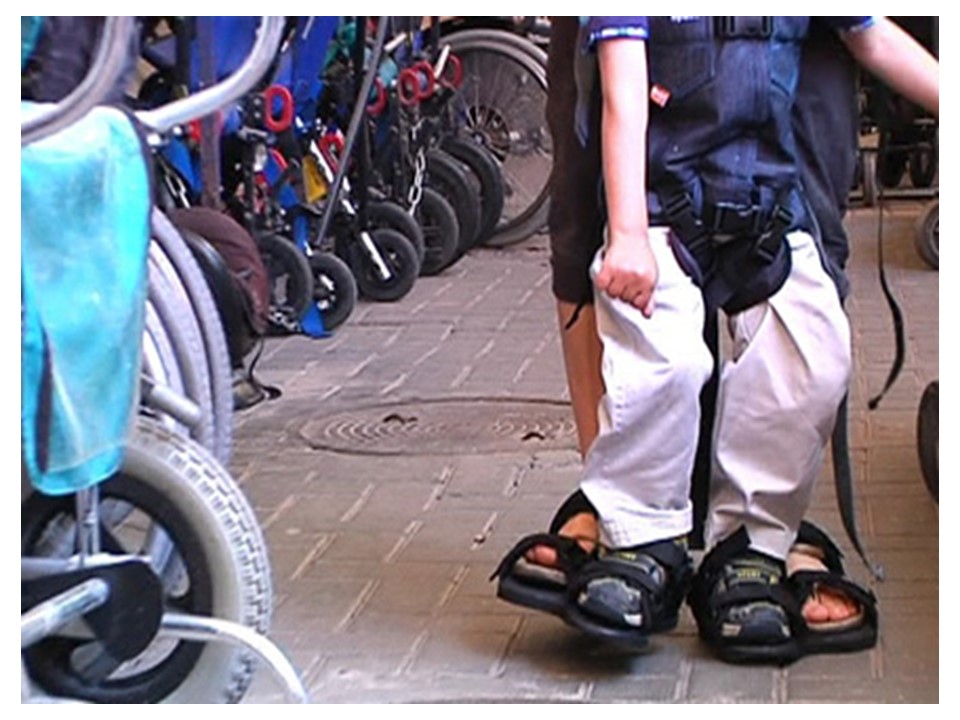
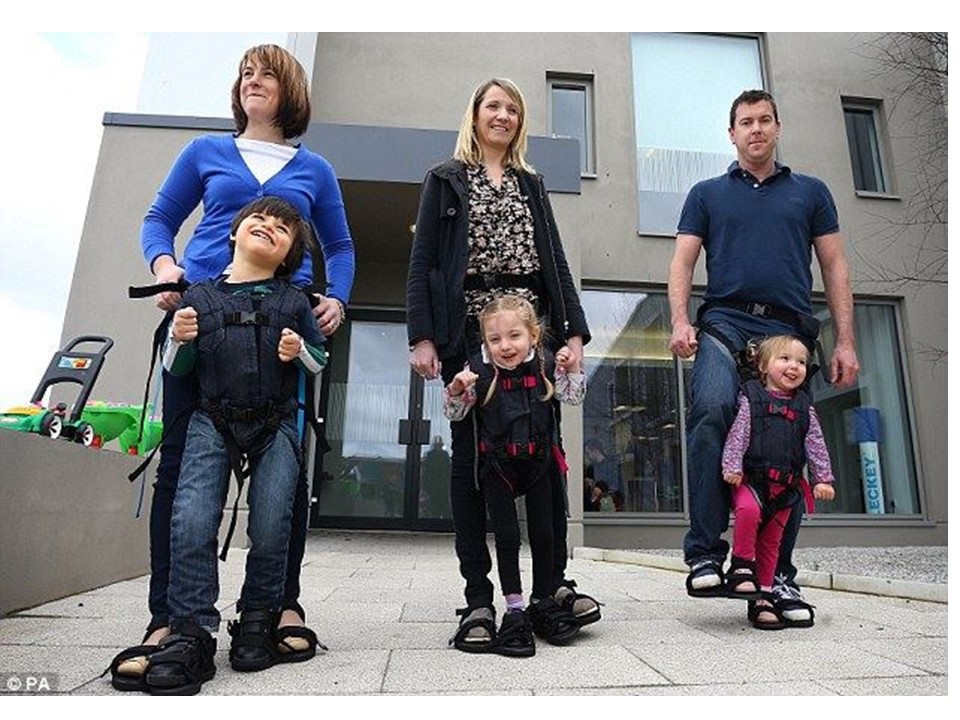
When our children were small, I recall fondly placing their little feet on mine, and walking around with them, while singing or humming “Teddy Bear’s Picnic” (dum di diddle di dum, di dum..).
Yesterday, a short clip on an Israeli news program brought back this memory poignantly. A loving mother, whose child could not walk owing to infantile paralysis, named Debby Elnatan, was determined that her little boy would walk.
“When he was 2, my son Rotem had doctors tell me that Rotem did not know what his legs were. I began to tie his feet, his hips and his back to my body and legs and we started to walk together. In the end, after some trial and error, I arrived at the product now called Oopsie. The first time I tried it, he collapsed. But a year later, we could leave our home with it and go out into the street, to play or to shop. This gave Rotem a childhood.”
Ooopsie is simply a set of sandals for mother or father and for the child, fastened together. Ultra simple! Among its many advantages: disabled children get to interact with other children at eye level.
According to the website Mako, Rotem is now 19 and is too big to use his mother’s invention. But this month, thanks to cooperation with an Irish company, children with paralysis all over the world can enjoy the invention. The Facebook page of the company has already been swamped with messages from thrilled parents, with video clips showing their children “walking” or even “dancing”. Oopsie costs $500, but parents say, this is nothing compared to the radical change it makes in the lives of their children.
If you know someone with a small child who cannot walk, spread the word. This device is really cool, simple, and in some ways, life-changing, for parent and child. And it reflects one of the most inspiring aspects of creativity — refusal to accept the word ‘impossible’.
Goal-Driven Innovation: the Case of U.S. Health Care
By Shlomo Maital
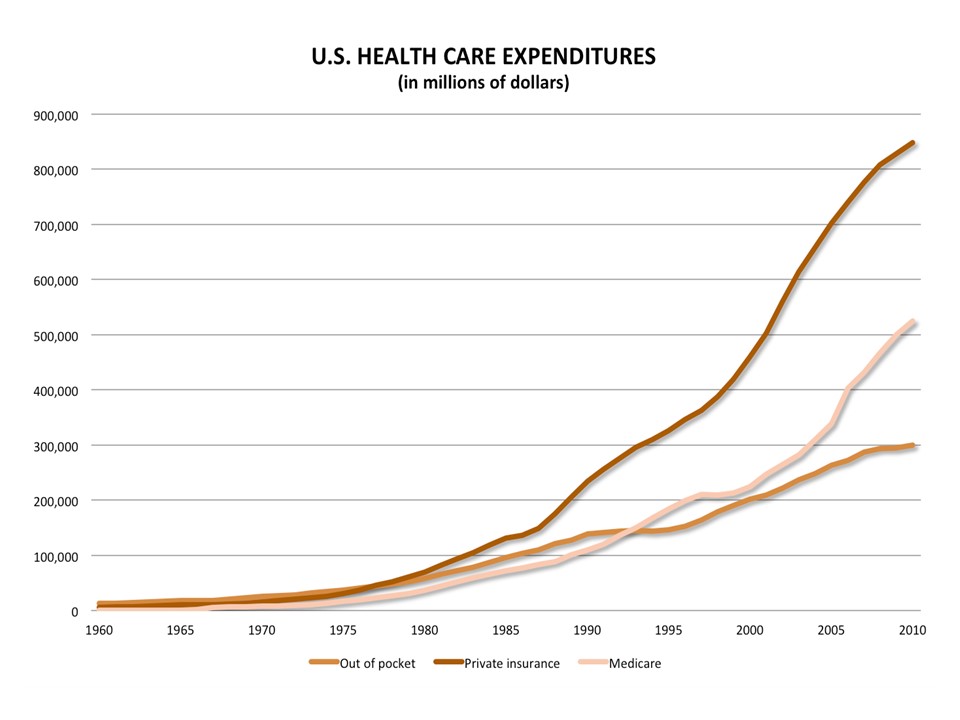
U.S. health care expenditures ($billion)
The U.S. spends 18 per cent of its GDP on healthcare. Much of the recent rise in healthcare spending has been driven by higher prices and costs.
In any industry faced with rising costs, innovation must play a role. Harness creativity, ideas, new thinking, to get costs under control. Yet in healthcare the opposite has happened. More and more innovation has created amazing medical technologies that costs astronomical sums – devices, drugs, etc. Innovation became part of the problem, rather than the solution — it’s great to know that you can save lives, but how many people can afford to have their life saved, at those prices?
Writing in today’s Global New York Times, David Brooks notes that healthcare inflation seems to be under control, and partly, as a result of cost-saving innovation:
“ …Recently health care inflation has been at historic lows. As Jason Furman, the chairman of President Obama’s Council of Economic Advisers, put it in a speech to the Hamilton Project last month, “Health care prices have grown at an annual rate of 1.6 percent since the Affordable Care Act was enacted in March 2010, the slowest rate for such a period in five decades, and those prices have grown at an even slower 1.1 percent rate over the 12 months ending in August 2015.”
There is naturally some controversy over why precisely health care prices have stabilized. But here is one theory:
Jonathan Rauch, in a report for the Brookings Institution, argues that the health care market is more open to normal business model innovation than ever before. The quality of health care data and analytics is improving exponentially. Pressures to reduce costs are ratcheting up. Profitable niches are growing for efficiency improving products. In the past, most innovation involved improving quality of care at high cost. Rauch described many entrepreneurs who are providing innovations that maintain current quality of care but at lower cost. We seem to be making at least some incremental progress toward a structural reduction in health care inflation.
Innovation indeed is regarded as a panacea, when the world faces severe problems, as with healthcare provision, and increasingly severe budget and resource constraints.
But the innovation effort has to be focused, with a goal. If health care inflation is the problem, direct your innovation efforts toward controlling and reducing costs, rather than ever-more-expensive gadgets and drugs that make the problem worse.
Like all human activity, innovation needs a clearly defined goal – a precise question to which it is directed. For America, the question should probably be: how can we use our creative thinking to keep healthcare prices stable? So far, it seems to be working.
Chinese Innovation: On the Rise
By Shlomo Maital
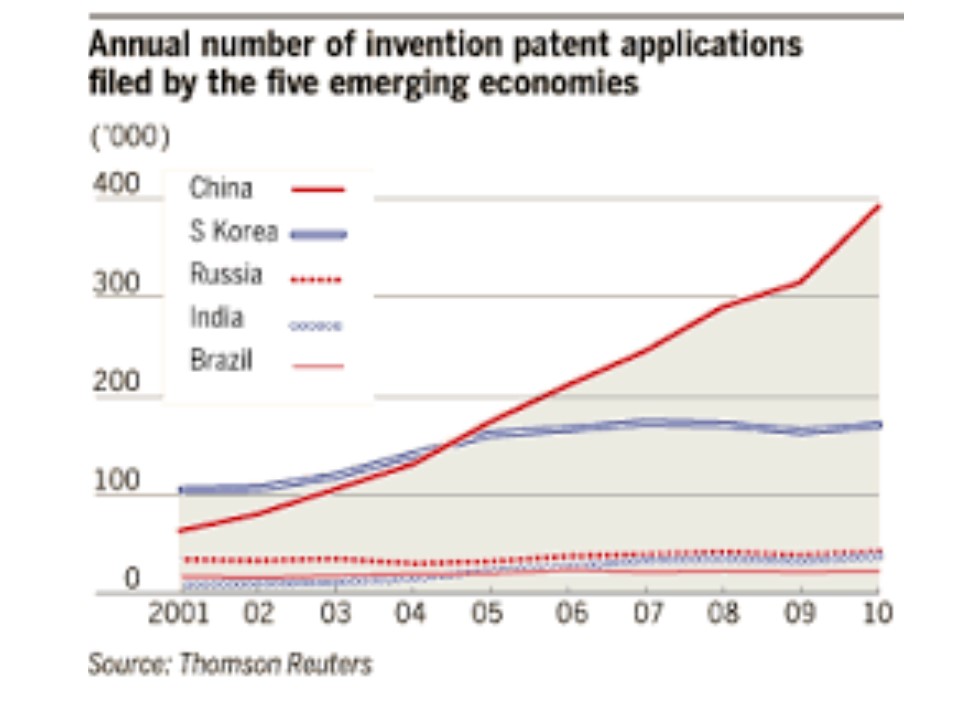
An insightful new report by McKinsey Global “China’s Innovation Imperative” sheds important light on China’s massive effort to become more innovative.
Here are some of the report’s key insights:
* “to realize consensus growth forecasts—5.5 to 6.5 percent a year—during the coming decade, China must generate two to three percentage points of annual GDP growth through innovation”. In other words up to half of China’s GDP growth must come from innovation. This is no easy task.
* “…about 40 percent of the increase in total factor productivity could come from innovations in higher-level manufacturing and services enabled by the Internet. Other innovations could come from catch-up activities that bring Chinese enterprises up to global best practices as well as breakthroughs yet to emerge. China will have evolved from an “innovation sponge,” absorbing and adapting existing technology and knowledge from around the world, into a global innovation leader.”
* “China has become a strong innovator in areas such as consumer electronics and construction equipment. Yet in others—creating new drugs or designing automobile engines, for example—the country still isn’t globally competitive. That’s true even though every year it spends more than $200 billion on research (second only to the United States), turns out close to 30,000 PhDs in science and engineering, and leads the world in patent applications (more than 820,000 in 2013).”
* “…we identified four innovation archetypes: customer focused, efficiency driven, engineering based, and science based. We then compared the actual global revenues of individual industries with what we would expect them to generate given China’s share of global GDP (12 percent in 2013). As the exhibit shows, Chinese companies that rely on customer-focused and efficiency-driven innovation—in industries such as household appliances, Internet software and services, solar panels, and construction machinery—perform relatively well.”
In general, China has strengths in process innovation, as it proves each time it takes production blueprints from a foreign firm and quickly produces the product. China also appears strong in incremental innovation. Perhaps a new focus should be placed on radical innovation – game changing new ways to create value and to do business.
The mantra of China’s 13th 5-year-plan is “China dreams”. Dream big, China.
Scientific Evidence: Origins of Creativity
By Shlomo Maital

In our book Cracking the Creativity Code: my friend and co-author Arie Ruttenberg and I present a framework for creativity called ZiZoZi – zoom in (on the problem), zoom out (to find solutions), zoom back in to apply them. Repeat as needed.
Recently browsing through old Scientific American issues, (March 2013), I found an especially wonderful one on “The Evolution of Creativity”. In it Heather Pringle, who writes on archaeology, explores how human creativity evolved, over thousands of years of human history. It includes this passage, which describes a process similar to zoom in/zoom out:
“….[creative] individuals are excellent woolgatherers. When tackling a problem [according to cognitive scientist Liane Gabora, U. of British Columbia, and Scott Barry Kaufman, psychologist at NYU], they first let their minds wander, allowing one memory or thought to spontaneously conjure up another. [Zoom Out].
“This free association encourages analogies and gives trise to thoughts that break out of the box. Then as these individuals settle on a vague idea for a solution, they switch to a more analytic mode of thought. They zero in on only the most relevant properties, Gabora says, and they start refining an idea to make it work. [Zoom In].
Gabora believes that as hominoids developed bigger brains, this led to a greater ability to ‘free associate’. More stimuli could be encoded in a brain made up of many billions of neurons. More neurons could participate in the encoding of a particular episode, leading to a finer-grained memory and more potential routes for associating one stimulus with another.
The key seems to be the word “associate”. Creative people link things that other people find totally unrelated. These ‘leaps’ of insight occur in brains that are good at making such connections.
And the more we practice, the better we get at it.
The Limitations of Ltd. Companies: An Insurgency
By Shlomo Maital

One of the great social innovations that made possible rapid economic growth and progress was that of the limited liability company. The idea began in England and spread to America. By limiting what you lose in starting a business, many were encouraged to do so. According to Wikipedia:
“By the 15th century, English law had awarded limited liability to monastic communities and trade guilds with commonly held property. In the 17th century, joint stock charters were awarded by the crown to monopolies such as the East India Company. The world’s first modern limited liability law was enacted by the state of New York in 1811. In England it became more straightforward to incorporate a joint stock company following the Joint Stock Companies Act 1844, although investors in such companies carried unlimited liability until the Limited Liability Act 1855.”
Is it possible that public companies have outlived their usefulness? An article in The Economist, “Reinventing the company”, makes this point.
“…after a century of utter dominance, the public company is showing signs of wear. One reason is that managers tend to put their own interests first. The shareholder-value revolution of the 1980s was supposed to solve this by incentivizing managers to think like owners, but it backfired. Loaded up with stock options, managers acted like hired guns instead, massaging the share price so as to boost their incomes”
“In insurgent companies, by contrast, the coupling between ownership and responsibility is. Founders, staff and backers exert control directly. It is still early days but, if this innovation spreads, it could transform the way companies work.”
Here is an example of an insurgent company – a huge one, Alibaba, founded by Jack Ma in 1999 – a Chinese public company, of all things, listed in America.
“In June, Jack Ma, the founder of Alibaba, a giant Chinese e-commerce firm, addressed the Economic Club of New York, whose members include many Manhattan luminaries and Wall Street chiefs. Mr Ma’s message was that his company exists for the long-term good of society, a far cry from the creed of shareholder value followed by many in the room.”
Run that by us again? Alibaba exists for the long-term good of society? Alibaba wants to help millions of small American businesses sell their goods globally? (How come AMERICAN companies haven’t said the same, or done the same??).
U of Chicago Professor Milton Friedman and his group of free-market economists fiercely criticized companies that donate money to charity, saying the money belongs to shareholders, and is not the company’s to give away.
We have seen where THAT kind of capitalism leads. Perhaps capitalism is evolving, in a positive direction, after all.
How to Cope with a VUCA World
By Shlomo Maital

What in the world is a VUCA world? VUCA is an acronym, standing for volatility, uncertainty, complexity, and ambiguity . And daily, the world seems determined to prove how increasingly VUCA it is!
This is why, in this blog, I write so often about discomfort, ambiguity, chaos and how we relate to them all. In the latest Scientific American, Gareth Cook interviews author Jamie Holmes about his new book Nonsense: The Upside of Ambiguity. Here are some excerpts from what Holmes observes:
Moments of confusion can be pretty memorable, and not in a good way. How is this thing supposed to work? What is the teacher’s point? Where am I, and how do I get to where I am going? But confusion is greatly underrated, argues the journalist Jamie Holmes in his new book, “Nonsense.” Naturally, it is good to understand. Yet, Holmes writes, our discomfort with not knowing can lead us astray — to bad solutions, or to brilliant options never spotted. If we could learn to embrace uncertainty, we’d all be better off — and better prepared for modern life.
In hiring, for instance, a high need for closure (a clear firm yes/no decision) leads people to put far too much weight on their first impression. It’s called the urgency effect. In making any big decision, to counteract that, it’s not enough just to know that we should take our time. We all know that important decisions shouldn’t be rushed. The problem is that we don’t keep that advice in mind when it matters. Before making important decisions, write down not just the pros and cons but what the consequences could be. Also, think about how much pressure you’re under. Are you tired or feeling rushed? If your need for closure is particularly high that day, it’s even more important to be deliberate.
I absolutely agree. Never EVER let pressure from others rush your decisions. Take a deep breath. Say to yourself, YOUR crisis is not necessarily MY problem.
Holmes: “One area where there is more and more interest in ambiguity is among entrepreneurs and businesspeople, simply because the future in many business sectors is highly ambiguous. Earlier this year, Thomas Friedman had an op-ed about disorder in the business world (“Chaos is the New World Order”, see my blog on this) where he highlighted just how disruptive the business models of Uber, Facebook, Alibaba, and Airbnb are. Uber is the biggest taxi company in the world, he pointed out, yet has no cars. Facebook doesn’t create media, Alibaba has no inventory, and Airbnb doesn’t own the real estate it uses. So the communication platforms we’re using are revolutionizing a range of industries.”
In our schools — do we equip our children to deal with a VUCA world? Or is the world we create for them one of canned tests with right and wrong answers, where you must not be wrong ever? If the world is grey, rather than black and white, why does that color never appear in our schools?
Lady Gaga – Revisited
By Shlomo Maital

In 2011 and 2012 I blogged about pop singer Lady Gaga twice. Once about her passion and connection with her fans (she records songs after long exhausting performances, capturing the intimate link with her audiences) and once about her foundation. Apparently even serious NYT columnists like Nicholas Kristof and David Brooks share my interest. Today’s International New York Times has a wonderful David Brooks column about Lady Gaga, who was given an award together with Sophia Loren, Herbie Hancock and other main-line celebs.
Lady Gaga’s speech was tearful. She recalled her childhood. “I suppose I didn’t know what I would become, but I always wantedto be extremely brave and I wanted to be a constant reminder to the universe what passions liks like. What it sounds like. What it feels like.”
Brooks expands on what it means to be passionate. “[People with passion] somehow get to the other side of fear. They get beyond that fog that is scary to approach. Once through it they have the freedom to navigate. They opt out of things that are repetitive and deadening. There’s even sometimes a constant recklessness there, a willingness to throw their imperfect selves out into public view while not really thinking beforehand how people might react.”
“Gaga is nothing if not permanently out there; the rare celebrity who is willing to portray herself as a monster, a witch or disturbing cyborg — someone prone to inflicting pain. Gaga is her own unique creature, whom no one could copy.”
I think we can all learn from this flamboyant pop singer known as Lady Gaga (whose real name is Germanotta). Be yourself. Be fearless. Try things. Get through the fog of fear and uncertainty to the otherwise, to the shores of Creativity Land. Be like Gaga. It’s worth a try.
Soft Skills Start in Pre-K
By Shlomo Maital

In 1982, engineers at Carnegie Mellon University, in Pittsburgh, Pennsylvania, built a Coke machine connected to the Internet (or the existing network – Internet did not yet exist), that could report how many Cokes had been sold and how cold they were. This was perhaps the birth of what we know now as the Internet of Everything – everything, everyone, connected, everywhere, all the time, by Internet. By 2025, only 10 years from now, some 25 to 50 billion devices will be connected – cars (self drive), fridges, people, computers, machines, virtually everything.
Great? A new 20 trillion dollar industry? Jobs? Happy people?
Perhaps. But the downside could be, a sharp decline in people’s social skills. When things talk to each other, people need not. And social skills, society, collaboration, community, friendship, helping others, this is what makes us human, what keeps the world more or less together.
Writing in the New York Times, Oct. 18, Claire Cain Miller makes a key point: “Occupations that require strong social skills have grown much more than others since 1980”. Yet cultivating those social skills is on the decline, in schools focused on homework and tests. Increasingly, worldwide, even kindergarten kids are getting homework, instead of time to play. The graph below shows how crucial social skills are in the kind of jobs that are coveted.

We recently visited Touchstone Community School in Grafton, MA. We spoke with Cheryl and Tamara, who teach young children. We shared recess with the kids, and romped in big grassy fields, threw frizbees and learned to do cartwheels. We saw how vital recess, and play, are, for young children. And above all, we saw how easily very young children related to us, strangers, called us by first names (a Touchstone touchstone), asked how we are, what we are doing, and even interviewed us. Those social skills did not just happen. They were cultivated. And they grew especially in playtime, in recess. We saw an older boy play with a wheel device, and a small child stood in front of it. The natural instinct: shove him aside. What the boy did? Gently put his hand on the small child’s shoulder, explain to him that he was in the way, and ask him if he would please move aside. THAT is a social skill. Perhaps as important as knowing 8 times 9 is 72.
Technical skills can be automated, the author notes. But social skills? We have to learn them, make them a part of our social DNA from an early age. Pre-kindergarten is crucial for this. We must do everything to preserve the ‘soft’ skills learned in school, because they are the ones that are ‘hard’ to acquire later, and make us employable.

 TIMnovate