
You are currently browsing the category archive for the ‘Innovation Blog’ category.
Nothing is Rotten in Denmark
By Shlomo Maital
 Copenhagen: The Little Mermaid
Shakespeare’s famous line, “something is rotten in the state of Denmark”, from Hamlet, needs amendment. These days, very little is rotten there, and other countries can learn much from it. But are they? Paul Krugman’s latest New York Times column doubts it.
What is Denmark’s story? It is a welfare state with enormous social benefits, that takes care of its children, homeless, ill people, and others. It pays for it with heavy taxes, also on the wealthy, but at the same time maintains a vibrant economy. Here is how Krugman, a Nobel Laureate in Economics, decribes it:
Denmark maintains a welfare state — a set of government programs designed to provide economic security — that is beyond the wildest dreams of American liberals. Denmark provides universal health care; college education is free, and students receive a stipend; day care is heavily subsidized. Overall, working-age families receive more than three times as much aid, as a share of G.D.P., as their U.S. counterparts. To pay for these programs, Denmark collects a lot of taxes. The top income tax rate is 60.3 percent; there’s also a 25 percent national sales tax. Overall, Denmark’s tax take is almost half of national income, compared with 25 percent in the United States. Describe these policies to any American conservative, and he would predict ruin. Surely those generous benefits must destroy the incentive to work, while those high taxes drive job creators into hiding or exile. Strange to say, however, Denmark doesn’t look like a set from “Mad Max.” On the contrary, it’s a prosperous nation that does quite well on job creation. In fact, adults in their prime working years are substantially more likely to be employed in Denmark than they are in America. Labor productivity in Denmark is roughly the same as it is here, although G.D.P. per capita is lower, mainly because the Danes take a lot more vacation. Nor are the Danes melancholy: Denmark ranks at or near the top on international comparisons of “life satisfaction.”
How many times does this have to be said? A nation CAN take care of its people – its unemployed, jobless, skill-less, college students, children, sick, mentally ill – while paying for it through taxes (not deficits), and maintain a happy growing economy. The rich? They will pay taxes and not change their behavior on jot. There is no reason for any political system to pander to the rich, even though they use their funds to buy political influence.
Nothing is rotten in Denmark. Is anybody watching and listening? American conservatives? The last word goes to Krugman:
It’s hard to imagine a better refutation of anti-tax, anti-government economic doctrine, which insists that a system like Denmark’s would be completely unworkable.
Alone with our Phones: the Downside of Cellular
By Shlomo Maital

Will dependence on devices mean we no longer know how to engage, befriend and converse with live humans? Will IoT kill empathy?
In her latest book, Reclaiming Conversation: The Power of Talk in a Digital Age, MIT Professor Sherry Turkle, a sociologist and clinical psychologist, decries the decline of simple human contact.
“We’re talking all the time,” she writes. “We text, post and chat. …Among family and friends, we turn to our phones instead of each other.”
The result? “Our young people would rather send an electronic message than commit to a face-to-face meeting or even a telephone call.” The resulting “flight from conversation” damages what is most human about us – our ability to form relationships, empathize, sympathize, understand, collaborate.
In the world of IoT, will ‘things’ communicate in place of people? And will we as a result lose much of our essential humanity?
The 2013 movie “Her” follows Theodore Twombly, played by Joaquin Phoenix, as he falls in love with Samantha, a computer operating system, whose silky voice is that of Scarlett Johansson. Are we already falling in love with our ‘things’? I am told that depriving teenagers of their cell phones, as a punishment, is regarded by them as life-threatening.
Every new technology has its downside. Cellular technology enables us to communicate with everyone, everywhere, any time, all the time. This is a great boon. But it is also destroying our ability to relate to other human beings.
How can we reap the benefits of ubiquitous smart phones (according to TIME magazine, a year ago, most people now surf the Web with their phones, not tablets or PC’s), without the downside that Turkle depicts?
High School Tech: What Schools COULD Become
By Shlomo Maital

In another wonderful column, David Brooks (NYT Oct. 16) describes a documentary film, Most Likely to Succeed, by Greg Whiteley, in which San Diego’s High Tech High is featured, started by San Diego high tech and business leaders. I can do no better than to quote Brooks’ words:
Greg Whiteley’s documentary argues that the American school system is ultimately built on a Prussian model designed over 100 years ago. Its main activity is downloading content into students’ minds, with success or failure measured by standardized tests. This lecture and textbook method leaves many children bored and listless.
Worse, it is unsuited for the modern workplace. Information is now ubiquitous. You can look up any fact on your phone. A computer can destroy Ken Jennings, the world’s best “Jeopardy!” contestant, at a game of information retrieval. Computers can write routine news stories and do routine legal work. Our test-driven schools are training kids for exactly the rote tasks that can be done much more effectively by computers.
In High Tech High….There are no textbooks, no bells… Students are given group projects built around a driving question. One group studied why civilizations rise and fall and then built a giant wooden model, with moving gears and gizmos, to illustrate the students’ theory. Another group studied diseases transmitted through blood, and made a film. “Most Likely to Succeed” doesn’t let us see what students think causes civilizational decline, but it devotes a lot of time to how skilled they are at working in teams, demonstrating grit and developing self-confidence. There are some great emotional moments. A shy girl blossoms as a theater director. A smart but struggling boy eventually solves the problem that has stumped him all year. In the school, too, teachers cover about half as much content as in a regular school. Long stretches of history and other subject curriculums are effectively skipped. Students do not develop conventional study habits.
Brooks is not uncritical of High Tech High. In this blog, I have also made the point that in order to foster creativity, you cannot discard the hard tough discipline of mastery – mastering old knowledge, while thinking about how to create new. Brooks echoes this thought.
The cathedrals of knowledge and wisdom are based on the foundations of factual acquisition and cultural literacy. You can’t overleap that, which is what High Tech High is in danger of doing. “Most Likely to Succeed” is inspiring because it reminds us that the new technology demands new schools. But somehow relational skills have to be taught alongside factual literacy. The stairway from information to knowledge to wisdom has not changed. The rules have to be learned before they can be played with and broken.
This is worth repeating. Innovation is INTELLIGENTLY breaking the rules. In order to break the rules intelligently, creatively, first you have to learn them. You have to know physics, to engineer wonderful new devices. The key is, can we teach physics, without ruining the creative spark in those we teach?
Is America in Decline? The Economist’s View
By Shlomo Maital
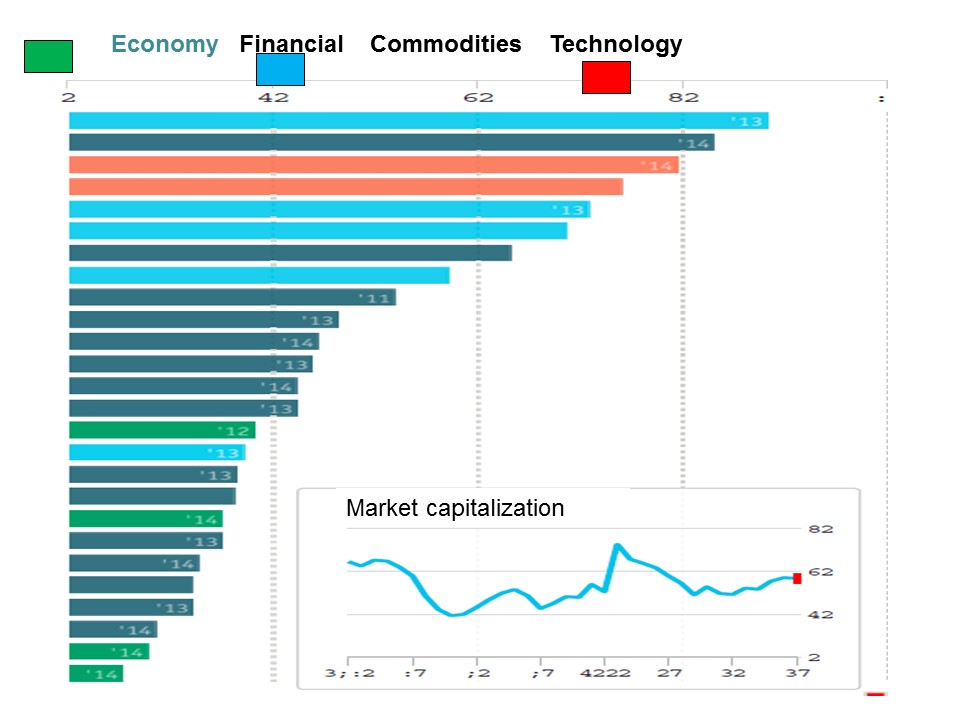
U.S. % of global total for various indicators…
Is America in decline?
An excellent graphic by The Economist (daily chart) lists a variety of economic, financial and technological indicators for the U.S. as a share of the global total. America leads firmly in venture capital investments, and the U.S. dollar is still 60 per cent of total world forex reserves. In technology, the U.S. leads firmly only in “social media’ (which does not generate jobs, only wealth for a handful) and “cloud hosting” (similar to social media). Most of the indicators in which America dominates are financial in nature. US dollar share of bonds, R&D spending, FDI stock, debt, etc.
So here we have it. The U.S. is still the financial leader of the world, but not the technology or economic leader. There is a serious mismatch.
So the question arises: Can the U.S. remain the center of financial stability of the world? Or will its flagging economy weaken the dollar and the whole world system? Are we due for another crisis?
In history, no power has remained dominant in finance without remaining dominant in economics (note the decline of the British empire and its industrial power, and the decline of the pound sterling).
Touchstone School: “Magical Moments”
By Shlomo Maital

My wife and I are visiting Touchstone Community School, here in Grafton, MA, about an hour from Boston. In this and several following blogs, I would like to recount briefly some ‘magical moments’ I experienced there, in a pre-K to Grade 8 school where children do not take formal tests and where their imaginations and social skills are fostered.
Background: Thanks to the hospitality of Touchstone, I’ve brought a Chinese family from Shantou, Guangdong (where Technion has a joint venture program), to visit the school – Jin, my former Shantou U. student, his wife Yuen, and 3-year-old daughter Yue, or Sophia. Together we’re making a documentary film, hoping to bring the message of Touchstone’s “transformative schooling” back to China and to Israel.
 Sophia and her new friend…language is no barrier!
Values: We joined a group of Grade 7-8 children discussing Touchstone core values. The class itself had earlier chosen core values: all began with “C” — Confidence, curiosity, connection, creativity. These values appeared on a ‘flag’ created by the children which included one square per child, where the square reflected the child’s own personality. This emphasis at Touchstone on being an individual is pervasive.
I asked the students about rules. If you have core values, and act on them, do you really need rules? Rules are external, externally enforced; values are internal, internally enforced. The discussion was interesting, the consensus was – values can replace rules.
There followed a discussion about table arrangements. Pairs? Fours? One big square table? The consensus was: One big table, more inclusive. Inclusiveness is a school-wide core value. I suggested, maybe a oval or round table? But there is no such table at Touchstone. However, there is an oval carpet. Let’s sit around the carpet, the students suggested. I came up with a round table that splits into four segments, so work in pairs and small teams can take place. We need to have it built.
One conversation at a time? This is an IDEO principle. It is implemented in this class with Jupiter, a soft toy, tossed from one child (the speaker) to another (who raises their hands and wishes to speak). One child was applauded, for actually catching Jupiter with one hand (apparently, a first! The students joked about it…not in a mocking manner).
I could not help but notice the huge developmental gap between the girls and the boys…the girls are way way ahead of the boys, which is common at this age.
There is a core issue here. Teachers who graduate from teachers’ colleges learn about the rules of pedagogy and the rules of schooling. They then implement those rules in the schools where they teach, and children learn about following an external set of rules, with punishments (and rewards, at times). Children who follow rules well, do well in school. Rebellious kids don’t. But creativity demands rebellion. Are we eradicating it with our rule-based system? Touchstone begins with values. Values are internal. Why not replace external rules with internal values? And make ‘confidence’, and ‘creativity’ core values?
John Maeda: Unconventional Design Thinking
By Shlomo Maital
John Maeda has had a remarkable career, in computer science at MIT, and MIT Media Lab, then as head of the famed Rhode Island School of Design, now as a partner in Kleiner Perkins. He is also a famed video artist Here are his views on design, as told to McKinsey’s Hugo Sarrazin.
Design was once largely about making products attractive. Today it’s a way of thinking, a creative process that spans entire organizations, driven by the desire to better understand and meet consumer needs. Good design is good business. This came from T.J. Watson Jr., in a 1966 memo to all of IBM. Moore’s law (computing power doubles every 18 months) is dwindling… so now we have to buy [things] because of how they make us feel.
Whenever someone has come to me asking for the ‘silver bullet’ (for great design), I say, “There’s only a silver ray…and you have to know where to point it, you might get lucky”.
I was talking to a CEO startup — I offered my opinion, “Just because you can do it doesn’t mean you should do it. If you think about design adding value, a lot of what people don’t understand is that sometimes the best design consultants will tell you NOT to design it.
[Consulting for e-Bay companies]… I observed that the designers were all spread out. …So I connected all of them together, some 380 of them, into one community that could see each other. And the CEO could see them. ..the CEO said, “oh, so design itsn’t about this pixels thing, it’s about systems thinking!” He totally got it. [Sarrazin: It’s getting the right people together, creating the sense of community. It’s also reframing what it is!].
Maeda: Reframing: Exactly!
Innovator: Visualize! It works!
By Shlomo Maital
 Jake Arrieta
What can one learn about innovation from the New York Times Sports section?
Well, it turns out, a great deal. Take for instance Chicago Cubs’ talented pitcher Jake Arrieta. He just won his 20th game, first pitcher in the Major Leagues to do so. And he did so even though the Cubbies, as fans call them, are not THAT strong a team, last I looked they were 7 games behind the leading team and not likely to make the playoffs.
Jake Arrieta practices a powerful technique known as ‘visualization’. Before you tackle a task, start a company, implement an innovation – visualize it. REALLY see it, in every detail. Go through the motions, second by second, picture yourself as, say, Steve Jobs, announcing Macintosh in 1984. (He rehearsed that short talk, in which he introduces the Mac as a person, many many times, with a coach). REALLY see it. Then, when you actually do it, it will be familiar, comfortable, you’ll be at ease, and perform at a very high level, like pitcher Jake Arrieta.
Arrieta has a 20 wins, 6 losses record, with a 1.88 earned run average (fewer than 2 earned runs per game). Here is how he describes his ‘visualization’ technique:
“You don’t think about something for the first time the day you do it. You think about pitching in the playoffs; you think about pitching in the World Series. And if you don’t, you should.” Arrieta pictures himself pitching on game day, the day he is scheduled to pitch, he seems himself pitching against the nine opposing betters, one by one, he strategizes, he throws his sinking slider, his fast ball…. Again and again.
I am trying to apply this. I visualize myself in class, in a lecture hall, and lately, in front of a camera. I picture myself talking. I see my gestures, I see the audience, every detail, the water glass, the lectern…. You know it is working when you have a feeling of ‘déjà vu’, hey I’ve been here, done this, before, on the actual day.
You can ‘visualize’ long range too. Think ahead backward. Picture where you want to be in 10 years. The room, the situation, the people around you, your team, everything. Picture it in detail. Maybe even draw it. Then work backward. What are the many things you need to do to make it happen.
Try it! It works.
Laudato Si: Worth Careful Reading
By Shlomo Maital
“Our common home is like a sister with whom we share our life and a beautiful mother who opens her arms to embrace us. This sister now cries out to us because of the harm we have inflicted on her by our irresponsible use and abuse of the goods with which G-d has endowed her. We have come to see ourselves as lords and masters, entitled to plunder her at will. … This is why the Earth itself, burdened and laid waste, is among the most abandoned and maltreated of our poor…she ‘groans in travail’.
These are the eloquent opening words of Pope Francis’ new encyclical, Laudato Si, “Praise the Lord…”. Yesterday was the Jewish holy day Yom Kippur, Day of Atonement. My sister in law Rabbi Suri led a discussion of Laudato Si, as we read excerpts, and discussed the Jewish and Catholic views on ecology and ethics. I plan to read the entire document. Meanwhile, based on excerpts, I urge you to read it all. Most Papal encyclicals are dense and scholarly. This one is written in Pope Francis style, clear, well-reasoned, with beautiful metaphors and sharp admonishments.
We have indeed laid waste to our earth. The 15th COP Conference of Parties (the UN’s euphemism for impotent political gatherings) will take place in November in Paris. But there is a groundswell that holds out hope. Rather than ineffective top-down political leadership to deal with global warming, we now are seeing increasing bottom-up activism, with each individual everywhere asking, what can I do to use less water, waste less, plunder less, in order to be a moral human being, as Pope Francis counsels? If each of us acted on our beliefs, even in small ways, the aggregate effect would be immense.
Perhaps Laudato Si will ignite such a groundswell of rebellion and action world-wide. We will listen carefully to Pope Francis’ address to Congress today, and to the UN tomorrow.
Five Life Lessons: Learning Life Forward
By Shlomo Maital
 Kirkegaard
The great Danish philosopher Soren Kirkegaard once defined the tragedy of life: “We live life [looking] forward, we learn life [looking] backward”. My wife and I are visiting York University, in Toronto, Canada. I spoke to a class of young engineers, just beginning their studies, at the invitation of my host, Prof. Andrew Maxwell, who heads the BEST Bergeron Entrepreneurship for Science & Technology program in the Lassonde School of Engineering. I shared with them these 5 life lessons, that I have learned personally:
- Take on BIG challenges: challenge yourself hugely. If you fail, failure is glorious, and you learn a lot, so much that there really is no such thing as failure, when you’re tackling something enormous. If you succeed – well, your life takes on huge meaning.
- Start with WHY! Find something you are deeply passionate about. This will be your rocket fuel. Start with this, and move on from this point. Many of my young students do not yet know what their life passion is, because no-one has asked them, nor have they asked yourself. Use your passion to fuel your rocket – but first, be sure to find such a passion.
- Be like da Vinci: in SOME ways. Leonard da Vinci was immensely creative, he invented the submarine, tank, airplane, parachute, and vastly more things. He drew with left-handed in his notebook, and wrote notes in mirror writing, to keep them secret. So in this – be UNLIKE him. Don’t keep secrets. If you never share your ideas, you’ll never improve or find people to help you implement them.
- Be truly expert in at least one thing, go deeply into it; and learn a little about everything you can, you never know. Steve Jobs studied calligraphy (handwriting) at Reed College. Why? It interested him. Because he did, the Macintosh, when launched, had beautiful fonts. This led to desktop publishing. DT publishing saved the Mac, created a huge market, and it was utterly unintended… simply because Jobs loved beautiful fonts.
- Become very comfortable with being uncomfortable. All great things emerge from people who are uncomfortable about something – they just HATE it, can’t tolerate it, want to CHANGE it. Much of modern life is about becoming, and remaining, comfortable, free of thirst, hunger, pain, boredom, anything uncomfortable. So get uncomfortable about something, and be comfortable with it, because THIS is what will drive you to action.
Green Energy for the Poor: The M-KOPA Kenya Model
By Shlomo Maital

Innovation at its best helps the poor, and uses creativity in its business design, not just in technology. Here is an example, by Ngozi Okonjo-Iweala, former Nigerian finance minister and World Bank official, writing in the International New York Times. He recounts the M-KOPA system in Kenya, Tanzania and Uganda, that brings cheap clean power to families:
“It’s called M-KOPA. The “M” stands for ‘mobile’ and ‘kopa’ means “to borrow”. The company’s customers make an initial deposit, roughly $30, toward a solar panel, a few ceiling lights and charging outlets for cellphones – a system that would cost about $200. Then they pay the balance owed in installments through a widely-used mobile banking service….The solar units are cheaper and cleaner than kerosene, the typical lighting source and once they’re fully paid for after about a year, the electricity is completely free. More than 200,000 homes in Kenya, Uganda and Tanzania use M-KOPA’s solar system”.
That to me is a “wow”. The idea should spread to rural India and to rural China, to Myanmar, and throughout Africa. Note how this system combines technology, business innovation (the mobile payment system), and sensitivity to the needs of the poor. Electric power is vital not just for quality of life, but also for education, so that kids can read and do their homework in the evening.
Special congratulations to the M-KOPA innovators! They could be candidates for a Nobel Peace Prize.

 TIMnovate