
You are currently browsing the category archive for the ‘Innovation Blog’ category.
How IBM’s Executive School Fostered Creativity
by Shlomo Maital
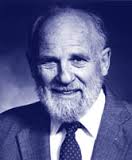 Louis Mobley
Almost 60 years ago, in 1956, Louis R. Mobley built the IBM Executive School to make IBM senior managers more creative. He used 6 key principles. They are highly relevant today – they made IBM a great company. I found this on a blog called Creativity at Work, in turn citing a Forbes article by August Turakk.
Try these principles on yourself. Build your own personal Executive School.
1. Traditional teaching methods (reading, lecturing, testing, memorizing) are worse than useless; they are counter productive, they build ‘boxes’.
2. Becoming creative is an UNLEARNINg process, not learning – you need to abandon, discard, destroy and trash beloved assumptions.
3. You don’t learn to become creative. Instead, you BECOME a creative person behaviorally, by your actions. You transform yourself. By action learning, constant effort and practice, you find solutions to problems that are totally unobvious. You become a creative person through practice, like a piano player learning to play the Minute Waltz.
4. The fastest way to become creative is to hang around with creative people. Creativity is infectious. If you hang around dullards, you will soon be one.
5. Creativity is highly correlated with self-knowledge. If you don’t know what your own inner biases are, you cannot overcome them. Mobley’s school was one “big mirror”.
6. Creative people give themselves permission, and others, TO BE WRONG. Fail fast to succeed early, is the principle. There are no bad ideas, only building blocks to good ideas, as Edison believes and practiced.
Jeff Bezos Follows the Money
By Shlomo Maital

Have you been following Jeff Bezos’ remarkable reinvention of Amazon? Ignore his purchase of a new toy, The Washington Post – that isn’t part of the reinvention.
Bezos is doing what many successful companies fail to do. As Peter Drucker explained decades ago, companies fail not because they do things wrong, but because they do the wrong things… they do the right things for too long until they BECOME wrong. Amazon became a market leader in on-line book sales, then broadened to selling everything, was highly successful – and while it was successful, Bezos is reinventing it, a highly difficult task. (“If it ain’t broke, why fix it? How many CEO’s believe that, and die with their company).
According to David Streitfeld (NYT April 4, p. 15), Amazon Fire TV “is part of a multi-billion-dollar effort by Amazon to move from selling goods produced by others, (low margin), to presiding over the entire process of creation and consumption (downloads and streaming).”
Amazon is now selling a device, Amazon Fire TV, that lets consumers watch Amazon’s video library, as well as play games, on their TV sets.
Recall that very quietly, Bezos positioned Amazon as a major supplier of cloud services, leaving Microsoft, IBM and other huge technology companies behind.
Bezos is using what Bain & Co.’s Orit Gadiesh called “profit pools” – a tool that shows profit margins at each stage of the value chain, and asks senior managers to ask, ‘where is the money [today]?’ and ‘where will the money be in 5 years?’? This is precisely what Bezos asked. His answer: creating download content. And he is able to move Amazon, with alacrity and skill, to where the money will be.
Bezos may well slip and fall in future. But until now, his strategic moves have been alacritous and visionary. And risky – he is not afraid to risk billions.
He’s worth watching carefully, to learn how to innovate tomorrow even when what you innovated yesterday is a big success.
Can We Feed 9 Billion People?
By Shlomo Maital


The new United Nations report on climate change * is very disturbing. It shows climate change is far worse than we had feared, with average temperatures liable to rise by as much as four full degrees, flooding coastal cities and creating turbulent weather.
Today, in the New York Times, Eduardo Porter invokes the ghost of Thomas Malthus, who wrote two centuries ago that population growth would generate famine, starvation, plagues and war. It didn’t happen – yet. Could it?
In case you haven’t noticed, the FAO global food price index rose from 100 in the year 2000 to 160 today, 2014. This is nearly as high as it was in 1970, when the world faced rapid food price inflation.
The IPCC report refutes the idea that climate change will help food production by making food-growing areas warmer. Apparently, faster photosynthesis caused by more carbon dioxide in the area helps weeds more than crops, while ozone and high temperatures actually reduces yields of major grains, according to the report.
To feed over 9 billion people worldwide in 2050 will require 70 per cent more calories than the world consumes today. That’s a huge increase. Where will it come from? Or will we see growing numbers of hungry people?
We’d better tackle the problem right now. Because, Malthus forecasted in 1800, hungry people go to war, desperately, to feed their kids. Especially when half the world overconsumes and grows obese, while half the world goes hungry. There must be a better way.
* U.N. Intergovernmental Panel on Climate Change (UN IPCC), report issued Monday.
* Eduardo Poter, “a forecast of famine, revisited”, International NYT April 3, p. 16.
How High Frequency Traders Ripped Us Off:
Michael Lewis Exposes Wall Street – Again!
By Shlomo Maital

I should always read a book before I blog about it, and generally do. But permit me, just this once, an exception. Michael Lewis’ new book Flash Boys is just too important.
Lewis is an author, age 53, whose books (Liar’s Poker, The New New Thing, Moneyball: The Art of Winning an Unfair Game, The Blind) expose Wall Street. He worked on Wall St. in the 1980’s, made a big salary, thought the salary was unjustified, quit, wrote a book about it exposing Wall St.’s fraudulence in the 1980s, — and it became a best-seller, as all the MBA students bought the book not to understand the fraud but to learn how to make big bucks fraudulently.
Flash Boys exposes how ‘high frequency trading’ rips us off. Here is how Michael Baram explains it, and links it to ‘dark pools’ [off-stock-exchange markets] (in the International Business Times website):
“High-frequency trading is the controversial practice in which firms use sophisticated computer algorithms to trade securities in milliseconds. On Wall Street, information is the coin of the realm and anyone who has an inside track on a large fund’s trades can exploit that knowledge — a pension fund trying to buy 100,000 shares of Microsoft at a certain price range may prefer to hide that order inside the dark pool instead of trading it on a public exchange such as the Nasdaq. But by paying for a special connection to the dark pool, high-frequency traders are able to find that pension fund’s order, go over to the Nasdaq and buy it at a lower price, and then quickly sell it to the buyer in the dark pool at a higher price.”
For years, I have known that foreign exchange traders do this practice, also known as front-running. A big client asks to buy 100 m. yen. The trader buys the yen for his own ‘nostrum’ account at a cheap price, the price of yen (in terms of dollars) rises, he buys the yen for the client at a higher price, then at once quickly sells the yen he bought and ‘flips’ a quick profit. If you do this daily, hourly, soon you make billions, for your bank and for your bonus. It’s unethical, immoral, maybe illegal, but – who knows? And who can prove it? Nobody ever went to jail for front-running.
Now Michael Lewis and his quality research show us that high-frequency traders are doing the same thing. They use their inside information to make money at the expense of pension funds and the public. Dark pools account for 12-15 per cent of all stocks trade in the United States.
As Lewis writes: “The hidden passages and trapdoors that riddled the exchanges enabled a handful of players to exploit everyone else… [Like casinos] You invite a few to start Texas Hold ‘Em by telling them that the deck doesn’t have any jacks or queens and that they won’t tell that info to other people joining the game … By 2013, the world’s financial markets were designed to maximize the number of collisions between ordinary investors and high-frequency traders – at the expense of ordinary investors.”
There seems to be no end to the Wall Street perfidy. The regulators are always a dozen steps behind. If and when the high frequency ‘dark pool’ loophole is closed, by then there will be a new and profitable one. Lewis cites a Royal Bank of Canada employee, Bradley Katsuyama, who fought back by trying to create an honest level-playing-field stock exchange.
The big central stock exchanges, like NYSE, have broken up into many smaller electronic exchanges. This has made it far easier to hide unethical practices that rip us off. Lewis has exposed them. But as we speak, count on it, they’re working on new and better ways to steal. Because, it’s all about money, and for those involved, doing the right thing is for dumb suckers, like you and me.
How to Choose People to Hire
By Shlomo Maital

Hiring people for either a startup or established company is one of the most crucial decisions senior managers make. And in my experience, many mistakes are made.
Whom should you hire? How should you hire? David Brooks writes about it in his New York Times column today, “the employer’s creed”.
Here are some of his rules, and I’ve added a few of my own.
Avoid people with “a high talent for social conformity”. You want to have people to tell you what you DON’T want to hear, not what you do want to hear. There are enough of the latter already.
Don’t favor people with high GPA’s. I’ve found that the grade-grubbers (hey, I WAS one once, damaged my brain permanently) are not the creative mavericks you want to hire.
Reward honesty. Choose people who write honest applications, rather than sugar-coated ones with chocolate icing. You want honesty above all. Beware of the liars, even little white lies.
Hire infected people – evangelists. This comes from Guy Kawasaki, the Macintosh guru. He was a psychology grad, jewellery business person, no tech experience – and he made the Mac a big success. Why? Because he was ‘infected’, an evangelist (in Greek – someone who brings the good news). Hire people who share your passion, not those looking to flip their options.
Hire diverse people. If you have a diverse workforce, you are more likely to get good ideas. Your range of people, their personalities, skills, passions, need to be wide, so that you can do ‘zoom out’ on new ideas far wider and better.
Invest a lot of time and effort in hiring. I know a CEO of a Canadian company, who hangs out with potential management hires for a whole day, lunches with them, plays squash with them… to get to know them. That will save you a whole lot of trouble in the future. If you make a bad hire, by the time you realize it much damage may have happened.
Never ever abandon hiring solely to your HR people. They hire according to the book they learned in college. Sometimes, when you hire, you need to throw the book away. Make hiring your own key responsibility.
From Idea to Product: Crossing the Chasm
By Shlomo Maital


When I teach entrepreneurship and innovation, I do a bit of theatre. I show my class a ‘matryoshka’ Russian nested doll set, and one by one assemble each doll, nested inside a larger one. I do this until I have 9 dolls on the table, down to the tiniest one. Then, I tell the story how one year, a sharp-eyed student asked, why nine? Instead of ten?, and I discovered a tenth tiny-tiny doll, much smaller than a pinky fingernail.
I had been unaware of its existence, inside the 9th doll, for years. See this? I hold it up to the students. This is the idea. This is the fun part. This is the easy part. The hard part? Implementing the idea. Building a business around it – the other 9 dolls. Without that, that tiny ‘idea doll’ is of no value.
Prof. Daniel Nocera, Harvard University, is an example. He has developed an artificial leaf. It’s an invention that generates energy the way a tree or a plant does. “Light strikes a container of water, and out bubbles hydrogen, an energy source, as the light breaks H2O into hydrogen and oxygen.” How does this work? Writes Jack Hittmarch (NYT March 29): “A silicon strip coated with catalysts breaks down the water molecule [using sunlight].” Wow! Hydrogen! You could use all that hydrogen to power fuel cells, which are devices that convert the chemical energy from a fuel into electricity through a chemical reaction with oxygen or another oxidizing agent. Hydrogen is the most common ‘fuel’ for fuel cells.
Big wow! But the discovery was made years ago. Nocera says his system is very safe. “My system is based on water, so if there was a catastrophe we’d just need a mop.” However, hydrogen is highly flammable, and highly explosive. So turning the Artificial Leaf into usable energy means surmounting many obstacles. Create viable fuel cell technology. Solve safety issues, in storing hydrogen. Get consumers accustomed to using fuel cells. There are many cheap reliable nonpolluting energy sources. The issue, it seems, is not the invention. It’s how to make it desirable and usable for consumers. And THAT is a huge problem.
Nocera says that fracking and cheap natural gas is “killing” his artificial leaf invention. But one day fracking may actually help. Fracking can produce hydrogen, at a cost of carbon dioxide. If such hydrogen production becomes widespread, so will the infrastructure to use it. And then, Nocera’s artificial leaf will be popular, because it can produce hydrogen (to feed the infrastructure) without generating carbon dioxide. It will defeat fracking. To sum up: There are loads of great new technologies that ‘solve’ our problems. But there is a lack of wise capable entrepreneurs who know how to commercialize them fast, cheap, good, friendly, easy…. And governments willing to supply the needed infrastructure.
Innovators should bone up on these technologies and invest creativity not in new ideas but in how to implement old ones and diffuse them widely. Long ago, Geoffrey Moore taught us how important it is to ‘cross the chasm’ between early adopters of innovation and mass-market buyers. There is a different chasm, equally hard to cross – the chasm between a great idea based on sound technology, and a widespread commercial product or service used and loved by all. There is as much or more need for creativity in crossing this chasm as there is in inventing new technologies.
How America Buried Its Future in Its Defense Budget
By Shlomo Maital

In Thomas Friedman’s New York Times column, March 31, he writes about his cruise on the U.S.S. New Mexico, a modern nuclear attack submarine, underneath the Arctic ice cap.
He describes: “Excellence…if anyone turns one knob the wrong way on the reactor or leaves a vent open, it can be death for everyone. …As one officer put it: ‘You become addicted to integrity’. There is zero tolerance for hiding any mistake. The sense of ownership and mutuality and accountability is palpable.”
How many American companies would LOVE to be able to describe themselves as Friedman describes the U.S. Navy submariners? How many would LOVE to have world-class cutting-edge technology, like the U.S. Navy, far beyond that of other companies? Why don’t they? Because the U.S. defense budget in 2014, despite cuts, will total $526.6 b., or 4 per cent of America’s GDP. This is fully one-third of all the world’s defense spending in 2014, or $1.538 trillion, up from $1.538 trillion in 2013, the first rise in global defense spending in a decade. America is burying its economy in those costly nuclear subs.
Years ago, I visited an aircraft carrier, the U.S.S. Theodore Roosevelt. 11 decks of amazing technology and 5,000 superbly trained 18-year old or 20-year-old sailors. Planes launched and retrieved, at night, in darkness, simultaneously. Microsoft, IBM, eat your heart out.
America’s chief rival, China, spends only $132 b. a year on defense, or one-fourth that of America. And NATO? The 28 NATO nations have agreed they should spend 2 per cent of GDP on defense (half of America’s level), but none except the U.K. (2.4 per cent) actually do.
And Russia? Russia will boost its military spending by 44 per cent in the next three years, to fulfill Putin’s vision of a Great Russia (“bring back the U.S.S.R.!”).
So to sum up: The world is again in an arms race, defense spending is rising, and we are wasting huge sums on things like nuclear subs. Europe, as always, is sheltering under America’s defense spending, and has nothing to face Russia with. America has sunk its economy in military technology, which despite myths does not translate into cool civilian technology, for the most part.
* What purpose do those superb Navy subs and aircraft carriers serve, when the main threat to America is Taliban terror, al Qaida fighters armed with AK-47’s and home-made improvised explosive devices?
* Would the world be a better place if America’s economy were made stronger by diverting defense spending into infrastructure and civilian technology and education?
* Should Europe quit sponging off America and spend to defend itself?
* Is Russia again going to impoverish itself by putting billions into defense rather than rebuilding its flagging civilian economy, just as the U.S.S.R. did, fatally? Russia’s Siberia oil production is declining because Russia simply is not maintaining its oil infrastructure there – this, despite piles of cash in the bank. Simple incompetence.
Stay tuned.
How We Humans Can Learn from Chimpanzees
By Shlomo Maital

BBC World Service’s Science Hour program is outstanding. On March 30, one of the topics was animal behavior. It was recalled how Jane Goodall saw chimps use twigs to get ants from inside anthills, and proved that animals know how to use tools. Then broadcaster Adam Hart asked, do animals think like humans? Do they have moral principles?
The fascinating research by Emory University researcher Frans De Wall, a Dutch primatologist, was mentioned. He studies whether animals empathize, i.e. understand and sympathize with other animals? They do indeed. Chimpanzees go over to chimps who lost a fight, and put an arm around them to comfort them. Yawn contagion is a predictor of empathy (if someone else yawns, causing you too to yawn, you are empathic). Chimps who saw videos of yawning chimps were likely to yawn themselves if they knew the chimp involved, i.e. had a reason for empathy.
But do animals have a sense of equality and fairness? De Wall reports: “We did experiments with capuchin monkeys. They are very sensitive to who gets what. In our experiments we had 2 monkeys side by side. We gave them pebbles and they had to give them back to us, to get a reward. If both got the same reward, they perform this task 25 times in a row without fail. But If one gets a grape, another gets some cucumber, and grapes are far better rewards, the chimp who gets cucumber gets upset, protests, throws away the food (similar to human reactions), and goes into protest mode, or strike. No more returning pebbles!”
With The Economist’s cover story on Crony Capitalism, new attention is being focused on the obscene salaries capitalist managers pay themselves, especially those in banks, insurance companies, hedge funds and financial services. The animal studies reveal a key point. It is part of our evolutionary DNA that societies should be fair. Fair societies are cohesive, and thus survive better and longer than selfish unequal ones. This began with primates, chimps and apes, and has transferred to human society too. Crony unfair unequal capitalism, where a handful rip off the majority of working people, will simply not survive. One way or another, the people will find a way to put a stop to it, just like De Wall’s chimps.
Check out De Wall’s books: Our Inner Ape, and Chimp Politics. In many ways, chimp society is more advanced than our own human society in the age of rip-off capitalism.
All That’s Wrong With Democracy:
Roger Cohen Gets It Right!
By Shlomo Maital

Roger Cohen, the New York Times columnist, is a fierce critic of my country Israel – sometimes deservedly, sometimes excessively. But lately he’s been a fierce critic of U.S. President Obama, and this time, it’s richly deserved. In today’s New York Times, he tears a strip off Obama for his weak wishy-washy speech in Europe on how to stand up to Russia. The problem is, Cohen says, that Western democracies are “failing to deliver”, while despots like Putin actually have been performing rather well.
The proof? Soaring unemployment in Europe (3 m. unemployed in France, for instance), rising fascist right-wing parties (Marine LePen and the Front Nationale did well in France’s municipal elections last Sunday), European integration is stalled and Europe is internally divided and at odds, the EU is overly bureaucratic and undemocratic; income disparities in Europe and the U.S. are huge and growing; there is “spreading middle-class dystopia”; money has skewed fairness on both sides of the Atlantic, corrupting democracy. Scorched earth Republicans devote their politics to obstruction. “A CEO can earn $80 m. for a few weeks of work while incomes for most Americans are stagnant.” Many young people have lost the sense of possibility and hope.
Concludes Cohen: “Unless Western societies find a way to shake their moroseness, level the playing field and rediscover [equality], they are going to have a hard time winning the contest of ideas (against the despots)”.
“Now is not a time for bluster,” intoned Obama. And that is precisely what he provided in his speech – empty words. Saudi Arabia has given up on the U.S. Israel may soon have to do the same. And Vladimir Putin is laughing up his sleeve.
A full century ago, Louis Brandeis, U.S. Supreme Court Justice, said that you can’t have both democracy and great concentrated wealth. Israel just passed a law to try to mitigate that concentration. Before the U.S. and Europe can confront Russia, they need to look in the mirror and confront their own problems.
Is France Missing the Boat?
How to Exile Your Youth
By Shlomo Maital

Ah, France, home of Paris, great cuisine, culture, the inspiring French Revolution, relaxed lifestyle…! Alas, France – your most important recipe, how to inspire your youth and keep them from leaving the country, has failed. And the results are disastrous.
Entrepreneurs are leaving France, according to Liz Alderman, writing in the New York Times (March 22). Here is how she begins her piece:
“Guillaume Santacruz is among many French entrepreneurs now using London as their base. He said of his native France, “The economy is not going well, and if you want to get ahead or run your own business, the environment is not good.” Guillaume Santacruz, an aspiring French entrepreneur, brushed the rain from his black sweater and skinny jeans and headed down to a cavernous basement inside Campus London, a seven-story hive run by Google in the city’s East End. It was late on a September morning, and the space was crowded with people hunched over laptops at wooden cafe tables or sprawled on low blue couches, working on plans to create the next Facebook or LinkedIn. The hiss of a milk steamer broke through the low buzz of conversation as a man in a red flannel shirt brewed cappuccino at a food bar. A year earlier, Mr. Santacruz, who has two degrees in finance, was living in Paris near the Place de la Madeleine, working in a boutique finance firm. He had taken that job after his attempt to start a business in Marseille foundered under a pile of government regulations and a seemingly endless parade of taxes. The episode left him wary of starting any new projects in France. Yet he still hungered to be his own boss.
He decided that he would try again. Just not in his own country.”
Every country, including my own Israel, must understand this: Entrepreneurship is global. Entrepreneurs will start their business elsewhere, if you do not create the right conditions for them. Make it easy to start a business, and most important, easy to close a business if it fails. Make it easy to get a small amount of startup zero-stage money. Make it easy to hire, and to fire. Make it easy to find experienced management advice. Lots of countries do.
France just had local elections. Everyone is preoccupied by the rise of LePen and the right-wing nationalists. This is a problem. But it is trivial compared to the cost of losing bright young people who if they stayed would create new businesses and many new jobs for other young people. France is 41st (!!) in the world in ‘ease of starting a business), and about 149th in ease of registering property. Why? Blind dumb bureaucracy that could be eliminated in one day. Wake up France! You have the world’s best schools of engineering and some of the world’s best engineers. Keep them at home, help them start businesses. If you don’t, they’ll leave – and France will never be the same. And that applies to all countries, Greece, Spain, Italy – and my own Israel. Ever notice how many foreigners (from India, Israel, etc.) are in Silicon Valley, starting businesses?


