
You are currently browsing the category archive for the ‘Innovation Blog’ category.
Lessons of the Ukraine/Crimea:
Will Insanity Recur?
By Shlomo Maital

Crimean War
My friend Bilahari Kausikan, Ambassador at Large in Singapore’s Foreign Ministry and until recently First Permanent Secretary, has wise words regarding the Ukraine/Crimea crisis, published in the Straits Times. He visited Kiev in December, recalls hearing a speech by an EU politician in Independence Square – and thought, “this could end up like Hungary in 1956”, when the West encouraged Hungarian revolt, then folded its arms and did nothing to help when Russian tanks invaded.
“Russia cannot allow Ukraine to become part of the Western system without losing an essential part of itself and abandoning Putin’s goal of a revived Russia as a great power,” Kausikan observes. Some 17% of Ukraine’s population, or 8 million people, is ethnically Russian. This is the largest Russian diaspora in the world. They live in the Crimea, and East and southeast Ukraine. Russian gas pipelines run through Ukraine, and Sevastopol is Russia’s only warm water port.
“It was inevitable that Russia would move decisively,” Kausikan notes. (He once served as Singapore’s Ambassador to Moscow). And as usual, Russia’s intervention “caught the West flatfooted”. The U.S. is weary of wars. And “the EU has neither the stomach nor the capability to wage war on Russia”.
Kausikan believes that the West gave false encouragement to the Ukrainian, without the capacity to deter Russian intervention or respond effectively.
Once again, my own view is that President Obama, and the incompetent EU foreign Minister Katharine Ashton have proved worse than incompetent. “The West mistook their hopes for reality,” Kausikan writes. Because the West has no stomach for military intervention, they thought Russia felt the same. Stupid.
“Do not listen to the sweet words of foreigners,” Kausikan counsels Singapore. And, he might have added, Israel, as well. Small countries have no room for error. And the great powers that ‘support’ them are increasingly unwilling to stick out their necks for their friends.
“It is the Ukrainian people who paid and who will continue to pay the heaviest price,” Kausikan writes. “We (Singapore) must never lose the ability to look after ourselves, because if we cannot look after ourselves, nobody will look after us.” True of every single small nation, sandwiched between a paper-tiger marshmallow former great nation, America, a bankrupt internally-conflicted EU, and an aggressive Russia led by a megalomaniac dictator who is, according to Merkel, “detached from reality”.
Watch your backs, small nations. Nobody else will.
And, an historical footnote: The Crimean War, between the French British & Ottoman empires and the Russian Empire, lasted from Oct. 1853 to Feb. 1856. Russia lost. But there were 300,000 to 375,000 dead, including 100,000 who died of disease. The cause of the war? Rights of Christians in the Holy Land. France promoted the Catholics. Russia, the Orthodox. I’m not kidding. That was the cause of a bloody war. So maybe, in the 21st C., we are a tiny bit more civilized.
Gossip is Good? – Lucy Strikes Again!
By Shlomo Maital
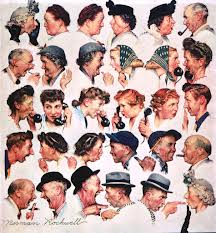
Norman Rockwell’s take on ‘gossip’
Financial Times columnist Lucy Kellaway has done it again! This time, she writes about ‘gossip’ in her column – and manages to persuade us that “gossip is particularly important in offices. It helps us know who to avoid, it undermines bullying bosses, it binds people together and shores up a company’s culture.” And what’s more, she buttresses her unusual case with academic research.
“….according to recent research from Stanford University, published in Psychological Science, not only have I done no harm by gossiping, I have been making the world a finer place. Talking about people behind their backs increases co-operation, upholds the moral code, punishes the selfish and rewards the unselfish. And if people know they get voted off the island for bad behaviour, they behave less badly.”
According to the Psychological Science website, “Their research shows that gossip and ostracism can have positive effects, serving as tools by which groups reform bullies, thwart exploitation of “nice people,” and encourage cooperation. “Groups that allow their members to gossip,” said Feinberg, “sustain cooperation and deter selfishness better than those that don’t. And groups do even better if they can gossip and ostracize untrustworthy members. While both of these behaviors can be misused, our findings suggest that they also serve very important functions for groups and society.”
The Jewish faith places gossip among the most heinous of sins. In Hebrew, gossip is “lashon ha-ra”, which means, “evil tongue”. Indeed, in our faith, you must not speak evil of people behind their backs, or even to their face (destroying a person’s self-respect is a colorful Hebrew phrase, “le-halbin panim”, or literally, to ‘whiten somebody’s face’). And, you also must not even praise people excessively to their face.
In the academic ‘publish or perish’ game, the more illogical, contrarian or radical your idea, the more likely you are to get it published. “What’s new?” is what editors ask, and if the answer is, well, nothing much – don’t bother to submit. So there is inherent bias toward articles like the one in Psychological Science about gossip, in which black is white, good is bad, and wrong is right.
But Lucy – I don’t buy it. Gossip is destructive. Period. Norman Rockwell (above) got it right.
“Gossip and Ostracism Promote Cooperation in Groups”, Psychological Science. By Robb Willer, Stanford University, in collaboration with co-authors Matthew Feinberg, a postdoctoral researcher at Stanford, and Michael Schultz from the University of California–Berkeley.
Who am I? Montaigne & Self-Awareness
By Shlomo Maital

Michel de Montaigne was one of the most influential writers of the French Renaissance, b. 1533, d. 1592, a short 59-year life. He wrote thoughtful essays that investigated his own thoughts, and personality.
Writing in his New York Times column, David Brooks tackles Montaigne, along with another great essayist, Samuel Johnson. I doubt there is another columnist alive who would dare to make a column out of two authors who have been dead for hundreds of years. As a high school French student in Regina, Canada, I once impetuously wrote an essay on Montaigne – but the truth is, I didn’t understand a word of what he wrote.
Brooks quotes Montaigne: “If others examined themselves attentively as I do, they would find themselves, as I do, full of inanity and nonsense. Get rid of it I cannot without getting rid of myself. We are all steeped in it, but those who are aware of it are a little better off.”
In others words, as Nietzsche counselled, “become who you are”. But first, understand who you are.
I teach young people in many countries. Increasingly I find that Generation Y, those born after 1980, lack an understanding of who they really are, and what their passions are. The reason seems to be the connectedness of the smartphone. Why bother to know what you really think, if you can ask others instantly? If you are permanently instantly linked to others, how can you ever build self-awareness, when your own self disappears in the swamp of ‘connected socially-networked others’? How can you become who you are, if you do not ever really know who you are?
There is a kind of serenity that comes with self-awareness. I deeply regret that many troubled people I encounter never achieve that serenity. It starts with recognizing our own faults, our own flawed character. If you are constantly looking outward, at what others are tweeting and posting, you will never have time and space to look inward. And that’s a real shame.
Local Empathy: Toilet Innovation in Japan and Kenya
Incremental Excremental Innovation
By Shlomo Maital

Toto’s Sound Princess
The core of innovation is meeting an unmet want or need in a creative manner. The tough part is simply identifying that need. Here are two examples of how empathy – feeling AS IF you were the person in need – is crucial. And how incremental innovation can be…excremental.
* A Japanese toy company, Toto, invented the otohime, or “Sound Princess”. It is installed in thousands of restrooms across Japan. What does the Sound Princess do? When you press the button (see photo), it mimics the sound of flushing water.
Why? Many Japanese women were continually flushing, so that the sound would mask the sounds they made in using the facility. The portable purse-friendly device is a huge best-seller in Japan.
I would LOVE to know the back story, of how (and more important, WHO!) invented this device.
* The Umande Trust, a Kenyan community organization, tackled the problem of disposing of human waste in Africa. A common solution is the ‘flying toilet’ – plastic bags of human waste, flung as far as possible. Umande builds massive biodigesters that composts the output of a fleet of toilets. Each toilet charges a few pennies for each use, and makes about $400 per month. The biodigester composts the waste, creates biogas and makes hot water for some 400 residents.
There are probably millions of would-be entrepreneurs who are trying to devise apps, to rival WhatsApp, sold recently for $19 b. The field is too crowded. I wish they would focus on dark corners, basic areas where there are unmet needs because, well, human waste is just not appealing. By empathizing with ordinary people, observing their daily lives, entrepreneurs can create value in areas far from the standard smartphone. But, it starts with empathy, a keen eye and sharp ear, and a deep passion for making the lives of ordinary people better, even incrementally.
* Dayo Olopade, International New York Times, March 1-2, 2014, p. 6
Unlocking the Innermost Secrets of our Brains
By Shlomo Maital

In his excellent reportage, “mapping the brain’s inner language” (NYT Feb. 26, p. 7), James Gorman tells how R. Clay Reid left a top job as Harvard Medical School professor, to join the Allen Brain Institute in Seattle, in 2012 (an institute funded by a huge grant from Microsoft scion Paul Allen). He did it, for the freedom to research the mouse brain. Why? Because many kinds of research can’t yet be done on humans, and the brains of mice and even flies “share common processes with the human brain”. In particular, Reid has tackled the million neurons in the mouse’s visual cortex. The visual cortex is the part of the cortex that processes visual information; it’s in the back of the brain (see above).
Harvard too has a mouse project. The Human Connectome project (after the ‘genome’ and ‘proteinome’ projects) tries to build a structural map of the mouse brain, down to the amazing level of packets of neurochemicals at the tips of brain cells!
How do Reid and other neuroscientists study the mouse brain? First, a mouse is trained to look at an image. Then, it learns to press a lever when the original image appears, among several others. Reid studies what happens in the two second period, during which the photons of the image hit the retina, the brain sends info to the cortex, the neurons in the cortex do some computation, and send a message to the mouse’s paws to press the lever. This is a complex process involving genetics, electricity, and chemistry. It is revealed in electron micrographs that show every neuron and every connection in the mouse’s visual cortex.
In the end, Reid notes, the brain features the ‘molecules’ that underlie behavior.
Understanding how the brain processes information and then tells us to act on it will be a huge breakthrough. It may help us cure awful neurological diseases (ALS, Parkinsons). Perhaps, one day, as we mark the 100th anniversary of the outbreak of World War I, a terrible war no one wanted that needlessly, stupidly, killed 16 million people (civilians and soldiers) and wounded 20 million more !, we will understand the parts of the human brain that create senseless violence and death.
What is Helping the Dollar Defy Gravity?
By Shlomo Maital

What in the world is helping the U.S. dollar defy gravity, keeping it from falling relative to other currencies? The U.S. economy’s recovery is weak, job creation is awful, President Obama is incompetent, the Congress is deadlocked, and America is turning inward, or returning to its traditional isolationism. Moreover, the Fed continues to print dollars (by buying $85 m. worth of Treasury bonds monthly). There is an enormous overhang of printed dollars out there.
China has lots its appetite for buying dollars. According to Floyd Norris (New York Times, Feb. 22-23/2014), China bought a net $48.5 b. worth of U.S.Treasury bonds last year. This is $20 b. less than in 2012. China now holds $1.27 trillion in Treasury bonds; together with Japan, this amounts to 42 per cent of the total $5.8 trillion in Treasuries held by all foreigners.
There is a great science fiction plot here. What if those foreign Treasury holders decided to spite the U.S. by dumping their dollar holdings? The dollar would crash, stock markets all over would drop, and an enormous crisis would result. Why would anyone do this? Well, America has plenty of ill-wishers out there. The fact is, the fate of the dollar, and the U.S. economy, is now in the hands of Chinese, Japanese and others, who hold vast amounts of U.S. assets.
By great good fortune, just as China is easing off its dollar purchases to support the dollar, Japan, under Abe and his “Abe-nomics”, has stepped up its buying. Japan bought a huge $71.3 b. in Treasuries in 2013, up from $53 b. in 2012. Japan is now the single largest purchaser of dollar assets. Of course, Japan does this to weaken the yen and help its exports. So far, it isn’t working too well.
It is significant that the American public, including the banks, slashed their holdings of U.S. treasuries. Clearly everyone knows that interest rates aren’t going down, they’re going up, which means Treasuries are going down, which means we should be selling them. Apparently, foreigners are more bullish about the dollar than Americans are. Not a good sign.
Right next to Norris’ column is an account of Fed discussions during the 2008 crisis. It is very disturbing. It shows how clueless the Fed Open Market committee was, especially after the Lehman bankruptcy, and how the Fed continued to worry about inflation, when the pressing problem was in fact deflation. It seems that not only are there no competent political leaders left in power, there are no competent economic and financial leaders either.
Tiger Mom’s Triple Package: Racism? Realism?
By Shlomo Maital

Amy Chua & Jed Rubenfeld
“Tiger Mom” is back. Amy Chua, who wrote a book about her tough approach to raising her two daughters, as an Asian Mom, (Battle Hymn of the Tiger Mother, 2011) has a new book, co-authored by her husband Jed Rubenfeld: The Triple Package.* In it, they make a claim that several ethnic groups excel in America – Jews, Mormons, immigrants from China, Cuba, Lebanon, India, Iran, Nigeria — excel, because they are different. They have the triple package. First, impulse control, or self-discipline. Second, self-belief, self-confidence, almost a feeling their ethnic group is superior. Third, prejudice, or inferiority complex – the feeling they are persecuted, hindered, so they have to do like Avis – try much harder. The authors make the claim that America in general is lagging because it lacks the triple package – especially, when everyone is trying to make others feel self-confident, worthy, avoiding frustration, and when ‘no child left behind’ focuses on the laggards rather than the geniuses. The ‘self-esteem’ movement, which wants everyone to feel good about themselves, seems to prevent tackling big challenges that might – heaven forbid – damage our self-esteem though (G-d forbid)…the F word, failure!
The book has been pilloried, as racist and worse. It is not. My parents were immigrants. And they indeed tried harder. And they imbued me with the same ethic. Since when does the thesis that immigrant groups bring energy and the desire to excel become racist?
The fierce criticism Chua and Rubenfeld have absorbed suggests they may have touched a nerve. In a society that fosters instant gratification, impulse control and self-discipline are becoming rare. Some groups still have it. They seem to succeed. Is that racism? Or realism?
* Chua & Rubenfeld, The Triple Package: Penguin, 2014.
Microsoft’s New CEO: Asking the Right Questions
By Shlomo Maital

Satya Nadella
Microsoft has a new CEO, to replace veteran CEO Steve Ballmer. He is Satya Nadella, 47 years of age, born in India, and he has been on the job for 17 days. He’s been with Microsoft for 22 years; previously he worked for Sun Microsystems. He’s a computer engineer.
Nadella was interviewed by the New York Times’ Adam Bryant (Feb. 21). In the past, Microsoft has never missed an opportunity to miss an opportunity. MS, Gates and Ballmer missed the Internet, smartphones, you name it, they missed it. Only flexibility and alacrity, the ability to recover, kept Microsoft alive. Gates was able to mobilize his forces, tell them up front we missed this one, then engage them in catching up. Microsoft is great at catching its foes from behind…usually.
Nadella’s interview shows he understands what the key questions facing Microsoft are. And by the way, any large organization, competing in global markets. Here are some his observations. They are right on the mark.
“We (MS) have operated as if we had the formula figured out, and it was all about optimizing. ..Now it is about discovering the new formula. [What he means here is, MS was great at operational discipline, ‘optimizing’, but now it needs some radical innovation, ‘the new formula’.] So the question is, how do we take the intellectual capital of the 130,000 people and innovate, where none of the category definitions of the past will matter? Any organizational structure you have today is irrelevant because no competition or innovation is going to respect those boundaries.”
Take note, organizational experts. Don’t waste your time on your company’s organizational structure. It is irrelevant. You are being attacked by innovative startups that don’t even have one.
“Everything now is going to be much more compressed in terms of both cycle times and response times.” MS is a huge elephant. It has to learn to dance, in Lou Gerstner’s phrase, because its competitors salsa, rather than waltz.
“You have to be able to sense those early indicators of success, and the leadership has to really lean in and not let things die on the vine. When you have a $70 b. business something that’s $1 million can feel irrelevant. But that $1 m. business might be the most relevant thing we are doing.”
He gets it! MS has ignored important innovations in the past, because they were too tiny to merit attention or managerial time. But they were the disruptive innovations that changed the world.
“What people have to own is an innovation agenda, and everything is shared in terms of the implementation.”
“One of the things that drives me crazy is …”this is how we used to do it.” Or….this is how we do it”. Both are dangerous traps. The question is: how do you take all of that valuable experience and apply it to the current context and raise standards.”
Those indeed are the issues, Satya. Good luck to you. Now let’s see if you can deliver. You don’t have a whole lot of time.
Loneliness Can Make You Ill: Find a Friend, Befriend a Loner
By Shlomo Maital

Reading my wife’s copy of the American Psychological Association’s MONITOR magazine, I found an article citing a study by John Cacioppo, showing that “the perception of loneliness” is closely linked to higher rates of mortality.
It is the perception that is the problem. “It’s not being alone or not” that affects your health, Cacioppo says. “You can feel terribly isolated even when you’re around other people.” And indeed some people actually enjoy being alone.
But there are those who perceive that they are alone, no matter how many friends and relatives they have to interact with. Loneliness can make people feel chronically threatened, and this emotion can wear on the immune system.
We’ve known for a long time that our emotional wellbeing is directly, physiologically, linked to our immune system. I have several friends who have experienced highly stressful situations and have fallen ill afterward. Apparently, the feeling of being all alone, with no one there to ‘catch our back’, is one of those emotional stress factors.
I wonder whether Generation Y, the ‘connected generation’, the kids who permanently, 24/7, connected to one another by their smartphones, will feel less lonely than the older generations, when they cross 50. I wonder whether a cell phone SMS is a good substitute for a face-to-face hug or smile. I guess we will find out.
I guess one action item emerging from this is: If you’re feeling lonely, find a friend; if you know someone who’s feeling lonely, be a friend. You may save a life. And it may be your own.
* John Cacioppo, et al. Loneliness: Human Nature and the Need for Social Connection, 2008. [study of 2,100 adults ages 50 and older].
How “Angry Birds” Can Help Cure Cancer
By Shlomo Maital

The BBC World Service program Health Watch recounts this morning how British cancer researchers, with a burst of creativity, have enlisted cell phone games to help them cure cancer.
Here is the story.
An intensive British study of the genetic foundations of breast cancer has revealed a number of genes related to the illness. It is complicated by the fact that breast cancer is not just one illness, but perhaps 10 different ones. This study involves study of massive amounts of data, much harder than finding a needle in a haystack. It requires identifying “peaks and troughs” in data, to find places where gene defects are linked to breast cancer.
Someone had the brilliant idea, that the human eye is terrific at pattern recognition, better than perhaps software. So why not create a game, Genes in Space, in which people with idle time, who play games on their cell phones, could view gene data, in the form of ‘peaks and troughs’, and play a game in which you get points for finding those peaks and troughs. It’s a real gripping cell phone game, perhaps not quite Angry Birds, but close, involving destroying threatening asteroids, etc.
One ‘formula’ for creativity is X+Y. Find an X (search for genes related to breast cancer), and a Y (cell phone games), and find a creative novel useful way to link them, in a way that has not been done before. The British researchers have done that. They use the idle time of people to do something useful.
Great idea, team. Are there other ways that we can use Angry Birds technology, to do good for humanity, instead of just burn time?


