
You are currently browsing the category archive for the ‘Uncategorized’ category.
Banks’ Billions: Shame
By Shlomo Maital

HSBC (Hong Kong & Shanghai Banking Corp.), based in Britain, is Europe’s largest bank, by assets, with widespread business in Asia.
Ever wonder what the impact of the US Federal Reserve’s panicked interest rate hikes was? Copied by the European Central Bank and nearly everyone else, including the Bank of Israel? Stamped out inflation? Not quite.
Obscene profits for the banks. Such as HSBC. Here are the numbers:
HSBC’s net profit more than doubled to $18.1 billion in the six months ended June, a sharp spike compared to the $9 billion in the same period a year before.
The bank’s profit before tax rose 147% year-on-year to $21.7 billion, up from $8.78 billion in the first half of 2022.
HSBC’s board approved a dividend of $0.10 per share, and announced a further share buyback of up to $2 billion. None of the profits will drive investment and job growth.
In short – Central Banks delivered a windfall of profits to the banks, which then divvied them out to shareholders. And the middle class who have mortgages? They are hit hard, and their higher payments go straight to the pockets of the banks’ shareholders.
Where are the regulators? If the banks are making billions in profit through higher interest rates, are they paying us higher interest on our deposits? Because the money they make, is made on our money deposited with them.
No.
It is not just HSBC. ALL the huge banks are raking in the money, billions and billions of it.
And the worst part of this is – nobody protests. It is as if this is how capitalism works, how it always works.
There ought to be a law.
Israel’s Slippery Slope
By Shlomo Maital

Israel’s economy is on a slippery slope, because – its democracy has stumbled.
Here is why.
In their 2012 book Why Nations Fail *, leading economists Daron Acemoglu and James Robinson trace why some nations rise to riches and others fall to poverty. Israel is/was among the former, with $55,000 GDP per capita, driven by hi-tech.
It is a very long book, over 500 pages – I’ll save you the time to read it. The authors find: “Countries such as Great Britain and the United States became rich because their citizens overthrew the elites who controlled pover and created a society where political rights ere much more broadly distributed, where the government was accountable and responsive to citizens and where the great mass of people could take advantage of economic opportunities.” (p. 3)
These words described Israel – unto Nov. 3, when a far-right government won a tiny majority in the Knesset, by 30,000 votes, only because a huge-ego Labor party leader refused to join with smaller parties – and did not achieve the 3.25% threshold required, wasting a huge number of left-center votes. With a 64-56 majority in the Knesset, this coalition government is held hostage by a tiny homophobic group led by a convicted felon banned from army service, who now, hard to believe, is the Minister in charge of our national security. The Justice Minister is bent on ‘reforms’ that will neutralize the checks and balances of the Supreme Court. All this, so that Prime Minister Netanyahu can wangle a get-out-of-jail card, as he is on trial for corruption.
It happens that democracies stumble. The US stumbled in 2016 with Trump. So did Hungary. They tend to recover.
But will Israel?
“Fundamentally, it is a political transformation… that is required for a poor society to become rich”, note the authors. And vice versa. An undemocratic transformation can quickly lead to a country becoming poor.
Since Nov. 3, the number of Israeli startups has fallen by half. Capital has fled. The shekel has plummeted. The government budget deficit soared.
Far-right ministers pooh-poohed this. With the Knesset now in recess, cynical members of the ruling Likud party now talk about the need for consensus – after raising their hands in favor of a law that basically removed ‘reasonableness’ as a constitutional requirement for any government decision.
A majority of 30,000 votes, out of 4 million, can do what they want in the Knesset. But they cannot force bright young people to volunteer for army service, launch startups or pay huge taxes. In today’s world, there are no borders for those with strong human capital skills.
Israel is on a slippery slope. Massive demonstrations have taken place regularly for over half a year – and are likely to continue and swell for another half year, as the economy declines. It is a shame, because Israel’s economy performed best of the OECD nations during and just after COVID.
I find two reasons for optimism. One — Israel’s young people have rediscovered the precious value of democracy — like a beautiful Picasso painting on the wall, largely unseen until it is removed or stolen, when we suddenly deeply miss it. Two — the fragile Netanyahu government will be unable to run the country when more than half its population oppose it vehemently. It may take some time for them to learn this.
Democracy is a slipper slope. Money flees undemocratic nations, and no nation can build an economy without money. Marching back up the slope after damaging democracy is harder and longer than sliding down it.
Israel is a young country, only 75. I guess it has to learn the hard way.
* Robinson, J. A., & Acemoglu, D. (2012). Why nations fail: The origins of power, prosperity and poverty. London: Profile.
Why Do People Believe Whacko Conspiracy Theories?
By Shlomo Maital
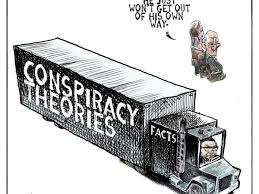
Caption: “He just won’t get out of his own way!” (Toronto Star)
Consider Robert Kennedy Jr., son of the late Bobby Kennedy. He spews horrendous whacko conspiracy ideas, some about vaccines, profits enormously from them, and by some polls has support among 20% of Democrats for his destructive presidential campaign. Kennedy has compared vaccines — which have saved millions of lives — with the genocide of the Holocaust.
In December 2016, TIME magazine reported that “a 28-year-old man was arrested on Sunday for allegedly walking into a Washington, D.C., pizza joint with an assault rifle, saying he wanted to investigate claims that the restaurant was running a pedophile ring from its basement with the help of Bill and Hillary Clinton.“
Why? Why do whacko conspiracy theories gain so much traction?
A massive study to uncover the motivational and personological correlates of conspiratorial ideation spanned 170 studies, 257 samples, 52 variables, 1,429 effect sizes, and 158,473 participants.*
The researchers found this: “Overall, the strongest correlates of conspiratorial ideation pertained to (a) perceiving danger and threat, (b) relying on intuition and having odd beliefs and experiences, and (c) being antagonistic and acting superior.
Let me translate this.
* If you are, say, part of a white poorly-educated minority in a nation with growing brown and black populations, and a flood of migrants, you perceive danger and threat. Especially in times of great uncertainty and chaos – like, now.
* If you are relatively poorly educated, you will be more open to wild whacko ideas. (Note: some of those who purvey them, like Robert Kennedy, are well educated, but cynically see opportunity to gain influence and wealth by disseminating them).
* And finally, if you perceive you are becoming an underclass, you fight back by espousing ideas that make you seem superior, antagonistic to those who you think are trying to replace you. It is one way to fight those who oppose you.
There is no easy answer. Conspiracy theories will get wilder and wilder. They are fallout from a divisive, divided, massively unequal society with huge extremes of wealth and poverty. And social media make it trivially easy to spread crackpot theories, the wilder the better. A former US President was a happy participant, embracing openly QAnon in 2022.
I guess, in society, you sow what you reap. Sow poor schools, deep poverty amidst armies of billionaires, and a threatened white minority, and you will reap conspiracies. Putting the genie back into the bottle may no longer be possible.
* Bowes, S. M., Costello, T. H., & Tasimi, A. (2023). The conspiratorial mind: A meta-analytic review of motivational and personological correlates. Psychological Bulletin.
Barbie: More Real Than Real?
By Shlomo Maital
I haven’t seen the movie Barbie yet, nor am I likely to (it will come to Israel only later this year). But I note that it is breaking box office records, and I am following closely the interviews with its director Greta Gerwig.
First, some background – how Barbie dolls were born. Ruth Handler’s husband Elliot was a co-founder of a toy company Mattel. Ruth watched her daughter Barbara play with paper dolls and saw the little girl was giving them adult roles. She pitched the idea of an adult-bodied doll to her husband and to Mattel, at a time when all dolls were ‘baby dolls’, infants. They loved the idea…. And Barbie was born.
The movie: Gerwig told journalists that she and spouse Noah Baumbach (who wrote the script) wanted the movie to be ‘real’ — and so the script included Barbie contemplating her own death!
What? This pink figment of unreality, with a totally unreal body figure that perhaps harmed little girls by pitching them body images that were unreal…. contemplating her death? The producers bought the idea, even liked it. And it turns out, so does the public.
According to The New York Times, a moribund movie theatre in remote Scotland has sold out the movie.
It is funny, ironic, maybe a bit sad – that an imaginary doll figure is conveying life truths to millions of women the world over (and, truth be told, men too), for whom the script narrative resonates.
Lessons drawn? The power of a narrative. The integrity of art, even when making a movie about a doll figure. Out-of-the-box thinking (would you have written a Barbie script that includes contemplation of death?). The power of a story to resonate among people, when it reflects reality.
I guess I need to see the movie. Maybe with a few grandchildren?
No Phones! Try It!
By Shlomo Maital

Christopher Nolan is a top movie director, who directed the hit movie Oppenheimer, a 3 hour epic. He is famous for, among other things, not allowing cell phones on the set. His reasoning is eminently sensible. He wants everyone – crew, actors, etc. – to focus, to immerse themselves in the movie, without distractions.
Makes sense.
It’s worth a try. Next time you have a group meeting, or engage in an individual project that needs focus and immersion — shut your phone down and put it in another room. Break the tyranny of the plasma screen. Take control.
Expect a fight. Loads of people are addicted helplessly.
The movie has not yet come to Israel. But all the experts praise Oppenheimer, its direction and lead actor. Maybe banning cell phones helped.
Consider the Cockroach
By Shlomo Maital
Few insects arouse as much loathing as the cockroach. Just this morning, my wife called for me to deal with one, lurking in the shower. And…they are fast! If this morning’s cockroach could play wide receiver for the Pittsburgh Steelers, they would win the Super Bowl. I salute him or her.
Cockroaches are getting a bad rap. They are amazing insects. Consider this (from Wikipedia):
* Only about 30 cockroach species out of 4,600 are associated with human habitats.
* Cockroaches are ancient, dating back some 320 million years! (Humans have been around for barely 50,000 years). Evolution has made them perfectly adapted to any place they choose to live in. They are hardy insects capable of tolerating a wide range of climates, from Arctic cold to tropical heat.
* Some species, such as the gregarious German cockroach, have an elaborate social structure involving common shelter, social dependence, information transfer and kin recognition. Pretty human, right?
* They are popularly depicted as dirty pests, although the majority of species are inoffensive and live in a wide range of habitats around the world.
So, if we humans continue to ruin our planet, I am betting cockroaches will inherit the mess. And they will do just fine.
Here is a lovely Spanish song about them (with translation). Interesting that I couldn’t find any English songs about them. Good for our creative Spanish friends!
What can we learn from the cucaracha? Resilience. The song recounts how she never stops dancing, even lacking two hind legs.
La Cucaracha
Song by Pica-Pica
The cockroach the cockroach
La cucaracha, la cucaracha
can’t walk anymore
Ya no puede caminar
Because it doesn’t have, because it lacks
Porque no tiene, porque le falta
One leg to walk
Una pata para andar
a big cockroach
Una cucaracha grande
He walks in the kitchen
Se pasea en la cocina
And my mother’s flip flop
Y la chancla de mi madre
He has removed a paw
Le ha quitado una patita
The cockroach the cockroach
La cucaracha, la cucaracha
can’t walk anymore
Ya no puede caminar
Because it doesn’t have, because it lacks
Porque no tiene, porque le falta
One leg to walk
Una pata para andar
This lame cockroach
Esta coja cucaracha
never gives up
Nunca se da por vencida
And even if it lacks a leg
Y aunque le falte una pata
Always dances in the kitchen
Baila siempre en la cocina
He has such a bad leg
Tiene tanta mala pata
this poor lady
Esta pobre señorita
That my father with his flip flop
Que mi padre con su chancla
He has taken another leg
Le ha quitado otra patita
The cockroach the cockroach
La cucaracha, la cucaracha
can’t walk anymore
Ya no puede caminar
Because it doesn’t have, because it lacks
Porque no tiene, porque le falta
The two back legs
Las dos patitas de atrás
angry and very upset
Enfadada y muy molesta
she called all her friends
Llamó a todas sus amigas
“Oh, soon we will have a party
“Ay, pronto haremos una fiesta
In the middle of the kitchen
En medio de la cocina”
The cockroach the cockroach
La cucaracha, la cucaracha
can’t walk anymore
Ya no puede caminar
Because it doesn’t have, because it lacks
Porque no tiene, porque le falta
The two back legs
Las dos patitas de atrás
The cockroaches, the cockroaches
Las cucarachas, las cucarachas
they never stop dancing
Nunca paran de bailar
Even if they don’t have, even if they lack
Aunque no tengan, aunque les falten
The two back legs
Las dos patitas de atrás
It’s over
Se acabó
Life as a Perpetual Venn Diagram
By Shlomo Maital
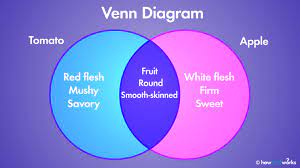
“A Venn diagram is a diagram that shows the logical relation between sets, popularized by John Venn (1834–1923) in the 1880s. The diagrams illustrate simple set relationships in probability, logic, statistics, linguistics and computer science.” (Wikipedia). (See diagram).
In its simplest form, it is two circles, representing two people or things or data sets, and the intersection shows common elements.
In a way, I sort of live my life as an active Venn diagram. Here is how.
We are blessed with a great many grandchildren, with varied personalities, interests and beliefs. As a retired but active professor, I encounter a great many people, hosting visitors to Technion. In all these interactions, my goal is to make contact. (“ET – phone home!”).
But how? Sometimes, a daunting task for an 80-year-old great grandfather, trying to ignite the interest of a four-year-old.
Venn diagrams help a lot.
Find the intersection. What do I know that my counterpart finds of interest?
And using the First Principle of Creativity: There is ALWAYS an intersection, common ground. Always. You just have to find it. Sometimes, it takes a bit of work. Watch the eyes, they light up when you find it. Two people who live and breathe have something in common.
Ask questions. Sometimes you strike paydirt with a question. Finding the intersection of the two circles requires finding the nature and extent of your counterpart’s circle (assuming you know your own). You need to know both. So explore theirs with questions.
Tomatoes and apples? Common ground? Well – they’re both fruits. Really.
Common ground between me and a four-year-old? Lego, animals, and ice cream. The latter, preferably with chopped up Oreo cookies.
How to Be More Creative: Five Ideas
By Shlomo Maital

The business weekly The Economist has, in its latest issue, a great piece titled “What to read to become more creative”.
I can save you, dear readers, some time by summarizing the basic ideas in the five books Economist reviews.
1. Graham Greene. A world of my own. Greene wrote 25 wonderful novels. Yet he suffered, like many of us, from ‘creative blockage’. He was saved by … dreaming. “It is possible to rise above the quicksand of creative block by freeing oneself from the impulses of perfectionism and self-doubt.” Greene’s book was published after his death, and recounts some of his dreams –Prince Philip as a scoutmaster, Pope John Paul II in a hotel room. In dreams, our ‘imagination runs unbounded by the strictures of external judgment’.
Small suggestion: Practice day-dreaming — let your thoughts run wild while you are awake. In another article, Economist suggests that ‘tedium’ is a great creativity-booster. Boredom and idle time can lead to great ideas, that pop into our heads, if we leave room for them.
2. Julia Cameron. The artist’s way: A spiritual path to higher creativity. Cameron, an artist, recommends “two practices for artist recovery” — a) the morning pages – a daily ritual of witing three sides of paper, in ‘stream of consciousness’ (whatever comes to mind); and b) artistic dates – expeditions to inspire creative connections through frivolity, each week. My own ‘take’ on this is ‘zoom in/zoom out’. Zoom in, into your own head; zoom out, to anything out there in the world that could inspire you. Her book, by the way, has sold over 5 million copies.
3. Scott Barry Kaufman and Carolyn Gregoire. Wired to create: Unravelling the mysteries of the creative mind. Kaufman is a psychologist, and heads the Imagination Institute at U of Pennsylvania; Gregoire is a science writer. They list ten things creative people do differently – from daydreaming to cultivating solitude. (Many of us avoid solitude at all costs!). They cite Picasso, who once said, if I know what I am going to do, why bother doing it? Meaning: Let your impulse and your intuition have free rein.
4. Albert Read. The Imaginative Muscle. I love this one. Creativity is a muscle, he writes. It can be trained. I spent years working with managers on retraining their creative muscles, that most of them, nearly all of them, said they had lost forever because they did humdrum things the same way day after day, for high pay. Read starts with an ancient cave painting and tries to pin down imaginations’ “constant mercurial nature”. I’ve written books on creativity, but have barely begun to understand the fluid, changing nature of ideation. But I do know — by exercising your creativity brain daily, in every possible way, you can strengthen it, just as you strengthen your biceps and abs with exercise. The creative brain IS a muscle. Use it or lose it.
5. Samuel Franklin. The cult of creativity. Franklin claims that today’s cult of creativity – cult, because its adherents treat it as a near cure-all for all that ails us — began “in the 1950s as a psychological cure for …structural and political contradictions of the post-war order.”. And it is true, that when the world is in its deepest crises, innovation is at its highest level of intensity. “The concept of creativity never existed outside of capitalism”, he claims. What nonsense. Creative people had ideas long before free-markets took hold. Just read the Bible. So, sure, be creative. But remember, for every weirdo idea guy and gal, you need dozens of disciplined people to bring their ideas to fruition. Imagine a society with all creative weirdos. Yikes.
mAGIc: Artificial General Intelligence
By Shlomo Maital
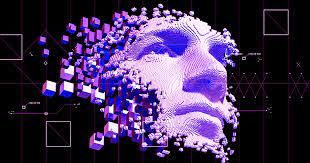
In March, after Microsoft researchers experimented with OpenAI’s new ChatGPT4, they published a paper on the results. They had, they wrote, “identified sparks of artificial general intelligence” (AGI). ***
AGI is the ability of artificial intelligence to do anything humans can, but better. So, a huge heated debate resulted. Here, below, are the words, of Professor Ronen Eldan, Weizmann Institute, who was a lead researcher and co-author.[1]
“…Some of us were skeptical…but it just left all of us slack-jawed. It was like discovering a new continent in the era when they thought the earth was flat. After four months of experimenting, we understood that we had to share this with the world.”
“…The model demonstrated a high level of proficiency compared to humans across a broad range of tasks, and …it happened far more rapidly than we expected….The main takeaway is that we can now create an intelligent being out of nothing. All you need to do is to take a lot of information from the internet, shove it into an algorithm –admittedly, one that took a long time to develop—and then a sort of mathematical miracle happens. We get this being, which embodies the intelligence extracted from the information on the web.”
“It seems like magic…. Computers that can communicate, draw conclusions, generate knowledge, in some ways better than most humans. And we still don’t really understand how it works.”
Where is AGI headed?
“…if the models continue to advance at the pace of the past few years, then I would go out on a limb and say it will be a revolution on the scale of the Industrial Revolution.”
Let’s be clear. Professor Eldan is a mathematician, not given to hyperbole. He was given access to explore ChatGPT4 as a scientist. His views above are the result.
[1] Source: Israeli daily Haaretz, Monday July 10, 2023, p.7 (English edition).
*** Sparks of Artificial General Intelligence,
Sébastien Bubeck, Varun Chandrasekaran, Ronen Eldan, Johannes Gehrke, Eric Horvitz, Ece Kamar, Peter Lee, Yin Tat Lee, Yuanzhi Li, Scott Lundberg, Harsha Nori, Hamid Palangi, Marco Tulio Ribeiro, Yi Zhang, Computer Science: Computation & Language, March 2023
Global Outlook: Not Too Rosy
By Shlomo Maital

The Economist Intelligence Unit (EIU) issues global forecasts from time to time. The latest is far from rosy. Here is a summary. Not too rosy.
* Globally, economic growth will be slow — stuck at around 2.5-2.7% yearly during from 2024-2027. Reason: The three main economic ‘engines’, US, EU and China will also grow slowly, at around 2.0%, 1.7% and 4.1%, respectively.
* China’s slow growth, relatively, is a problem, because China has become habituated to generating large employment growth — though its aging population makes that less urgent.
* World inflation will slow from 4.8% in 2024 to 3.2% in 2027.
* Global food supplies will remain perilous (Russia now threatens to leave the Black Sea grain shipment accord).
* US and China, now foes, are each untying their ecosystem links that brought benefits to each. This is proving difficult and costly – and overall, is bad for the world economy.
* Experts think the bloody Russia-Ukraine war will drag on forever – but I believe it may come to a sudden and unpredictable end, when Putin falls.
What does this mean for us ordinary citizens? I probably say this too often, but — err on the side of caution, set aside an emergency fund just in case bad, unexpected things occur – as they seem to do these days.

 TIMnovate