
You are currently browsing the category archive for the ‘Uncategorized’ category.
When Good People Do Bad Things
By Shlomo Maital

Jewish people all over the world (there are nearly 16 million of us – half of them in Israel) have marked the holy day of Yom Kippur – the Day of Atonement. On this day, we fast (many do), and read prayers seeking forgiveness and redemption for the misdeeds we have done during the year. We ask for a fresh start.
Here is my take on the practical philosophical problem we all encounter daily.
Why do good people do bad things? Why do WE do bad things? How can we do better?
Notice the assumption buried in the question. Good people? ARE people good? Really? Take a look around the world. Yikes.
Here is my argument. Assume people are good. All people. It is a working assumption. Sometimes we are proven wrong. People do bad things to us. So – is it a wrong assumption?
No. It is a working hypothesis, one to live by, one to enrich our lives. Because – the alternative is to assume that people are basically bad, evil. What a way to live! I know people who knowingly or not make that assumption. And – how super naïve can you be, when I live 100 kms. (60 miles) from Gaza City, which harbors Hamas, whom one can say are …bad. Really bad.
I am an economist. Economists assume that people ‘maximize utility’. In short, act to maximize their enjoyment of things. Egocentric. And the pinnacle of this theory, embraced more or less by political leaders, is the Rotten Kid theorem by U. of Chicago Professor Gary Becker, Nobel Laureate no less. Kids do selfless things for their families, not out of empathy and good deeds, but out of selfishness, because they expect to get a return for their investment. Egocentric.
No, Prof. Becker. People are good, people do good things, and not to get a reward. But because it is the right thing to do. Economics is a house built on sand, because of its underlying, wrong assumption. People are not driven by selfishness. Some are. Most aren’t.
So, on Yom Kippur, I begin by reaffirming – that I AM a good person. This is basic. If you assume you are evil, the road is open to continue doing bad things.
But I also realize I have done bad things. Hmmm. When? Why? What were they? What can I, must I, repair? How?
This sounds like a Sunday School lesson. But in fact, it is a basic cornerstone of daily life. You are a good person. You stumble. We all do. It can be fixed. We can change.
Oren Harmon, a naturalist, has written a wonderful book titled Metamorphosis, describing the amazing changes that 75% of the world’s species undergo – like the butterfly emerging from the chrysalis, woven by a caterpillar! Or the tadpole that becomes a frog.
Humans too can undergo metamorphosis – radical change. From bad to good. It is very hard. Just watch the Monarch butterfly emerge from its chrysalis! Unfold its wings. Dry them. Flap them. Get ready to migrate from Northern US to Mexico – eating only, ONLY, milkweed pollen. That butterfly is saying, what the hell just happened? Well, I’d better get on with it. My caterpillar days are over. I don’t even remember them.
Jews are celebrating the New Year, 5786, in Hebrew transliterated, Year Tash-Pooh. Yes, it is the Year of Winnie the Pooh. The naïve, ever-optimistic bear, who assumes people are good. Cynics mock him. But he comes out ahead in general.
Let’s re-read Winnie the Pooh and ponder about what he says, during the coming 12 months. A start: “You’re braver than you believe, stronger than you seem, and smarter than you think”.
And – you are a better person, perhaps, than you think.
Less Government? Govt. Jobs Have Been Shrinking for 75 Years
By Shlomo Maital
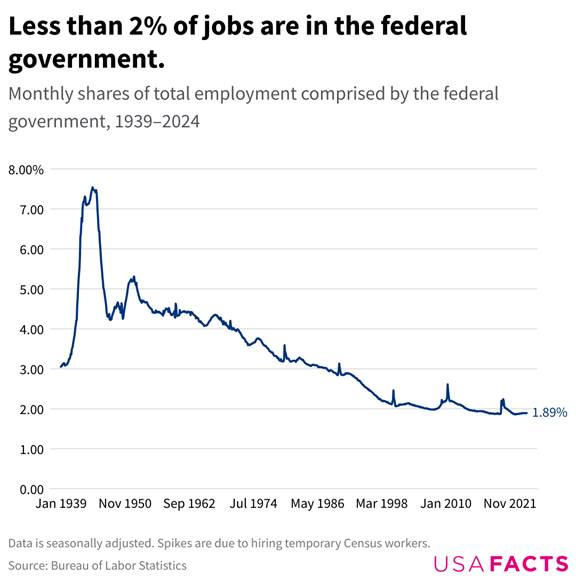
The current US Administration, and, fleetingly but horrifically, DOGE under E. Musk, has systematically attacked the federal government’s institutions and sought chaotically to slash public spending and public services, claiming “waste”.
We have news for it. Federal employment has been shrinking for 75 years, since the end of World War II, when wartime efforts and the draft were at their peak. (See graph). Today, less than 2 per cent of all jobs are in the federal government – a decline that has occurred steadily under both Republican and Democratic Presidents.
Consider the European Union. The % of people employed in the national government sector has been stable, at 16-17%. Some countries have higher figures, like Sweden and Denmark (near 30%), while others, such as Germany and the Netherlands, had lower shares around 11-12%. Even when US state and local government employment is figured in, US public sector employment is very low.
Some services are by nature ‘public’ – healthcare, education, defense. They are best provided by government. For-profit healthcare has an internal contradiction – the more ill people there are, the more drugs and medical care they consume (for profit).
Americans would be smarter, healthier, and probably happier, with more government, not with less. It seems pretty obvious. But not to half the population.
Building Our Courage Muscles
By Shlomo Maital

I work out regularly, trying to avoid the muscle loss that accompanies aging.
But there is another muscle, apart from pecs, biceps, lats, and the infamous glutimus maximus, that need work.
Courage.
The American Psychological Association Monitor magazine has an excellent article about building our courage muscle.[1] It’s a metaphor – but a strong one. Like muscle strength, if we do not exercise our courage, it decays and weakens.
But – what is courage? A soldier falling on a grenade to save his band of brothers? Sure – but more than that, much more. It is our daily acts of doing hard things, even risky ones, because – it is the right thing to do.
Dr. Jim Detert, who has studied courage, debunks the myth that courageous acts are grand, heroic, mythic actions. Detert developed a courage ladder, “where people list their challenges from mild to difficult, practice decision-making, get feedback and coaching. Many people, most people, say they need more courage.
So try this. Take on challenges. Do one hard thing daily. Train your courage muscle to accept challenges. When they emerge, as they always do, your courage muscle will be ready – just as your bicep is after doing 10 kg. reps twice a week.
[1] Tori Deangelis. “In Search of Courage”. APA Monitor Sept. 2025
Be Happy – Be Healthy
By Shlomo Maital
I want to share this with my readers, probably I’ve written about it before.
I’ve observed among family and friends, and even strangers, that illness often follows periods of sadness, loss, distress and trauma. And there seems to be a reason.
Our immune system, which is crucial for fighting invaders and illness, seems to weaken in the wake of depression and sadness. Why? Well – here is a simplistic theory.
Our brain wants to know if we have full motivation to continue to live. If that motivation is weakened, so is the brain’s and body’s ability and desire to keep us safe and healthy and fight invaders.
I have seen this so often.
So – be happy. Not ‘ecstatic’ happy. But happy, active, vigorous, interacting, socializing, finding meaning and creating value…. It may prove to be the very best medicine.
Give the Poor Money? It Doesn’t Work
By Shlomo Maital

OK, so – I am a liberal. But my favorite erudite NYT columnist David Brooks is not! He says so in the heading of his latest column (Sept. 5): “Why I am not a Liberal”.
And, why indeed is he not a liberal? Because, apparently, liberals believe in giving poor people money – and the data show it does not work.
We’ve known this for a long time. Ever since Susan Mayer’s 1997 book, “What Money Can’t Buy: Family Income and Children’s Life Chances.” “Even if you double people’s incomes”, Brooks summarizes, “the evidence is that it would have a limited effect on their children’s dropout and teenage pregnancy rates or other outcomes.”
What DOES matter? Their parents’ characteristics. Values. Education. Social skills. Family setting. Etc.
But progressives doubled down, insisting on creating and supporting a welfare state, which simply…gives the poor money.
This, at a time, as Brooks observes, when “most of our problems are moral, relational and spiritual more than they are economic.”
And, as I boringly observe often, in the 1930’s Economist Lionel Robbins argued that “normative economics (involving right and wrong, good and bad) was wholly unscientific and should therefore be cast out of the field”. Thus making economics utterly irrelevant, for almost a century.
What does work for the poor? Investing in great schools, for a start. Narrowing the huge gap between, say, educational performance in Southern US states and those in the Northeast.
Many of my Jewish ancestors came penniless to North America – and rose to upper middle class standing, through hard work and aspiration. They weren’t given money. But they did instill key values in their children, i.e. myself and my sister.
At a time when ‘evidence-based’ is an accepted gold standard of policy, how is it that the liberal supporters of the welfare state continue to back it? When the evidence is against it.
The Politics of Hatred
By Shlomo Maital

Consider the ‘new populist politics’ now prevalent in Israel, the US, and other countries.
It is the politics of V. Not “V” for values and vision. V for vengeance, vindictiveness, vitriol, violence. It is the politics of hatred. Hate those who do not agree with you. And…worse, yet, act on that hatred.
This week, Jews everywhere are reading a key chapter in the book of Deuteronomy. And it counsels hatred (?). Remember “Amalek” (an enemy leader who attacked the Israelites from behind, on their way to the Holy Land), we are told.
UK Chief Rabbi, explains: The intent is the opposite. Remember, in order NOT to let hatred dominate your thinking and your emotions. Battle your enemies. Defeat them. And – do not hate them. This is stated clearly in this chapter of the Bible: do not hate the Edomites, do not hate the Egyptians, even though Egypt enslaved you and Edom fought you.
Some 20 years ago, Israel extracted settlers from Gaza. Members of the current Israeli government have vowed vengeance – and two decades later, seek to destroy the democratic system that led to the withdrawal from Gaza. It is driven by deep burning hatred.
The Hamas leader, imprisoned for two decades in Israel, attacked Israel on October 7, 2023, and killed many women and children and elderly, often brutally. The result led to a huge disaster for the people of Gaza – death and destruction. The UN Secretary General Gutierres asks Israel, ‘what did you expect?’, referring to the Hamas attack. We ask him, and supporters of Hamas – what did YOU expect? Give them expensive presents?
Now, it is time for efforts at conciliation. Not hatred. Athletes know that competing on the basis of burning hatred addles the brain and prevents it from properly strategizing and winning. Rattle you opponent, get them ‘emotional’ – and you are on your way to winning.
Same for nations. Nations with leaders who leverage hate will ruin their followers and their nations. It is happening before our eyes.
Alas.
Origami – in Space
By Shlomo Maital

Recently, my grandson and I followed YouTube instructions and built an origami military tank that shoots paper pellets, with the help of an elastic band. It was challenging and took a second try.
Origami originated in Japan, following the 7th century CE when paper was brought to Japan – and the art of folding paper quickly ensued. A brilliant New York Times article by Kenneth Chang describes ‘bloom pattern’ origami — ‘rotationally symmetric, around the center’, like petals of a flower.
Bloom pattern origami creates truly beautiful paper folding. But – is that all?
Consider the James Webb Space Telescope, that brings us almost daily incredible photographs from space. The whole telescope had to be folded compactly in order to fit inside the 5.4 meter space in the Ariane 5 rocket that launched it. Once in space, the telescope would unfold, like the petals of a very complex flower. The crucial sunshade of the telescope is 21 meters! Four times as big. As big as 11 tall men stretched end to end, head to heel – and a six-year-old to boot.
But how to do this?
Origami. It is an origami problem, in reverse. Take the final telescope. Then, calculate how to fold it, to fit neatly into the launch rocket. Like origami.
The telescope and its crucial sunshade were folded 12 times.
The skill in calculating how to do this involved bloom pattern symmetry.
One of the key principles of creative innovation is X + Y. That is, combining two things that seem unrelated.
Space telescope, = X. Origami bloom symmetry = Y. X + Y. Presto. Folded and unfolded space telescope.
Some pretty smart people figured this out. Well done!
What We Can Learn From….Cockroaches
By Shlomo Maital

A brave editor of the weekend Haaretz magazine (Hebrew) made the latest cover story describe…cockroaches. With a realistic cockroach on the cover.
Talk about bravery. For unclear reasons, people seem frightened, disgusted and even panicked by them.
Let’s defend these intrepid little insects. Here’s what we humans, on this planet for a piddling 50,000 years, can learn from these insects, who have been around for some 320 million years – and probably will still be around when we humans erase one another from the planet by CO2 or war or plague or some other mishap. Source: Wikipedia
* “They are common and hardy insects capable of tolerating a wide range of climates, from Arctic cold to tropical heat. Tropical cockroaches are often much larger than temperate species.” True, humans populate tropics and the Poles. But cockroaches shame us in how fast and well they adapt, in size, habits, and survival instincts. Humans near the equator are not larger, e.g., than those in Alaska.
* “Some species, such as the gregarious German cockroach, have an elaborate social structure involving common shelter, social dependence, information transfer and kin recognition.” Ever hear of a cockroach war? I don’t think so. Cockroaches are social insects and get along with one another really well. That’s one reason they have endured so long.
* “ Their name ‘cockroach’ comes from the Spanish word for cockroach, cucaracha, transformed by 1620’s English folk etymology into “cock” and “roach”. The scientific name derives from the Latin blatta, “an insect that shuns the light”, which in classical Latin was applied not only to cockroaches but other insects.” Recall the wonderful Latin song, La Cucaracha, which in part praises the little bug. It’s dance-able! Here are some words from it: People they say the cockroach Is a very small animal And when it gets into a house, It’ll soon be the master of it all. Hey – they aren’t kidding.
Look. Cockroaches are harmless. They do not spread disease, like mice. They’re just trying to make a living, like us. We make it hard for them, by extreme cleanliness. But, that’s a good thing, right? They spur us to sweep and mop the floors.
Next time you see one? Overcome your innate disgust and fear. Think about what that little creature has done to survive for 320 million years. And then, think about how we humans can change our ways to try to do the same.
Be happy…& be healthy
By Shlomo Maital
I have a theory I would like to share. It’s based on close observation of people around me.
To be healthy, you need to work at being in a happy frame of mind.
Why? Because your immune system requires it. If your brain says you are unhappy, your immune system loses its motivation to keep you healthy.
I’ve known people who suffer setbacks, tragedy, car accidents, loss of loved ones… and fall ill.
This sounds naïve. My country is in deep trouble at the moment and it is easy to fall into despondency. Rebbe Nachman, who suffered from manic depression, taught us to practice irrepressible optimism. It was how he treated himself.
Consider ice cream. I make good ice cream. It makes me happy. I eat it. Not excessively. And I drink Coke. Also not excessively. Economists teach the law of diminishing returns. That second scoop? It will taste far less good than the first. Same for alcohol.
Do things in moderation, in daily life, that make you happy and keep you happy. In general, I believe, without a lot of deep medical evidence, that in the end it will keep you healthier. And by the way – practice it on those you love, not just yourself. Make those you love happy – so you can keep them healthy, and keep them with you longer.
The Role of Lithium in Alzheimer’s: Breakthrough?
By Shlomo Maital

A paper just published in Nature (August 6, 2025) reports: “New hope for Alzheimer’s: lithium supplement reverses memory loss in mice. Studies in rodents and humans suggest that low levels of the metal contribute to cognitive decline.” Here is a summary:
“Replenishing the brain’s natural stores of lithium can protect against and even reverse Alzheimer’s disease, suggests a paper published today in Nature. The paper reports that analyses of human brain tissue and a series of mouse experiments point to a consistent pattern: when lithium concentrations in the brain decline, memory loss tends to develop, as do neurological hallmarks of Alzheimer’s disease called amyloid plaques and tau tangles. The study also found evidence in mice that a specific type of lithium supplement undoes these neurological changes and rolls back memory loss, restoring the brain to a younger, healthier state.”
“If confirmed in clinical trials, the implications could be profound. Dementia affects more than 55 million people globally; most have Alzheimer’s disease. Anti-amyloid therapies on the market slow cognitive decline, but “they don’t stop it. They don’t restore function,” says co-author Bruce Yankner, a geneticist at Harvard Medical School in Boston, Massachusetts.”
Alzheimer’s has been researched for decades. It has been “a tough nut to crack”, say the researchers – a vast understatement. If lithium holds the key, it would be a huge surprise. What in the world is lithium, a metal, doing in the brain? What role does it play anyway? What irony, if the world that runs on lithium iron batteries should find that our brains run on lithium, too!
And a postscript: Co-author Bruce Yankner’s research grant has been slashed by actions of the President of the United States.

 TIMnovate