
You are currently browsing the category archive for the ‘Uncategorized’ category.
Dangers of One-Person Rule
By Shlomo Maital
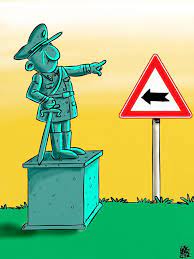
There is a problem, when a single leader makes decisions alone, without balancing opposition views. Inevitably, there is disaster.
Mark Zuckerberg has driven Facebook toward the metaverse, even embracing the Meta name… and I believe it will fail. There is no real value created for its users. And despite evidence it is failing, he is plunging billions into the effort. Where is his Board? A CNBC report states: “Meta documents show main metaverse is losing users and falling short of goals.”
Putin? Did he listen to his military advisors prior to his disastrous and malicious invasion of Ukraine? Did they have the guts even to speak?
Bolsinaro? Did he listen to anyone when pooh-poohing COVID, delaying purchase of vaccine, etc.?
As uncertainty mounts in the world, people seem to seek strong leaders – even those who trample democracy. View China, Hungary, Trump, Bolsinaro, Putin, and a long list of others. But sooner or later, autocrats who listen to no-one make big mistakes, drinking their own Kool-Aid, believing in their own false narratives of intelligence. (Trump labelled himself ‘very smart, a very stable genius’. Really?). And on the other side, democracies make huge mistakes (see below) – but eventually fix them, though it takes too long. (Putin invaded Crimea in 2014, it took far too long for democracies to grasp the danger he posed; even Merkel, with East German roots, erred).
Take Great Britain. One per cent of the electorate (Conservative party members) choose an incompetent Prime Minister, with crackpot libertarian views. She implements them. The pound sterling collapses. Her mini-budget is retracted, humiliatingly. Truss will eventually resign; she has lost all credibility. She made a mistake. But it will be corrected fairly quickly, by British democracy.
But take another example. Brexit. The British people narrowly voted for leaving the EU (Brexit), without truly understanding the implications. It was a disastrous mistake by David Cameron, who felt sure the referendum would fail. But he paid for it.
Today? “As of July 2022, 52 percent of people in Great Britain thought that it was wrong to leave the European Union, compared with 36 percent who thought it was the right decision.” People know they made a mistake. I believe, at some point, a visionary leader will bring Britain back into the EU. If the EU will take them. But the damage is huge. The point is: It is recognized that Britain made a mistake.
Ever seen an autocrat who admits to mistakes? According to one estimate, only 14% of UN members are fully democratic. Will they win out over autocrats? My bet is, yes!
A Brain Prosthesis That Improves Memory
By Shlomo Maital
As a senior – very senior – citizen, I follow closely the science of memory. On Ira Flatow’s Science Friday podcast, Dr. Robert Hampson, neuroscientist at Wake Forest University School of Medicine, in Winston-Salem, North Carolina, recounted his team’s amazing research on ways to help the brain remember stuff.
“When people hear the word “prosthetic,” they’ll probably think of an arm or a leg. But what about a prosthetic for the brain? A team of neuroscientists is designing a device that could “zap” the brain into remembering information better, and it’s targeted for people with memory loss. They’re doing so by studying the electrical patterns involved in memory, then mimicking them with electrodes implanted in the brain.”
Hampson studied epileptics who had implants in their brains’ hippocampus, to control seizures. [The hippocampus is part of the limbic system, and plays important roles in the consolidation of information from short-term memory to long-term memory, and in spatial memory that enables navigation.] He and his team helped the hippocampus remember pictures, by providing it with ‘codes’ that it had created when storing the initial memory. By jogging the brain’s memory, Hampson and team improved memory by 35%. That is a big deal, right?
What about Alzheimer’s patients? Hampson said his team will now begin working with them, to test his prosthesis and see if it helps. For more than two decades, the search for drugs that counter the plaque (amyloid proteins) that clog the brain, in those who suffer from Alzheimer’s, has been fruitless.
Perhaps Hampson’s approach offers new hope.
.
How Thinking Tires the Brain
By Shlomo Maital

Ever feel tired, just from sitting around and thinking hard? Now comes a scientific breakthrough, beautifully reported by The Economist (August 22).
A team of scientists led by Antonius Wiehler of Pitié-Salpêtrière University Hospital, in Paris, hypothesize that cognitive fatigue results from an accumulation of a certain chemical in the region of the brain underpinning control. That substance, glutamate, is an excitatory neurotransmitter that abounds in the central nervous systems of mammals and plays a role in a multitude of activities, such as learning, memory and the sleep-wake cycle.
In other words, cognitive work results in chemical changes in the brain, which present behaviorally as fatigue. This, therefore, is a signal to stop working in order to restore balance to the brain.
But — how did the researchers discover this? They did a neat experiment:
To induce cognitive fatigue, a group of participants were asked to perform just over six hours of various tasks that involve thinking. Half were assigned easy things to do and half hard ones. For example, in one task, letters were displayed on a computer screen every second or so. Those in the easy group had to remember whether the current letter matched the previous letter or, for the hard group, the one shown three letters earlier.
What did they find?
“During the experiment the scientists used a technique called magnetic-resonance spectroscopy to measure biochemical changes in the brain. In particular, they focused on the lateral prefrontal cortex, a region of the brain associated with cognitive control. If their hypothesis was to hold, there would be a measurable chemical difference between the brains of hard- and easy-task participants. And indeed, that is what they found. Their analysis indicated higher concentrations of glutamate in the synapses of a hard-task participant’s lateral prefrontal cortex. Thus showing cognitive fatigue is associated with increased glutamate in the prefrontal cortex.”
So, my friends. If you have spent hours working on an idea, writing something, thinking hard, planning — your brain tires. Doesn’t help to push on. Rest. Your prefrontal cortex is where ideas are born. Give it a break. Give the brain time to get rid of all that glutamate. It’s like lactic acid that accumulates in your muscles toward the end of a long run.
Aging: A Differential Calculus Approach
By Shlomo Maital
Warning: This blog uses differential calculus (derivatives) to explain the aging process.
Let X be ‘perceived wellbeing’ at any given age. Then: dX/dt is the change in perceived wellbeing over time.
- Youthful glee. For the young, dX/dt is positive, and d2X/dt2 is also positive. Wellbeing is rising, at an increasingly more rapid rate. The world is your plum or your oyster
- Maturity. dX/dt is still positive, but d2X/dt2 is negative, Wellbeing is rising, but at a slower and slower rate. Burdens and responsibilities temper fun. When d2X/dt2 switches from positive to negative, you are at an inflection point. Wellbeing shifts from rising at a faster rate, to rising at a slower and slower rate… until….!
- Later maturity. dX/dt becomes zero. Wellbeing is thus at a maximum. You’re reached your peak. Perceived wellbeing is maxed out.
- Early old age: dX/dt is negative. Wellbeing is declining. Health problems, money problems, and others. At this point: you enjoy what you have, and work so that the slippery slope doesn’t become TOO slippery. Just – don’t let it get any worse, you hope. But… it sort of does, though not too fast… until
- Later old age. Ah, well. d2X/dt2 is seriously negative. That old slippery slope is really slippery.
But remember: it is ‘perceived wellbeing’. You do have some control. Enjoy the little things. Like a glass of great wine, or single malt.
And one final word.
Since when do mathematicians know anything about growing old? It’s all just Greek to us.
Infinitesimal calculus was developed in the late 17th century by Isaac Newton and Gottfried Wilhelm Leibniz independently of each other Newton died at age 84, famous and well off, and was buried in Westminster Abbey. Leibniz died at age 70 – but was one of the world’s most renowned thinkers, making seminal contributions to philosophy, theology, ethics, politics, law, history and philology.
I kind of doubt that d2X/dt2 became that negative for either.
Nobel Prize for Physics 2022
By Shlomo Maital
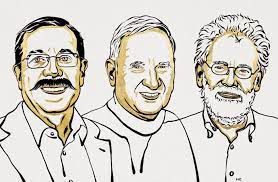
“The Nobel Prize in Physics 2022 was awarded jointly to Alain Aspect, John F. Clauser and Anton Zeilinger “for experiments with entangled photons, establishing the violation of Bell inequalities and pioneering quantum information science”.
Confusing? Mysterious? Baffling? Jargon? “Bell inequalities???”.
Here is Washington Post’s clearer take on the prize winners:
Washington Post: “ The 2022 Nobel Prize in physics has been awarded to three researchers for their pioneering experiments in quantum information science, a burgeoning field that could revolutionize computing, cryptography and the transfer of information via what is known as “quantum teleportation.”
“The three physicists are John F. Clauser, 79, of Walnut Creek, Calif., Alain Aspect, 75, of the Université Paris-Saclay and École Polytechnique in France, and Anton Zeilinger, 77, of the University of Vienna.
“The physicists honored Tuesday found experimental ways to confirm what had previously been theorized, including the “entanglement” of photons (particles of light) in a phenomenon that Albert Einstein famously referred to as “spooky action at a distance.” As the Royal Swedish Academy of Sciences put it Tuesday: “What happens to one particle in an entangled pair determines what happens to the other, even if they are really too far apart to affect each other. The laureates’ development of experimental tools has laid the foundation for a new era of quantum technology.”
“For Clauser, the honor was a long time in coming.
“This is all for work I did more than 50 years ago,” he said, clearly elated Tuesday morning when reached at his home.
“As a graduate student at Columbia University, where he received his doctorate in 1969, “I was struggling to try to understand quantum mechanics, unsuccessfully. Didn’t understand what I didn’t understand,” he said.
“But then he came across a paper by the physicist John Bell that suggested that quantum theory and a rival set of theories, known as “hidden variables,” were inconsistent with one another. Clauser thought: “If there’s a difference between the two, it must be testable.”
“After Clauser moved to the University of California at Berkeley, he and colleagues rummaged through storage rooms for supplies, found “scrap hanging around in the physics department” and cut metal in a shop. “We didn’t have any money to spend, so we had to build everything from scratch ourselves,” he said. The result was a 30-foot-long apparatus that could beam photons — particles of light — in opposite directions.
“In 1972, Clauser and doctoral student Stuart Freedman — who died in 2012 — reported that their experiment detected entanglement consistent with predictions of quantum mechanics, according to the academy.
[Note: Freedman may have shared the Nobel, had he lived. Alas.]
“Clauser said he was surprised by the result, which contradicted Einstein’s views on quantum mechanics.
“Einstein assumed that nature consists of stuff, distributed throughout space, including bits of information and the like. That seems very reasonable. And, in fact, general relativity is based on that. What the experiments show is that is not true,” Clauser said. “You can’t localize bits of information in a small, finite volume. That simple result then has applications that extend to quantum encryption and other forms of quantum information theory.”
“Quantum mechanics is an area of physics going back more than a century, and it has yielded applications, including transistors and lasers, that people use in everyday life. But the potential applications of the principles of quantum mechanics appear limitless.”
And, the Post may have added, quantum computing is now creating high-powered computers that are orders of magnitude more powerful than conventional computers.
The Bountiful Benefits of mRNA Thanks, COVID!
By Shlomo Maital
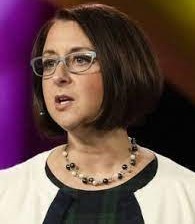
Prof. Kathryn Whitehead, Carnegie-Mellon U.
There are things in this world that are bad – like, really really bad – that brings bountiful benefits.
Take, for instance, COVID.
COVID???
Well, yes. It brought us mRNA vaccine technology. In just 11 months, mRNA vaccines were developed, tested and implemented. Saving countless lives. And that technology may be used in future to teach our bodies’ immune systems to fight cancer, Ebola, and other nasty illnesses.
But how does mRNA work? A brilliant TED talk by Prof. Kathryn Whitehead, a drug-delivery scientist from Carnegie Mellon U. in Pittsburgh, explains it. I am awed by how clearly, she describes this complex technology.
Want to know how that mRNA vaccine you got works? Here is Prof. Whitehead’s explanation, given in a brilliant TED talk recently.
The Magic: when messenger RNA (mRNA) enters the cells in our body, the mRNA acts like an instruction manual, that tells our cells to make a foreign protein, in this case, the coronavirus spike protein. When our immune cells see the spike protein, they rush to protect us from it, and they teach themselves to remember it. Presto! ….so that they can kill it if it ever returns.
The Problem: When mRNA is administered it’s injected into our muscles or our blood stream, but we actually need it to go inside of our cells.
Unfortunately, mRNA is fragile, and our bodies will destroy it before it goes very far.You can think of mRNA like a glass vase that you’d like to send in the mail without a box and bubble wrap. It’ll break long before it’s been delivered. And without an address on the box, your postal delivery service will have no idea where to take it. And so if we’re going to use mRNA as a therapeutic, it needs our help.
The Struggle: For over five decades, scientists and engineers like myself have been creating the shipping materials for nucleic acid drugs, like DNA and RNA. Through trial and error, we’ve created packages that deliver intact vases to the wrong address; that delivered to the right address but with a broken vase; packages that get ripped apart by attacking dogs; and packages that throw out the mail carrier’s back. It’s taken many years to get the science right.
The Solution: Fat! Yes, fat cells! In fact: cholesterol. The stuff we are warned about, that clogs our arteries?
Prof. Whitehead continues: Deliver the mRNA package in tiny balls of fat that we call lipid nanoparticles. Let me tell you what they are and how they work. So first of all, “nano” just means really, really small. Think of how small a person is compared to the diameter of the earth. That’s how small a nanoparticle is compared to the person. These nanoparticles are made up of several fatty molecules called lipids.
Fat is an awesome packing material — nice and bouncy. Interestingly, our cells are also surrounded by fat to keep them flexible and protected. Years ago, scientists had the idea to create lipid nanoparticles that would act like a Trojan horse. Because the lipids in the nanoparticle look similar to the membranes that surround our cells, the cells are willing to bring the nanoparticle inside, and that’s when the mRNA is released into the cell.
It turns out that while cholesterol can be bad when it’s in our bloodstream, it’s actually a really good thing for our cell membranes. Cholesterol is a stiff molecule that wedges itself in between the other lipids in the nanoparticle to fill in the gaps and hold them all together. It provides structural support so the nanoparticles don’t fall apart in between the injection and when they get into our cells.
Finally, one more ingredient. This one is a polymer called polyethylene glycol. So let’s call it PEG. That’s much easier. PEG is a water-loving molecule. So it surrounds the lipid nanoparticle and it holds it all together — the bubble wrap for the mRNA.
QED.
- – – – –
My own take: It took many scientists many, many years of hard work and long hours to perfect the lipid nano ‘delivery’ molecule – just in time for Pfizer and Moderna to save the world.
Those scientists deserve the Nobel for Medicine – just today awarded to a Swedish scientist, who sequenced the DNA of Neanderthal Man.
A brilliant feat! But – compared to what Prof. Whitehead described? The Swedish Academy is detached from reality.
Powell’s Blunder(s)
By Shlomo Maital

Jerome Powell (Financial Times)
Jerome Powell is Chairman of the Federal Reserve Board of Governors. He was elevated to chairman by President Donald Trump, succeeding Janet Yellen in the position. Yellen is now Secretary of the Treasury. Powell was renominated as chair by President Joe Biden on November 22, 2021. That was a huge mistake.
Powell expanded the US money supply, in the wake of the COVID pandemic, and lowered interest rates to zero. As inflation began to rise, he insisted that the inflation was temporary. It was not. He was too late in raising rates. Now, he is raising them rapidly and excessively – covering his behind, in the wake of his misread of the data. The result is causing havoc, as other Central Banks follow suit (including in my country, Israel. The US dollar is rising, other currencies are falling, raising their import prices and ‘exporting’ US inflation. Powell’s excessive tightening is rattling capital markets, and the Dow Jones is now officially in a ‘bear’ market (20% decline).
What is causing US inflation? Here is an alternate theory to that of Powell.
People cut spending radically during the COVID lockdown – virtually, two to three years. Now they emerge and are playing catchup. They have money, while wages too are rising. There is inflation illusion – inflation-adjusted wages are not up that much, but they appear to be higher.
At the same time, businesses, that lost heavily during the pandemic, 2020-22, are playing catchup, jacking up prices, because – they can, as people are willing to pay those prices, because, they have money in their pockets.
So if this is the cause of inflation, what impact will higher interest rates have? It will kill the housing market, hurt employment. And perhaps bring recession.
What is the alternative? Recognize that some inflation is not so terrible, while higher unemployment and recession is far far worse. Moderate the interest rate hikes. Tax excessive corporate profits (noticed lately the billions the banks and energy companies are raking in, with low taxes?).
Don’t believe me. Who am I anyway? Believe Jeremy Siegel, Professor of Finance at the Wharton School, Univ. of Pennsylvania. And many other distinguished economists, who believe Powell’s current policy is disastrous, covering an equally disastrous mistake, which he will not admit to.
Biden could have found a far wiser person instead of reappointing a Trump appointee. Recall how Ben Bernanke rescued the US during the 2008 financial crash. Powell is not in Bernanke’s league. And alas, the people of the United States are paying the price.
Queen Elizabeth II: Bringing People Together
By Shlomo Maital

Queen Elizabeth II died on Thursday Sept. 8. Today (Sept. 19) is her funeral. Many thousands of people queued to pay their respects, as her coffin lay in state, waiting for many hours, with lines stretching for miles.
According to the BBC, the British people waiting in the queue struck up friendships, exchanged phone numbers, and made friendships. Queen Elizabeth brought people together, even after her death.
Hearing this, I recalled my own family. We are scattered, across the US, Canada and Israel. When someone in the family passed away, we would often gather together, for traditional Jewish rituals. Despite the sad occasion, there was great happiness in simply being together. Death brought us together. At one point, we said, why do we only gather together on sad occasions? Let’s get together on happy ones. And we organized family reunions, at least 3 of them, that were truly memorable.
The Queen brought people together, in friendship and brotherhood/sisterhood, in her lifetime. And even after her death. Very few people can say that. And as half the world view her funeral, as only the British can do it, she reminds us of the core values: grace, dignity, humility, concern for others, good manners, service to others, that bring all of us together.
Lubaina Himid’s Questions
By Shlomo Maital

Lubaina Himid

Last week my wife and I visited the Tate Modern museum, London, and enjoyed the remarkable art work of British artist Lubaina Himid.
Most artists seek to make statements, one way or the other, with their art. Himid, whose work focuses on African culture and heritage, has a different perspective.
She asks us questions. Her questions appear in a wall poster, on cloth hangings, which she calls ‘speaking cloths’ and in her brochure. Here are Lubaina Himid’s list of questions, for us to ask as we view her paintings and as we live our lives.
Food for thought.
What is my plan? What will I learn about myself here? What would I do in this situation? How is my life the same as this one? What does this setting offer me today? Which questions am I asking? How fast do I want to go? Who do I want to be? What can I hear? What do I want to say? Who could I work with? What would a sharing of space mean? Can we do this together? What makes me happy? What am I frightened of? How much power can I have and what will I do with it? Where shall we go together? What does love sound like? What do I really want? Is this enough? How much time do I need? What difference can I make? What can an understanding of language do? Is this really what I want to do? How should it end?
The Insanity of Weapons Spending
By Shlomo Maital

Scrapped German battle tanks
“Insanity is doing the same thing over and over and expecting different results.” This quote is often attributed to Einstein. Whoever said it – it applies today. Here is what I mean.
The world faces a climate crisis, famine, an endemic pandemic, floods, and vast poverty. And a hot war in Ukraine, and a burgeoning Cold War between the West and Russia/China/Iran.
Resources are scarce for improving life for billions of people. We can’t even find a few bucks to buy math textbooks for poor kids in Bangladesh, who want to learn math. We need many billions of dollars for climate disaster mitigation. Parts of the world swelter, as I write this; parts (Afghanistan, Pakistan) face devastating deadly floods.
Yet consider this. Even in the face of the global pandemic, defense spending has continued to rise, totaling a staggering $2.1 trillion in 2021 –the entire annual output of South Korea. This was a 6% rise.
In 1980 military spending was $366 b. [All the data come from SIPRI, Swedish International Peace Research Institute, a respected source]. So since then, in 42 years, defense spending has doubled twice, and then rose half again.
By my calculation, in the past 42 years, despite the end of the Cold War, collapse of the Soviet Union, and global trade and finance — the world has spent a staggering $48.2 trillion on ‘defense’. This is 2.4 times the US’s annual GDP – the largest GDP in the world.
And for what? Yet rain or shine, peace or war, defense spending continues to grow almost everywhere.
I live in Israel, a country living in a bad neighborhood. We face threats continually. Yet even in Israel, massive spending exists on heavy weapons that seem like dinosaurs, in an era of asymmetric warfare featuring cheap drones and improvised explosive devices.
Imagine, as John Lennon dared to sing. Imagine – if just a small part of this wasteful spending were put to good use – to feed, house, clothe, and educate people everywhere. Why? Because inequality, a global pandemic on its own, leads to conflicts that seem to justify defense spending.
Is anyone trying to think about arms races, the insanity of them? Yet they are heating up, as US-China rivalry grows alarmingly. And modern weapons? Somehow, when they exist, they seem to get used, alas.
One F-35 fighter costs $136 million, including spare parts. Imagine what good could be done with the cost of just one of these gold-plated planes.
Consider Russia. The lives and resources wasted by the demonic delusions of a crackpot will cost, have cost, the people of Russia heavily, and will for decades. Much of its fossil fuel wealth has gone into weaponry. It is not just a waste. It has encouraged a military adventure that will impoverish, ultimately, the nation.
Yet year by year, defense spending keeps growing. Globally. We need to change the words. “Defense”? Is Russia’s war on Ukraine defense? China’s threats to Taiwan defense? Let’s call it what it is. Wasteful moronic insane weapons spending, ultimately destined for what you see in the photo – the scrapyard.
In every country, strong military establishments lobby for more and more money. Politically, they are irresistible. Those who oppose them, sound like crackpots. And the military appetite grows, as military technology gets more and more costly, far more than the rise in the cost of living.
The US engaged in a pointless war in Vietnam. Apart from lost lives, billions of dollars were wasted. Was the lesson learned? No. The US did it again, for 20 years, in Afghanistan. What would Afghanistan’s citizens enjoy today, if those military resources were invested in improving their lives? $300 million per day, or $2 trillion total. Again: the whole South Korean annual GDP.
Yet the insanity goes on. And likely will. We can only join with Bob Dylan, who sang, despondently, when will they ever learn? Ever?

 TIMnovate