
You are currently browsing the category archive for the ‘Uncategorized’ category.
“SCREAM Politics” – The More Outrageous, the Better!
By Shlomo Maital
Once upon a time, politicians used to choose their words with some caution – because in general, their words were recorded and could (and often were) used against them.
Today? We are in the era of SCREAM Politics. Caps. Politicians purposely say outrageous, often stupid, things, just to get attention. And often, it works for them.
Why?
With social media, there is an incredibly huge amount of noise thrown at us daily. So naturally we filter it out. It has become increasingly hard for politicians to get our attention. And without our attention, well, they simply do not exist.
Hence, the politics of SCREAM. Speak in bold face capital letters. Otherwise, your voice will not be heard.
In Israel, a leading Likud politician David Amsalem suggests putting political opponents into concentration camps. A storm of protest occurs. He sticks to his guns. And inwardly smiles. Well done. I made it into the news. My supporters love me.
Rep. Marjorie Taylor Greene (R. Georgia) has her Twitter account suspended, for saying that there are “extremely high amounts of Covid vaccine deaths.” She never apologizes or retracts. Will she be re-elected in 2022? You bet.
Note: Georgia trails the US average in percentage of the population who are vaccinated. Over 30,000 Georgians have died from COVID-19.
Making high-volume noise seems to get votes. And not just among Republicans. Some Dems do it too, maybe a bit less. At least they do not support “Stop the Steal”.
So today, in politics, in the US, Israel and other democracies, we have scream politics. The result – what economists call ‘adverse selection’. Crackpots like Amsalem and Marjorie Taylor Greene enter politics, scream loudly, get elected, scream even louder – and sensible normal people opt out of this stupid system, especially young people. And sane politicians end up imitating the crazies. Scream politics becomes the norm.
In the end we will end up with legislatures filled with idiots. Maybe we already have. And I just don’t see the solution…..
How to Win Friends & Influence People:
The Desmond Tutu Technique
By Shlomo Maital

Archbishop Desmond Tutu
Dale Carnegie made a stellar career based on his massive 1936 best-seller How to Win Friends and Influence People. And truly his book has lots of good practical ideas for doing this. His 6 ways to win friends: Become genuinely interested in other people. …Smile. …Remember that a person’s name is, to that person, the sweetest and most important sound in any language. …Be a good listener. …Talk in terms of the other person’s interest. …Make the other person feel important – and do it sincerely.
But the late Archbishop Demond Tutu, who has just passed away, fondly known by people as “Arch”, had a different method. It was recounted by a close associate, former President of Ireland 1990-1997 Mary Robinson, in a BBC interview.
DesmondTutu had a permanent twinkle in his eye. And he loved to make people laugh. He once, recounted Robinson, confronted President Obama, an admirer, giving him a stern lecture on all Obama’s failings….. then, seeing Obama’s crestfallen expression, burst into laughter, and explained it was just a joke.
The Tutu method is simple. Enemies? Foes? Opposing forces? First, make them laugh. Any way you can. You may not persuade them. But you certainly defuse the tension. And you just may make a friend out of a former enemy.
President Biden again spoke on the phone to Vladimir Putin, expert professional trouble-maker. I doubt he used the Tutu method. Probably there is no way Biden could make Putin even crack a smile. But, what if Biden had opened by asking Biden if he had taken off his shirt for the cameras, when he last visited Siberia? (Putin does this all the time, to project his macho image). And, what if Biden had suggested that he, Biden, too was going to try it, to boost his abysmal approval ratings. Would that get a smile? Might not. Might not prevent a disastrous invasion by Russia into Ukraine. But — it might have worked better than threatening “sanctions”. I am smiling, just imagining Biden’s octogenarian physique.
What Kant Can Teach Me…And You
By Shlomo Maital
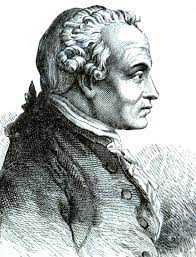
Immanuel Kant 1724-1804
My friend R. James Breiding’s excellent blog provides a timely reminder of my Philosophy 1 studies at Queen’s University, Canada, in 1960…many many years ago. A dense philosophy tome from 1785 by Kant proves up-to-the-minute relevant.
Our instructor at Queen’s, A.R.C. Duncan, a clear-thinking prickly Scot, taught us logic, ethics and metaphysics, all of this in one demanding semester. Everything I learned in those few lectures, I remember and use. Nothing is more practical than philosophy, despite what many believe.
For instance, Kant. How can we know what is right and what is wrong? Kant told us. His principle, the “categorical imperative”, is simple and highly relevant. And it applies everywhere, to everyone, at all times. Here it is, from 1785, when Kant was a wise 61-year-old:
“Act only according to that maxim whereby you can, at the same time, will that it should become a universal law.”
In other words — if I refuse to be vaccinated or wear a mask, would I be happy if everyone else did the same?
Am I happily going without a mask because I can do so since everyone else wears one?
Breiding notes that the US Supreme Court, in an earlier day when it was not yet polluted with five Trumpist hacks, invoked this principle:
“The U.S. Supreme Court may have decided similarly in Jacobson v. Massachusetts (197 U.S. 11; 1905) when it ruled “It is within the power of a State to enact a compulsory vaccination law . . . for the prevention of smallpox and the protection of the public health”. Similar reasoning underpins rules against drunk driving where one’s freedom can be devastating to another.”
One’s freedom CAN be devastating to another. So civil society limits that freedom. Personal freedom is not unlimited. It never was.
Why is this so hard for so many to understand?
Going to Mars? What We Learn from It
By Shlomo Maital

The trip to Mars will take about seven months and about 300 million miles (480 million kilometers). One day a team of astronauts will make the journey. On the way, they will be confined in close quarters for over 200 days. They will argue. They may face crises. They will have to resolve them on their own… Even though radio waves travel at the speed of light, it can take over 20 minutes for a message to travel from Mars, and the same time to return. Mission control can’t be much help. The Mars team is on their own.
How will they get along? How will they resolve disagreements? A research project is underway in Texas, where teams are subjected to “going-to-Mars” conditions and their behaivor is studied. Here is how The Economist describes the results, in their special Christmas edition. I think we can learn a lot on Earth from the Mars experiment, about how to manage our teams and our work in teams:
Inside Building 220 at the Johnson Space Centre in Houston, Texas, is a structure three storeys high and 14 metres long, composed of two standing cylinders connected by a third lying on its side. Called the Human Exploration Research Analogue (hera), it is a laboratory in which crews perform mock space missions of a few days to a few months. They are confined to the laboratory, eat only space food and follow a minute-by-minute itinerary of tasks and exercise. Monitored by cameras and microphones night and day, they are routinely prodded, physiologically and psychologically. Vibrations, sound effects and communication delays with a mock mission control add to the realism, and the stress. Dr Contractor calls hera the “ultimate human Petri dish”. With no one to complain to about their colleagues, teams in hera work, live, eat and solve problems together. In one experiment, four-member crews participated in mock 30-day missions to an asteroid called Geographos, where they collected rock samples and simulated spacewalks. They faced communications delays with Earth of up to five minutes each way, and at one point underwent 24 hours of sleep deprivation.
What did NASA learn from these experiments?
Conflict within a team is not always a bad thing. Happy teams are not necessarily the most productive. “If we’re going to draw an arrow of causality, it’s stronger to reword the statement as ‘a productive team is a happy team’,” says Leslie DeChurch, a psychologist at Northwestern University. “Nothing builds cohesion in a team like excellence.” Avoiding conflict can discourage the creative friction that can generate new or better ideas. Conflict associated with tasks is different from that associated with personalities. Conflict over ideas can be helpful. But when conflicts get personal, things can get ugly.
I think this conclusion – creative friction can be highly productive – applies to couples as well. It may not be ideal if you never argue. Argue – and then move on. Intel made this into a winning value. Disagree – and commit. Self-efficacy is powerful. If you feel you are productive, together, then you will be even more so facing future challenges.
Oh –- and one more thing. Laugh together. It’s very important:
Perhaps the most important insight NASA has gleaned from studying team dynamics—in space and on Earth—is the preciousness of one trait in particular: a sense of humor. Studies of crews overwintering at the South Pole show that a confined group needs people to fulfil various roles, including leader, storyteller, and social secretary. But the most important task by far is that of the clown, a person who is funny and also wise enough to understand each member of the group and defuse tensions. Laughter, as much as courage, will sustain astronauts on their long quest to Mars.
- The Economist: HOW TO PREVENT CONFLICT ON THE WAY TO MARS. Missions to the red planet will need a new breed of astronaut. DEC 18TH 2021
Why Use a Mas? The Science
By Shlomo Maital

Youthiapps.com
Why wear a face mask? (to prevent spread and infection of COVID)? I learned about the science from a Science Friday podcast, hosted by John Dankosky, interviewing Professor Thomas Moore, from Rollins College, in Winter Park, Florida.
Face masks work! And here is why. Moore uses a sophisticated device, to track the flow of air as it leaves our mouths when we exhale. It can do this, because the air we exhale is warmer than the surrounding air. The temperature difference can show up visually, and we can literally watch the air as it exhales from our mouths and noses.
When we exhale without a mask, the air (and aerosols containing the virus) extend from our mouths for several feet horizontally.
When we wear a mask, the air exits from the sides of the mask, from the top of the mask and from the bottom of the mask. At first glance, this seems to make the mask ineffective? But no, not at all! According to Professor Moore, the air exiting the mask, top and bottom, simply rises (warm air rises), to above head level! And above head level, it is not infectious. So yes! Wear a mask! It does work. Even if you sense the air you breath out is still excaping from the sides and top and bottom.
And those plexiglass barriers? They work! Because again, they direct the air we exhale up and away from the head of, say, the bank clerk opposite us.
Want to sing? Singing without a mask expels air for much longer distances, horizontally, and can be dangerous. There are singer’s masks, that look like duck bills, extending away from the lips. If you want to be heard and understood better, get a singer’s mask — it makes the sound of your voice almost natural.
Bottom line. Yes, masks ARE effective. They do reduce infections and spreading. And with the new variant Omicron about to dominate and displace Delta, masks have become crucial – once again. And no, it is not about your personal freedom! It is about whether you care enough about your friends and neighbors, and strangers, to do one simple thing (wear a mask) to avoid harming them. If you don’t care — well, you rank very low on the scale of caring thoughtful humanity.
Beatles’ Creativity: The Inside Story
By Shlomo Maital

In the Dec. 8 issue of The New York Times, journalist and editor Jere Hester reviews Peter Jackson’s new 8-hour documentary “The Beatles: Get Back” on the Beatles and the process they went through to record Let It Be, their last album. Jackson, you may recall, directed the J.R. Tolkien (The Hobbit) movies.
Here are the eight lessons Hester summarizes, about creativity Beatles style, based on the film:
* Set Audacious Goals:
“Early on in the film, Mr. McCartney struggles to get enthusiastic group buy-in on the quest to come up with 14 new songs within two weeks and record them live for a TV show. Tension among the members and the pressure to achieve this seemingly impossible goal temporarily drive George Harrison from the band.” But thinking big and expansively opens up new creative possibilities. Brainstorming possible venues for the concert, they consider a children’s hospital, a cruise ship, an amphitheater in Tripoli. None of these ideas stick, but the freewheeling, anything-goes thinking plants the seeds for the epic rooftop performance to come.
* When the Going Gets Tough, Come Together
“Even while bickering in the cavernous Twickenham movie studio before Mr. Harrison’s departure, the Beatles huddle in the corner as if they’re back on the tiny stage of the Cavern Club in Liverpool, where they played together before hitting it big. The longtime friends and bandmates are barely talking, but they’re playing and singing and riffing off one another’s ideas. Among the multiple cases in point: “I’ve Got a Feeling,” perhaps the last true Lennon-McCartney composition. As John Lennon later puts it, “All we’ve got is us.”
* Mix Structure With Improvisation
“When Mr. McCartney comes in hard with the ambitious show goal and tries to step up as the band’s de facto leader, Mr. Harrison and Mr. Lennon bristle — not only over the shifting power dynamic but also because it disrupts that duo’s evolving free-form way of working. “You’ve got to carry on until you get there,” Mr. Harrison tells Mr. McCartney as they struggle through early tries of “Two of Us.” Mr. Lennon becomes a blunt cheerleader: “I’d say improvise it, man.” Mr. McCartney, tired of being the uptight taskmaster, briefly relaxes and sees the song start to take shape through a jam.”
* A Change of Scenery — and Goal — Can Help
“After Mr. Harrison’s return to the band, the four gather in the cramped basement of Apple Records, having agreed to at least temporarily shelve the TV special idea. There, they jam, joke and loosen up as the numbers they’ve been working on get tighter. “You’re working so well together,” the record producer George Martin remarks to Mr. Harrison. “You’re looking at each other, you’re seeing each other. It’s happening, isn’t it?”
* New Blood Can Freshen Things Up
“The arrival of the master keyboardist Billy Preston improves the vibe, the playing and the behavior of the Beatles as a unit. The creative spirit revived by Mr. Preston radiates beyond the band — to Yoko Ono’s impromptu vocalizing and Linda Eastman’s capturing the sessions in photos, each offering their own brand of inspiration. Ringo Starr goes from behind the drums to the piano to write “Octopus’s Garden.” The guest appearance is so successful that Mr. Lennon suggests that Mr. Preston be made a Beatle, and Mr. Harrison calls for adding Bob Dylan. Mr. McCartney chooses humor over exasperation in his response: “It’s bad enough with four.”
* Always Be Working:
“Despite their varying levels of engagement during the sessions, the Beatles generally arrive to the studios ready to work, and the sessions are remarkably fertile — especially for Mr. McCartney, who turns out “Get Back” and “Oh! Darling,” among other songs. Mr. Harrison brings in “All Things Must Pass” and muses that he’s written enough songs for a solo album. Even as wine, beer and more flows, the Beatles stay disciplined, working and reworking lyrics and arrangements until they get them right. “To wander aimlessly is very un-swinging,” Mr. McCartney says. “Unhip.” “
* Creativity Can Be Repetitive and Boring, Until It’s Transcendent
“ Watching the umpteenth run-through of “Don’t Let Me Down” may not be everyone’s cup of English tea. But it’s the repetition and exhaustive honing of lyrics and musical arrangements that delivered the songs embedded in the musical DNA of generations of fans. And it’s the repetition that gives the band the confidence it needs to bring the show to the rooftop. Up there, they gave it their all for 42 minutes, until the police ended a performance for the ages.”
* Nothing Lasts Forever — Except the Art, if You’re Lucky
“One thing is clear from “Get Back”: The Beatles didn’t want all that they’d built to end. But they knew things would have to change to move forward. The documentary allows us to watch the struggle of four men, all still in their 20s, trying to grow up, yet not grow apart, creatively and otherwise.”
Viagra Prevents Alzheimer’s
By Shlomo Maital

Just out: “According to a new study from Cleveland Clinic, there might be a way to prevent- or significantly reduce- the likelihood of developing Alzheimer’s disease. A study published in Nature Aging from Cleveland Clinic’s Genomic Medicine Institute found that an analysis of over seven million users of sildenafil showed they were 69 percent less likely to develop Alzheimer’s than non-sildenafil users after six years of follow-up.”
Researchers note: this is a correlational study. The causal physiology has not been determined. Is it simply that Viagra users are more active socially and hence stimulate their brains? Do hormones generated by sexual activity help keep brains healthy?
The FDA approved an iffy Alzheimer’s drug that costs $60,000 – and is doubtful in its efficacy. Viagra is now generic, sildenafil…and costs very little. This could be great news for us old guys. Viagra – for healthy brains? What could be bad?
Those Vexing Anti-Vax: “I Owe You Nothing”
By Shlomo Maital

source: L’Express
Do you struggle to understand the anti-vaxers? Here is a New York Times Op-Ed that may help: “Behind Low Vaccination Rates Lurks a More Profound Social Weakness”, by Anita Sreedhar and Anand Gopal, Dec. 3. Sreedhar is a family physician, Gopal is a sociologist.
The bottom line: The most highly-correlated variable with anti-vax is…social class. The underclass is saying, we don’t believe you, we don’t trust you, and we don’t owe you, as a result of decades of neglect, including the two terms of Democratic Presidents Clinton and Obama.
In the US and globally, as Omicron spreads rapidly, the situation is serious:
”About 70 percent of American adults are now fully immunized, but in pockets around the country — from the rural South to predominately Black and brown neighborhoods in large cities — vaccine hesitancy remains a stubborn obstacle to defeating the pandemic. And it’s not just in the United States: In 2019, the World Health Organization declared vaccine hesitancy one of the 10 threats to global health. With persistent vaccine avoidance and unequal access to vaccines, unvaccinated pockets could act as reservoirs for the virus, allowing for the spread of new variants like Omicron.”
Vaccine hesitancy was an accident waiting to happen:
“Over the past four decades, governments have slashed budgets and privatized basic services. This has two important consequences for public health. First, people are unlikely to trust institutions that do little for them. And second, public health is no longer viewed as a collective endeavor, based on the principle of social solidarity and mutual obligation. People are conditioned to believe they’re on their own and responsible only for themselves. That means an important source of vaccine hesitancy is the erosion of the idea of a common good.”
And this conclusion: “… It turns out that the real vaccination divide is class.”
“….Americans began thinking about health care decisions this way only recently; during the 1950s polio campaigns, for example, most people saw vaccination as a civic duty. But as the public purse shrunk in the 1980s, politicians insisted that it’s no longer the government’s job to ensure people’s well-being; instead, Americans were to be responsible only for themselves and their own bodies. Entire industries, such as self-help and health foods, have sprung up on the principle that the key to good health lies in individuals making the right choices.”
If you sanctify individual choice and freedom – the freedom to make stupid choices is included. And the ultimate result will inevitably be opposition to whatever the government is trying to pitch. When people are told, ‘you have to….xxx’ those screwed by government in the past are more likely to say, ‘No, I do not have to..’. ‘I owe you nothing!’. ‘Because you do nothing for me’.
And the wealthy? “Vaccine uptake is so high among wealthy people because Covid is one of the gravest threats they face. In some wealthy Manhattan neighborhoods, for example, vaccination rates run north of 90 percent.”
What should be done? Structural long-term change. The authors recommend:
“The experience of the 1960s suggests that when people feel supported through social programs, they’re more likely to trust institutions and believe they have a stake in society’s health. Only then do the ideas of social solidarity and mutual obligation begin to make sense. The types of social programs that best promote this way of thinking are universal ones, like Social Security and universal health care. Universal programs inculcate a sense of a common good because everyone is eligible simply by virtue of belonging to a political community. In the international context, when marginalized communities benefit from universal government programs that bring basic services like clean drinking water and primary health care, they are more likely to trust efforts in emergency situations — like when they’re asked to get vaccinated.”
The obscene rise in income and wealth inequality, driven by shark capitalism and impotent governments, has created a vexing anti-vax underclass. Until the root cause is addressed, all the science in the world will not help.
Capitalism Rakes It In! Record Profits
By Shlomo Maital
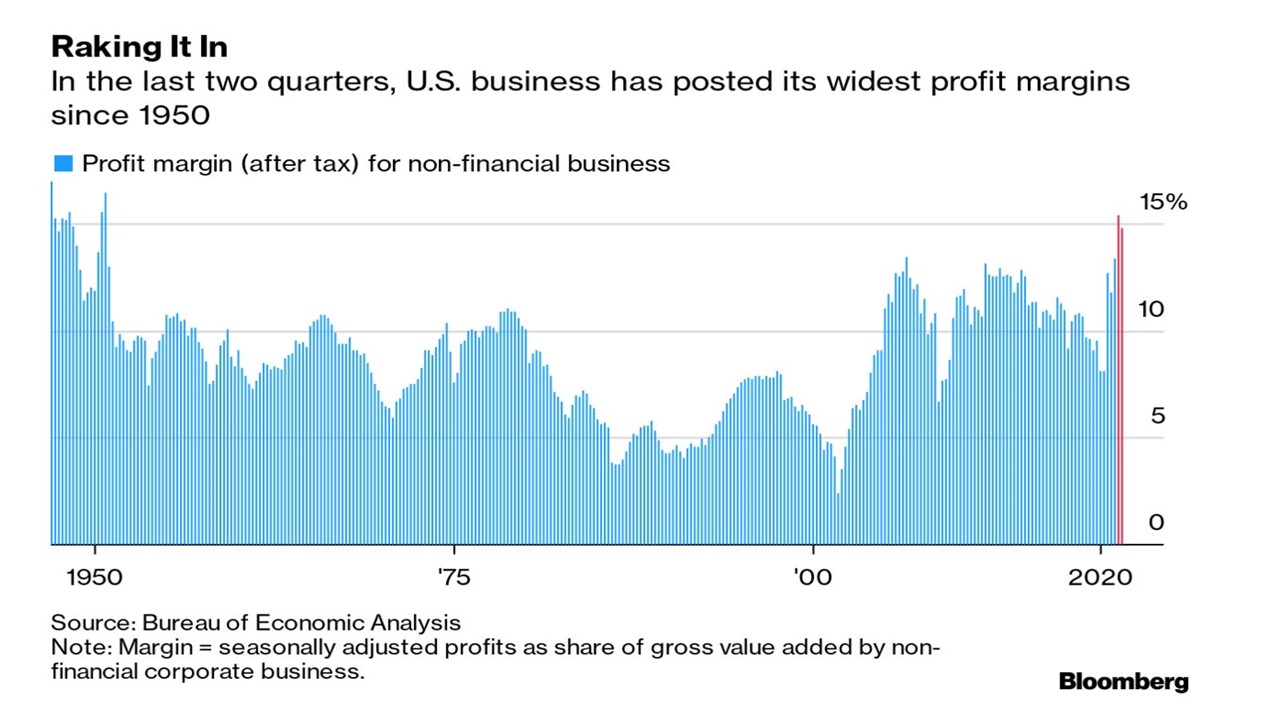
Two facts about the US economy: a) persistent high inflation and b) soaring profit margins, widest since 1950! 15% AVERAGE profit margin, according to Bloomberg, for non-financial corporate business. The average profit margin since 1950 has been around 7.5%.
Hmmm. Any connection between inflation and record profits?
Much of the inflation (rising prices) is driven by costs – supply chain disruptions, higher wages, slumping productivity in some cases. AND…. On the demand side, people have money and are eager to spend it, after the many months of lockdown, and are spending more of it on actual goods, rather than services (tourism, restaurants, theme parks).
This is a perfect storm for businesses, enabling them to raise prices and fatten profits. Why? Well, first, because you can (why do millionaires buy $20,000 watches? Because they can)…. And second, because, well, that’s what capitalists do, right? Maximize profits? Anybody remember Prof. Milton Friedman? Higher prices cover higher costs — and then add some, to boost profits.
When people have money and are eager to spend it, they are less price sensitive. That means, higher prices do not negatively impact how much people buy. Businesses are quick to sense this and to capitalize.
On-line buying was supposed to generate strong downward pressure on prices, by enabling people to easily and quickly search for the cheapest price. But with Amazon’s domination, this has largely evaporated. Amazon cleverly plays to ‘instant gratification’ by delivering goods quickly – one day, two day, or even same day, which offsets price resistance.
What can be done? Not much. Maybe one key thing. If businesses are making huge profits, then at least tax those profits fairly – and the incomes of the wealthy to whom most of those profits accrue.
Try this on for size: Over the past decade, US millionaires have paid an average income tax rate of 8.2%. True! I’ll be that what you readers pay is double, triple, quadruple. Is that fair? If free markets let businesses reap profits, at least make them pay their fair share of taxes.
Stephen Sondheim, 1930-2021

Stephen Sondheim has passed away; he was 91. If you love Broadway musicals, then Sondheim has brought you much pleasure and happiness. See the long list below of musicals, most of which he wrote both music and words – for West Side Story, just the words (with Leonard Bernstein’s wonderful music).
Writing both words and music is really really hard. Here is how The Economist describes it, in its obituary:
“To do both things, write lyrics and compose, was rare and tricky. Music was fun, abstract and inside him; lyrics were a sweat, though he thought of himself as a playwright first. Combining them required not inspiration, like some girl twittering on his shoulder, but patient craft. He had to let the lyrics sit lightly on the melodic line, bubble and rise, while ensuring that the music made them shine and sometimes explode.”
At school, Sondheim made friends with Oscar Hammerstein’s son James. Oscar Hammerstein became Sondheim’s mentor. The Economist:
“He [Sondheim] was instinctively a mathematician, sidetracked while still at school by the great lyricist Oscar Hammerstein, the father of his best friend, who taught him almost all he knew. Maths was kept for the puzzles and cryptic crosswords he invented where slowly, link by link, the solution gleamed into view. By contrast, the 15 musicals he wrote for the American stage, works that propelled him into the company of Irving Berlin, Cole Porter and Noël Coward, were studies in disconnection. Though he might place his characters in ostensibly jovial parties or reunions, deep emotional fissures soon appeared again.”
Sondheim did not seek huge popularity. Many of his musicals closed after very short runs. The Economist:
“Audiences …tended to leave the theatre baffled. Plenty walked out. They found him too intellectual, the subjects uncomfortable and nothing hummable in the flowing, conversational scores. With the exception of “A Funny Thing Happened on the Way to the Forum” (1962), his first foray into Broadway in both hats, his runs were short. His name could be twisted into the pleasing anagram, “He penned demon hits”. But his only one (big though it was) was “Send in the Clowns” from “A Little Night Music”, a song written mostly as simple questions and again about disconnection. (“Isn’t it rich?/ Are we a pair? Me here at last on the ground/You in mid-air?”) He treated the 32-bar torch songs, again really hard to write, as commentaries or little one-act plays to move the plot along. If there was a plot. Lack of popularity did not bother him. He had never set out to be corporate or commercial; he loathed all that. His only desire was to experiment, to make himself nervous in new territory and not do the same thing twice.
Sondheim’s childhood was very unhappy. It impacted his life and his work right to his death:
“Sondheim detested his mother, who was said to be psychologically abusive and to have projected her anger from her failed marriage onto her son: “When my father left her, she substituted me for him. And she used me the way she used him, to come on to and to berate, beat up on, you see. What she did for five years was treat me like dirt, but come on to me at the same time.” She once wrote him a letter saying that the only regret she ever had was giving birth to him. When she died in the spring of 1992, Sondheim did not attend her funeral. He had already been estranged from her for nearly 20 years.
Sondheim was sent to military school as a child, then to another school. You can sense this dark past in some of his musicas, especially Sweeney Todd. The Economist: “He saw himself as an outsider: an only child who got the best marks at school, Jewish, gay, shy… He loved collaborating on musicals, notably with the producer Hal Prince and the writer James Lapine, because he had found such family feeling nowhere else. Until he was 61, he lived alone.”
Here is Sondheim’s legacy – a part of it:
1954 Saturday Night
1957 West Side Story
1959 Gypsy
1962 A Funny Thing Happened on the Way to the Forum
1964 Anyone Can Whistle
1965 Do I Hear a Waltz?
1966 Evening Primrose
1970 Company
1971 Follies
1973 A Little Night Music
1974 The Frogs
1976 Pacific Overtures
1979 Sweeney Todd
1981 Merrily We Roll Along
1984 Sunday in the Park with George
1987 Into the Woods
1990 Assassins
1994 Passion
2008 Road Show
Often, deep powerful world-changing creativity comes from dark places, as it apparently did with Sondheim. You do not have to suffer to be creative – but if you do suffer, sometimes you can transform the pain into works of lasting beauty. Sondheim did. Rest in peace.

 TIMnovate