
You are currently browsing the category archive for the ‘Uncategorized’ category.
Innovation Blog
Induction? Deduction? No! Abduction!
By Shlomo Maital
In the history of science, it is known that Francis Bacon, in the late 16th C., urged scientists to engage in induction: Observe carefully, then generalize and theorize based on those observations.
Today, that approach is the foundation of what is known as grounded theory: deeply-engaged involvement with a company or product or team or organization, data collection, and only then, organizing the data into hypotheses and theories.[1] This, I believe, is how management research should be done.
But it isn’t. Why?
Bacon was soundly defeated by Descartes, who preached deduction. He said that first one begins with a set of assumptions and hypotheses, and only then, moves on to collect data and test the hypothesis — what is known today as the scientific method.
Now, along comes Roger Martin, former McKinsey partner and now Dean of University of Toronto’s Rotman School of Management. I’ve visited Rotman several times, and find it is one of the few business schools that practices innovation, rather than simply teach it. The reason is its Dean, Martin, and principal donor, Joseph Rotman.
Martin urges abduction. (No, not the kind that means to kidnap). Abduction, to Martin, means “the logic of what could be”. He builds on the forty-year-old concept of anthropologist Gregory Bateson, (Steps to an Ecology of the Mind, 1972), who described a form of reasoning, “this is to this, as that is to that”, that leaps laterally, through story and analogy, finding links where others see none. Writing in Business Week, together with his colleague Jennifer Riel, Martin uses Research in Motion (RIM), Canadian inventors of Blackberry, as a powerful example. He notes that when an innovator comes up with an imaginative idea, those who fund and judge it often demand validation, proof — using deduction and/or induction, “what is”. This is often not possible, especially for truly imaginative ideas.
Instead, those squareheaded nay-sayers should apply a different type of logic: abduction, from the Latin “ab” , from, and “deducto” , to carry or lead.
Writes Margin: “….When facing an anomalous situation, we can turn to a third form of logic: abductive logic, the logic of what could be. To use abduction, we need to creatively assemble the disparate experiences and bits of data that seem relevant in order to make an inference- a logical leap-to the best possible conclusion.”
Martin recounts the story of RIM:
“At Research in Motion, makers of the ubiquitous BlackBerry, abductive logic is embedded in the culture. Mike Lazaridis, RIM’s founder and co-CEO, encourages his people to explore big ideas and apparent paradoxes to push beyond what they can prove to be true in order to see what might be true. “
RIM began by making beepers. Its founder pressed RIM workers to see the ultimate beeper (abduction). Martin urges organizations of all kinds that seek to be innovative to practice abduction, just like RIM:
“Asking what could be true – and jumping into the unknown-is critical to innovation. Nurturing the ideas that result, rather than killing them, can be the tricky part. But once a company clears this hurdle, it can leverage its efforts to produce the proof that leaders depend on to make commitments-and turn the future into fact,” says Martin.
[1] “Bridging the Chasm Between Management Education, Research, and Practice: Moving Towards the Grounded Theory Approach”, by Shlomo Maital, Srinivas Prakhya, and DVR Seshadri: VIKALPA, Jan.-March 2008
Innovation Blog
Science Breakthroughs by 2020: 20/20 Vision?
By Shlomo Maital
In its Jan. 7 issue, the science weekly Nature [1] asked leading scientists to predict the coming decade’s developments in their field. Here are some of their views:
Internet: Google research director Peter Norvig:
¨ Content will be a mix of text, speech, still and video images, histories of interactions with colleagues, friends, information sources and their automated proxies, and tracks of sensor readings from Global Positioning System devices, medical devices and other embedded sensors in our environment
¨ The majority of search queries will be spoken, not typed, and an experimental minority will be through direct monitoring of brain signals. … The results we get back will be a synthesis, not just a list. A decade from now, the result will summarize the major approaches, contrast their differences, automatically translate any foreign documents into my language, and then rank the results by efficacy or place them in a table or chart as appropriate.
Personalized medicine: David B. Goldstein, Duke University
¨ ….here’s one confident but uncomfortable prediction of what personalized genomics could look like in 2020. The identification of major risk factors for disease is bound to substantially increase interest in embryonic and other screening programmes. Society has largely already accepted this principle for mutations that lead inevitably to serious health conditions. Will it be so accommodating of those who want to screen out embryos that carry, say, a twentyfold increased risk of a serious but unspecified neuropsychiatric disease?
¨ Some advances will be relatively uncontroversial, such as the development of tailored therapeutic drugs based on genetic differences that are otherwise innocuous. Others will be transformational, such as the identification of definitive genetic risk factors that provide new drug targets for conditions that are often poorly treated such as schizophrenia, epilepsy and cancers.
Energy: Daniel M. Kammen, Director of the Renewable and Appropriate Energy Laboratory, University of California, Berkeley
¨ By 2020, humankind needs to be solidly on to the path of a low-carbon society — one dominated by efficient and clean energy technologies. It is essential to put a price on carbon emissions, through either well-managed cap-and-trade schemes or carbon taxes. Creative financing will also be needed so that homes and businesses can buy into energy efficiency and renewable energy services without having to pay up front. An example is the Property-Assessed Clean Energy financing mechanism, which my lab is helping to design and promote.
¨ Deployed widely, these kinds of [alternative energy] solutions and the development of a smart grid would mean that by 2020 the world would be on the way to an energy system in which solar, wind, nuclear, geothermal and hydroelectric power will supply more than 80% of electricity.
Global governance: Jeffrey Sachs, Director, the Earth Institute
¨ By 2020, the world needs an effective system of global governance for managing sustainable development. It will require systematic improvements in four areas.
¨ First, politics must take account of technical expertise. In international negotiations such as the Copenhagen climate process, negotiators spend a lot of time arguing over the legalities of agreements but little time discussing technological options.
¨ Second, public and private investments in new technologies should be managed as part of an integrated system. Almost all environmental challenges, from greenhouse-gas emissions to the depletion of groundwater resources, demand technological transformation. Achieving this will need a mix of public and private enterprise.
¨ Third, corporate lobbying must be restrained: it is one of the greatest dangers to sustainable development. In the United States, corporate influence through lobbying, campaign funding and misleading advocacy campaigns has been an enormous obstacle to effective regulation of the economy and environment.
¨ Finally, global financing for poorer countries must improve if international agreements on climate, land use and biodiversity are to succeed. The record of aid delivery to poor countries is dismal.
Synthetic biology: George Church, Professor of Genetics, Harvard Medical School
¨ In the past decade, the cost of reading and writing DNA has dropped a million-fold, outstripping even Moore’s law for exponentially increasing computer power. The challenge for the next decade will be to integrate molecular engineering and computing to make complex systems. The development of engineering standards for biological parts, such as how pieces of DNA snap together, will permit computer-aided design (CAD) at levels of abstraction from atomic to population scales. Biologists will have access to tools that will allow them to arrange atoms to optimize catalysis, for example, or arrange populations of organisms to cooperate in making a chemical.
¨ The obvious application will be in manufacturing and delivering drugs more efficiently. However, these treatments might be superseded by smarter ones, such as oral vaccines and ‘programmable’ personal stem cells or bacteria (which exploit sensors, logic and actuators harvested from natural and lab evolution) that could, for example, sense a nearby tumour, coordinate an attack and drill into the cancer cells to release toxins. Another application is in the production of chemicals, biofuels and foods — for example, the development of parasite-resistant crops or photosynthetic organisms that can double their biomass in just three hours. As costs drop, such technology will allow developing nations to leapfrog fertilizer-wasting, fossil-fuel-intensive and disease-rife farming for cleaner, more efficient systems, just as they are leapfrogging costly landlines in favour of mobile-phone networks.
¨ As electronic chips hit conventional manufacturing limits, they will be replaced by atomically precise and fault-tolerant biological circuits. Three-dimensional ‘bio-printers’ could make nearly all manufactured goods much less expensive. The grand challenge will be to anticipate the many unintended consequences of the synthetic biology revolution — ecological, economic and social — and to safeguard against them.
Universities: John L. Hennessy, President, Stanford University
¨ Perhaps the largest threat to our research universities over the next decade is the financial challenge facing governments. In the United States, for example, budget deficits have caused many states to reduce their funding for public universities, and at the federal level, there is likely to be no growth or a cut in funding for research programmes.
¨ To address these financial and intellectual challenges, universities need to be willing to change how they see their research and teaching mission. The scale and complexity of today’s global problems demand a more collaborative, multidisciplinary approach.
¨ Traditionally, universities have been structured around disciplines and departments. The agencies that fund research often reflect that structure in their financial support of projects. That rigidity can be a barrier to innovation, and to the need to educate students for a more collaborative working environment. Therefore, universities and funding agencies need to encourage working across disciplines — for example, through academic centres based around broad themes rather than narrow fields. The challenge will be to do this without abandoning the traditional disciplines and the role they have in ensuring excellence.
¨ As financial pressures increase, institutions may be forced to make difficult decisions — prioritizing areas in which they have sufficient existing strength or student interest and collaborating with peer institutions that have greater capability in other fields. Continuing support for fledgling cross-disciplinary efforts in difficult financial circumstances will require vigilance.
[1] Nature 463, 26-32 (7 January 2010) Published online 6 January 2010
Global Crisis
The American Ship IS Sinking – Ask Jeff Garten! By Shlomo Maital
In 2005, I wrote an article for the Israeli business daily Globes; the heading was “The American ship is sinking!”. It was mostly ignored, except for a handful of financial services managers who attacked me for raining on their picnic.
It is now 2010. The American ship IS sinking. But don’t take my word for it. Listen to Jeff Garten, whose scary article “Toward a post-dollar world” was recently circulated by McKinsey Global Research Institute
Jeffrey Garten was the Undersecretary of Commerce for International Trade under the Clinton administration and former Dean of the Yale School of Management. Before this, Garten served on the White House Council on International Economic Policy under the Nixon administration and on the policy planning staffs of Secretaries of State Henry Kissinger and Cyrus Vance of the Ford and Carter administrations. He is the author of five books.
Here is a summary of his argument.
1. Massive deficits and debts of the United States, and the shift of economic power from West to East, have led (and will lead in future) to a massive decline in the U.S. dollar. This will change everything. The world will be radically altered, with a new distribution of winners and losers.
2. Within a decade, the U.S. could be borrowing close to $750 b. a year just to pay the interest on its massive debt. To close the gaps, while keeping the dollar at its current strength, taxes would have to be raised to sky-high levels and spending brutally slashed. No US leader will have the courage to even begin to do this, including Obama.
3. Washington therefore will have little choice but to take the time-honored course for big-time debtors: Print more dollars, devalue the currency and service the debt in ever-cheaper greenbacks. The U.S. will thus camouflage a slow-motion default. It’s the easiest way out.
4. By 2020 China India Indonesia Korea and Vietnam together could generate more wealth than the U.S., Europe, Japan and the EU combined. Intra-Asian trade is booming and Asian currencies will become widely used in trade and investment.
5. A much cheaper dollar is a sad development for the US, it will make its citizens poorer and they will pay higher prices for everything they buy abroad.
6. A weaker dollar will make the US a bargain basement for foreign direct investors, allowing them to pick off America’s most prized corporate assets. It will diminish the political influence and prestige the US had while the dollar has been king.
7. A weak dollar will bring higher interest rates. This will bring American overspending to a screeching halt.
8. The decline of the dollar will lead to an era of competitive devaluations — the competitive battlefield will encompass agriculture, alternative energy and other technologies.
9. An alternative to a global monetary system based on the dollar is the new imperative. That means a multicurrency framework, including the euro, yen, renminbi.
10. Companies and investors everywhere ought to be planning for this new world. A world in which the dollar has lost a good deal of its strength will have profound impact on geopolitics, the global economy and global trade and finance. It marks the end of the American empire. LITTLE THINKING HAS BEEN DONE ABOUT WHAT ALL THIS WILL MEAN AND HOW IT IS BEST HANDLED. IT IS TIME THAT CHANGED!
Food for thought? Have you and your company worked out Item 10? What will you do to prepare for a rapid 30 per cent fall in the dollar?
It’s one thing when an obscure Israeli writes that the American ship is sinking. It is quite another, when a top AMERICAN expert who helped shape the current global economy says it.
Innovation Blog
How To Get Your Customers To Innovate For You: Building a Customer Innovation Center
By Shlomo Maital
If you happen to be in St. Paul, Minnesota, and survive the freezing weather and deep snow, drop in to 3M’s “World of Innovation” Center. You will find 40 “technology platforms” that 3M believes can be combined and applied to meet market needs.
3M wants its customers to come and see these platforms and then come up with ideas — like using dental technology to improve car parts. Visteon, an automotive supplier and customer of 3M, has worked with 3M (following a visit to the Innovation Center) to develop navigation displays, Thinsulate material (to reduce noise) and optical films that hide elements of the dashboard until the driver asks for them to be displayed. These technologies appear in a new concept car developed jointly by 3M and Visteon.
According to Mary Tripsas, associate professor at Harvard Business School, more and more companies are building centers where customers are invited for face-to-face innovation sessions. [1] 3M has set up such centers in Japan, Brazil, Germany, India and China. Its 23rd such center opened this month in Dubai!
Usually, notes Tripsas, such centers are located near the company’s own research centers. They help bring marketplace customer-driven ideas to their innovation efforts.
Dr. John Horn, VP R&D at 3M’s transportation and industrial business, notes the Centers are not just about harvesting ideas, they also cement long-term relationships with customers. He notes that at the Centers, no products are shown. “It would constrain their thinking,” he notes. He says that the focus is not to find out what customers need, but rather what they are trying to accomplish. Typically a visiting customer team presents an open-ended view of their business to 3M experts, who pepper them with questions.
These centers remind me of EMC2 ‘s Executive Marketing Center, where customers similarly present their business. Only after deep listening does EMC suggest a solution — and usually, a sale results.
Hersey, the chocolate company, has a similar center. There they try different merchandising arrangements, to see which work best. Pitney Bowes too has one. I once visited a model store at Staples headquarters, used to test new store layout.
HBS Professor Ranjay Gulati’s new book Reorganize for Resilience discusses customer innovation centers, as part of his study of how companies can be more customer-centric.[2]
[1] “Seeing customers as partners in innovation”, New York Times, Dec. 27, 2009.
[2] Gulati, Ranjay. Reorganize for Resilience: Putting Customers at the Center of Your Organization. Harvard Business School Press, 2010.
Innovation Blog
Why is Santa Claus Always Dressed in Red?
By Shlomo Maital
Today, Dec. 25, Christians all over the world celebrate Christmas. It’s a perfect day to ask the enormously important question:
Why is Santa Claus always dressed in red, with white trimming?
The answer is simple: Coca Cola!

BBC’s news magazine reports that:
Coca-Cola’s involvement kicks in in the early 1930s when Swedish artist Haddon Sundblom started drawing ads for Coke featuring a fat Santa in a red coat trimmed with fur and secured with a large belt. His drawings were used in the company’s festive advertisements for the next 30 years, well and truly cementing the image.
According to Cass Business School (London) Professor Vincent Mitchell, Coca Cola achieved several goals with this clever marketing campaign. First, to get people to drink Coke in the winter (it was previously regarded solely as a summer drink). Second, to make the image of Coca Cola younger and attract young people to drink it. Third, to associate Coke with the happy fun-loving image depicting enjoyment and fun — a branding tactic that continues consistently to this day.
Prior to Coke’s ads, Santa Claus appeared in a variety of colors — red, green, brown, blue, white…. After the ads, the ‘authentic’ Santa dressed solely in red with white trim.
Coke changed the nature of Christmas, not just the image of Santa. Prior to the Coke ads, Santa had a rather stern aspect, admonishing children that those who failed to be good would not get presents. The Coke ads stressed the presents-without-strings aspect of Santa, making Santa obese, jolly, good-natured and the farthest thing possible from a moral figure.
Innovation Blog
Want to be a Top CEO? Don’t Get an M.B.A.!
By Shlomo Maital
 Steve Jobs: NO MBA!
Harvard Business Review’s latest issue offers a list of the top 50 CEO’s in the world. Each listing includes information on whether the CEO has an MBA or not. [1]
The study examined which CEOs of large public companies performed best over their entire time in office—or, for those still in the job, up until September 30, 2009. Data were collected on close to 2,000 CEOs worldwide.
The results are startling.
Of the world’s top 10 CEO’s, half do NOT have an MBA, incuding Steve Jobs (#1 – Apple), Eric Schmidt (#9 – Google), Jeff Bezos (#7 – Amazon), Yun Jong-Yong (#2 – Samsung), and Alexey Miller (#3 – Gazprom).
And of the world’s top 50 CEO’s, only 14 do have an MBA — or 28 per cent! Some 72 percent do NOT have an MBA.
Why? Isn’t the MBA degree, at vaunted schools like Harvard, MIT, INSEAD, Northwestern, London Business School, supposed to train managers for leadership roles? Why are many MBA programs worldwide facing shrinking enrollment? I know a major business leader who refused to hire MBA’s, for years, on the grounds the MBA did real damage.
There are many possible hypotheses. I have taught in MBA programs on three continents. My own explanation is simple. MBA programs all over the world are very similar. They provide packaged solutions to business issues and encourage conservative here-is-how-it-is-done learning. In one of my courses, I once asked my students if they would be upset if I criticized what they had been taught in a finance course (NPV, “net present value” – a major destroyer of human brain cells). The students unanimously welcomed it…but my colleagues did not. It just is not done.
Want to make the top 50 list? Lead a great company? Work for small companies, do a wide variety of functions, take risks, learn incessantly — and if you must do an MBA program, pick one that is innovative and challenges conventional wisdom.
[1] “The Best-Performing CEOs in the World” by Morten T. Hansen, Herminia Ibarra, and Urs Peyer, Harvard Business Review, Jan.-Feb. 2010.
Hope for Innovators: You Do Not Need a Brain To be Inventive
The Case of the Einstein Octopus
By Shlomo Maital
A report on the BBC today captured headlines all over the world:
An octopus and its coconut-carrying antics have surprised scientists. Underwater footage reveals that the creatures scoop up halved coconut shells before scampering away with them so they can later use them as shelters. Writing in the journal Current Biology, the team says it is the first example of tool use in octopuses.
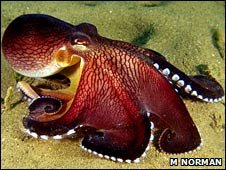
Tool use was once thought to be an exclusively human skill, but this behavior has now been observed in a growing list of primates, mammals and birds. They do things which, normally, you’d only expect vertebrates to do.
Vertebrates? Do all vertebrates come up with inventive ways to adapt to their surroundings, breaking the rules and tradition??? Alas, all too few. Witness Copenhagen — perhaps if the octopuses were gathering in Denmark, rather than world leaders, we might have a chance of reducing atmospheric carbon to survivable levels of 350 ppm, compared with 390 ppm at present. But, regrettably, our leaders have two arms, rather than eight, and human brains (an hypothesis still to be proved) rather than those of octopuses.
Apparently, the veined octopuses (Amphioctopus marginatus) used to use empty clam shells for their homes. With a growing scarcity of clam shells, the clever octopuses (whose brains are very very tiny) have adapted to using half coconut shells discarded by humans. The process through which this happened was probably fairly rapid, but nonetheless evolutionary. These octopuses are tasty morsels for fish. Only those smart enough to hide under coconut shells survive to reproduce, as Darwin explained.
Dr Mark Norman, head of science at Museum Victoria, Melbourne, and one of the authors of the paper, said: “It is amazing watching them excavate one of these shells. They probe their arms down to loosen the mud, then they rotate them out.”
After turning the shells so the open side faces upwards, the octopuses blow jets of mud out of the bowl before extending their arms around the shell – or if they have two halves, stacking them first, one inside the other – before stiffening their legs and tip-toeing away.
If only humans could speak ‘octupese’ (the language of octupuses). We could ask them, how can we solve the problem of growing acidity of the oceans, due to water absorbing concentrations of atmospheric carbon which become carbonic acid?
Count on them to have better answers than Obama, Brown, Ban Ki Moon or Sarkozy.
Innovation Blog
How Ada Yonath Deciphered the Ribosome and Won the Nobel Prize: Lessons for Innovators
By Shlomo Maital
 Prof. Ada Yonath, a scientist at Israel’s Weizman Institute, in Rehovoth, is the fourth woman to win the Nobel Prize for Chemistry. She joins Madame Curie, Curie’s daughter, and Dorothy Hodgkins.
Yonath deciphered the structure of the ribosome. How? And why does it matter? What can innovators learn from her discovery?
Here is an edited transcript of the short interview that appears on the Nobel Prize website, following the phone call that told her she had won the prize.
—————-
Interviewer: Your prize was awarded for your work in discovering the crystalline structure of the ribosome. What is a ribosome? What did you discover?
Yonath: The ribosome is a machine [inside the human cell]. It gets instructions from the genetic code, and operates chemically in order to produce its product: Proteins. During their work, ribosomes work very fast, very well, very accurately. During their work, they have to “proofread” the results (check that the protein they produced is precisely right), and to protect the protein until it is capable of protecting itself. Think about a baby kangaroo, in its mother’s pouch for weeks before it emerges into the world. Likewise, the protein made by the ribosome first goes into a “pocket”, or tunnel, and only then into the world. Like the baby kangaroo, the newly born protein progresses, until it emerges from its ‘pouch’.
Interviewer: You are the fourth woman to win the Nobel Prize for Chemistry. Your predecessors were: Marie Curie; her daughter; Dorothy Hodgkins; and now you. What gave you the courage to try?
Yonath: A serious bicycle accident. I had a brain concussion, a serious one. I had some free time while recovering and I read a lot. I read a study that showed that polar bears’ cells pack their ribosomes regularly, periodically, on the membranes of the cells, when they hibernate for the winter. I asked myself, why do they do this?
The logical explanation: At the end of the winter, when they awake, bears need lots of active ribosomes. By packing them closely, the ribosomes are preserved and are ready to function when the bears wake up in Spring from hibernating. This is the way they preserve active ribosomes, by this close packing. I read this and I thought, maybe this is the way to for solve the structure of the ribosome. This gave me the idea that ribosomes can be packed in an orderly way, so that one can determine their structure [by X-ray crystallography]. This was not believed at that time. I used ribosomes from very robust bacteria, ones that survived the harsh conditions of the Dead Sea, under very active conditions, and I took advantage of research done before me at the Weizman Institute on how to preserve their activity, and their integrity, while they crystallize. [The method Yonath developed is known as cryo bio-crystallography. It is now the standard method used by structural biologists].
When people ask me, how did I discover the structure of ribosomes, I say, because of a brain concussion, a blow to the head. This is technically true — but it is not the whole story.
Interviewer: Did you ever doubt you would succeed?
Yonath: I doubted all the time, the research was extremely difficult. The insight I had with the Bears was just one small step. Afterwards, there were lots of problems. At one point I described what I am trying to do in this way: we are climbing mountains in order to reach the summit; these mountains are like Everest, very difficult to climb; when you get to the top, you find there is another mountain behind it to be climbed afterward, an even higher one… and so on.
———————————
Yonath’s research will likely have world-changing impact. According to Wikipedia:
Yonath elucidated the modes of action of over twenty different antibiotics targeting the ribosome, illuminated mechanisms of drug resistance and synergism, deciphered the structural basis for antibiotic selectivity and showed how it plays a key role in clinical usefulness and therapeutic effectiveness, thus paving the way for structure-based drug design (i.e. designing molecules that heal, rather than use trial-and-error on thousands of compounds, hoping to find one that works).
Yonath’s life story holds the key to understanding her dogged persistence and fiercely-independent thinking, in the face of huge skepticism (in a male-dominated profession). She was born in the Geula neighborhood in Jerusalem, then and now a slum, living in a tiny apartment. Yonath’s parents were extremely poor; her father, a rabbi, ran a failing grocery store. Her parents sent her to elementary school in a better neighborhood to make sure she had a good education. Later she went to a top (and expensive) high school, and gave math lessons to help pay the tuition.
In her career: “I was the village fool for many years,” she told the Jerusalem Post. “It didn’t bother me at all. I had doubts of course. At first, I wasn’t sure that it would work. I had a lot of luck. For quite a while, I didn’t receive a higher academic status. I didn’t feel any discrimination against me as a woman scientist, but I hadn’t produced a lot of science journal articles. The Weizmann Institute showed me respect and didn’t require many administrative tasks, so I was quite independent. I did what I wanted.”
The result was a Nobel Prize and a breakthrough discovery that one day will save many many lives.
====================================================
POSTSCRIPT: Break the Rules!
Innovation is (intelligently) breaking the rules, this Blog has noted countless times. In her Nobel speech on behalf of all the participants (she was chosen to speak for them all) at the gala Nobel banquet, before 1,300 participants, Ada Yonath broke the rules: the strictest one. Do not NOT use your talk to say ‘thank you’, the Nobel organizers cautioned, wisely seeking to avoid the inane boring speeches actors make at, for instance, the Oscar ceremonies.
“I’m known as someone who carries out orders,” she said, meaning the precise opposite. “I want to warmly thank my loyal driver, Nisse.” (The crowd laughed). “Without him I would be lost in Stockholm, a wonderful (though dark) city. As a result, without Nisse, I would have missed most of the exciting events during this magical week.” (Loud applause).” Does this suggest a key innovation principle: Share the glory with those who help you, including the lowliest! According to her colleagues and students at the Weizman Institute — Yonath does.
She continued: “ …Isaac Bashevis Singer [who won the Nobel Prize for Literature in 1978] said in his Nobel speech, ‘people ask me why I write in a dead language, Yiddish’. Well, in my case too, people used the word ‘dead’ — when I spoke of my plans to determine the structure of the ribosome, top scientists said, ‘why? …ribosomes are already ‘dead’ and we know all we need to know about them!’. [‘Dead’, because until Yonath, to study ribosomes, you had to kill them]. ‘You will be dead before you succeed,’ these scientists said. Well, happily, ribosomes are alive and kicking …and so am I!”
Yonath sat next to the King, Gustav XVI, and said the conversation was fascinating; the King is knowledgeable about science and technological innovation.
Innovation Blog
HuaWei – Case Study – “Created in China” Is Real, Imminent – and a Major Threat To Your Business [1]
By Shlomo Maital
Dec. 2/2009
技 有限公司 Huawei Technologies Co. Ltd.
“Their (HuaWei’s) technology is innovative, and their bid provided the lowest cost of ownership for us. In our business, the lowest cost of ownership is key.” – Morton K. Sorby, head, business development, Telenor
A Personal Note: Two years ago, I helped lead a best-practices benchmarking trip to China, for 30 senior Israeli high-tech managers doing a TIM executive program. During our visit to a huge science park near Beijing, we heard the Director tell us: “Today, Made in China. Tomorrow: Created in China.”
Loose translation: Today China achieves phenomenal economic growth by low-cost manufacturing of products invented and designed in the West. Tomorrow it will move up the economic ‘food chain’, and invent and design its own products — and then make them, too. Can you compete with that?
This strategy is a direct threat to the U.S., Europe and Israel, because if China replaces them in the food chain, they will by definition be below China — and the implications for economic growth, wellbeing and GDP per capita are sweeping.
Do we see widespread awareness in the West of this strategic threat? Do we see national industrial policies designed by panels of experts to meet the challenge? Or does the West continue to believe that China will remain where it is — a low-cost manufacturer.
HuaWei Technologies Co. Ltd., global producer of network solutions for telecoms, is a concrete example of a major success of “Created in China”. This is why I have written this brief case study narrative. There are many more HuWei’s in China now gaining in strength and self-confidence. You will doubtless soon meet them in the marketplace. Are you ready?
Basic Facts: HuaWei was established 21 years ago, in 1988, by Ren Zhengfei, a former People’s Liberation Army officer. He remains its CEO. HuaWei began as an importer of PBX phone systems. It quickly began developing its own. In 1993 it began selling its own digital telephone switch, beginning with rural areas in China and expanding into major cities. HuaWei won its first overseas contract in 1996. By 2004 its sales abroad exceeded its domestic sales. In 2009 the World Intellectual Property Organization WIPO reported that Huawei was ranked as the largest applicant under WIPO’s Patent Cooperation Treaty (PCT), with 1,737 applications published in 2008, replacing Philips Electronics. In Dec. 2008 Business Week ranked HuaWei 3rd, after Apple and Google, in its World’s Most Influential Companies list.
HuaWei is privately owned. HuaWei marketing director Edward Zhou says the company is owned by its 87,502 employees. The U.S. thinktank RAND Corp. claims HuaWei “maintains deep ties with the Chinese military”, as a customer, political patron and R&D partner. HuaWei denies it. Its headquarters are in Shenzhen.
HuaWei’s revenues in 2008 (a bad year for network infrastructure companies) was $23.3 b., up 43 per cent from a year ago, and generating $1.15 b. in net income (up from $957 m. in 2007). Foreign sales account for three-quarters of its revenue, up from 43 per cent a year ago. (See Figure).
HuaWei supplies gear to China’s three largest operators — China Mobile, China Telecom, China Unicom — and has doubled its share of the $38 b. global mobile equipment market to 20 per cent in 3Q 2009, up from only 11 per cent a year earlier. It thus replaced Nokia Siemens (19.5 per cent) but trails Ericsson (32 per cent).
HuaWei as Innovator: HuaWei’s value proposition is based on “cost of ownership” i.e., the total lifetime cost of their equipment, rather than the price. HuaWei is not always the lowest-priced competitor. “Our focus has been on lowering the total cost of ownership for the network as a whole,” Edward Zhou notes. In an era when telecom’s ARPU (average revenue per user) is falling, cost of ownership is crucial. For instance, HuaWei’s SingleRAN multipurpose wireless network that transmits in 2G, 3G and LTD (long term evolution) signals saves operators money, because they can buy a single grid rather than install separate ones for each technology. HuaWei is apparently the first to deploy, on a large scale, the new 4G technology, LTE, in base stations.
Another Personal Note: My reliable inside sources at HuaWei tell me this: HuaWei is regarded in China as its most prestigious high-tech global company. HuaWei’s salaries for engineers are significantly higher than those paid by other Chinese high-tech firms, though they are still much lower than in the West. So, Chinese engineers, when they graduate, compete fiercely for HuaWei jobs, both for prestige and for money. What HuaWei demands in return? Twenty hour (20) work days. This is not an exaggeration. Twenty hour workdays out of 24. Four hours of sleep, etc. Because HuaWei gets the very top talent among the hundreds of thousands of graduating Chinese engineers, it has enormous innovative ability and enormous ability to scale up rapidly and deploy globally.
To prepare itself for global expansion, HuaWei engineered an enormous transformation of its business processes, using leading consultants. They now employ best practices in management innovation, gleaned from top companies all over the world.
And if this is not sufficient…..: China’s second largest networking equipment firm is ZTE. Its sales, too, rose 43 per cent in 3Q 2009, to $2.2 b. ($8.8 b. annual). In our benchmarking trip, we visited ZTE, which is now supplying China’s mobile operators with its own home-grown 3G technology. We observed that ZTE is no less dynamic and menacing, as a competitor, than HuaWei. And both have become highly self-confident, following marketplace success.
If you believe that China’s mobile market is the world’s fastest growing (rivaling India’s), and if your company is in the industry, you may eye that market enviously. As you do, think about meeting HuaWei and ZTE head-on, in China or in Asia in general. Think of meeting them in more stagnant markets in Europe. Think of matching their scale, innovativeness, infinite bank credit and speed.
If you are happily not in the network infrastructure business, picture a version of HuaWei in your own industry. If there is none right now, there will soon be. Believe me.
Valium, anyone?
[1] This case study is based in part on material in www.huawei.com, and Kevin J. O’Brien, “Newcomer from China roils mobile network field”, New York Times, Nov. 30 2009, www.nyt.com.
Global Crisis Blog
America and the Marshmallow: Obama’s Real Dilemma


America today faces the same choice that psychologist Walter Mischel presented to a group of American four-year-olds in the 1960’s.
In a famous experiment, Mischel offered the pre-schoolers a tasty marshmallow, in full view and ready to pop into their mouths, or two marshmallows if they could wait for 20 minutes.
Some kids grabbed the ‘instant gratification’ marshmallow. Some waited.
In a follow-up study, Mischel showed that the kids who could defer gratification were better adjusted, more dependable, and got SAT (scholastic aptitude test) scores that were 210 points higher than kids who wolfed down the tempting marshmallow, when graduating from high school.
Later, Daniel Goelman featured this experiment in his book on Emotional Intelligence.
Today, America as a country confronts a similar dilemma. After years of small or zero personal saving, with rundown infrastructure, inadequate human capital investment and staggering public debt, Americans are looking at a tempting “marshmallow” on their tables. With the economy struggling to emerge from recession, and with job creation anemic, Americans are asked in various ways to resume their old habits of spend/spend/spend (marshmallow NOW!).
But what America needs is a bit of improved deferred gratification. It needs to increase saving, in order to pay off huge debts, rebuild infrastructure, modernize its factories and revamp its failing schools.
How in the world can this occur? What will bring Americans to wait for the two marshmallows? When an enormous bloated monster exists — advertising, marketing, sales — whose sole purpose is to get Americans to spend, when not even a ‘mouse’ organization exists to encourage saving, and when Americans no longer trust banks, brokers or investment funds, after losing half their pensions and life savings — why would Americans suddenly become good at deferring gratification?
Two years ago, scientists discovered the physical location in our brains, where the ‘marshmallow’ decisions are made. [1] Americans do have brains. They do have the medial-frontal cortex capability of waiting for the two marshmallows. It just needs some exercise, after withering from disuse. Perhaps an adult version of the grade-school program “Stoplight” (see box) might be in order.
Somebody (President Obama?) needs to tell Americans that the party is over. It is time to tithe — set aside ten per cent of everything for future marshmallows. When this happens, we will know America is serious about remaining a First World power, rather than sinking into Third World mediocrity.
===========================================
“STOPLIGHT”
In school lessons in social/emotional learning, posters on school room walls remind kids, that when they get upset, they should remember:
Red light – stop, calm down, and think before you act.
Yellow light – think of a range of things you should do (not just your first impulse)
Green light – pick the best one and try it out.
What about an adult version? Spread similar posters all over shopping malls, Macy’s, supermarkets, Wal-Mart…? Red light — do you really need this shmata? Will it really make you happy? Yellow light — think of other ways you could invest that money, and how much more good it could do, either for yourself, your family, or for others. Green light — pick the instant marshmallow, or the delayed one — after using your medial-frontal cortex, which daily grows stronger and stronger.
[1] Marcel Brass and Patrick Haggard, “To Do or Not to Do: The Neural Signature of Self-Control ” Journal of Neuroscience, August 22, 2007, 27(34):9141-9145.

 TIMnovate