
You are currently browsing the category archive for the ‘Uncategorized’ category.
Innovation Blog
“M” Stands for Murdoch, Microsoft &….Monopoly
By Shlomo Maital
Nov. 25/2009
Microsoft is like the famous racehorse Silky Sullivan — the greatest come-from-behind racer in the history of the world.
Ridden by jockey Willie Shoemaker, Silky once galloped along in a race until the field was 41 lengths in front of him—and still won by three lengths. To accomplish this, he had to clock the last quarter in 22 seconds flat.
Microsoft never misses an opportunity to miss an opportunity. Then, using their muscle, cash and aggressive marketing, they blow smarter faster competitors out of the water. Anyone remember Netscape — the browser that invented browsers, before Internet Explorer? Microsoft leveraged its Windows monopoly to stuff Internet Explorer down our throats; bye bye Netscape.
Microsoft’s CEO Steve Ballmer is at it again. (Bill Gates is busy giving away his money, rather than trying to make more). Microsoft missed the search-engine/advertising boat. So, Microsoft is negotiating a deal with News Corp. founder Rupert Murdoch, giving Microsoft’s new search engine Bing exclusive rights to news from Murdoch’s newspaper (New York Post, Wall St. Journal, The Sun, Times of London and others). Exclusive — meaning, the news from those papers will not appear in Google. Microsoft will pay Murdoch substantial sums in return.[1]
Murdoch is a hardnosed businessman. He hates leaving money on the table. Why give news away for free? he says. But guess what, Mr. Murdoch? Infinite amounts of news are available for free on the Internet. If you try to limit access, people will read their news elsewhere. They have oodles of alternatives. The BBC, a great source of news, already announced they will continue to provide their content for free.
“I’d rather have fewer readers who pay, than many readers who don’t”, Murdoch says.
Microsoft’s attempt at creating monopoly restrictions is not surprising. What is surprising is Murdoch. He is known as an implementer of modern technology. Why does he not understand that the rules of the news game have changed forever and irrevocably? Monopoly by definition rests on there being no alternatives or substitutes. When there are infinite substitutes, monopoly is impossible.
Nice try, Microsoft. Nice try, Murdoch. In your case, “M” stands not for Monopoly, but Mistake — a Big Mistake.
[1] International Herald Tribune, Nov. 25/2009, “Big changes in offing for news media and the Web?”, p. 14
Innovation Blog
Lifeline Express: 400,000 Lives Changed in India – Should America Follow Suit
By Shlomo Maital
Nov. 24/2009
How can one bring medical care to remote villages in India? Often, children and adults in India have medical problems that can be cured easily with surgery or other care, things like cleft palate or cataracts — but suffer with them for their entire lives, because they cannot afford medical care in the cities, or even get to the cities, where hospitals and clinics exist.
India’s rail network is one of the largest in the world. It transports 18 million passengers yearly, has 1.4 million employees and has a route covering nearly 40,000 miles.
In 1991, Indian Railways and the Indian Health Ministry joined forces to provide a simple solution to providing basic medical care for remote poor villagers. They called it Lifeline Express, or Jeevan Rekha Express. Equip a train with modern medical equipment and operating theatres. Staff it with volunteer doctors and surgeons. Run the train through the length and breadth of India, to more than 7,000 stations. Inform the villagers in advance, examine them quickly and choose those best suited for the Lifeline Express care. The project is supported by Impact UK (a charitable foundation), Indian businesses and individuals. Some 400,000 Indians have benefitted so far. A second train has now been added.

Lifeline Express focuses on:
* Orthopaedic and surgical intervention for correction of handicap and restoration of movement, especially those as a result of polio.
* Opthalmological procedures and interventions, eg cataract surgery and intraocular lenses.
* Audiometry and surgical interventions for restoration of hearing.
* Surgical correction of Cleft palate.
Other countries, such as China, have begun imitating Lifeline Express. But why, I wonder, should Lifeline Express be implemented only in poor countries? Why not in America?
United States has some 48 million persons without health insurance. What about an American Lifeline Express, travelling to remote areas and cities alike, bringing badly-needed medical care to those who cannot afford it because they are uninsured? America, like India, has a rail system and a large number of people who need medical care but cannot afford it. Indian found a partial solution. Why should not America imitate it? Funding should come from the pharmaceutical companies, whose obscene prices for lifesaving drugs generate many billions of dollars in profits.
Innovation Blog
Innovation in Cities: “Remove One Zero, Two Zero’s, from the Budget” — The Case of Curitiba
By Shlomo Maital
Nov. 21/2009
This is the story of the world’s most innovative city, Curitiba, in Brazil. Curitiba is the capital of the southern Brazilian state of Paraña, with some 3.5 m. people in metro Curitiba. Every mayor and city council in the world should have made at least one trip here to benchmark the innovations led by the incredible Jaime Lerner. Most have not.
To my knowledge, the mayors of Jerusalem and Tel Aviv (past and present, including former Israeli Prime Minister Ehud Olmert) have not been here. The result: expensive, over-budget, bungled projects for light-rail or subway systems, in both Tel Aviv and Jerusalem, that, at least in Jerusalem, are making inhabitants’ lives miserable (owing to torn-up streets) and will do so for years to come. In contrast, in my city Haifa, a dedicated bus lane is zipping residents from the southern end of the city to the northern end in next to no time.
What are Jaime Lerner’s innovations? Choosing to run for mayor in Curitiba, Brazil, in 1988, only 12 days before the election, and winning a surprise victory, Jaime Lerner did the following, using creativity and common sense, and a lot of independent thinking:
* Speedybus: Used Federal money earmarked for a subway to build instead a Speedybus system — long ‘accordion’ buses carrying up to 300 people, built specially by Volvo, owned and run by private companies, with dedicated bus lanes. Bus stops board passengers in one minute (you pay in advance of boarding), buses run frequently, and housing is planned so most people are within walking distance of a bus, making cars unnecessary or even inconvenient. The Speedybus system costs one per cent of a subway and does the same job. Curitiba’s bus system carries 2.3 million passengers daily — more than Rio de Janeiro’s subway!
“What is a subway?” Jaime told the BBC. “Speed, comfort, reliability, frequency! We provide these with Speedybus, because we designed it for these four qualities.”
* Sheep: According to Wikipedia, “Curitiba is bordered by floodplain. While wealthier cities in the United States such as New Orleans and Sacramento, have chosen to build expensive, and expensive-to-maintain levee systems to build on floodplain. In contrast, Curitiba purchased the floodplain and made parks. The city now ranks among the world leaders in per-capita park area. Curitiba had the problem of its status as a third-world city, unable to afford the tractors and petroleum to mow these parks. The innovative response was “municipal sheep” who keep the parks’ vegetation under control and whose wool funds children’s programs.”
Jaime told the BBC, “the sheep are the best public servants! They never go on strike!”
* Food for garbage: Like many Brazilian cities, Curitiba has barrios, slums. They were once jammed with garbage; the streets were too narrow to permit access for garbage trucks. Jaime Lerner told the people: Bring me your bags of garbage to collection centers, and I will give you in return a bag of food. One bag of garbage, one bag of food. It was cheaper than garbage collection. The barrios residents responded. Within three months, the barrios were clean.
* Recycle: Many cities are drowning in garbage. Curitiba is not. Curitiba citizens recycle. How? Jaime Lerner had the schools teach children how to separate organic and non-organic garbage. Organic garbage goes into compost piles. The children taught their parents. Now, 70 per cent of all garbage is separated, one of the highest ratios in the world. Curitiba has a lovely nearby bay. Once it was a garbage dumping ground. Lerner began to pay fishermen by the pound for retrieving garbage from the bay. Now, fishermen fish for fish, when they can, and when they cannot, they fish for garbage. Curitiba saves many millions of reals in this way.
* Schools: Lerner has a program where poor kids who don’t want to go to school can be apprenticed to city employees. As a result Curitiba has many fewer gangs than does, for instance, Rio.
* Bikes: There are 62 miles of bike routes in Curitiba, used by 30,000 bikers daily.
But what is Jaime Lerner’s biggest idea — the truly revolutionary innovation?
How often do we hear public officials and politicians say this sentence:
Yes, we would like to do good things, solve problems, make citizens’ lives better — but, we lack the money.
Here is Jaime Lerner’s ‘take’ on this statement.
“Do you want to change things quickly?” he asks. “Remove one zero from the budget. Do you want to change things even more quickly? Remove TWO ZERO’s from the budget.”
He did it. If you have no money, you have to invent, create, innovate, improvise. How often do we throw money at a problem (or accept the problem because of lack of funds), rather than throwing energy, creativity and start-from-scratch innovation at it?
If the world’s mayors do not visit Curitiba, perhaps Jaime Lerner can visit them.
But will they listen?
Bernanke Needs Eyeglasses: He Cannot See Bubbles
By Shlomo Maital
Nov. 19/09
“It is inherently EXTRAORDINARILY difficult to know whether an asset’s price is in line with its fundamental value”.
Fed Chair Ben Bernanke, in a speech given on Monday Nov. 15/09
When the Master of the Universe, the distinguished Princeton University Professor , expert on the Great Depression and the person who controls the fate of every one of the 6.8 billion people on the planet (through controlling the value of the US dollar) says, he CANNOT tell whether there is an asset bubble or not… well, every one of us has cause to worry.
Professor Bernanke, looking at the diagram below, showing the median US house price divided by median income, is there anything in the diagram that gives you a slight clue that America was in the midst of an enormous housing bubble? ANYTHING????
Prof. Bernanke, I know a terrific optometrist. He can prescribe new eyeglasses for you. You need them urgently. Because if you cannot see the old bubble, that means you will not see the next one either. And that means, all of us are in deep hot water.
Innovation Blog
The Subject We All Know the Least About: Ourselves
By Shlomo Maital
Nov. 13/2009
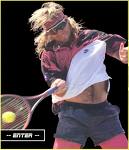
Andre Agassi
U.S. tennis great Andre Agassi has published his memoir, “Open”. It attracted controversy because in it he admits to using crystal meth, a banned substance, and then lying about it to tennis officials.
Agassi was a ninth-grade dropout, with a tyrannical and abusive father who was so awful, Agassi spent much of his life trying to build an alternate family for himself. He told his story to Pulitzer-Prize winner J.R. Moehringer, who grew up fatherless in Manhasset, NY, and found his role models in pubs.
Agassi spent 250 hours with Moehringer, telling his story. He told NY Times journalist Charles McGrath, “I have a lot of capacity for pain, but I didn’t understand how hard this process would be. I was being asked to talk about the subject I know least about: me!”.
What a powerful observation! The subject that most of us know least, I believe, is indeed — ourselves. Why? Because the journey inward, into ourselves, is fraught with pain — and unlike Agassi, who often played through pain (as do all pro tennis players or pro athletes in general), most of us ‘leave the court’ when in pain.
I believe that the hard and long journey outward, toward creative ideas, must begin with an even harder and longer journey — inward, into ourselves, to understand our deepest passions, our frailties, weaknesses, failings, and fears. Self-awareness and self-knowledge are powerful tools, and vital ones, if we are to persist in the bumpy road to world-changing innovation.
Socrates got it right. “Know yourself,” he advised, 2,500 years ago.
We come to know ourselves, usually, by looking backward at our lives and compiling ‘lessons learned’ — perhaps, too late to make effective use of that knowledge.
Don’t put it off. Begin your inward journey now. I offer this advice as someone who began it much much too late in life.
Innovation Blog
The Powerful Vision of Those Who Cannot See, The Sharp Ears Of Those Who Cannot Hear:
How Adina Tal Changed the World
By Shlomo Maital
Nov. 11/2009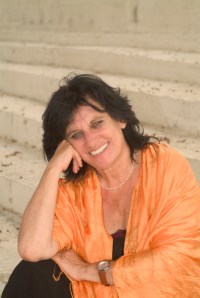
Adina Tal
“..the human spirit has no limits — except those we ourselves place upon it.”
– Carl Jung
Part One: Eating in the Dark
Last night, to celebrate my 67th birthday, my wife, son and daughter-in-law took me out to dinner. It was, for me, an inspiring life-changing experience. I’d like to share it in this blog, which will be longer than usual. If you have the patience to read to the end, all 3,500 words, I believe you will find it rewarding.
We ate at “Na La’ga-at” (Hebrew for “Please touch”), a center in Jaffa (south of Tel Aviv) that hosts thousands of visitors yearly to its theatre show, restaurant BlackOut, Café Kapish and special events.
Let me describe the meal first, at BlackOut, and then, the Center and its founder.
We remove watches with glowing dials, cell phones and anything else that glows. We enter a pitch-black room, guided by our waitress whom I will call “Dalya” — walking in file, one person’s hands on the shoulders of the person ahead. Dalya seats us. The blackness is perfect. Earlier, in the light, we ordered. I choose “surprise” –dishes chosen by the chef.
Dalya has no problem serving us in the dark, because she is blind. She was born with failing vision, which later worsened. She can see light and dark, but no more. Dalya is indomitable. She works at BlackOut, and is a guide at the Holon Children’s Museum, which has a “blackout” room to enable visitors to experience blindness. She travels, has friends, and uses her computer. She was widowed five years ago. Despite everything, her voice has a cheerful lilt, her face is luminous and she is boundlessly optimistic. And she knows my wife’s blind student, at Haifa Univ., whom she identifies through the name of the student’s guide dog. Dalya, too, had a guide dog, who died of cancer some years ago, a wrenching loss for her. Since then she has not had the heart to seek a new one, and moreover, since she travels, she would have to leave the dog with friends, perhaps burdensome for them.
Our son Yochai mentions to Dalya that he saw a film about a blind person who climbed Everest. Yes, Dalya says, he’s here! He is a waiter here! And she invites him to our table. Ethiopian in origin, he talks about the extreme cold and altitude. He runs distances, with a friend, and he too has a happy lilt to his voice. Listening to him, I am thinking about what psychoanalyst Carl Jung once wrote, how the only thing limiting what we can do is the constraints we place on ourselves.
The meal is outstanding: asparagus in tomato sauce with smoked salmon, salmon-stuffed crepes, baked salmon with a spicy crumb topping, fresh-baked bread, Chardonnay wine, chocolate ice cream with cardamom seeds — all eaten in pitch black, using hands, fingers, fork. I find my eyes closing, as the dark acts like a warm blanket, wrapping us, enfolding us, relaxing the senses, focusing attention on the taste of the food (no visual cues to distract me), and the conversation too is wonderful, because again, our eyes are not constantly shifting and distracting as we talk and listen. I ask Dalya endless questions, fascinated by her spirit.
What one thing would make your life better? I ask. Accessibility, she says. Bus drivers should announce the number of the bus. Often, she recounts, I get on buses and find it’s the wrong one, get off, and lose much time. Dalya gets around with a cane, and her memory is sharp — she remembers streets, curbs, and where things are in her home. And her hearing is intense. The brain compensates for one missing sense, vision, by sharpening the others.
As we leave, Dalya gives me her email address and we agree to correspond. Her face is radiant. I resolve to explore more deeply who innovated this remarkable Center and restaurant.
Part Two: Adina Tal Changes the World
Seven years ago, the curtain in the Na La-ga’at Center rises on “Light Is Heard in Zig Zag”, written and directed by Adina Tal. The actors? Twelve deaf-blind individuals, suffering from Usher’s Syndrome, a progressive genetic disease, who until then lived in darkness and silence.
In 2004 the company tours North America, gains rave reviews in Toronto, Montreal, Boston and New York, and is sold out. Adina and the company do workshops for deaf-blind groups in Boston.
In 2005 rehearsals begin in a snowy village in Switzerland for a new production, “Not by Bread Alone”, with actors learning to knead Challah for Shabbat. Actors learn to sense the vibrations of a drum, incorporated as cues in the show.
In September 2005 the group performs at New York City’s Lincoln Center. A new dream emerges: Building a center of its own for the group, in Israel. A rundown hangar is located in Jaffa Port. Eran Gur and a dedicated team renovate the place, assisted by the National Insurance Institute and the Ministry of Welfare, along with private donors and foundations (including the Blechs). Deaf waiters are recruited for the Café Kapish coffee shop; blind waiters, for the BlackOut restaurant.
In 2008 Adina Tal is awarded the Chesed (Grace) Award at Israel’s Knesset (Parliament).
Here is the story of how Adina innovated this remarkable play and center.[1]
In late 2002, Adina Tal did not plan on founding a theatre company and a non-profit organization. She was already running a successful theatre company, busy writing, directing, and even acting, and felt that she had reached a point in life where “I understood what life was about.” But underneath the satisfaction with her accomplishments buzzed a small desire to do something new, and when members of a non-profit organization that had just received a grant asked her if she would do theatre workshops with a group of deaf/blind people, to her surprise she found herself saying “yes.”
When she walked into the room she noticed that none of the dozen people there noticed her because they had no way of knowing she had entered the room, “and this was my introduction into what being deaf/blind means.” It also marked the beginning of a phenomenal story about theatre-making, human inventiveness, and the power of personal narrative. The surprise was genuine.
“No one in my family suffers from blindness or deafness,” she said, and while she had seen her share of theatre done by disabled people, going to see it felt like “doing a good deed,” and she never felt any need to go beyond that level. Yet there she was, driving from Jerusalem to Tel Aviv for her first meeting, partly hoping that something would happen to postpone or cancel this commitment about which she was having second thoughts.
Not that this beginning was easy or clear. A primary problem involved how to communicate with her participants. Each of them had an assigned interpreter/social worker, and the interpreter would talk to his or her charge by signing into that person’s hands. Shouting, gesturing, demonstrating, conversational interplay, the usual tools of a theatre director — Ms. Tal could not use them. So on that first day she formed them into a circle and simply began with physical movements — hand-waving, foot-stomping, and so on — to get them to feel their bodies in space and in relation to one another. On the drive back to Jerusalem, the initial sense of surprise had morphed into something else: she found that she had fallen in love with them.
After three months, events took a funny but decisive shift. Yuri Tevordovsky, from the Soviet Union, stated categorically that everything they were doing was “stupid.”
“Why are we doing all this pantomime?” he complained.
Ms. Tal asked him what he wanted to do.
“Gorky,” he replied immediately.
And how are we going to that? she persisted.
“That’s your problem,” Yuri shot back, “you’re the director.”
She answered that the problem was his, too, since he was blind and deaf.
“Okay,” he agreed, in a tone of voice that said, “Well, let’s do something together about this.”
This “something” became Nalaga’at. During those three months, in talking with their interpreters before, during, and after their weekly meetings, Ms. Tal got the sense that while they genuinely cared about these people, these caregivers were often cautious — perhaps too cautious — in letting them engage with the world. When Yuri spoke out, and the others concurred that they would like to do something more than what they were doing, Ms. Tal realized that they felt good in being pushed and not just accommodated. Just as any other artist would. Including herself.
But as the idea of making theatre with them began to crystallize, she thought that while she wanted to do serious work, she didn’t want to do Shakespeare or Brecht, or have them resemble a deaf/blind version of a hearing/seeing company. The source of their theatre would have to come from themselves, from their lives and their dreams.
And that was the spark that led to gathering material, writing, rehearsing, and eventually performing their signature piece known as “Light Is Heard In Zig Zag.” Along the way, Ms. Tal and the others who worked with the troupe learned and unlearned a great deal about the (dis)abilities of their actors. For one, “I had always had this fantasy,” she states, “that deaf/blind people were more sensitive to the world” and thus had greater insights and intuitions.
But she found that, at least with sufferers of Usher’s Syndrome, who are not born deaf and/or blind but whose hearing and seeing decay over time, they were not entirely used to their own afflictions and were often still learning after many years how to cope with the world. In other words, they had their own “blind spots” just like the rest of us. But their sensory deficits did not make them feel like victims or pawns, or even necessarily handicapped.
One of the actors, Gadi Ouliel, has the desire to one day drive a bus. When Ms. Tal learned this, she asked everyone else to board Gadi’s bus in a way that showed something about themselves. When Yuri Tevordovsky got on, he did so with a limp. When she asked him why he did that, he said he did it so that he could get the fare-reduction given out to disabled people. Obviously he didn’t consider being deaf/blind a proper “disability”; it was so much a fact of his life that he felt he had to add something on it to make himself appear more eligible for the rebate — something even a crafty sighted/hearing person might do.
Another lesson, more pertinent to the making of theatre, came from Ms. Tal’s realization that they lack an essential actorly skill: mimicry. In one exercise, she had each person take an actual grape and eat it. Then, using that sense memory, she wanted them to eat a pretend grape — and she was astonished to see one dozen different ways of eating a grape. Since none of them could see each other, they also could not copy each other — so each had to invent wholesale his or her singular grape-eating style. This excited the director in her because it made the act of acting fresh and innovative.
Unlike with seeing/hearing actors, who can rely upon past gesture-memories (and thus become lazy or derivative), Ms. Tal saw that they had to “re-invent the world all the time,” and in re-inventing it, see it anew.
“There is an energy,” she explains, “that I have never felt with any professional actor. I was discovering a whole new world.” She also realized something new about noise, that is, the noise that usually accompanies any kind of theatrical process. “I’m sensitive to noise,” she confesses, “and even though I myself always talk loudly, my concentration can get thrown off if there is too much of it in the room.” In working with the company members, noise was not obviously not a problem since communication had to be by touch. Thus, everybody could become much more concentrated on the work at hand, leading to a level of focus and deliberateness rarely achieved in more “normal” rehearsals. But perhaps the greatest challenge came with trying to find a way to establish with deaf/blind actors what is taken for granted in more usual theatrical circumstances: the umbilical relationship between actors and audience.
“Theatre,” she explains, “is about creating a moment of meeting between actors and audience.” But with deaf/blind people, “their sense of stage-presence is completely different.” Until there is a touch of some kind — actor to actor or interpreter to actor — they exist in something of a limbo because they do not have access to any visual or auditory cues that place them in time and space. Only touch puts them in the present moment. The challenge, then, was to create some form of virtual touch that linked the present momentness of the actors on stage with the being-in-the-present-moment of the audience.
The problem solved itself in an unexpected and unforced way. For the actors, the more they worked and performed, the more able they were able to build a sense of audience responses (which Ms. Tal labels as nothing short of “magical”). After performances, they would tell her that they felt that the audience that night was “dry” or “non-responsive” or “warm.” She didn’t know how they knew this, but she knew their assessments usually hit the mark. In turn, the force of their confidence on stage spilled into the audience, which prompted the audience to react to the stage-action differently. Normally, the audience looking through the “fourth wall” of a play is an eavesdropper, a voyeur, at something of a distance. But watching and responding to a troupe of deaf/blind actors who cannot, in turn, respond to the audience’s responding to them, forces the audience to rely less on the “outer” and to move more inside themselves, and this inward journey, in some “primary” way (to use Ms. Tal’s word), blends with the actors’ energies coming off the stage to create that umbilical so unique and essential to the act of theatre.
“I am not a mystical person,” she avers, “but I also can’t deny what I’ve seen — it is magical.” (And another small but important discovery about applause. Ms. Tal realized that the actors would have no way to know when the audience applauded them. So she devised a way of having the interpreters taps the actors’ knees to indicate when the audience was clapping, and each actor would pass this tap down the line, hand to knee, hand to knee, until everyone got the message.) It took about a year to create the first performance of “Light Is Heard In Zig Zag,” which puts the actors on stage with their interpreters as guides.
Since then the production has changed a great deal without losing its core focus on the personal dreams of the actors. And these dreams, as Ms. Tal points out, are no different than the dreams “normal” people have about what they would like to accomplish in their lives.
- · There is Gadi Ouliel’s desire to drive a bus.
- · Yuri Tevordovsky “dreams that one morning he will wake up and take a look at the sky, and if the sky is blue, he will go fishing.”
- · Bat Sheva Ravenseri wants to become a famous actress and singer,
- · Shoshana Segal would like someone to make her a birthday party,
- · Zipora Malks wants to be a chief-of-staff in the army (“a particularly Israeli dream,” Ms. Tal notes dryly),
- · Marc Yarosky dreams of walking into a local pub, ordering a drink, “and being treated like a king.”
After each show, actors and audience have a chance to mingle and talk, and on a promotional DVD about the show, an audience member, during one of these post-show meetings, states that “I’m bewildered by the capabilities, how far humans can reach.” And this sentiment of wonder and respect is echoed without exception by the audience members. As Ms. Tal says, “A lot of people are coming to see and hear us and want to be part of the group because they want to be near these people who had the courage to get up and do something.” But current realities press in on these moments of revelation and acceptance.
“We are working on a new production,” she points out, “that will use drumming extensively.” Drums, she has found, have been an excellent way to build communication in the group because the actors respond well to the vibrations as cues for action. And this new production will risk more than “Light Is Heard In Zig Zag” because there will be no interpreters on the stage with the actors, as there are now. “Only drums,” she says, “and cooking.” During the performance, the actors will prepare and bake bread; the show’s length will be the time it takes to complete that process. And, of course, at the end of the show, everyone will break bread with everyone else. (THIS NEW PRODUCTION WAS TO BECOME ‘NOT BY BREAD ALONE’ — HIGHLY PRAISED!)
Part Three. “Light is Heard in Zig Zag”
A review by Michael Bettencourt of “Light is Heard in Zig Zag” , performed on September 15, 2005, at Lincoln Center’s Frederick P. Rose Hall:
The stage in darkness. A double row of chairs. A voice — male, reverberant — speaks to the audience. Stage right a young man steps into the light, and his hands carve the air with signing. The stage brightens, and from stage left, in double single-file, the dozen actors enter, the one behind with a hand on the left shoulder of the one in front, guided in by the interpreters. They take their chairs. The performance begins.
It is a great performance, by turns mad-cap and touching, always committed and clean and direct. Each actor gets to tell his or her story — simple stories about simple wants and desires — and the staging of the stories, like the actors themselves, uses broad strokes to convey meaning: balloons, bubbles, blond wigs, blue cloth for the surface of a lake, over-sized foam-board cut-outs of flower bouquets, a pair of drums, and, at the end of the show, a sing-along. All of this is good the way good theatre is good: vaudevillian, unmawkish, inviting, unheady, clued-in — the jadedness cleansed away, critical distance cracked.
The most powerful pieces, to me at least, came when, at various times, one of the actors, stepping forward on the stage, the person signing to his or her left, the interpreter to the right at a microphone voicing a translation for us, “spoke” directly about being blind and deaf in a world not built for the sightless and soundless. We “able-bodied” in the audience, in an interstice between the rush-rush of our important day and how we have to get home after the show lets out to prepare for the next important day, are allowed to enter the space of “the other” and both forget about ourselves and remember ourselves, that is, drop the armor of ego and recover the power of a primary human-to-human connection by way of a shared frailty of being. We are all alike, like it or not, when it comes down to the struggle to make it all make sense.
This performance also has a second show just as spectacular as the first: when the actors and audience mingle afterwards. The lobby is jam-packed. The interpreters, umbilicaled to their actors, sign furiously into the actors’ hands as person after person comes up to offer praise and congratulations. Many in the crowd sign themselves, so while the usual post-show verbal buzz fills the air, pockets of gesturing humans create a kind of post-show physical buzz as well, the audience member singing to the interpreter who signs to the actor who signs back to the interpreter who passes it on to the audience member, all of this speeding along the way flocks of startled starlings wheel and spin through a cloudless sky.
We should support theatre like this — not because it’s “feel-good” or because we want to soothe ourselves as “do-gooders,” but because it is good theatre, that is, theatre that not only satisfies our aesthetic demands for craft and pleasure but also is enmeshed in, and drawing sustainable inspiration from, the world that faces it. Nalaga’at is embodied theatre, theatre from the body — not just from the bodies of the actors and their shepherding interpreters but from our bodies as well, a call to us to bind ourselves each to each, since that is the only salvation we have as humans, and the only salvation worth having.
[1] Taken from an interview by American playwright Michael Bettencourt, www.m-bettencourt.com
Global Crisis Blog
Three Global Scenarios: Take Your Pick, Share Your Wisdom
By Shlomo Maital
Nov. 3/2009
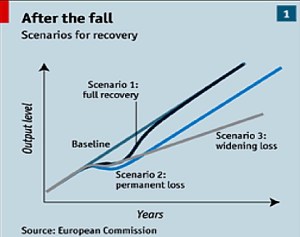
In The Economist’s Oct. 1 issue, a special report on The World Economy has an excellent and insightful lead article. The question addressed:
*** Will the world economy recoup its huge losses from the 2007-9 global crisis, catch up to the pre-crisis trajectory, and return to the original baseline growth (a large but one-time loss)? This is Scenario 1. (See Chart). (Prof. Milton Friedman believes this has been the case in every American recession, for instance).
*** Will the world incur a permanent loss in output, returning to the original global growth rate but NOT recouping fully the losses in wealth and output. This is Scenario 2.
*** Will the world incur a permanent and growing loss in output, with global output growth emerging SLOWER than pre-crisis and never regaining its original rate. This is Scenario 3.
It makes a huge difference for every single manager, business, family, government — everyone! — which of these scenarios will actually occur. If forewarned is forearmed, we all need to be forewarned. But as usual, our economists disagree and are of little help.
If you have insights into which of these scenarios you believe is most likely, and why, please share them with us and submit a comment.
Innovation Blog
2 Million Women Suffer — Who Cares?
The Terrible Shame of Fistula
By Shlomo Maital
Oct. 27/2009
If two million American, French, British or German women suffered from a life-destroying humiliating and unbearable condition — how many thousands of innovators and billions of R&D dollars would be devoted to finding a rapid solution?
But, fear not, it is only African, Asian and Arab women. So, who cares?
The condition is fistula. It is horrendous just to read about it. And despite a global campaign launched by that powerful, effective and efficient body called the United Nations, little progress has been made. We have excuses rather than results. It is a true disgrace, and a dark blot on the alleged humankindness of the wealthy half of the world.
The cost of curing the 2 million African, Asian and Arab women who suffer from the condition is $600 m., or $300 per woman, a sum equal to about 12 hours’ worth of crude oil production, or 0.1 per cent of what the world spends annually on advertising.
According to the UN:
Obstetric fistula is a hole in the birth canal caused by prolonged labour without prompt medical intervention, usually a Caesarean section. The woman is left with chronic incontinence and, in most cases, a stillborn baby. The smell of leaking urine or faeces, or both, is constant and humiliating, often driving loved ones away. Left untreated, fistula can lead to chronic medical problems, including ulcerations, kidney disease, and nerve damage in the legs. A simple surgery can normally repair the injury, with success rates as high as 90 per cent for experienced surgeons. The average cost of fistula treatment and post-operative care is just US $300. Sadly, most women with the condition do not know that treatment is available, or they cannot afford it. Like maternal mortality, fistula is almost entirely preventable. But at least 2 million women in Africa, Asia and the Arab region are living with the condition, and some 50,000 to 100,000 new cases develop each year. The persistence of fistula is a signal that health systems are failing to meet the needs of women.
If philanthropy is absent, where is creativity — a cheap effective solution poor women can afford? Where are the world’s creative gynecologists? What about a mass-production ‘assembly line’ surgical unit, portable, that can do hundreds of such operations, for example? What about enlisting 3,000 gynecologists and surgeons to donate a month a year curing fistula?
In 2003, UNFPA spearheaded the global Campaign to End Fistula, “a collaborative initiative to prevent fistula and restore the health and dignity of those living with its consequences.” What a relief. Rather — what a joke.
Perhaps we need a campaign to end the Campaign to End Fistula, and get down to some real action. I don’t see how we wealthy people sleep at night when so many people are suffering so badly, and so needlessly.
Postscript: Nicholas Kristof wrote his Sunday Oct. 31 NYT column on this subject — a topic he has been writing about since 2002. Here are the first paragraphs…
October 31, 2009, 10:10 pm
<!– — Updated: 8:48 am –>A Heroic Doctor, a Global Scourge
By Nicholas KristofMy Sunday column is about obstetric fistula, a horrendous childbirth injury that rarely gets attention or treatment because the victims are the most voiceless of the voiceless. Dr. Lewis Wall, the hero of the column, taught me about fistulas years ago, and so I’ve been writing about them periodically since my first column on the topic back in 2002.
For years, I’ve watched with admiration as Dr. Wall has persevered to try to build a fistula hospital in West Africa — and I’m thrilled that he is now fulfilling his dream. Those who want to help his Niger hospital can support his organization, the Worldwide Fistula Fund; tax-deductible donations to the hospital are possible right on the site, so please don’t send any money in my direction. For now the surgeries in Niger will be done in the existing leprosy hospital there, and he still needs significant sums to construct the new fistula wing beside it.
There’s another great fistula organization, the Fistula Foundation, that supports the Addis Ababa hospital and other places such as the remarkable Edna Adan maternity hospital in Somaliland.
Above all, I hope that we go even further and eradicate fistula globally. In the column, I mention Dr. Wall’s careful 12-year $1.5 billion proposal (written with Michael Horowitz of the Hudson Institute) to eradicate fistula. It’s also an effort to tackle maternal mortality; my sense is that fistula may be the best way to get traction for maternal health
Innovation Blog
Where the Wild Innovators Are:
What Innovators Can Learn from Maurice Sendak
By Shlomo Maital
Oct. 20/2009
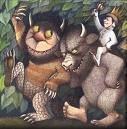
The animated movie Where the Wild Things Are, directed by Spike Jonze, has opened to critical praise and grossed $32 m. in its first days. Where the Wild Things Are is a children’s book by illustrator Maurice Sendak. Sendak was the son of Polish Jewish immigrants. He decided to become an illustrator after watching Disney’s Fantasia. Sendak published Wild Things in 1963. For the few who have not read it to their children, it is about Max:
….Max, who one evening, plays around his home, “making mischief” in a wolf costume. As punishment, his mother sends him to bed without supper. In his room, a mysterious, wild forest and sea grows out of his imagination, and Max sails to the land of the Wild Things. The Wild Things are fearsome-looking monsters, but Max conquers them “by staring into their yellow eyes without blinking once”, and he is made “the King of all Wild Things”, dancing with the monsters in a “wild rumpus”. However, he soon finds himself lonely and homesick, and he returns home to his bedroom, where he finds his supper waiting for him, still hot.
Break the Rules: Sendak’s book was controversial, because some experts felt it was too frightening for kids. But all parents know children have massive fears and confront them head on (unlike adults, who repress and deny them). Moreover, kids like to be frightened, when they know the fright will dissipate as ‘good night’ and warm supper and warm covers.
Initially the monsters were supposed to be horses. But Sendak’s publisher found that Sendak could not draw horses. So he suggested Sendak draw ‘things’. Sendak could draw ‘things’ — he based the monsters in his book, who are truly frightening, on dinner guests to his parents’ home, especially, his aunts. (Innovators: Adapt, adjust. Use what you have, not what you need or want.)
Seven years later, Sendak wrote and drew In the Night Kitchen, about a young boy prancing naked in the kitchen. This book caused a far greater controversy and several states banned it, because of the nudity. It remains banned in several states.
Sendak broke the rules for kids’ books, because he had an idea and was unafraid to implement it. The result was two true classics. The lesson for innovators is parallel to that in the world of sport, writing, music, or research.
· Never look over your shoulder for the critics/experts, while innovating. If you innovate to please them, if you innovate while thinking about what they will say, you are doomed. In American football, a wide receiver who thinks about the defender coming up to nail him, rather than focus on the ball, will miss the catch. Innovate according to your inner voice, like Sendak. Never ever think about what others will say.
This, of course, seems to defy the true-blue rule of “listen to your customers” or “fulfill a proven need”. In fact, it doesn’t. Sendak thought about the kids who would read his book. He wrote and drew for them — only for them.
Innovators create, for those whose lives they wish to change. And only for them — based on a deep true understand of who they are, what they want and what they need. If you shape your business idea according to what you think venture capitalists or investors may wish to hear, I think you are navigating by ‘radar’ rather than by your own internal ‘compass’. If so, you’re going to get lost.
Innovation Blog
Art and Copy:
What Innovators Can Learn from Advertising, or:
Why No Company Should Do “R&D”
By Shlomo Maital
Oct. 15/2009
A brilliant documentary about advertising is called Art and Copy. It is now playing at theaters across the U.S. Here is a brief synopsis:
ART & COPY describes advertising’s “creative revolution” of the 1960s — artists and writers who all brought a surprisingly rebellious spirit to their work in a business more often associated with mediocrity or manipulation: George Lois, Mary Wells, Dan Wieden, Lee Clow, Hal Riney and others featured in ART & COPY were responsible for “Just Do It,” “I Love NY,” “Where’s the Beef?,” “Got Milk,” “Think Different,” and brilliant campaigns for everything from cars to presidents.
Innovators can learn a lot from this 85-minute film. I often think that startups should BEGIN by creating the advertising for their product. If you cannot produce an exciting ad for it, why bother?
The film explains that in the 1960s and 1970s, the key people at ad agencies were account executives. The creative department was valued at less than zero. Then a revolution occurred. Creativity, not account managers, created order-of-magnitude changes in revenues and profits for Wendy’s (Where’s the Beef?), iPod, Apple, New York City, Nike, milk producers — and votes for Barak Obama. The creative department faced the risk aversion of senior managers and their wives, who a priori rejected brilliant but unconventional ad campaigns — and had to come up with new campaign ideas when their original ones were rejected, after weeks and months of round-the-clock work.
Two small memorable episodes from the film:
· Nike’s Just Do It campaign was inspired by a newspaper headline. In Utah, a convict about to be executed by firing squad said to the executioners: “Let’s Do It!”. An ad agency executive read the story — and came up with the legendary mantra for Nike.
· The ambience of the ad agency is crucial; all the truly creative agencies shown had spaces that were open, sunlit, comfortable, spacious, unusual — the exact opposite of design-by-committee. On the wall of one agency was a sign, made with 100,000 clear plastic push pins: Fail harder! A great sign. The unusual part of the sign: Rather than write the words: Fail Harder! with the push pins, as most people would do, the creator made the sign the hard way by filling all the spaces in the sign with push pins, leaving the words Fail Harder! only where there were no pins — far far harder and more time consuming but — far more striking. Take the hard way, the sign says. Don’t take the easy obvious way.
· Seize the opportunity! Nike brought in a Latin dance expert, to help pose models for still photos, for the iPod ad campaign. The expert, though not told to do so, took the model’s hand — and they did a torrid salsa dance. It was his way of showing the model how to pose. The creativity department watched in awe. At the end of the dance, everyone in the department agreed: This is our ad! That is how the famous iPod salsa ad was born — dancing figures, in black shadow, with the white iPod earphone cords.
In watching this film, Art and Copy, I reached the following rather wild conclusion. For what it is worth, here it is:
No company should do R&D, have an R&D department, or appoint a VP (R&D). There IS NO SUCH THING as R&D. Companies do not do research. Universities, labs, scholars do research. Companies do development. But there are different flavors of development.
Every organization should have a VP (Creativity). Every organization needs a Creative Dept., just like that in ad agencies, whose goal is to come up with wild unconventional ideas. In his or her creative department, there will be three reports: head of product (or service) creativity; head of process creativity (dealing with the company’s business model, every aspect of it, including sales, marketing , advertising, supply chain, pricing, and HR); and head of innovation scouting, or imitative creativity — benchmarking other industries to bring home new ideas, to adapt and adopt. (BT has a head of innovation scouting, for example). These three senior managers should work closely together, travel together, meet face-to-face frequently to exchange information, and should embrace the principles of Applied Creativity (head in the clouds, feet on the ground).[1]
Call a spade a spade. R&D? Why? If the goal is creativity, call the function just that. You will then staff the creativity group with creative people, by definition. The truly great ad agencies were created by creative people who were chewed up and spit out of conventional bureaucratic ad agencies. How many creative people are out there, crushed within bureaucratic organizations, just waiting for a chance to join a truly creative organization unafraid to call its R&D by that precise word.
[1] The concept of head-in-the-clouds, feet-on-the-ground was first taught to me by former Intel executive Avinoam Kolodny, now in the EE faculty at Technion-Israel Institute of Technology.

 TIMnovate