
You are currently browsing the category archive for the ‘Uncategorized’ category.
What can innovators learn from country music icon Dolly Parton? For the uninitiated, Parton comes from a poorer-than-poor home in East Tennessee. Today, she is 63 and is a huge brand. She has made 80 albums, had 25 number-one singles, published over 3,000 of her own songs, made great movies (Nine to Five; Steel Magnolias), and has her own record label. She owns a highly profitable entertainment theme park called Dollywood, in the Great Smoky Mountains foothills. Her net worth is estimated at $250 m. She has a children’s book coming out soon, and a line of clothing and accessories.
I think we can learn one small thing, and one big thing, from Dolly Parton.
The small thing: It seems to me that because the South tends to be less advanced, in business and education, we tend to stereotype and downgrade those with a southern accent. Dolly has made powerful use of this. With her Tennessee twang, she told CBS 60-Minutes interviewer Mike Wallace that “people (in business deals) think I’m dumb, and I let them, and then before they know it I walk off with their money”.
The big thing: Be real. Use your own life as your innovative material. Here are the words to Dolly’s latest hit, Backwoods Barbie. (She filmed the video clip in Los Angeles, at Fredricks of Hollywood, which makes outrageous lingerie). Every one is true. Dolly has had numerous plastic-surgery operations. She admits it and jokes about it. But, she sings, “I’m just a backwoods Barbie in a push-up bra and heels. I might look artificial, but where it counts I’m real.”

Backwoods Barbie
I grew up poor and ragged, just a simple country girl.
I wanted to be pretty more than anything in the world,
like Barbie or the models in the Fredricks’ catalog.
From rags to wishes in my dreams I could have it all.
I’m just a backwoods Barbie, too much makeup, too much hair.
Don’t be fooled by thinkin’ that the goods are not all there.
Don’t let these false eyelashes lead you to believe that
I’m as shallow as I look ’cause I run true and deep.
I’ve always been misunderstood because of how I look.
Don’t judge me by the cover ’cause I’m a real good book.
So read into it what you will, but see me as I am.
The way I look is just a country girl’s idea of glam.
I’m just a backwoods Barbie in a push-up bra and heels.
I might look artificial, but where it counts I’m real.
And I’m all dolled up and hopin’ for a chance to prove my worth,
And even backwoods Barbie’s get their feelings hurt.
I’m just a backwoods Barbie, too much makeup, too much hair.
Don’t be fooled by thinkin’ that the goods are not all there.
Yes, I can see where I could be misjudged upon first glance;
But even backwoods Barbie’s deserve a second chance.
I’m just a backwoods Barbie just asking for a chance,
just a backwoods Barbie.
Celebrating my 100th Blog Entry!

Suppose, just suppose, I gave you, innovative reader — a mission. Design an innovation that instead of meeting a need or want within a given culture, changes that culture massively, creates a new need and only then meets it.
Meet Webkinz.
Webkinz pets are lovable plush pets that each come with a unique Secret Code. With it, you enter Webkinz World where you care for your virtual pet, answer trivia, earn KinzCash, and play the best kids games on the net!
So – where is the culture change?
One of my friend told me that in one of Haifa’s leading schools, BOYS come to school with plush toys (perhaps, a little cat or dog) — yes, macho 12-year-old boys with skinned knees and a broken front tooth — that embody their Webkinz pet. During the lunch break, the boys feed their toy cats, because the Webkinz website says they have to feed it, or it will be unhappy. Or play with it, sing to it, put it to sleep or pet it.
As every parent knows, the culture of young boys is fiercely resistant to all efforts to civilize or tame it. The peer pressure of their friends provides a powerful magnetic shield against all parental efforts to penetrate it.

Let’s tip our hats to Webkinz. They create demand for plush toys by literally bringing them to life, through a magical website. If they can change the culture of 12-year-old boys, perhaps it is possible to change, with innovations, the culture of adolescents, senior citizens, terrorists, bond traders or politicians.
In my lifetime, I’ve read a great many speeches by CEO/Chairpersons, given to annual shareholders meetings and printed in Annual Reports. They are generally tedious and overly rosy. But recently I read GE CEO Jeffrey Immelt’s talk to GE’s annual meeting on April 27. It was exceptional, with a strong message for innovators.
Summarized in one word: RESET!

In Immelt’s own words:
I believe we are going through more than a cycle. The global economy, and capitalism, will be “reset” in several important ways.
• The interaction between government and business will change forever. In a reset economy, the government will be a regulator; and also an industry policy champion, a financier, and a key partner.
• The financial industry will radically restructure. There will be less leverage, fewer competitors, and a fundamental repricing of risk. It will remain an important industry, just different.
• There are other resets as well: the diminished role of the automotive industry; a prolonged downturn in housing; a decline in the prominence of alternative investments; and the nature of executive responsibility and compensation. You get the point.
Successful companies won’t just “hunker down”; they will seek out the new opportunities in a reset world.
The ‘reset’ button initiates a restart. This is exactly what is happening in global markets. It is a source of enormous opportunities.
Have you pressed your own reset button? If not, why not? If you did — what happened? What emerged?
True capitalism is based on generosity, not greed.
DURING A RECENT VISIT TO DAVOS AND LONDON, Chinese Prime Minister Wen Jiabao brandished his favorite book. It isn’t Mao Zedong’s Little Red Book, of course. This other book is one that Wen regards as the Bible of capitalism. He carries it everywhere and quotes from it often.
It isn’t Adam Smith’s The Wealth of Nations, either. It is Smith’s earlier book, The Theory of Moral Sentiments, read by few these days but providing to many who do read it the definitive statement of what drives free markets.
Wen’s China is no paragon of economic and political freedom. Wen does, however, grasp a basic truth that many in the West fail to see. The core principle of capitalism isn’t the greedy pursuit of self-interest, as The Wealth of Nations implies, but the opposite. As Smith describes in The Theory of Moral Sentiments, the single-minded effort to create value for others is at the center of capitalism.
Never Really Tried
The current global crisis, which is an episode of what John Kenneth Galbraith described as capitalism’s “recurrent descent into insanity,” doesn’t signal that capitalism has failed. It means instead that genuine capitalism was abandoned, or never really tried, by its modern adherents.
Socialism, too, was never tried, or so its adherents say. When the Berlin Wall fell nearly 20 years ago, socialism was declared a failure. But was it really socialism when the murderous dictator Josef Stalin hijacked Russia and killed at least 18 million people in the Gulag prison camps? Was it socialism to designate street maps and the price of tomatoes as state secrets? Or to make starting a business a criminal offense? When Mao Zedong exiled scientists and scholars to the countryside to do hard labor, and drove China deeper into poverty, was that socialism?
Mao’s Little Red Book says “a communist must be selfless, with the interest of the masses at heart.” Mao and his system flunked that test badly. It remains to be seen if some new socialists can live up to those empty words.
Or capitalists: Mao’s definition is very close to Adam Smith’s definition of a capitalist. The first 30 words of Moral Sentiments state: “How selfish soever man may be supposed, there are evidently some principles in his nature, which interest him in the fortune of others, and render their happiness necessary to him.”
Creating Value
Consider Henry Ford, the quintessential entrepreneur. Capitalism, Ford said, is this: If you want to make a buck, try. If you succeed, you can keep it. And Ford made a lot of bucks and kept most of them. But he also had another powerful vision, not of his own wealth and well-being, but rather the wealth and well-being of others. He built cars so efficiently and so cheaply that nearly everyone could afford one, at a time when only bankers had wheels.
By his skill and capitalist acumen, Ford reduced the price of his Model T from an unaffordable $5,000, in 1909, to an affordable $500 in 1927. His method of mass production was justly heralded as the Second Industrial Revolution.
Ford’s true aim was to satisfy his customers. “I will build a car for the multitude…everyone will be able to own one and enjoy with his family the blessing of hours of pleasure in God’s great open spaces,” he said. He founded an industry that employed millions at good wages and built 15 million Model Ts.
Only when capitalists create real long-term value for the mass of customers do they succeed and become sustainably wealthy. Such wealth accumulation in turn is crucial for two reasons:
It is the best, indeed the only, signal that value is being created for the masses, as people vote for products with dollars. And it is accumulated wealth, reinvested, that drives innovation, growth and more value creation.
Without the rigorous market-based test of profit, how could Mao or anyone know what the masses wanted or needed? Without substantial profits and retained earnings, where would the resources for innovation come from?
So why did the global capitalism of recent vintage fail? Because it was never genuine capitalism at all, because it was distorted and misused for personal gain by a handful of misguided individuals and because it was based on insane incentives to seek short-term gain.
The individuals who pursued huge bonuses as traders and speculators by taking on unacceptable risks-were they really capitalists? Were they capitalists when they appropriated for themselves half their investment bank’s profits as bonuses, even as the bank transmuted from partnership to public company? Or were they practitioners of “IBG YBG,” in the memorable phrase of author Jonathan Knee in The Accidental Investment Banker — “I’ll Be Gone, You’ll Be Gone, before the disaster we will cause occurs.” That isn’t capitalism. It is suicide, except that the banker jumps off the cliff and the clients die, too.
Customer’s Margin
When capitalists build businesses that create enormous value for people far beyond the cost of the resources they use, they prosper. But they can only do this if they have empathy for other people and their needs, as Henry Ford did, and if they seek with energy and creativity to provide what people want and need.
Capitalists thrive only when their profit margin generates a “customer’s margin.” That is when the capitalist’s reward for producing roughly matches the value of the customer’s satisfaction beyond the price paid. In these difficult times we should try genuine capitalism, as Adam Smith explained it in The Theory of Moral Sentiments.
The capitalists who create value for enough people by truly and sustainably enhancing their well-being will be rewarded. The next generation of managers, entrepreneurs and political leaders must embrace and apply this principle when they rebuild the damaged economies of the world.
This article was originally published in the Barron’s [financial weekly of the Wall St. Journal], Editorial Commentary, May 11, 2009).
The answers are: Yes! And…Yes!
In Harvard Business School’s Working Knowledge newsletter, Jim Heskett writes about a new book by Matthew S. Olson and Derek van Bever, Stall Points. Their book uses a large database of companies to examine failure of 50 companies in the Fortune 100, since 1955, and 90 non-US companies, that ‘stalled’ — i.e. their revenues that grew, then dropped precipitously in a single year and did not recover for a long time, if at all. Fewer than half the companies were able to return to pre-stall growth rates within a decade.
Why? What causes the stall?
It is not the case that all large organizations are devoid of innovation. Three examples of innovative elephants are Apple, Virgin and Tata, the Indian conglomerate. Apple’s innovation engine appears to be the fertile brain of its founder Steve Jobs, who returned to rescue Apple and appears to have a knack for serial innovation. Virgin, similarly, is driven by the questing mind of Richard Branson, who has made innovation and intrapreneurship part of Virgin’s DNA. And Tata? Its founder Jamsetji Tata imbued Tata, from its first day, with an unceasing energy for developing new products and new businesses, without fear of taking on industry leaders. The latest example is Tata’s $2,000 car.
The key lessons seems to be that large-company innovation needs a senior champion, at the CEO level or close to it. That leadership, combined with the organization’s muscle and resources, generates winning innovation. Without that leadership, the large organization ends up “doing the [same] things right”, as Peter Drucker noted, instead of “doing the right things”.
M.S.Olson, Derek van Bever, STALL POINTS: Most Companies Stop Growing – Yours Doesn’t Have To. Yale Univ. Press: New Haven, CO 2008.
In baseball, there are nine players on a team. The two key players are the pitcher, who throws the ball, and the catcher, who catches it.
We usually conceive of our conscious mind as a ‘pitcher’. For creative persons, the conscious mind ‘throws’ ideas. And like baseball pitchers, we can train our mind, it is thought, to throw more and better ideas.
Now, comes some research from two brilliant neuroscientists, Joydeep Bhattacharya (London) and Bhavin Shetch (Univ. of Houston), showing our conscious minds are not pitchers — but rather, catchers. They catch ideas. But from where? Where are the ideas thrown from?
From our unconscious minds — our ‘intuition’ where our brain works on problems without our being aware of it. Their work is summarized in the April 19 issue of The Economist.
Here is their lovely experiment. Subjects were given a problem.
There are 3 light switches on the wall, on the ground floor of a 3-storey house. Two of the switches do nothing. One turns on a bulb on the second floor. When you begin the bulb is off. You can make only one trip to the second floor. How do you work out which is the one that turns on the light?
Subjects were wired with EEG caps — electro-encephalograph machines that detect the magnitude and location of brain activity.
Their key finding? The EEG machine predicted which subject would get the answer, up to 8 seconds before they actually solved the problem! Subjects who cracked the problem had an increase in high-frequency gamma waves from the right frontal cortex before they solved it. They themselves were not aware they had solved it for several seconds.
“Conscious thought does not solve problems,” summarizes The Economist. “Instead unconscious processing delivers the answer to consciousness once it has been arrived at.”
Conclusion: Think hard about a problem, hard enough to get your subconscious, or intuition, or ‘third eye’, interested. Then forget about it — and wait for it to ‘pitch’ the solution to your conscious mind. But be ready! Listen hard. And be sure to exercise your intuition, not just your conscious thought processes.
Malcolm Gladwell’s recent book Blink – The power of thinking without thinking summarizes a lot of evidence about the power of the unconscious.
P.S. The answer to the light bulb problem?
Turn on switch #2 and turn it off. Turn on switch #3 and leave it. Go up to the 2nd floor. If the bulb is on, it is switch #3. If the bulb is off, but is warm, it is #2. If the bulb is off and is cold, it is #1.
Governments all over the world are faced with challenges not seen since 1929: Dealing with a global depression whose dimensions match or even exceed those of 1929-39 (Eichengreen and O’Rourke, 2009; see Appendix), without creating mountains of debt that will threaten stability when the crisis ends and the upturn begins.
One of the fiercest dilemmas concerns taxation. As tax revenues plummet in the face of economic decline, governments debate whether to cut taxes (to stimulate spending) or raise taxes (to reduce ballooning deficits). Liberals like Nobel Laureate Paul Krugman claim:
“…people who think fiscal expansion today is bad for future generations have got it exactly wrong. The best course of action both for today’s workers and for their children is to do whatever it takes to get this economy on the road to recovery.”*
Meanwhile, national governments like that of Ireland encounter a different reality:
“…Asserting Ireland must restore international confidence in its debt-laden economy, Finance Minister Brian Lenihan announced an emergency budget plan [that included] higher taxes and lower government spending to bring the deficit in line.” **
Are there basic principles, anchored in those of management, that can guide policymakers as they grapple with hugely difficult problems (unemployment, deflation, bankruptcy, rescue of failed firms and banks)?
As a beginning to this discussion, here are 10 principles that serve as policy criteria. For each policy plan or program, each criterion should be evaluated and quantified. Weights should be provided, so that alternate programs can be compared and evaluated, and trade-offs optimized. A methodology developed at Harvard Business Review by Prof. Howard Raiffa (“even swaps”) can also be employed to this end. (Raiffa, 1998).
1. Speed. The rate at which jobs are being lost in the U.S., Europe and Asia is alarming. Programs should be evaluated on the speed with which they begin to impact jobs, income and the economy in general. For example, many infrastructure programs seem attractive but require long months to be felt, owing to requirements of planning, and authorization.
2. Employment. The global financial crisis became a global economic crisis, and now a global employment crisis, with some 250 m. unemployed expected worldwide by the end of 2009. Programs must be evaluated primarily with regard to their impact on jobs — each job created results in several more, owing to indirect ‘multiplier’ effects.
3. Asset yield: Most programs increase budget deficits, already large and alarming. This can be justified, if the program creates ‘yielding assets’ that will generate income in future that can pay for debt redemption.
4. Periphery: In the global depression, proportionally more jobs are lost in outlying areas than in cities. Programs should be judged in part on their impact on the periphery. A common failing of many programs is that they tend to benefit primarily cities and urban areas.
5. Fairness and distribution: A related criterion is that of fairness — How does the program impact lower and middle income groups, and does it appreciably benefit them and improve their wellbeing? This criterion is often crucial in building public support for such programs.
6. Experimentation and Trial & Error: A well-known management innovation principle states: Fail often to succeed faster. Innovative fiscal-stimulus experiments should be attempted, because there is no proven theory that can state in advance with certainty which programs will succeed (even though the 10 principles stated here are a rudimentary attempt to shape such a theory). Governments, as well as scientists, can and should experiment.
7. Efficiency: Programs should be evaluated on cost-benefit criteria — direct and indirect costs, relative to direct and indirect benefits, including hidden ones.
8. Long-run competitiveness: The correlation between GDP per capita and competitiveness in global markets, as measured by the IMD, is 0.6; this means that programs should in part be evaluated according to their contribution to making the nation more globally competitive, toward the day that global markets and trade recover and create new opportunities.
9. Legislative smoothness: Programs generally are part of a political process, involving governments, ministries and legislatures. Some programs are politically divisive and stall as a result. Others are inherently part of a wide consensus. This criterion is an aspect of the first criterion, speed, but is important enough to stand on its own.
10. Perception and public comprehension: Programs require public understanding and support in order to fully succeed. How will the public perceive the program? How will it be marketed, motivated and ‘sold’? When public money is used, and when taxpayers’ funds are increasingly scarce and highly sensitive, there is growing importance attached to how ordinary people perceive programs and whether they will support them.
Fiscal stimulus packages should be competitive in nature. Ministries should be asked to propose a package of such proposals. Each proposal should include a quantitative evaluation of each of the 10 criteria. The resulting fiscal stimulus package should comprise a winning set of the proposals from various ministries, evaluating objectively according to the 10 criteria, and perhaps using ‘even swap’ methodology in the evaluation. There should always be ‘second-place’ programs in readiness, in the event that the global downturn proves longer and deeper than anticipated. There should be an ongoing process for evaluating existing programs, and a continual flexible process for monitoring them.
Barry Eichengreen and Kevin O’Rourke, “A Tale of Two Depressions”, www.voxeu.org, 2009.
John Hammond, Ralph Keeney and Howard Raiffa. “Even Swaps: A Rational Method for Making Trade-Offs”, Harvard Business Review, 1998.
Appendix: “It’s A Depression, All Right”
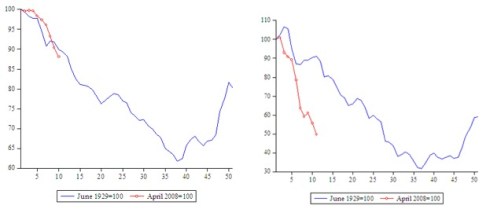
Fig. 1. Global Industrial Production, Fig. 2. Global Stock Prices, Months
Months After Peak: 1929 and 2008 After Peak: 1929 and 2008
(Peak = 100) (Peak = 100)
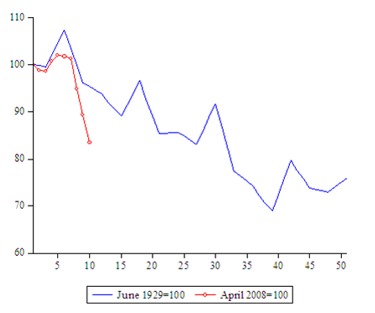
Fig. 3. World Trade, Months
After Peak: 1929 and 2008
(Peak = 100)
Source: Eichengreen and O’Rourke, 2009.
____________
*International Herald Tribune, Dec. 2, 2008, p. 9
**”Income taxes would rise under Irish budget plan”, Eamon Quinn, International Herald Tribune, April 8, 2009, p. 15
It is now official.
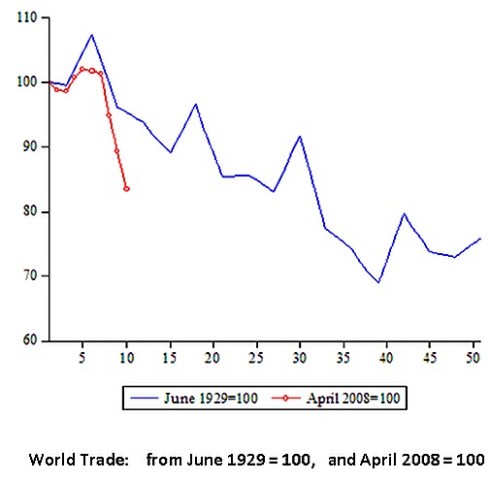
Berkeley economist Barry Eichengreen, a scholar who studies the Great Depression of the 1930’s, has shown that the current global downturn is steeper (measured from the peak in April 2008) than the decline during 1929-33, in terms of global industrial production, global stock prices and global trade. (See the graph below).
“It’s a Depression, all right,” he says.
Now that this ‘baby’ has been given its true name, innovators must ask: What type of innovations are appropriate for such desperate times?
Here are a few ideas:
* Don’t kill innovation to survive — when the upturn arrives it may prove fatal. McKinsey Global Institute shows that most companies are wise enough to know this — R&D spending has for the most part not been slashed.
* Rethink every single one of your business assumptions, including ones that are sacred, because during and after a Depression, all the rules of the game change, sometimes radically.
* Have a Depression mindset. Think about what people need during a Depression. In the 1930’s, movies boomed — it took people’s minds off their troubles. What will boom during the 2009-12 period? How can you amuse and divert and relax people?
* Value for money is crucial. Everyone is more price sensitive, even the billionaires. Wal-Mart and McDonald’s are doing booming business for that reason. Starbucks is not. Create value for money and make super-certain your clients realize it.
* Branding’s importance grows in a Depression. There is so much uncertainty, people seek certainty in what they buy, through brands. Build and strengthen your brand, or create one.
* Be ready to turn on a dime. This Depression may last a long time. But when it stops, the inflection point will be rapid. Be ready for a rapid change in mindset — people will welcome a return of the good times and their preferences, behavior and wants will change accordingly.
What is your profession?
Some can answer that question with pride — nurse, doctor, social worker, manager, psychologist.
Me? I’m a doctor — but not the kind that helps people. In fact, the opposite. Because, I am an economist with a Ph.D. And my profession has done the world enormous damage.
We (a majority of us) sold the world the criminally-outrageous notion that unregulated free markets makes the world wealthy. True, a handful of greedy persons in the banking and finance industry distorted and misused this principle for their own purposes. But the legitimacy for their actions, and the policies politicians embraced, came from the once-respected discipline of economics. Most of the world bought the free-market notion, and the resulting global crisis is like a fierce storm, spreading from America to all parts of the world, including Asia. IMF economists regularly adjust their global forecast downward, without embarrassment, scrapping what they predicted just weeks earlier.
But the real failure of economic science — some economics departments actually call themselves that, or did once — is not its bankrupt predictions, nor its catastrophic free-market ideology. It is the utter inability of economics to find innovative policies to lead the world out of the black hole economics has led it into.
Last year Newsweek ran an article presenting ‘crisis policy’ ideas from each of seven Nobel laureates in Economics. I found almost nothing truly creative in any of them. None of them addressed one core issue: The collapse of trust and confidence, in banks, financial markets and in one another. None of them even began to grapple with the other core issue: Though the supply of money and credit has grown rapidly, owing to Central Banks, the money is stagnating in bank accounts and is doing no-one any good, as a result.
So, when Business Week asks, in its latest issue, “Hey, Economics Geniuses! What Happened?” — I feel both anger and agreement: Anger at my profession, agreement with the mocking tone of the article.
“Seven decades after the Depression,” Economics Editor Peter Coy writes (himself, an economist), “economists still haven’t reached consensus on its lessons. The debate has only intensified in recent weeks.” Or, as George Bernard Shaw once said, line up all the economists in the world, in a straight line, and they still will not reach a conclusion.
Among Coy’s not-so-coy claims about economists, all of which are true:
• “They claim a precision that neither their raw material nor their skill warrants”;
• “Too many assume that people behave like the mythical economic man who is hyperrational and omniscient”.
And, Coy should have added,
• Economists crunch numbers in their offices, believing in their truth, rather than talk to people in offices, factories and shopping malls, which is where the real truth lies.
For 40 years, I committed all the above sins, and only now, after a decade of working with companies and managers in several countries, do I realize how little I really understood about how the world works, and how flawed were the theories I taught.
Keynes built a powerful theory that showed the world how to cure a Depression. He published it in 1936, in the midst of the Depression. But by the time it was understood and applied, the Depression was long over. I believe this was a bitter disappointment for him.
“Perhaps out of the (current) failure (of economics) will emerge a better macroeconomics profession,” Coy writes.
Sure. But by then, it will be too late for the new theories to do any good, to help anybody, to reduce unemployment or limit suffering, in the current crisis; a cynic might even claim that perhaps, those theories will simply sow the seeds of the next crisis.
Under pressure from the Obama administration, General Motors’ Board of Directors fired current CEO Rick Wagoner (who has been working for $1 a year) and appointed Fritz Henderson, a finance expert who made his career mainly at GM’s bank, General Motors Acceptance Corp. (GMAC), and who specialized in restructuring and job cuts. Henderson’s pay will be $1.2 m. a year. Previously he was GM’s CFO and COO.
His first statement was to say that GM might actually welcome bankruptcy proceedings.
For 65 years, GM was the world’s greatest, largest industrial corporation. Founded by management genius Alfred P. Sloan, who put together a random collection of car makers (Cadillac, Chevrolet, Pontiac, Buick, Oldsmobile) in the 1920’s, GM took on and defeated the incumbent, Ford, with beautiful cars, powerful engines, closed bodies and colors other than black.
For years GM was run by managers who loved, lived, ate and slept automobiles. Then it fell into the hands of the bean-counters. Its fate was inevitable. When companies are run by those who manage by P&L, rather than by design, quality, speed, horsepower and engines — in fact, when any company is run by those focused on numbers rather than on product — it deserves bankruptcy.
What is especially infuriating is that GM could have enjoyed a far better fate*. Some 24 years ago, on Jan. 8, 1985, then-GM head Roger Smith announced the founding of GM’s Saturn division. The goal? “Saturn is the key to GM’s long-term competitiveness, survival and success,” Smith said. Its mission: “to develop and produce an American-made small car that will be fully competitive with the best of the imports … [and] affirm that American ingenuity, American technology and American productivity can once again be the model and the inspiration for the rest of the world.” It was the same Roger Smith who “diversified” GM into robotics, space satellites, and data processing, buying Ross Perot’s EDS and Hughes Aircraft. Roger loved cars so much he shifted GM away from them. He and his predecessors turned GM from a visionary car company into a bank. They invested in everything but cars.
For years, GM made no money on making and selling cars, because its cars were in fact dowdy and terrible, in looks, performance and repair records, relative to Japanese imports. Instead, GM made all its money by lending money at 11 % to impatient car buyers, who wanted to drive home with their new car and yielded to “just sign here on the dotted line” to GM car loan peddlers. GMAC borrowed money at low interest, and lent it at high interest. This was GM’s real business. When the global financial crisis, rising interest rates and unfunded pension debt and health care debt lowered GMAC’s credit rating, boosting its interest costs, GM’s fate was sealed.
 Saturn was to emulate Japanese quality, excellence and productivity. And it succeeded. GM’s Saturn division made great, dependable cars that rarely needed repair. It was GM’s first new brand in 70 years. People loved them. Tens of thousands of Saturn owners used their vacation days and flocked to Saturn’s plant in Spring Hill, Tennessee, 45 miles south of Nashville, to celebrate Saturn Homecoming. Ever hear of Chevrolet owners doing that? Paul Ingrasia reports:
In June 1994 more than 40,000 Saturn owners and their families trekked to Spring Hill for the first Saturn Homecoming. It was the sort of “cult car” gathering usually attended by owners of 385-horsepower Corvettes, not by people who had purchased 85-horsepower econocars. The Saturn owners were feted with factory tours, country-music concerts and barbecues with the people who actually designed and built their cars. After selling fewer than 75,000 cars in 1991, its first full year, Saturn sold more than 286,000 in 1995, and topped the respected J.D. Power Customer Satisfaction Survey.
In order to make Saturn innovative and different, GM built a fireproof impenetrable Chinese Wall between it and the other divisions. The reason? GM’s bean-counting anti-innovation dull-design bureaucracy would otherwise kill Saturn. Its cost-reduction standardization made Buicks look like Chevies, or Pontiacs, and its premium Cadillac began to look like a Hyundai. Of course Saturn had to be insulated.
Problem was, if GM could not infect Saturn, neither could Saturn teach GM to make beautiful durable cars. That Chinese Wall vaccinated Saturn from bean-counting infection, but also vaccinated GM from Saturn’s love of quality cars. Saturn is now being treated like the same toxic sub-prime mortgage assets GMAC bought.
“This is a real tragedy,” says Prof. Saul Rubinstein of the School of Management and Labor Relations at Rutgers University, who coauthored a book on Saturn. The lesson for GM and its American rivals now struggling to stay in business, he says, is that when they launch daring innovations, they need the will and a way to ensure that those ideas don’t get drowned by the corporate mainstream.
General Motors deserves bankruptcy. The CEO’s who led it there — Roger Smith, Rick Wagoner, and now Fritz Henderson — deserve infamy. They earned tens of millions of dollars, in return for ruining a great company. They betrayed the memory of Alfred P. Sloan. They betrayed the trust of many thousands of hard-working car workers, who worked with pride and honor. They do not deserve a cent of American taxpayers’ bailout money. They taught the world, and generations of MBA students, a key lesson.
If you do not love your product, if you do not innovate, if you do not manage your product and instead manage your short-term bottom line, if you cut costs instead of creating value, you may pretend you are maximizing shareholder value, but what you are doing in fact is destroying long-term shareholder value and destroying jobs. Your behavior is not only bad management, it is morally wrong. You give management everywhere a bad name, a bad taste and a bad smell.
There is no room for Saturn in GM’s future — because GM has no future at all, thanks to those who ruined a great company.
_______________
*What follows is based in part on: Saturn was Supposed To Save GM, by Paul Ingrassia, NEWSWEEK, April 13, 2009.

 TIMnovate