
You are currently browsing the category archive for the ‘Uncategorized’ category.
Last Wednesday, India’s Tata Motors delivered its revolutionary Nano car to journalists for a test drive, in Pune, India. According to Reuters journalist Nick Kurczewski, “the tiny Indian-built four-door manages to combine thrift, functionality and, shockingly, even a measure of driving enjoyment.” All this, for $2,000, or less than the cost of a stereo system on a Cadillac.
But how? What is the formula for an innovation revolution?
First, vision. Tata Chairman Ratan N. Tata dreamed of a car affordable by Indian families, with a $2,000 price tag. Second, a great team of engineers began to work, to make it happen. And third — subtraction. Take away unnecessary features that do not contribute value, but only add to cost.
The Nano has tiny dimensions. It is two feet shorter than a Mini Cooper. Its body and chassis are steel, while the bumpers are plastic. The round little car looks conventional, a bit like a turtle. Its aluminum engine has 32 horsepower, 624 cc’s, and two cylinders and is rear mounted. It goes from zero to 80 km. per hour in 16.4 seconds — not a Lamborghini, but not bad either. The Nano has a turning radius of 13 feet (4 meters) and can turn 360 degrees in its own shadow. You can fit four people into it, and even five in a pinch. The Nano weighs only 600 kgs. (about 1,300 pounds).
Exactly a century ago, Henry Ford began building Model T’s. After making 15 million of them, the price fell to (in 1927 dollars) $500. I wonder if Tata is aware that the market launch of the Nano came 100 years after Henry Ford launched the Second Industrial Revolution. I wonder if the short-sighted credit raters at Standard & Poor — the same folks who, with Moody’s, brought you the subprime mortgage crisis — who downgraded Tata to B+ (below investment grade) know what pistons or distributors or engines are. I wonder if the overpaid folks who run Ford, GM and Chrysler are just a tad envious of the visionary Mr. Tata.
An article in the Times of London On-Line website by Emily Ford provides ten key rules for fostering innovation in the workplace — not just in high-tech startups. In these difficult times, challenging workers at all levels to come up with great new ideas can boost morale and boost revenues too.
1. Make innovation a top priority. Ford points out that “companies that generate 80% of their revenue from new products typically double their market capitalization over a five-year period.” In the global downturn, a common reaction is to hide in the basement and wait for the storm to pass. A pro-active approach — for instance, asking, “what will be our new hit products when the upturn begins and consumers resume spending?” — is far better.
2. Take risks and embrace failure. The global downturn has made everyone — managers, investors, savers, ordinary people — far more risk averse. To innovate, it must be recognized that failure is possible, or even likely. Celebrate failure, as a worthy attempt to succeed, in the same way you celebrate success. Ford cites an expert: “You have to give people the freedom to fail and to fail fast… that’s a real challenge in a risk-averse culture.”
3. Keep your people’s eyes on the future. Many organizations face a bleak future, as revenues collapse and layoffs mount. An innovation focus can fight this doom-loop spiral. Ford cites the following finding: “A study of internet banking in the United States looked at chief executives’ letters to shareholders between 1991 and 1995. Those with the highest percentage of sentences about the future introduced new technology the fastest.”
4. Foster creativity at all levels. Not all great ideas occur only to senior managers. Often, those who work at the ‘coal face’ (directly serving, facing or selling to customers) are best aware of changing market conditions and hence know how best to react to them. Challenge everyone in the organization to think hard about what they do and how they do it, and how it might be done better and differently.
5. Break the rules. Innovation is breaking the rules. Challenge your workers to first state what the ‘rules of the game’ are, for your industry (nearly all of these are unwritten and unspoken assumptions), and then, second, find ways to break them, to create value for customers. This does not imply, of course, breaking laws or ethical principles. We have had enough examples of that kind of behavior to last us several centuries.
6. Collaborate across boundaries. Innovation often involves cross-boundary thinking — linking a variety of disciplines. Get your accountants, marketers, salesmen, secretaries, everyone to talk to engineers, technicians — break company boundaries, in order to build new ideas.
7. Think global. Global geopolitics are rapidly changing in this time of crisis. Innovation may involve rethinking the geographies of your business. Where can we do business, profitably, that at present we do not?
8. Act fast and keep refining. “Launch things early then get feedback,” the head of Google UK says. Or, as Guy Kawasaki has said, controversially, “ship, then test!”. You never know if an innovation will work, until you try it on a customer. Find clients willing to suffer a bit in order to try something really new.
9. Cannibalise your own products. Use innovation to destroy your own products. If you don’t, your competitors will. Intel, for instance, perfected this strategy, introducing the 286 and 386 microprocessors to replace previous versions well before competitors could do so. Sony failed at this. They delayed introducing MP3 players, in order not to hurt Walkman sales, and lost a huge market.
10. Be ambitious. Even in a massive downturn, set high goals. “When this crisis ends, our new ideas and new thinking will enable us to emerge as market leaders.” Innovation has always sought not to gain a point or two of market share, but to make competitors and their business models irrelevant, as Gary Hamel taught us. Use your innovative vision to scoop up great people laid off by companies who can see no future and therefore will not have one.
I wrote my March 1 blog about the Rocky Mountain News, a venerable 150-year-old newspaper that went bust. I suggested how it could have avoided bankruptcy, in the face of a 50 percent fall in advertising revenues. Later, I heard an expert note that subscribers to American newspapers fell from 60 million to 50 million in the past decade — but subscribers to Internet editions rose from about zero to 75 million! The newspaper industry faces bankruptcy — even though it has more clients, more subscribers! Why? Because like the music industry, it has failed to adapt to the changing times. It treated the Internet not as savior but as fierce foe. What a tragedy. And what a dumb mistake. But a small handful of newspaper managers seem to see the light.
Not far from Colorado, in the state of Washington, a newspaper understands the paradigm shift. It is the Seattle Post-Intelligencer. Here is what the International Herald Tribune wrote on March 17:
Seattle newspaper drops the ‘paper’
By William Yardley and Richard PérezPeña
Tuesday, March 17, 2009
SEATTLE: The Seattle Post-Intelligencer planned to produce its last printed edition Tuesday and become an Internet-only news source, Hearst Corp. said, making it by far the largest American newspaper to take that leap. But The P-I, as it is called, will resemble a local Huffington Post more than a traditional newspaper, with a news staff of about 20 people rather than the 165 it had, and a site with mostly commentary, advice and links to other news sites, along with some original reporting. Other newspapers have closed and many more are threatened. But the transition to an all-digital product for The P-I, announced Monday, will be especially closely watched in an industry that is fast losing revenue and is casting around for a new economic model.
And the way that The P-I is changing might hint at a path for future newspaper closings. To some extent, in shifting its business model, it will enter a new realm of competition. It will compete not just with the print-and-ink Times, but also with an established local news Web site, Crosscut.com, a much smaller nonprofit organization that focuses on the Northwest. The move shows how some newspapers, in the future, may not vanish but move the battle from print to the digital arena.
‘ Had Hearst not made this decision, the survival of The Times was unlikely,’’ said Jill Mackie, vice president for public affairs at The Times.
The P-I lost $14 million in 2008. Hearst announced in January that if it could not find a buyer, it would cease printing. Few people expected a buyer to emerge. Hearst hopes to capitalize on the healthy Web traffic The P-I already has — about 1.8 million unique visitors a month, according to Nielsen Online. It usually outranks the online readership of The Times, despite a smaller print circulation: 118,000 on weekdays last year, compared with 199,000 for The Times.
‘‘We clearly believe we are in a period of innovation and experimentation, and that’s what this new SeattlePI.com represents, said Steven R. Swartz, president of Hearst’s newspaper division. We think we’ll learn a lot, and we think the Seattle market, being so digitally focused, is a great place to try this.’’
David Brewster, the publisher of Crosscut, praised Hearst for creating new journalism, rather than completely shutting down The P-I. There’s definitely room, he said. Seattle will be quite a vital place.’’
Here is a headline, from Feb. 27:

Personally, I hate headlines about a 150-year-old Colorado newspaper going bust and closing, throwing journalists and other workers into unemployment.
So, I am appoint myself Chief Copy Editor. Here is my new headline.
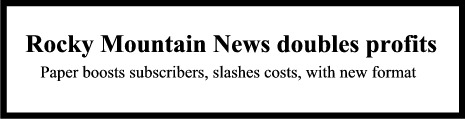
Now, how can I change reality to make the headline true?
Quite simple.
In the sharp downturn, which saw the U.S. economy contract by 6.2 per cent in the last quarter of 2009, advertising revenues have plummeted. Newspapers and magazines everywhere are losing fortunes, and some are closing their doors. To keep Rocky Mountain News alive, we must slash its costs by half.
How in the world can that be done?
By ‘printing’ a paperless paper. Deliver the paper every morning, at 4 a.m., to each subscriber, electronically, downloaded to an electronic book (say, Amazon’s Kindle 2) provided free of charge by the newspaper, in return for a year’s subscription. Every newspaper in the world that is printed on paper can instantly cut its costs in half, and save the world’s forests, by becoming paperless and digital. Even when Kindle 2 is priced at $399, Rocky Mountain News could still make money if it gave them away in return for a multi-year subscription. A supplementary business could be selling downloaded books, music and movies. In time this business could grow far bigger than the newspaper.
Why, then, don’t papers do it?
They will. The global crisis may not always be the direct cause of paradigm shifts in industry, but it is always a force multiplier that accelerates the speed such shifts take place. The necessity to slash costs radically, as revenues dive, will force newspapers to abandon paper. And in every single industry, there will be equally radical shifts in business designs.
What is the paradigm shift for your industry? And what actions are you taking to prepare for, and implement, it?
We cannot make people younger, like Benjamin Button. But can we stop them from growing older?
Almost two years ago, a brief piece appeared in the New York Times that described a magical pill, a molecule called resveratrol, that had the following properties:
Imagine a pill, derived from a compound found in something as benign as red wine, that treated the most feared and debilitating diseases of aging: illnesses like diabetes, neurodegenerative conditions like Alzheimer’s and Parkinson’s, and many forms of cancer. Imagine, furthermore, that this pill had no injurious side effects. Imagine, finally, that the pill’s only side effect conferred what human beings have always wanted: an increase in life span. (NYT, July 8 2007).
Resveratrol is the discovery of David Sinclair, Professor Pathology at Harvard Medical School. Sinclair partnered with Christoph Westphal, M.D. and Ph.D. and a venture capitalist, in 2004, to found Sitris Pharmaceuticals. This startup was built to commercialize Sinclair’s amazing discovery, made in 2003 when Sinclair was only 37, that resveratrol, found in red wine and other plant products, extends the life span of mice by as much as 24 percent and the life span of other animals, such as flies and fish, by as much as 59 percent. It also helps those with diabetes.
How does resveratrol work? Apparently it turns on the SIRT1 gene, found in all living cells, that is normally inactive but has the ability to delay aging. Resveratrol is found in red wine and comes from the skin of red grapes. In grapes, it evolved to battle insects and pests. There have been numerous reports that drinking red wine slows aging. Alas, according to Dr. Westphal, interviewed on the CBS program 60 Minutes, you would have to drink 1,000 bottles of red wine daily to get enough resveratrol to matter
“Not recommended,” Dr. Westphal says drily.
But concentrated, in a pill, that’s a different matter. Resveratrol has had startling results in mice, and is now undergoing additional clinical trials in humans. It may be on the market within five years.
How does the SIRT1 gene get turned on, to slow aging and prevent disease? Dr. Sinclair’s mentor at MIT, who discovered the gene family of which SIRT-1 is one, believes that SIRT-1 is normally activated by caloric restriction. That is, somehow, if the body is hungry, it activates the gene. A long series of studies shows that a 30 per cent reduction in calories extends life substantially among both people and mice and reduces morbidity. Apparently hunger turns on SIRT1. Most of us, however, are not able to slash our caloric intake by that much for extended periods — even though there is a society known as CRS, Caloric Restriction Society, whose members do precisely that, and show great vigor and good health. (They are now the subjects of a large clinical study). But popping a reservatrol pill daily? Well — that’s easy. And reservatrol does turn on that powerful SIRT1 gene.
For those who understand genetic biology, some of the results from Sinclair’s lab were published in a leading academic journal, Cell, in November 2008. And it is already possible to buy resveratrol (unofficially) on the Web.
By the way, Sitris was acquired by Glaxo Smith Wellcome. The price: $750 m. Apparently Glaxo sees big profit in a drug that may make aging obsolete.
I recently spoke to a group of managers, including the CEO, from a successful high-tech company that makes semiconductors. I tried to explain why the current global crisis is not another recession or business cycle, but in fact, in every industry, comprises a global paradigm shift — a totally new set of ‘rules of the game’, for doing business.
As expected, some of the managers expressed skepticism, saying they had heard this line before, in previous recessions.
Here, then, is my attempt to persuade them, and everyone, why this downturn is different.
A global paradigm shift is a fundamental, major change in the way people (workers, managers, investors) think and behave. Such a shift should be pervasive, sweeping and self-evident. Here are a few of these paradigm shifts, taken from today’s issue of the International Herald Tribune. In this single issue, Feb. 23, chosen randomly (the day after I gave my talk), we can see many of the key changes now sweeping global markets. Here are 10 of them. Perhaps each individual trend is not massively important — but taken together, they do comprise a radical difference in how we will do business tomorrow and in the future.
1. From luxury to modesty. “A dose of deference and earnest showbiz” by Alessandra Stanley. “Every Oscar ceremony tries to reclaim old Hollywood glamour; this one tried to suit the times by reverting straight to old Depression-era glamour.” Conspicuous consumption is no longer acceptable. Even those with money no longer flaunt it. At last night’s Academy Awards, dresses were more modest. See also: “Advertisers shun Academy Awards spotlight”, by Stuart Elliott. “Consumers change their attitude toward conspicuous displays of consumption”.
2. Reverse privatization: “As doubts grow, U.S. will judge banks’ stability,” By EDMUND L. ANDREWS. America and Obama will be forced to take over Bank of America and Citigroup. We will see this policy spread, as governments begin to understand that until they nationalize banks and other businesses, they will not be able to look into the balance sheets of these troubled businesses, separate good assets from bad, and relaunch them. This is a paradigm shift, because it reverses the tidal wave of privatization, in which governments sold businesses they owned. Now they will buy businesses or nationalize them.
3. Reverse globalization. Businesses once went ‘global’ at breakneck speed. Now they are retrenching and returning to becoming more local. “Royal Bank of Scotland faces major retrenchment”, by Joseph Schmid. “Royal Bank of Scotland is preparing a sweeping reorganization of its businesses that could see it exit half of the roughly 60 countries where it operates”.
4. Return to sanity. “Brother, can you spare a few million more?” by Jonathan Abrams. “This is a period of economic-induced retrenchment for many [baseball] teams.” Not only baseball teams. Individuals, investors, hedge funds, companies — all are re-evaluating the bubble-like inflated prices they paid for other companies, for stocks, for assets, for buildings, or even for free-agent baseball players. The IHT account speaks of Randy Wolf, a left-handed pitcher who missed out on a $28.5 million three-year contract with Houston Astros, as the latter ‘retrenched’. Instead he ended up with only a $5 million one-year contract with another team. Wolf was philosophic about it.
5. …and return to empathy. The wealthy and well-off are becoming more empathetic with those who have little or nothing, and no job. (See above). Wolf said: “I make a very good living and get to do what I love to do. With people losing their jobs and they’re making $40,000 a year and they’re working their tails off 12 months a year to make ends meet, it’s not right for me to complain.”
6. Nostalgia: When times are hard, we long for earlier, better days. This is reflected in fashion and in product design. “The incredible ’80s”, by Suzy Menkes. “The overwhelming theme of the early shows of London Fashion Week has been a 1980s revival.”
7. Return to sanity in executive pay: Executive salaries, once astronomical, will now become more sane. Some executives may have to give back some of the excessive pay they received in previous years. “Reclaiming pay from executives,” by Gretchen Morgenson.
8. Fierce streamlining of operations: “Ryanair plans to scrap airport check-in desks”. Ryanair wants its passengers to check in on-line, and will have only baggage drop counters, and those, only for ‘one in five’ travelers, at extra cost. Companies everywhere are fiercely streamlining their operations, to boost productivity and reduce costs.
9. Back to basics: Consumers increasingly take public transportation, and eschew restaurants for McDonald’s, now enjoying an enormous boom in revenues and profits. ”Ridership on subways at its highest since 1950″. In 2008 ridership on NYC subways was the highest in almost six decades. We are seeing major increases in price sensitivity everywhere, as customers and clients who once ignored price now focus on it. Saving is back in fashion.
10. Fierce tightening of regulation: All over the world, regulators are tightening their control over the companies and institutions they oversee. “An investment gian left to wither?” by Elinor Comlay. ” ‘Regulatory requirements are going to dramatically reduce the amount of risk that Bank of America is allowed to take’, said ..an analyst at Morningstar in Chicago.”
These are only ten of the many global paradigm shifts now taking place all over the world. I have doubtless missed many of the most important ones. Readers are invited to contribute their own observations.
In writer F. Scott Fitzgerald’s remarkable short story collection, Tales of the Jazz Age, there is a modest little story that doesn’t seem to fit with the rest. Its title: “The Curious Case of Benjamin Button.” In it Fitzgerald tells of a person who is born an old man, then gets younger as the years pass, finally becoming a tiny baby and disappearing. The recent movie based on it won three Academy Awards, including visual effects, art direction and makeup. Producers worked on the film for 18 years before finally completing it. It has been a box office flop in America but leads foreign box office revenues.
At a very personal level, this movie means much to me. I took early retirement from my university at the age of 61. I then began a new career, working with managers and companies. That new career gave me many insights into how best to do executive development, as an educator.
I wish I were Benjamin Button. I wish I could now go back and apply that knowledge, in my university. It is a bitter paradox that we gain wisdom through life, and just when it peaks, as pensioners we are probably unable to apply it — and then the wisdom, most of it tacit, disappears together with us, is never transferred to others and is thus lost forever.
One of the great innovations we need today is a “Benjamin Button button.” Press a button, and the wisdom of older people is digitized, captured, organized and transferred to others. As this happens, the persons imparting the wisdom become younger.
On second thought — such an invention exists. It is called a digital recorder.
I urge my fellow golden-agers to find ways to capture and impart what they have learned. It will make you younger, in spirit if not in years.
Can someone build a website that might facilitate a Benjamin Button process?
Who invented GDP?
Like many powerful management tools, the idea to compile data on a nation’s output was born not as an academic theory but out of a pressing practical need — in this case, the need to manage Britain’s meager resources in the desperate early stages of World War II.
In a series of three articles published in The Times of London, Nov. 1939, economist John Maynard Keynes noted that in World War I, excessive money creation stemming from defense spending led to inflation, which greatly hurt the working classes. Can we avoid this in World War II? asked Keynes. We can. But how? First by calculating “the maximum current output we are capable of organizing from our resources” (i.e. GDP). Next, “by estimating how fast we can safely draw on our foreign reserves by importing more than we export” (i.e. Imports minus Exports). Next, by estimating the minimum necessary capital formation needed to maintain plant and buildings (Gross Capital Formation). Next, by estimating how much will be required by our war effort” (Public Defense Consumption). What is left is “the size of the cake which will be left for civilian consumption” [i.e. both personal and public]. Keynes recommended using taxation and compulsory saving to ensure that consumption spending did not exceed that ‘cake,’ so that demand-pull inflation should not emerge. Keynes’ little 1940 book How to Pay for the War provided some initial estimates for Britain, 1940 (building on data collected by Colin Clark):
GDP = £4,850 m. = Personal and Public Consumption plus Exports – Imports (£ 4,140 m.) plus Gross Investment (£ 710 m.).
Partly as a result of Keynes’ influence, Britain did finance World War II with relatively little inflation, far less than in World War I.
If management begins with measurement — how in the world did governments build economic policy without knowing GDP, before 1940? And why did not economists invent the GDP metric centuries before Keynes?
Perhaps my fellow economists can provide some answers.
Michael C. Leach is the current head coach of the Texas Tech Red Raiders football team. He is regarded as one of the most innovative offensive minds in college football. With a budget a fraction that of other top teams (Nebraska, Texas, Texas A&M, Oklahoma) and with only limited ability to recruit top high school talent, Leach has taken Texas Tech to a #2 ranking in America, and ended last season as #7. Most of his players are from Texas.
Leach’s Red Raiders ended the 2008 regular season with 11 wins and 1 loss, the best in school history. The season also marked Tech’s first win over a #1 ranked team — Texas. Tech, along with Oklahoma and Texas, shared the Big 12 South division title. The Associated Press named Leach the Big 12 2008 Coach of the Year.
Leach did by changing the paradigm.
Leach’s teams are intelligent. He stresses to his players that they are there to study and gain a degree, not to play football. An intellectual himself, he addresses his players on a vast array of subjects, including pirates and DNA — each of his mini-lectures or parables has a football moral at the end. Tech football players have among the highest graduation rates among all leading college football teams. They are very smart. They have to be.
On a recent segment of the CBS program 60 Minutes, interviewer Scott Pelly (himself a Texas Tech alumni) showed a very short videotape segment of Leach’s quarterback throwing a forward pass. Pelley asked the quarterback to describe what he was thinking and deciding. The response took three full minutes, for a play that took two seconds.
Leach trains his quarterbacks in a potent passing offense. On any given play, there are five potential receivers. The offensive line is spread widely across the field. At half time, Leach asks the players, socialist style, whether they feel they have all been given equal opportunities to ‘touch the football.’ Why? Fairness and efficiency. If one player gets the ball too often, the defense can ‘key’ on that player. If the ball is evenly distributed, the defense has no idea who will get it on any given play. This is at odds with standard coaching (for instance, the Super Bowl game in which star wide receiver Larry Fitzgerald nearly won the game singlehandedly, scoring with only two minutes remaining; Pittsburgh came back to score a touchdown just 32 seconds from the end.), which seeks to get the ball to the ‘money player’.
Most teams run 70 plays a game. Leach’s team runs 90 — a 28% increase. Why? Leach’s offense moves super-fast so that the defense cannot have time to organize and prepare.
How do we know Leach has created a paradigm shift?
According to experts, all the leading American college football teams now use elements of Leach’s innovations. You cannot patent a football innovation. All Leach can do is continue to innovate, stay one step ahead of his opponents and emulate Texas Tech’s Masked Raider mascot (a masked rider on a black stallion): race onto the field and surprise and terrify his opponents.
By the way: Leach himself is one of the few leading American college football coaches who never played football himself. He is a lawyer who once considered public interest law. Right now, the public interest lies in his upsetting teams more wealthy, more powerful and less innovative than his.
Tomorrow is the 200th anniversary of the birth of Charles Darwin, discoverer of the principle of natural selection and the theory of evolution. And in October we will mark the 150th anniversary of the publishing of his landmark book On the Origins of Species, a book that changed the way we think about the world.
What can we learn from Darwin’s life and discoveries about innovation?
1. Curiosity: Darwin was exceptionally curious about everything, from the time he was a small child. In his long four-year voyage on the Beagle, he visited Chile. He made extensive notes on everything he saw. There, he climbed high mountains and noted how layers of soil had been pushed up to form mountains. In the layers he found fossils of seashells and crustaceans. Aha! He thought. These layers were once, therefore, under the sea. How did a layer under the sea become a 12,000 ft. mountain? Later, he found the answer in a book by geologist Charles Lyell, who theorized (against conventional wisdom) that earthquakes pushed the earth up, twisting horizontal layers into near-vertical mountains. This process must have taken millions of years, Darwin thought. He filed this insight away — for later use.
2. Integration: Darwin read widely. He read about geology. And he read about economics. In 1798 an economist named Thomas Robert Malthus wrote an essay, An Essay on the Principle of Population, in which he observed that population expands rapidly, geometrically, while food expands only as an arithmetic series, meaning that food per person declines, leading to a struggle for survival. Darwin later remembered this idea and integrated it, along with his geology readings, into his theory. The theory of evolution owes its discoveries to Darwin’s ability to understand and use ideas very far from biology.
3. Courage: Prevailing theory about how species evolved attributed them mainly to Divine Providence. At the time Darwin lived, the Church was very powerful. Theories that contradicted doctrine were labeled as blasphemy. Nonetheless, Darwin published his insight, published in 1859, despite the consequences. Species evolve, he wrote, as they struggle for survival; only species who have traits that help them survive to reproduce will endure and pass on those traits. He used his observations of mockingbirds, collected in the Galapagos Islands, whose beaks had adapted according to conditions in different islands. This process, he noted, took many thousands of years. It contradicted the literal Biblical theory of creation (though, not entirely — the sun and stars were created only on the fourth day, so the first three “days” could have lasted for many millions of years). But Darwin wrote what he believed was the truth, regardless of Church sanctions.
Innovators should follow Darwin, as a role model, and constantly seek new ideas and information. One day, perhaps, you will take a piece from geology, a piece from economics, and a piece from botany and zoology, like Darwin, assemble it, integrate it, and find something so beautiful, so insightful, so earthshaking that the world will never again be the same.

 TIMnovate