You are currently browsing the category archive for the ‘Uncategorized’ category.
Know the old saying, nature abhors a vacuum?
Well, when it comes to creativity and ideas, it is not true. Nature truly loves a vacuum. Innovators create lots of them. Here is what I mean.
This morning, on my way to the bus stop, I noticed that my bus was already at the stop. As an addicted jogger, I chose to sprint to catch the bus. I ran about 30 yards and made it in time. But the driver refused to open the door and pulled out into traffic. Of course I was angry. In my mind, I began writing letters to the bus company, to the Ministry of Transportation and to the whole world.
And then, in a calmer moment, I had an insight. Wait one second, Maital. You are now on your way to jog along the beach. This is a time when ideas flood into your head. When you jog, there is a lovely vacuum of peace and serenity in your mind. When that vacuum is created, all kinds of great ideas flood into your head. Most people have experienced this – in hikes, and in the shower in the morning.
But when the vacuum is destroyed by negative thoughts – how to get even with the bus company – the creativity is ruined. I could easily have allowed this to happen this morning during my run. But at the bus stop, I made an instant decision simply to forget it – and to let the idea vacuum happen.
It worked. The Evidence? This blog.
My advice is to treat the space in your mind – what psychologists call cognitive resources – as your scarcest most valuable resource, even more than your financial resources. Treasure it, protect it, and above all, never never waste it. Simply, cancel all thinking that will not lead to positive results.
This takes practice. You need to work at managing your schedule, to create opportunities for creativity vacuums to happen. And you need to practice focusing thoughts on constructive positive areas rather than negative ones. It is not easy.
But once you master this, the results will surprise you. Try it!
David Wendorsky works for 3M in its labs. He also goes out to universities to speak to students about innovation.
On one of his visits, he noticed that students were reading books and making passages with highlight pens. He also noticed that some of them were flagging pages with Post-It notes.
Wendorsky put 2 and 2 together – and came up with 3M’s latest hit, a highlight pen that has little Post-It flag notes attached to it. By combining the highlight pen with the Post-It sticky notes, it is far easier both to highlight and to flag.
This is an example of an innovation ‘formula’ known as X+Y. Take two existing products. Combine them, in a manner that creates new value.
In my book Innovation Management, I describe the X+Y innovation of Lucky Goldstar (the early incarnation of today’s Korean giant LG). A brilliant engineer thought of combining a TV with a VCR, in the same box, using a single tuner, and called in a Viewmax. It was a hit. Stores bought it for counter-top displays. Students bought it for dorm rooms.
Another example is the cell phone with digital camera built in.
If you can add, you can innovate. Try this exercise: write a list of products you use daily, on the left hand side of the page. Now write the same list on the left hand side. Randomly, join products. See if you come up with something that makes sense and creates value.
Susan and Donald Sutherland, who lived in Tempe Arizona with their five daughters, thought they might like to start an ice cream business. They talked to a friend, bought some equipment – and 20 years later, Cold Stone Creamery is a $ 500 m. empire with 1,400 franchised stores across the United States.
What is their secret?
They asked, as Harvard Business School professor Ted Levitt counseled, what business are we in? Ice cream? No. Fun. Entertainment. Cold Stone personnel let customers design their own ice cream, choosing the ‘base’ ice cream flavor (French vanilla, pumpkin) and combining it with a huge variety of things like raspberries, M&M’s, Oreo cookies, etc. The ice cream is mixed with the flavorings on a cold granite slab. No two servings are the same.
When a customer gives a small tip to the Cold Stone personnel, they get a mini-performance: A spirited song and dance by the ice cream servers. According to Wikipedia: “In the spirit of joviality, and to encourage customers to give tips, Cold Stone instructs employees to sing a Cold Stone song, usually to the tune of recognizable melodies such as “Take Me Out to the Ball Game” or “Bingo,” when a customer places money in the tip jar. Lyrics include short, catchy phrases, such as, “This is our Cold Stone song, it isn’t very long.””
Like other franchises, Cold Stone strives to provide similar service at every store by supplying instructional material and training videos to franchise owners. The founders have intuitively applied the principles outlined by B. Joseph Pine in his book The Experience Economy. Cold Stone customers get, with their ice cream, a memorable experience. Chances are, they come back for more.
The Sutherland’s five daughters all grew up in the business. When the Sutherlands began to franchise it, they were opposed – they liked the “Mom and Pop” business they grew up in. But recently on the Oprah Show, they seemed to be enjoying the success and attention the booming franchise generates.
Cold Stone Creamery is now the sixth-best-selling brand of ice cream in the U.S. and now operates stores in Japan, Taiwan, South Korea, Puerto Rico, Indonesia, Guam, China, and Mexico. The company was also named the 11th fastest-growing franchise by Entrepreneur Magazine in January 2006.
Not everything is rosy. Richard Gibson recently wrote an article about Cold Stone in The Wall Street Journal, about how not to run a growing franchise.
It is a sad fact: Many startups and established companies run into trouble, when their innovative development projects go awry, exceed their budgets, miss their time targets and fail to achieve their goals.
Why? Most project managers are well-trained, experienced, diligent and hard-working. What goes wrong?
Former TIM Board Member Prof. Alex Laufer, past Dean of Technion’s Civil Engineering Faculty, has a theory. The classical discipline of Project Management assumes a world of certainty and provides finely-detailed planning tools, like Gant charts, that specify every detail. Most project managers use those tools in one form or another.
But the real world is chaotic, uncertain and stochastic in nature. Planning tools tend to be static, while projects they plan are highly dynamic. The conventional wisdom is misleading and even harmful. A dynamic project requires a dynamic approach to planning. Successful project managers are flexible, adaptive and quick to improvise solutions to unexpected problems that arise.
This brings to mind the early days of rockets and guided missiles. A branch of mathematics known as optimal control was used, to plot the optimal trajectory. But it was quickly discovered that rockets and missiles are constantly buffeted by unexpected forces – winds, humidity, temperature. You cannot plan the rocket’s trajectory just once and expect it to reach its planned destination. You have to recalculate the trajectory every millisecond. This is known as adaptive control.
In project management, a set-in-concrete project plan is often built. But almost invariably it quickly becomes irrelevant. You need an adaptive dynamic approach in order for your project ‘rocket’ to hit its target.
I recently had the privilege of evaluating a Ph.D. dissertation written by Laufer’s student, Zvi Zilick. Zilick has some grey hair and has long experience in managing projects. His thesis was unusual – it comprised 10 detailed case studies of successful dynamic project management, including a highly unusual story of an emergency heart operation to repair damaged heart valves. I wish every project manager could read these fine case studies. They combine both Zvi’s experience and the insightful experience of those whose stories he recounts.
In two books (and a new forthcoming one) Laufer explains his own principles of dynamic project management that contradict the current conventional wisdom. I recommend that every innovator read his 2000 book, co-authored by E. Hoffman, Project Management Success Stories (Wiley, NY). You learn more from successes than failures, Laufer notes, because there are millions of wrong ways to run projects (and fail), but only a few successful right ways.
How can you improve your own project management? First, read case-studies of successful project management. Second, drop your set-in-stone project models. Third, build in to your project plans buffers and ‘shock absorbers’ that permit flexibility. Fourth, remember that managing projects is not about steel girders or transistors, but rather it is about people. Laufer finds that ‘soft’ behavioral variables like interpersonal trust are far more important than ‘hard’ engineering variables. For example, do team members tell the truth? If they are slipping in their timetable, will they tell the project leader in time?
Projects are dynamic. Managing them, therefore, must also be dynamic. Why has it taken the discipline of project management so long to realize this?
Remember the hype about the New Economy? Companies with no revenue at all, without a real business model and without any grounding in reality launched Initial Public Offerings and raised millions, from 1995-2000 – solely because they had three letters, .com, after their name. After the crash, the words “New Economy” crashed even deeper than the NASDAQ.
Guess what? The new economy is real, powerful and is changing our lives. What the new economy really is, is the Digital Economy – converting knowledge, information, services and products into bytes, to sell, transform, transmit and store. The dot.com crash was just a minor and temporary setback, as almost always happens during enormous life-changing revolutions.
What is the key to business success in the New Economy?
Let me try to simplify it, in about 112 words.
Economists tell us there are two kinds of costs: VARIABLE (directly related to costs of production, such as raw materials, components, labor), and FIXED (not related to production, such as management, marketing, rent).
In the Old Economy, VARIABLE costs were dominant – the cost of making products.
In the New Economy, FIXED costs are dominant, because once you build the mobile network, or website, the marginal ‘production’ costs of adding another subscriber or customer are zero. In fact, they are negative! The digital economy has zero or negative marginal costs. Because for a network, the more people there are, the more valuable it is and the more people want to join it.
What does this mean? Take, for instance, Sprint, who spent $1 b. to build America’s first fiberoptic network. Once that network was in place, the name of the game was innovation – how to innovate new services, based on the network, that people would want and would pay money for? And innovation, not only in services, but in pricing. Pricing innovation is crucial.
Why?
Because economists teach that to maximize profit, companies need to equate price with marginal cost. This works in the Old Economy. But in the New? When marginal costs are negative? Negative prices? Pay customers for using our service???
Pricing policy is the most underutilized area for innovation. The New Economy requires innovative pricing for success – zero prices with subscription fees, zero prices with service contracts, zero prices just to gain eyeballs for advertising – all are pricing formulas that have created billion-dollar businesses, including Google.
If you want to launch a New Economy business in the new Digital Economy, don’t think pricing is Old Hat. Find ways to make money with clever pricing systems. Find ways to build demand and utilization for platforms that have nearly infinite capacity.
The New Economy is actually pretty old. We have always had platform businesses based on utilizing expensive platforms (copper-wire phone systems, for instance). The difference is, today, far more new service innovations are digital in nature. The digital revolution is spreading to huge industries, such as music and publishing, which for the most part simply do not see the revolution coming and have been trampled by it.
So, innovators: If your innovation is digital in nature: How does your innovative business model answer this question – how can I build a clever pricing model, when the cost of an additional customer is zero or negative? How will I find customers, sell to them, and retain their business, to boost utilization of my expensive platform?
Yves Saint Laurent, one of the world’s greatest fashion designers, died in Paris. He was 71. Here is what the New York Times wrote about him:
During a career that ran from 1957 to 2002 he was largely responsible for changing the way modern women dress, putting them into pants both day and night, into peacoats and safari jackets, into “le smoking” (as the French call a man’s tuxedo jacket), and into leopard prints, trench coats and, for a time in the 1970s, peasant-inspired clothing in rich fabrics.
Mr. Saint Laurent often sought inspiration on the streets, bringing the Parisian beatnik style to couture runways and adapting the sailors’ peacoats he found in Army-Navy stores in New York into jackets that found their way into fashionable women’s wardrobes around the world. His glamorous evening clothes were often adorned with appliqués and beadwork inspired by artists like Picasso, Miró and Matisse. Above all, he was a master colorist, able to mix green, blue, rose and yellow in one outfit to achieve an effect that was artistic and never garish.
What can innovators learn from Saint Laurent?
There are three simple lessons. First, he found inspiration, not inside his studio, but “on the streets.” Second, he was fearless, able and willing to break the rules of an industry that has very rigid rules. Third, he built his innovative designs on life style.
I heard a fashion expert explain Saint Laurent’s success brilliantly. “His success was due to the baby boomers”, explained Gil Michaely, Israeli Paris-based journalist. “He designed clothes for baby-boomer mothers who wanted to look like their daughters. He designed clothes, as well, for the daughters, who wanted to look like their mothers. And, he designed clothes for the mothers, who wanted to look like their [wealthy, successful] husbands.” Saint Laurent invented the pants suit, which now has become a high fashion item women wear not only to work but also to parties and evening social events.
“My small job as a couturier,” the New York Times quotes him as saying, “is to make clothes that reflect our times. I’m convinced women want to wear pants.”
“The clothes incorporated all my dreams,” he said after a show, “all my heroines in the novels, the operas, the paintings. It was my heart — everything I love that I gave to this collection.”
Live your dream, we tell innovators. Yves Saint Laurent not only lived his – he let other people wear them. In doing so, he made them beautiful.

NASA’s Phoenix explorer spacecraft, about to begin digging into the surface of Mars, has a major lesson for innovators. Sometimes you find the best ideas in the junk pile of discarded failed ones. Here is how the New York Times describes the process that led to the Phoenix’s rise, literally, from the junkpile ashes:
In NASA’s “faster, better, cheaper” era, two landers of almost the same design were built: Mars Polar Lander and Mars Surveyor 2001. The Mars Polar Lander disappeared as it tried to land on the planet in December 1999, NASA’s second Mars failure that year. After an investigation showed shortcomings in the spacecraft design, the Mars Surveyor 2001 mission was canceled, and the spacecraft was put in storage.
In 2002, Peter H. Smith of the University of Arizona proposed taking the mostly built Mars Surveyor 2001 spacecraft, which was to have landed near the equator, and using it to land in the northern arctic plains of Mars. NASA gave the mission, named Phoenix Mars, a green light in 2003.
Let us salute the innovative Peter H. Smith. We all recycle plastic bottles and newspapers. Why not recycle old ideas – especially those that have already been built and paid for? There must be a great many of them just lying around, waiting for the right “Peter H. Smith” to come along and discover them.
The remarkable story of Arnie Goldman, who had a fantastic idea, implemented it, ran out of money a few months before the legislation to validate it passed California’s legislature… and is trying again. This time, the story will have a happy end.
Arnold Goldman – or Arnie, as everyone calls him – is an extraordinary Jewish visionary, entrepreneur, electrical engineer, and author, in that order. Entrepreneurs can learn much from him. His earlier failure was colossal. Today, he is 63 years old, and has embarked on a new entrepreneurial venture. This time, he may succeed big-time. His latest book is Moving Jewish Thought to the Center of Modern Science. And, he believes he is the only person in the world who is convinced that 1+1 does not equal 2.
In California, where he was born and raised, Arnie was co-founder of Lexitron, the first company to sell word processing software, sold to Raytheon in 1977. He then came to Israel with his wife and three children to build a solar energy firm. In the early ‘80s, he founded Luz International, a pioneering solar-energy company based in Israel. The name Luz came from the Biblical city where Jacob dreamed of a ladder rising to heaven. Jacob renamed the city Beit El (House of G-d).
Arnie dreamed of building a new ladder to celestial energy. Between 1984 and 1990 Luz built nine SEGS (Solar Energy Generating Systems) in southern California, generating 2% of the area’s energy needs and aspiring to produce up to 10%. The solar energy fields built then used solar reflectors that covered 2 million square meters. Arnie used talented Israeli engineers for Luz’s R&D, done in Jerusalem.
At one point Luz produced 90% of all the solar-generated electricity in the world! But it ran into a snag. To compete with conventional energy suppliers, in the era of cheap oil, Luz needed its vast solar-mirror-covered fields to be exempt from property tax. Such exemptions had been legislated in California, but the legislation expired in 1990. Luz assumed the renewal and extension would pass easily. And it did, with over 90% of California’s legislature voting “aye.” Luz went ahead with construction of its 10th solar plant. At one point Luz had $300 m. in annual revenues.
But in 1991, the Republican Governor of California, Pete Wilson, vetoed the bill, under pressure from powerful electricity companies. Later in 1991, the U.S. Congress passed national legislation exempting solar fields from property tax – but it was too late. Luz had burned $20 m. a month to keep the construction going, and had run out of money. It was broke. Business Week says Luz went bust because rival natural gas systems were superior. But I think the reason was the delayed tax exemption.
Goldman says “the failure was shattering – financially and personally,” according to the Jerusalem Post. It took him 15 years to recover.
But Arnie is back – big time!
He has founded Luz II, wholly owned by BrightSource Energy, which he founded and chairs, a U.S. company that designs and builds large solar electricity plants. Investors in BrightSource include Google.org, the ‘social responsibility’ arm of Google, which together with other investors has put $115 m. into Luz II. According to Business Week (May 14), BrightSource signed a huge deal with utility giant PG&E (Pacific Gas and Electricity) to supply PG&E with up to 900 megawatts of solar electricity.
Luz II’s technology is unique. Unlike photovoltaic cells, Luz II’s thermal system uses concentrated heat from the sun to drive turbines, which in turn generate electricity. This technology is based on the system developed by the original Luz, in the 1980’s.
According to Business Week, “Israel is quickly becoming a hotbed of alternative energy research and startups.” Among them: Solel Systems, Zenith Solar, and the Trans-Mediterranean Renewable Energy Cooperation project, sponsoring Desertec, a scheme to install thousands of parabolic trough collectors in North Africa and the Middle East, to generate electricity for the often-cloudy Northern and Western Europe.
And Arnie? Well, about that 1+1… combine two hydrogen molecules with one oxygen molecule, 2+1, and you get not 3 but one water molecule. Combine one amoeba with another, and you get not 2 but millions.
He believes he can quickly build Luz II’s revenues to $3 b., 10 times those of the original Luz. “We can produce energy less expensively and more cleanly than anyone else in the world,” he told Jerusalem Post columnist David Horovitz in 2006.
“The Luz Brothers are back,” Arnie says. With oil at $130/bbl., we should all rejoice.
Presentation Slides
Results-driven innovation is thinking INSIDE the box. SLIDE #2. The “box” is the set of challenges, issues, problems industry faces. These challenges are communicated to universities. Universities then apply creative thinking and cutting-edge science to meeting the challenges, working hand in hand with industry. The trick, of course, is to know which boxes are essential and which can be discarded. Innovation without any boxes is of no value to anyone.
This, I believe, captures the essence of successful results-driven university-industry cooperation. We have heard many case studies showing how this is done here in India.
I have come 4,000 miles from India to deliver a very short message. Israel and India are strawberries and cream. Together our two countries can do great things. But how?
Here is my message.
Israel has a problem. As a nation we are a powerful innovation machine. But we sell our brains too early and too cheaply. We have 3,000-4,000 startups, in a country of only 7 million. But our great entrepreneurs and innovators ‘exit’ prematurely, selling their startups mainly to U.S. companies who leave a huge check with one or two entrepreneurs, but the people of Israel do not benefit, because a potentially great global firm, another Nokia or Infosys, has been stillborn. (SLIDE #3)
The solution is: (SLIDE #4) BUILD AN INDIAN INDIGENOUS INNOVATION MACHINE. Israel can help. We will gladly share the so-called secrets of our innovation machine. They are not really secrets. And it is not rocket science. India is already highly innovative –(SLIDE #5) I know this, because I work with Indian companies and have taught many brilliant and creative Indian engineers over the years, in America and in Europe. However (SLIDE #6) some of this creativity is deeply buried. Yesterday Vinay Deshpande noted that Indian students want to work for a ‘brand name’ company, even though 80 % of innovation comes from SME’s. My question is: How do you get Indian mothers to tell their sons and daughters to start risky businesses, rather than seek safe paychecks? The mothers of India hold the key. In Singapore Lee Kwan Yew told the mothers of Singapore, in 1965, to tell their kids to study math. A generation later, Singapore had many first-rate engineers.
NEXT: TAKE THE FRUITS OF ISRAELI AND INDIAN INNOVATIVE IDEAS, MANY EMERGING FROM UNIVERSITIES.
SCALE THEM INTO GLOBAL BUSINESSES RAPIDLY.
SHARE THE FRUITS OF SUCCESS BETWEEN OUR TWO COUNTRIES.
This is a session on case studies. So far, we have mainly heard about success stories. But we learn most from failures. One of the secrets of the Israeli innovation machine is that it is OK to fail. You get another chance. And another. Here is a story of a brilliant innovator, who bridged university and industry, made a huge fortune – and said he had failed. And indeed, he did fail. Here is the story.
SLIDE #7
CASE STUDY: Moshe Yanai, The Case of the Reluctant Multi-Millionaire
Moshe Yanai is a living legend in Israel, with a Midas touch in data storage technology.
He himself, however, appears rather disappointed with the outcomes.
Why?
Yanai graduated from Technion-Israel Institute of Technology in 1975, with a B.Sc. degree in electrical engineering. He went to work for Elbit (see above), where he helped design and build data storage equipment for mainframe computers. In 1984, after eight years at Elbit, he was sent to the United States to support a project sold by Elbit to the German computer company Nixdorf. He worked at Nixdorf for three years, until he met EMC2 co-founder Dick Egan. [Contrary to what people believe, EMC did not get its name from Einstein’s equation, but from the names of its co-founders Egan and Roger Marino.]
Yanai joined Boston-based EMC in 1987, when EMC employed some 1,000 people. He led development of what became the flagship division of EMC, Symmetrix, ultimately becoming its VP. Little EMC took on the giant IBM – and with its innovations, led by Yanai, defeated it utterly. Yanai’s team included many Israeli engineers Yanai ‘imported’ to EMC’s Hopkinton, MA. Headquarters. When Yanai left EMC, 14 years later, in 2001, it had a market value of some $200 b., and employed 25,000. During the decade of the 1990’s, EMC’s share price rose by more than any other listed company – some 85,000%!
After leaving EMC, Yanai returned home to Israel, reportedly a multi-millionaire from his EMC options and salary. He helped found EMC’s startup in Israel, known as Diligent. He also invested some of his personal wealth in another startup, XIV, and became its chairman. Both Diligent and XIV innovated data storage technologies.
Yanai found innovation skills among creative young people drawn from graduates of an Israel Defense Forces program known as Talpiot.
Talpiot’s participants are chosen from a pool of highly-motivated youth who specialize in hard sciences such as physics and mathematics. The soldiers, who all become officers, undergo more than three years of training – during which time they receive a degree in both physics and mathematics – and then join the Defense Ministry’s Research and Development Directorate or highly-classified units in the air force. Following the training, Talpiot participants are obligated to sign on for an additional six years of military service, for five of which they earn high salaries. (Jerusalem Post, August 6, 2007).
On Jan. 2, 2008, IBM announced it was acquiring Yanai’s XIV for a reported $250 m. “We are pleased to become a significant part of the IBM family,” Yanai said, probably smiling at the irony that after defeating IBM while at EMC, he had helped create technology at XIV that would now allow IBM to return in style to the storage business, to compete with EMC.
On April 18, IBM announced it was acquiring Diligent for $165 m. Diligent pioneered ‘de-dup’ technology, which, in case of two duplicate files, allows backup only of the difference between the two, thus saving storage space.
Israel’s daily business newspaper The Marker said that Yanai will pocket about $200 m. of the $415 m. IBM paid for Diligent and XIV.
It is hard to imagine feeling the emotion of ‘disappointment’ at such an outcome. Yet according to The Marker, Yanai was deeply disappointed. His dream was to build the next Israeli Nokia. As The Marker noted:
“Yanai had not intended to make such quick exits. His original plan was much more Zionistic. He wanted to build the two firms into a global company based in Israel. But in both cases, his partners insisted on selling when faced with such a good opportunity – and profit – and Yanai had little choice but to go along.” *
“My model is Nokia,” Yanai had told The Marker just two weeks earlier, on April 1. Instead, he had to settle for a different model: King Midas, of golden-touch fame. Will IBM build a new Nokia in Israel with Diligent and XIV? It is improbable.
AND IN CONCLUSION: SLIDE #8
_______________________________________________________________________________________
*The Marker, Friday April 18, 2008, p. A12. “IBM purchasing storage startup Diligent for $165 m”.
One of my heroes is Leonardo da Vinci, without doubt history’s most creative individual. But alas, out of honesty, I am forced to say in my talks about him that most of his great inventions – helicopters, submarines, parachutes – were never implemented, even in prototypes.
Well, an intrepid Swiss man (Swiss??? Intrepid??) named Olivier Vietta-Teppa built a version of da Vinci’s parachute (see the original sketch below), leaped out of a helicopter with it and… landed safely. This was after a Brit tried the same thing, in 2000, but had to use his reserve parachute (OK, I admit it – Olivier had one too… but he did not use it).
I doubt there are many examples of innovations that wait for 523 years before being implemented. Now – what about da Vinci’s helicopter? Submarine? Aircraft?
___________________________________________________________________________
Parachute that Da Vinci drew is made to work… after 523 years
By Ian Sparks- 28th April 2008, Daily Mail
Parachutes have come a long way in the last few decades. They’re easier to steer and a great deal less likely to go wrong. So it takes a certain amount of nerve to plunge 2,000ft relying on a “chute designed more than 500 years ago. However a Swiss daredevil has done just that, trusting to the genius of Leonardo da Vinci. Olivier Vietti-Teppa, 36, jumped at the weekend using a parachute based on sketches made by the Italian Renaissance artist in 1485. He said after the jump in Payerne, near Geneva: “It worked perfectly. I was unable to steer it, but I just glided gracefully to the ground.
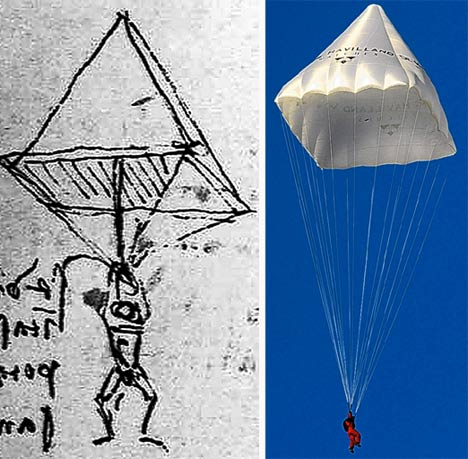
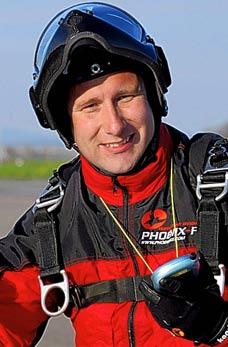
Used da Vinci’s parachute: Olivier Vietta-Teppa
“I came down smack in the middle of the tarmac at Payerne military airport. A perfect jump.” He admitted he had been wearing a modern reserve parachute in case da Vinci’s design – made out of four triangles of fabric and with a pointed top – had failed to open. Mr. Vietti-Teppa is the first person to have made it safely to the ground with the da Vinci model. In 2000, Briton Adrian Nicholas tried it but had to use a back-up parachute to complete his descent. Mr Vietti-Teppa’s parachute was made using modern fabric along lines imagined by da Vinci. The specifications were found in a manuscript dating from 1485.
The parachute consists of four equilateral triangles of fabric, seven yards on each side. The base of the pyramid is a square of mosquito net, which enables the parachute to open. A wooden frame originally conceived by da Vinci was not used. It has one drawback – it is impossible to manoeuvre. “You come down at the whim of the wind,” said Mr Vietti-Teppa.
 TIMnovate