Austerity is NOT the problem! It’s Zombie Banks!

By Shlomo  Maital

                 zombie

   At long last, we are beginning to understand what Europe’s real economic problem is.

  No, it’s NOT budget deficits and debt. And no, the ‘solution’ is NOT austerity (budget cutting, unemployment and massive suffering and social unrest).

   The problem is… Zombie Banks.  Banks that exist, but are zombies, because they do not do what banks are supposed to do – lend money.

   A zombie   (Haitian Creole: zonbi; North Mbundu: nzumbe) is “an animated corpse resurrected by mystical means, such as witchcraft. …a hypnotized person bereft of consciousness and self-awareness, yet ambulant and able to respond to surrounding stimuli.” 

   According to Stephen Fidler (Wall Street Journal, June 7-9, 2013, p. 4), “policy mistakes by European governments have stymied (bank) lending” …. “funds are being bottled up in Germany and other ‘safe’ economies….’what’s slowing down growth in Europe is a lack of credit’, according to Antonio Borges, a former European director of the IMF.”  In other words:  Zombie banks.

   Why aren’t European banks lending?  Because their balance sheets are stil riddled with unrealized huge losses, and the banks need the liquid cash much more than the loans, to spiff up their disastrous balance sheets.

   Why are European banks’ balance sheets so riddled with holes? Because the waffling European Central Bank hasn’t acted decisively to clean up the mess, buy up bad bank assets, write them off, and then move on. 

   In the U.S., notes Fidler, companies can raise funds in the capital market even if banks won’t lend to them.  But in Europe, this seems impossible.  The Europeans still don’t get it. And the economists are not helping at all.  In America, fully half of total financial assets belong to insurance companies and pension funds,  and these funds are accessible by companies directly.  It’s not the case in Europe.

   So, look for Europe to continue to stagnate, with high unemployment. According to wikipedia, “since the late 19th century, zombies have acquired notable popularity, especially in North American and European folklore.”    But zombie banks are definitely not popular.  Europe won’t recover until the zombies become living breathing normal human beings. 

No, You Can’t Patent What God Makes!

By Shlomo  Maital

                                                                            BRCA

   The Supreme Court has at long last corrected a terrible wrong.  According to the Los Angeles Times,   “The Supreme Court ruled that human genes are a product of nature and cannot be patented and held for profit, a decision that medical experts said will lead to more genetic testing for cancers and other diseases and to lower costs for patients.    In a unanimous ruling Thursday, the nine justices declared that human genes are not an invention, so they cannot be claimed as a type of private property.”

   A company called Myriad Genetics Inc. in Salt Lake City,   held patents on the BRCA1 and BRCA2 genes, related to breast cancer,  and hence had a monopoly on testing for the genes.  This enabled Myriad to charge thousands of dollars for these tests, making them inaccessible to women who could not afford it and hence endangering their lives. 

   The original patent was a travesty.  How in the world can you justify patenting something that God created, rather than humans?  Simply discovering something that God invented, rather than creating something new, should not ever have been patentable.  And the wrong that original patent did  cannot be fully righted, because we do not know how many woman died of breast cancer as a result of Myriad’s monopoly and price-gouging.   

   Hopefully, Angelina Joli’s courageous decision to undergo surgery, because of her family’s breast cancer history and because she has the offending genes, will heighten women’s awareness.  And even more hopefully, more women will now undergo gene testing, whose cost will fall drastically,  and enjoy longer better lives as a result. 

   Congratulations to Supreme Court Justice Clarence Thomas, writing for the court, who left little room for doubt about the justices’ view.  


“Myriad did not create anything,” he wrote. “To be sure, it found an important and useful gene, but separating that gene from its surrounding genetic material is not an act of invention.”

   Congratulations also to Dr. Harry Ostrer, now at Albert Einstein Medical Center, for being one of the plaintiffs.  

Mother Teresa on Wall St.

By Shlomo  Maital

                       Jason Trigg  Jason Trigg

   What are the odds you will find Mother Teresa on Wall St.?   Not too high?  Would you accept instead a young 25-year-old computer science graduate from MIT named Jason Trigg instead?   Here is what Dylan Thomas wrote about him, in the Washington Post (May 31):

   “Jason Trigg went into finance because he is after money — as much as he can earn.  The 25-year-old certainly had other career options. An MIT computer science graduate, he could be writing software for the next tech giant. Or he might have gone into academia in computing or applied math or even biology. He could literally be working to cure cancer.   Instead, he goes to work each morning for a high-frequency trading firm. It’s a hedge fund on steroids. He writes software that turns a lot of money into even more money. For his labors, he reaps an uptown salary — and over time his earning potential is unbounded. It’s all part of the plan. Why this compulsion? It’s not for fast cars or fancy houses. Trigg makes money just to give it away. His logic is simple: The more he makes, the more good he can do. He’s figured out just how to take measure of his contribution. His outlet of choice is the Against Malaria Foundation, considered one of the world’s most effective charities. It estimates that a $2,500 donation can save one life. A quantitative analyst at Trigg’s hedge fund can earn well more than $100,000 a year. By giving away half of a high finance salary, Trigg says, he can save many more lives than he could on an academic’s salary.”

  I think this is a great idea. But New York Times columnist David Brooks (Global NYT June 5) is doubtful.  “If you are thinking of following his example, I would really urge caution.”   Why???

    First:  “Every hour you spend with others, you become more like the people around you.”  In other words,  Trigg’s brain will become polluted by the money-grubbing it’s-all-about-me culture. 

     Second: “If you choose a profession that doesn’t arouse your everyday passion for the sake of serving, …you might become one of those people who loves humanity in general but not the particular humans immediately around.”

    Third: “I would worry about turning yourself into a means rather than an end.”

    I love David Brooks’ insight.  But in this case, I think he is horribly wrong.    What do YOU think, reader?

Three Day Startup!

By Shlomo  Maital

3ds cornell 3DS Cornell


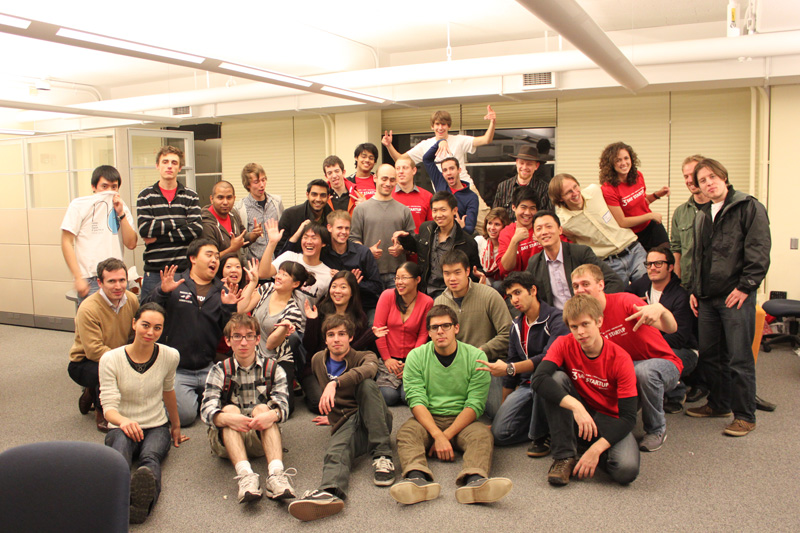
   This morning, at 8:30 a.m.,  we launch a 60-hour program here at my university, Technion, called 3DS  – Three Day Startup.    Headed by EE/CS  Professor Daniel Freedman,  the project chose 40 diverse students from over 100 applicants.  During the coming 72 hours, the students will each a) pitch an entrepreneurial idea,  b) choose about 7 or 8 of them for development, c) form into teams, and d) develop a winning business plan for each, collect market data and possibly even build a prototype.   On Friday afternoon, the student teams will pitch their idea to a group of venture capitalists.   They will be assisted by a team of experienced mentors.  [The photograph shows the 3DS group at Cornell University].

   “The 3DS program creates a living entrepreneurship laboratory on university campuses by bringing together students ranging from freshmen to freshly-minted PhDs, with diverse backgrounds, including computer science, business, engineering, law, design, communications and others. Participants gain experience in cross-disciplinary collaboration, brainstorming and ideation, and group productivity, including ad-hoc leadership and decision-making under severe time constraints. The resulting experience is just like that of working with a budding startup company.   Over the past four years, thirty-eight 3DS events on four continents have given rise to 28 companies receiving $8 million in funding. Thirteen companies from 3DS have been accepted to accelerators such as Y Combinator, TechStars, and 500 Startups.  3-Day Startup has a track record of success across the globe. The 2000+ 3DS alumni from 38 events over the last three years have started 28 technology companies that have collectively raised over $8 million in investment capital.”

3DS began in the entrepreneurial incubator at the University of Texas, Austin.

 Why not consider organizing and launching a 3DS event at YOUR university?  Check out   http://www.technion3ds.org   

 Engineers With Soul!

By Shlomo  Maital

                    Talesnick (right) and a student in the biogas generator pit with Namsaling villagers looking on     Mark Talesnick in Namsaling, Nepal


“Why,” asked Technion Civil Engineering Professor Mark Talesnick, “do rural schools in Nepal begin classes at 10:30?”

    “Because the kids don’t have alarm clocks?”   I answered, lamely.

   “Because,” he explained, “mothers and their children spend four hours, from 6 to 10 a.m. gathering wood for cooking and heating fires.”

   I spoke to Prof. Talesnick about Engineers Without Borders (EWB), a global organization whose Technion chapter he leads.    Talesnick holds the UNESCO chair for Sustainable Engineering in Developing Communities.  EWB is not connected with the similarly-named Doctors Without Borders.   Its mission is to join with local partners, mainly in developing communities, to implement sustainable engineering solutions, while widening the social conscience of its students and members, through low-budget high-impact projects.

     EWB forms bonds with the communities in which it works and makes sure it transfers its projects to locals before moving on.   It seeks to educate ‘engineers with souls’, ‘global engineers’, faculty and students,  who work to “develop sustainable appropriate engineering solutions to problems we have assessed in developing communities, solutions these communities can maintain, fix, sustain and reproduce.”

    Talesnick explains that “engineering schools worldwide emulate the lessons of schools in North America, where engineers are taught mainly how to build 80-story buildings and six-lane highways”.    “We are trying to create a new type of engineer at Technion – and it’s working,” he said.  “If we don’t change the way we teach engineering, the globe will collapse.”

     “My experience is that engineering curricula lack three crucial aspects,” Talesnick told me.  “First, social conscience.  I find that when social conscience is injected , students understand how their engineering tools can make positive impact.  Second,  at Technion, despite its being a technological institute, most electrical engineering students could not install a light switch, so “hands on” experience is imperative.  Third, I know this will sound corny, but I want my students to learn leadership skills.  Our curriculum produces technocrats;  I think that engineers and technologists should be shouldering as much of  the leadership in our society as do the lawyers, business people, ex-military personnel, and the new hit, journalists.   I have found that by introducing social conscience, giving the opportunity for hands-on work in real-life projects,  the outcome is leadership skills.  This is one part of my objective of introducing Engineers with Borders to the Technion.”

    The Technion EWB chapter has eight ongoing projects, including water and energy projects in Ethiopia and the Negev and a path-breaking one in Namsaling, Nepal.  Prof. Talesnick spoke about the latter, an “anaerobic digester”, or biogas generator,   with enormous passion.

     “Our partnership with the Nepali village of Namsaling (about 1,000 families) started in 2008.  The households have very limited financial resources.  Most of the families survive on limited agriculture,  most households will keep four or five large animals, yaks, cows, pigs or water buffalos.  Nepal finds itself literally between a rock (the Himalayas) and a hard place (India).  Namsaling and many other villages face the same challenges: Lack of clean water and sanitation due to animal and human waste running off into the water sources, resulting in health issues and digestive track disorders, and lack of affordable clean energy. A Nepali woman has a 30 times greater chance of contracting respiratory disease than a Western woman because of inhaling indoor cooking fire smoke.  Cooking, heating and lighting in so many rural Nepali households are achieved by cutting down trees and burning wood.  This creates a vicious circle – water has to be boiled to purify it, so more trees are cut down, burning more wood and creating more indoor smoke.  The question is, how can these problems be addressed together, within the capacity of the local communities?”

     The answer?  Biogas generators, which use bacteria,  water and animal manure or human waste in an oxygen-free environment to generate hydrogen, carbon monoxide and methane that can be used for cooking.   There are 200,000 such generators in Nepal.  But in a preliminary trip to Namsaling,  Technion students found that building them in villages was expensive and time-consuming. First, a pit is dug, filled with soil, then a dome is shaped over it, covered with concrete, and finally, the soil under the dome is removed.  Technion EWB students invented a way to build biogas generators faster and cheaper,  first using aluminum and Styrofoam (not readily available in Nepal),  then using locally-available bamboo fashioned into large pie-shaped sushi mats.  The team has built 60 biogas generators in Namsaling, and they hope to build 950.  Each one is a household unit, able to convert 40-50 kg.  (100 lbs.) of human and animal waste into 5-6 hours of cooking fuel daily.  Each of these units saves 12,000 kg. (25,200 lbs.) of wood per family a year.  That’s close to a dozen trees.

      The whole focus of EWB is to say, this is not about us (the visitors), it is solely about you, the village, the community, we have no political agenda, we simply want to help you help yourselves because it is the right thing to do and because we ourselves will learn and grow by doing so.

Dyslexia – It Has an Upside!

By Shlomo  Maital      

              dyslexia

    Over the years I’ve had many many students who are dyslexic.  Dyslexia is   “difficulty in learning to read fluently and with accurate comprehension”.  Since undergrad and graduate studies all require heavy reading, dyslexic students have a huge handicap, beginning with simply doing well enough in high school to get in to college.    Many of my dyslexic students developed their own methods and tricks for overcoming the handicap, and all had great determination to succeed despite the difficulty.   I’ve given many of them oral exams, for example. 

    Now, comes research showing that dyslexia may actually convey some advantages.  Writing in The New York Times, Feb. 4, 2012, “The upside of dyslexia”,  *    Anne Murphy Paul reports on research done by Gadi Geiger and Jerome Lettvin, cognitive scientists at MIT, who find that “people with dyslexia can rapidly take in a scene as a whole – absorbing the ‘visual gist’.”     Another scholar, Dr. Catya von Karolyi,  a psychologist at U. of Wisconsin, affirms that “dyslexia should not be characterized only by deficit but also by talent.”    

   Long ago, we knew that dyslexics populate fields like art and design in unusually high numbers.  Here are just a few of the artists who are and were dyslexic: Leonardo da Vinci, Ansel Adams, photographer, Tommy Hilfiger, clothing designer, Pablo Picasso, Robert Rauschenberg, Auguste Rodin, Andy Warhol.  Here are a few of the inventors who were dyslexic:  Alexander Graham Bell, Pierre Curie, Physicist (1903 Nobel Prize), Thomas Edison, Albert Einstein, Michael Faraday.

    I’ve found that creative people have unique ability to “zoom out”, to see the big picture; apparently this is a talent that dyslexics have in abundance.  

     Let’s be clear.  Difficulty with reading is a major challenge.  You can’t characterize dyslexia as a ‘gift’, that’s too glib and too patronizing.  But once you understand the true nature of dyslexia,  you can help orient dyslexics’ education in directions that build on their strengths.   And if you yourself are dyslexic, you can both overcome the reading disability and leverage the advantages that dyslexia seems to confer.   Edison and Einstein did.  And by the way, so did George Washington. 

The Financial Pandemic Has Finally Ended!

By Shlomo  Maital

    Banks  Bank Revenue/GDP (%)

  It took five financial crises,  endless bailouts using our tax money, media wars against lobbyists, and Occupy Wall St. protests – but at long last, the global banking and financial services industry has been gotten under control. The ‘pandemic’ of inflated bloated revenues, at our expense, seems to have ended permanently.  Thank heavens.

   An article in the latest McKinsey Quarterly  [Miklos Dietz, Philipp Harle and Tamas Nagy, “A new trend line for global banking”, McKinsey Quarterly May 2013] says that “after climbing for 30 years, the share of economic activity attributable to bank revenues fell in the wake of the global financial crisis. Looking forward, revenues oculd flatline at about 5 per cent of GDP through 2020 (the same growth rate as nominal GDP).”  (See Figure).

    Banks’ waistlines won’t grow, but they won’t shrink either – they’ll stay the same, after doubling as a proportion of GDP from 3 per cent to almost 6!  That’s good news.  It means that in order to compete  global banks will have to do what local Czech banks have been doing – innovate, give better service, listen to customers, and above all stop acting like drunken gamblers in derivative markets they don’t understand.  (See my previous blog). 

     I wonder, though, why it took us 30 years and five crises/panics to stop the pandemic. 

Would You Pay for the Gift of Helping People? Check out Africa Mercy

by Shlomo Maital

Mercy ShipsDr. Gary Parker, Nurse Alley Chendra & patient


 Some 35 years ago, a Texas entrepreneur and devoted Christian named Don Stephens and his wife Deyon had an idea. Let’s create hospital ships, he said, and sail them to West Africa, to treat illnesses there that go untreated, while in the West they’re cured in hours. Stephens was inspired by the international hospital ship S.S. Hope.

“Stephens’ research showed that 95 of the 100 largest cities in the world were port cities. Therefore, a hospital ship could deliver healthcare very efficiently to large numbers of people. The birth of Stephens’ profoundly disabled son, John Paul, also inspired him to move forward with his vision of a floating hospital. A visit with Mother Teresa in Calcutta, India, further deepened his commitment to serving the world’s neediest people.”

What emerged is a fleet of three hospital ships, including Africa Mercy, a 500 ft. ship with 8 decks and crew of 450, including 90 nurses, 15 surgeons and 8 operating rooms. Africa Mercy docks at ports in West Africa. In a recent 5 month period at port in Togo, 281 benign facial tumors were removed (causing terrible facial distortion, including ostracism, and often threatening death by strangulation), 34 cleft palates were repaired, and 794 blind people were given restored sight through cataract surgery.

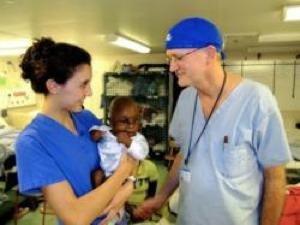
What is Stephens’ business model? Companies sponsor the ships, and people PAY to work on it, including nurses and doctors, in part by raising donations in their home communities in the U.S. Surgeon Gary Parker has served on the ship for 26 years! And is raising his two sons on it, together with his wife. Nurse Alley Chendra also met her husband on board (“we call it ‘The Love Boat’, she says).

I still find it angering and unacceptable, that a 30-minute routine operation to restore sight by removing cataracts and replacing foggy lenses with plastic ones, should be unavailable to many of the world’s poor. But unlike me, Don Stephens did something about it. He chose to act, rather than sink into despair over his son. Some of the pictures of the African children and adults, faced terribly distorted by benign massive tumors, are hard to look at. But African Mercy is doing something about it.

It was recently featured on a segment of the CBS TV program Sixty Minutes.

Why Governments (Us!) Pay Taxes to Global Corporations

By Shlomo  Maital      

     octopus                   Apple?

   Once, people and companies paid taxes to governments, to support worthy social investment.

  Today?   Governments pay taxes to corporations. The US government pays taxes, billions of dollars, to Apple.  How?  By allowing Apple to shelter its income in low-tax countries like Ireland, rather than pay taxes on its earnings, as it should, in America.   Senator Carl Levin said:   in 2012, Apple had exploited tax loopholes allowing it to avoid $9bn in US  taxes, or $25m per day, and said such practices did “real harm” to the US  economy. “You shifted the golden goose to Ireland.” 

   This has been going on for a very very long time.  Why have governments just now woke up to it?  Why is Apple’s CEO being called to testify in Congress now?  Because governments are strapped for cash and realize they are losing billions to the corporations.

    What is going on?  Simple.  Governments compete with one another to attract businesses. Ireland did this superbly well and built a strong economy on attracting US companies. To do this Ireland had to offer super low corporate taxes.   So, today, governments pay taxes to global corporations, rather than vice versa, because global corporations are able to play one government against another.

    Add to that creative accounting.  Starbucks makes huge profits in Britain, but pays almost no tax there, because the revenues are sheltered in low-tax countries.

    Note:  This is all legal!  It’s perfectly legal according to the law.  This is what Apple CEO Tim Cook shouted in Congress.

   The question you and I are asking is,   WHY is it legal?   Because it sure isn’t just that ordinary people pay stiff taxes but wealthy companies (and their wealthy shareholders) pay little or none. 

    Time for a change.  

Czech bank Modern Czech Bank

Stop the Next Financial Crisis – Check out the Czechs!
By Shlomo Maital

It is increasingly clear that both the United States (Wall St.) and Britain (London), two key financial centers, are fumbling the ball, in enacting new systems to regulate their banks and financial services providers. In both countries, the lobbyists, moneyed interests and scare tactics (‘over-regulate us and you’ll have to bail us out again’…) have emasculated planned stiff regulations.
That is why the experience of a small Central European country, Czech Republic, with 10 m. people, is so interesting and so relevant. I’m in Prague right now, to speak at a workshop on innovative thinking. Yesterday’s New York Times has a fine piece on Czech innovative thinking in banking. Here is the crux: Czech banks went into crisis a decade ago (before the global meltdown). The authorities learned their lesson and prevented a replay in 2008.
“The industry is in good shape; the sector is stable and has not needed any assistance in the recent crisis,” said Jiri Busek, an analyst with the Czech Banking Association. “It’s quite a unique position in Europe, and we are grateful for it. We are stable, healthy and profitable.” The sector went through a banking crisis in the late 1990s. Several banks failed, one major bank had to be acquired by a competitor and larger state-owned banks were privatized after bad loans were cleaned from their balance sheets. “We had this recent experience, and thus risk management here is very conservative, Mr. Busek said. The Czech National Bank is now mandated to supervise every player in the financial industry, whether investment brokers, insurance companies or banks. Yet, over all, the financial sector has kept growing: Year on year, lending was expanding at a 4.6 percent rate as of the end of March, up from 2.4 percent in 2012 and a low of 1.3 percent in 2009. “The sector is still attractive for newcomers,” Mr. Busek said. “After quite a few years of stagnation, several new banks opened in the last three years.
Listen to this account of an innovative new Czech Bank.
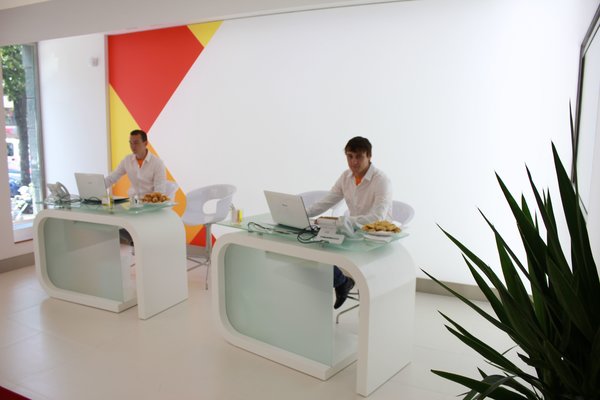
    Jakub Petrina, marketing director and a designer of Air Bank, part of PPF Group, an international financial investment company based in Prague, said the designers looked at the question of why people did not like banks and set out to create something that would be liked. “We went back to basics — listened to people and heard that bankers use complicated language, absurd fees, the terms and conditions are too long and complicated,” he said. “We realized it’s more complicated than it should be.” So Air Bank, which started in November 2011 and now has 125,000 customers, has a one-page price list and offers current and savings accounts with the same interest rate and no time restrictions or penalties related to withdrawals from the savings account. It provides simple personal loans, has a mobile app for iPhones and charges no fees for assistance — online, in a branch or by telephone. The philosophy of the bank is “let’s be as human as possible. Sometimes a banker seems like a different species,” Mr. Petrina said. “In our branches, the banker and customer sit next to each other and share a computer screen working together in the customer’s account.” “ We are after the big dinosaur corporate banks who’ve forgotten they are here to provide a service,” said Mr. Petrina, “We’re not worried about the other new banks. We have different models and strategy. It helps that there are more ‘new crazy bankers’ out there — makes people seriously rethink about their current bank.”

Heard of any similar innovations on Wall St.? London’s City? No? Banker and client sit next to each other and share a common computer screen??? How simple is that! Hmmmm… Have Wall St. and City bankers simply gone back to the bad old days? Perhaps we should send them all to Prague for six weeks… at their own expense. Compulsory.
* Lessons Learned, Czech Banks Thrive, By JACY MEYER. Global New York Times, May 21, 2013

Blog entries written by Prof. Shlomo Maital

Shlomo Maital

Pages