Economists are Loopy – And So Is the World!

By Shlomo  Maital    

                                                               Icf

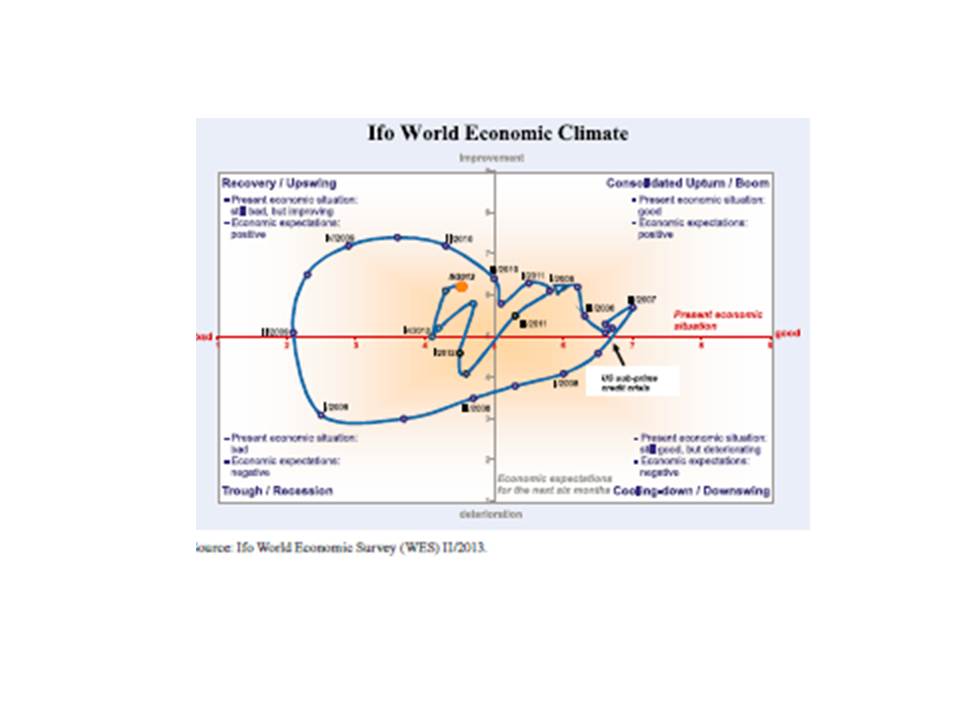
 I regularly respond to a questionnaire sent out by Ifo, a German think tank, in collaboration with the Paris-based Chamber of Commerce.  They sum up the results in an interesting diagram. (See above).  The x-axis represents the current economic situation.  The y-axis represents expectations for the next six months. 

     What we see is this:  a huge clockwise loop, The Great Recession, initiated by the US financial crisis;    then, a second smaller loop, beginning in the 2nd quarter of 2011.   (First, the economy sinks and so do expectations; then expectatoins improve, and finally the wave of optimism helps the current economy improve too).  We are now in a very weak recovery, stronger in the US than in Europe, and much stronger in Asia than anywhere. 

     What happened to create the second loop?  Why did we have a second, smaller repetition of the Great Recession?

    Because of us economists, and because of the financial markets.  Both preached austerity – budget cutting,  spending cuts, tax hikes, tightened belts.  This, at a time, when neither businesses nor consumers are spending, and exports are flat,  so if the government stops spending, there is no demand to support growth.  Bad idea.  

     Fortunately, in America, political gridlock between Republicans and Democrats prevented sharp budget cuts.  This is the main reason why the US economy is doing better than the EU.  It may not last.  The mandated ‘sequestration’ cuts are already being felt in the US. 

     It’s bad enough when the whole world does a terrible loop owing to economists’ preaching of unfettered free markets, turning loose Wall Street’s criminal speculative financial gambles.  It is  double insult when we REPEAT THE WHOLE THING again, albeit on a smaller scale, this time for a different reason – reckless austerity plans, rather than financial gambling.   By the way: prepare for a new loop — because Wall St. lobbyists have persuaded the US Commodities Exchange Commission to weaken stiff planned regulation of derivatives trading.  As a Silicon Valley prayer bumper sticker says,  “Oh Lord — give me one more bubble.”  They may get their wish.   

     I’m embarrassed to be an economist these days, even a retired one.  When asked my profession, I might just say, serial killer.  It’s roughly on a par.  

 Kill the Ump?  No – Just Fire Him!

By Shlomo  Maital   

    umpire

   “Kill the ump!   The ump is blind!  ….”     You hear these shouts often at baseball games.  As in football (soccer), decisions of umpires and referees are often blatantly wrong, revealed by slow-motion TV replays, yet UEFA refuses to succumb to technology (which, for instance, has hugely improved line calls in tennis), and so does baseball, mostly. 

    Solution?  A greatly underused principle of innovation:  Subtraction.  Bad umpires?  Get rid of umpires altogether.

    A graduate student at the southern U.S. university The Citadel suggested, two years ago, to his marketing professor Mike Veeck (grandson of legendary Bill Veeck, who owned the moribund St. Louis Browns), to get rid of umpires. Let fans call balls and strikes, with placards (“ball!”,  “strike”).  Let fans all “safe” or “out”.  Bill Veeck once had fans manage his team, while his manager sat in street clothes in a rocking chair atop the dugout.  The Browns, who were awful, won that day, 5-3!). 

    Mike Veeck owns the Gary Southshore Railcats baseball team, which plays in an independent league.  He tried his students’ idea and eliminated umpires altogether.  He had the catchers call balls and strikes.  He had Little League players form a jury, along the 1st and 3rd base lines, to call close plays as “safe” and “out”. 

   A small problem arose.  The Little Leaguers got bored and left after the sixth inning.   But overall, the experiment was a success.  And it happened in a week when Major League Baseball umpires made two huge mistakes. 

    Subtraction is a powerful tool for innovation.  Instead of adding stuff – get rid of stuff, especially stuff you think is absolutely essential.   Practice subtraction by removing an essential element from a familiar product (e.g. remove the wheels from cars), and then see what can be done with the result. 

     Umpireless baseball?  It works.  My version is professor-less college.  Get rid of the business school profs. Let the students teach each other. They’ll do it far better, and far more interesting.   Is anyone out there willing to try it?

  By the way, the late Bill Veeck (whose autobiography:  “Veeck, as in ‘Wreck’, is wonderfully entertaining) once had a dwarf, Eddie Gaedel, in his team’s lineup, and had him bat.  Gaedel was 3’ 7”  tall.  He walked on four consecutive pitches. The result was a rule change – you cannot play dwarfs in major league baseball anymore. 

Source:   “Safe or out?  Better let the crowd call it”.  Global New York Times, Sat-Sunday May 18-19, p. 13.  

 What, Are You Blind?  Actually – Yes!

By Shlomo  Maital   

                     charlotte brown    Charlotte Brown in action

  A pole vaulter sprints down the runway and misses the slot that anchors her pole prior to the vault.

  What, are you blind? says a track official curtly. 

  Yes, the pole vaulter answers.  I am.

   This never happened.  But it could have.  Blindness seems liks an insurmountable obstacle to sprinting down a runway, planting a pole in a precise spot, vaulting over a bar 12 to 15 feet high while turning your body 180 degrees with precise timing. 

    Charlotte Brown and Aria Ottmueller are several visually impaired – virtually blind.  Yet Brown has pole vaulted 11’  6” and hopes to break 12 feet soon.  She is a sophomore in high school, 15 years old.  She and Ann Ottmueller, who is 17, will compete in their state (Texas) track and field meets in the pole vault.

    There is no pole vault competition for the blind, even in the Paralympics.  But today athletes like Ottmueller and Brown are competing in mainstream events against able-bodied peers.   How do they do it?  According to Jere Longman, writing in the Global New York Times (May 11-12, p. 13),  “unable to rely on sight for vaulting, they have developed a mathematical compensation, counting their strides toward liftoff and trusting that the repetition of training will carry them safely over the bar.”

   “You can’t be afraid of what you can’t see,” Ottmueller said. “[In the air],  for a few seconds, nothing is wrong in the world, and nothing else matters,”  Brown said.

    Each of us builds our own obstacles, our own barriers, our own reasons why we cannot do something, and why we fail when we try.  These self-created obstacles are far higher, heavier and thicker than any the world itself creates.  From two blind pole vaulters, we learn that anything is possible, if you want it enough and if you believe enough.   

                                                     “The Only Thing That Stops a Bad Guy With A Gun…”

By Shlomo  Maital

             handgun

   Here is a “complete the sentence” IQ test.

   “The only thing that stops a bad guy with a gun is…”.

  What? 

   According to Wayne LaPierre, head of the powerful American National Rifle Association, the answer is:  “…a good guy with a gun.”  

    Since everyone is either a bad guy, or a good guy, in America, and since the bad guys mostly HAVE guns,  the solution, according to the NRA, is to give every good guy at least one gun,  preferably a semi-automatic with 100-bullet clips, so that you can mow down hundreds of bad guys at one time.

   But – is there any evidence supporting LaPierre?   Well, now.  Here is the evidence.  *    1.  “every time a gun in the home was used in self-defense or a legal shooting, there were four unintentional shootings, seven criminal assaults or homicides, and 11 attempted or completed suicides.”  Oops.   2.  “..a gun is 22 times more likely to be used in a criminal assault, an accidental death or injury, than it is for self-defense.”  Oops.  3. In 2010, 31,671 people were killed by guns in America, 73,505 were treated in emergency rooms for nonfatal gunshot wounds, and 337,960 nonfatal violent crimes were committed with guns.  Of the 31,671 dead, three of five were suicides, and the vast majority of the rest were homicides by people who knew each other.   No other Western democracy can come close to matching those 31,671 deaths by gunshots.

   So, how then SHOULD we complete the sentence above?  “The only thing that stops a bad guy with a gun is…preventing the bad guy from getting a gun in the first place, or taking it away from him or her when he or she gets one.” 

   Don’t confuse the NRA with evidence and facts.  All those facts come from Commie socialist left-wing traitorous scumbag liberals anyway. 

* Source:   Gun Science,  Scientific American, May 2013, p. 69.

 The Hunt for the Cause of Dementia: New Hope

By Shlomo  Maital

       prion           prions

  The latest issue of Scientific American (May 2013) describes vividly how scientists are on the trail to find the cause of Alzheimer’s and dementia, leading to hope for a cure.  We have known for years that Alzheimer’s is caused by clumps of proteins that lump together and destroy brain cells.  This has been known since 1906, when Alois Alzheimer identified the plaque linked to the disease.

         But why and how does this happen?

          A scientist, Stanley B. Prusiner, U. California San Francisco, found, in a series of brilliant experiments, what causes the brain to become like “Swiss cheese” in some diseases.   

      The culprit?  An innocuous protein, PrP, which when ‘misfolded’, causes other proteins to become mis-shaped, which in turn ‘infect’ other proteins, creating clumps that do great damage.  Prusiner called these protions ‘prions’ (proteinaceous infectious particles).  Of course, when he published his findings, scientists pooh-poohed them, doubting that a protein could act like a virus, infecting other proteins.  But in 1997 Prusiner won the Nobel Prize for his breakthrough.    

    Today we know prions cause “mad cow disease” (Creutzfeld-Jacob) and evidence grows that prions also cause Alzheimer’s and dementia.  Prions begin in one part of the brain, spread to other parts, eventually reaching the brain’s deepest reaches. 

     Now, what causes ‘prions’?   And is there a therapy that can halt their spread, or reverse it?   Some day, notes the Scientific American, “prion-like seeded protein aggregation may explain the origin of some of the most feared diseases of old age – and ..one day translate into treatments that alter the relentless progression of neurodegenerative illnesses”. 

   Let’s hope!

What We Learn from Sir Alex Ferguson

By Shlomo  Maital

Ferguson

Manchester United manager Sir Alex Ferguson has just announced his retirement, after 27 years at the helm of the great British football team.  Ferguson is 71.

   What can we learn from his career, and unparalleled success (48 titles, including 2 European championships, 13 British championships, 5 English cups, 4 English league cups, 3 Scottish championships, 4 Scottish cups, 1 Scottish league cup, …and more)?   

    What odds would you have given that the following manager would become the great football coach in history?

  *  He was born in poverty, son of a plasterer’s helper in the shipbuilding industry;

* as a player, he was unsuccessful,  signed by Rangers but dumped when he failed to mark Celtic captain Billy McNeill in the Cup final;

* he began to manage at age 32, at St. Mirren, who sacked him after four years because he ‘intimidated his office secretary’;  Ferguson had “no managerial ability”, said St. Mirren Chairman Willie Todd. 

      What I learn from Sir Alex is the enormous importance of two key qualities:  Fierce stubborn persistence, and the ability to learn continually, especially from failure.  His persistence, he may have gained from his lower-working-class Scottish origins.  According to Rob Hughes, Global New York Times soccer writer, perhaps the best of his kind, Sir Alex rebuilt Manchester United’s team five times, each time successfully, often building on local home-grown talent from the youth organization.  He could have moved on to another club. Instead he stayed and rebuilt.     

    I had the privilege of bringing a group of managers to Manchester United on a benchmarking trip.  We heard from the CEO, toured the amazing facility, and learned why Manchester United, together with Real Madrid, is valued at $3.1 b., with about $500 m. in annual revenues.   It is a superbly managed business, where everything runs like clockwork, and is owned by the Glazer family, Americans.  Unlike the Russian and Arabian oligarchs who own a third of the English Premier League clubs, the Glazers more or less keep their hands off ManU operations.   

     What I learn from Sir Alex is the life lesson of  simply not giving up,  facing reality, learning from failure and building it into success.  Ferguson had his eye on Dutch striker Robin Van Persie (Arsenal),  and lured him to ManUnited despite more lucrative offers. Von Persie’s goals brought ManU the league title this year.  (He scored three in the first half of the recent game against Aston Villa; the second goal was ‘the goal of the century’, a cannon-shot volley, according to Sir Alex). 

    Sir Alex teaches us, do what you love doing with passion and stubborn stick-to-it-iveness, pick yourself up after failure, be loyal,  always always learn,  and try again, and again, and again…and if you do it long enough, you too will be the greatest in the world at what you do, like Sir Alex.

Is Intel Making a Big Mistake?

By Shlomo  Maital   

                                                  Peres

Israel’s President Shimon Peres (left) with Intel Israel President Muli Eden and CEO Maxine Fassberg

    Israelis love Intel, for two major reasons.   One, its fab in the south of Israel is exceptionally efficient and generates billions of dollars in exports for Israel, as well as creating thousands of well-paying jobs; its R&D center in Haifa, near where I live, is a collection of exceptionally creative engineers.   Two, an Israeli, David (Dadi) Perlmutter, Intel’s Executive VP, is Israel’s most senior executive working for a large global company.  The Pentium and the Centrino were his idea.

    This is why I read with distress this morning’s Financial Times report, that 52-year-old Brian Krzanich was appointed  Intel’s next CEO, succeeding Paul Otellini.  Krzanich, an engineer, comes from the production side of Intel, rising through the ranks to manage a fab.   Otellini came from Marketing.

      Here is FT’s take on the appointment:  “His appointment will increase speculation that Intel could focus on growing this side of its business (manufacturing) to become more of a foundry for outside companies, given its lead in the miniaturization of chips….”

   A financial analyst commented:   “One of the things that Intel really needs to look at is how it can tie up with some of the key fabless chip suppliers, which are Arm-based companies like Apple and Qualcomm, in order to leverage its manufacturing strengths, even if it doesn’t get to leverage its processor design strength.”

   To me, this means Intel is giving up on innovation and focusing on its operational excellence.  I think this is a wrong decision.  History shows that those who make products – the middle of the value chain – lose profit margins to those who design the products, and those who market them.  Why else would Nike forego having its own factories, and invest solely in back-end and front-end activities? 

   Intel chips have lost the battle to ARM chips.  This doesn’t mean, however, that Intel has lost the war.  The hasty retreat is premature and does not do justice to Intel’s history of bold innovation and risk-taking.  

Teacher! Leave Them Kids Alone!

Are We Ruining Our Kids’ Imagination – in Kindergarten??!!

By Shlomo  Maital  

           kindergarten math

A Kindergarten Math Work Sheet

    My wife, a school psychologist specializing in early childhood, drew my attention to some disturbing research, that confirms my earlier blogs about the worrisome decline in creativity among children, due to rigid test-based schooling. 

     In their book  Crisis in the Kindergarten:  Why Children Need to Play in School, (Alliance for Childhood, College Park MD., 2009)  Edward Miller and Joan Almon report on research  argues that:

      “the traditional kindergarten classroom that most adults remember from childhood—with plenty of space and time for unstructured play and discovery, art and music, practicing social skills, and learning to enjoy learning—has largely disappeared. Among the findings of the latest research,  … is that, on a typical school day, kindergartners spend four to six times as much time in literacy and numeracy instruction and taking tests or preparing to take them (about two to three hours per day) as in free play or “choice time” (30 minutes or less).

     What are the poor kids doing?  Filling out work sheets like the one shown above (“counting backward”).   No Child Left Behind has now polluted our kindergartens, after ruining elementary and secondary schools with its ‘study-to-take-tests’ approach.

     Why is this happening?  Well, of course, because kids who start learning stuff early do better later, right?

      Wrong!

“Most troubling in this hijacking of kindergarten is that there is no evidence that a heavy emphasis on teacher-led instruction and scripted curricula yields long-term benefits for children. In particular, low-income children who need support to succeed in school are not showing significant long-term gains.”

    There is no benefit from eliminating unstructured play in kindergartens. But there is huge damage.   Take away kids’ unstructured play and you remove their daily opportunities to dream, to imagine, to play-act, and in general, to create worls where anything is possible.  This is proven.

     It’s bad enough when we do this in elementary school.  But in kindergarten???? In a society that pays lip service to innovation, why are we ruining our kids’ imaginations, at the age when creativity is at its peak? 

   The above research is about American kindergartens; but I have a hunch the trend is spreading elsewhere, too.  In Asia, where competition to get in to elite colleges is fierce, I understand that preparations for this can begin as early as kindergarten. 

     Let’s recall Pink Floyd’s song The Wall: “Teacher leave them kids alone. Hey! Teacher! Leave them kids alone!”    It starts in kindergarten.

     If you have small children or grandchildren in kindergarten, hang around some time and see what they do.  Check out whether your kids are allowed to be kids, or whether they become miniature college students.  You do have the choice – you can pick nurseries and kindergartens that get it.  It’s your responsibility. 


Economists Finally See The Light!

By Shlomo  Maital

                 pleasure         

  With my new Ph.D. in Economics, in 1967,  I quickly knew I was in the wrong discipline.  My wife, a psychologist, helped me see that the basic assumptions economists made about human beings were ridiculous.  As Nobel Laureate Daniel McFadden summarized them:  “sovereign in tastes, steely-eyed and point-on in perception of risk, and relentless in maximization of happiness.”   I also knew WHY economists assumed a world that did not exist. Without these assumptions, they could not build mathematical theorems about behavior.  So the tail of math wagged the dog of reality.  With my wife, I did some research applying psychology to economics, 41 years ago, in 1972, long before behavioral economics became fashionable (it was published only in 1978)*  I also wrote a book on the subject, in 1982,  but 31 years ago,  no-one was interested. **

    Today one can say that the mainstream of economics is behavioral.  In a new paper by McFadden***,   “he outlines a “new science of pleasure”, in which he argues that economics should draw much more heavily on fields such as psychology, neuroscience and anthropology. He wants economists to accept that evidence from other disciplines does not just explain those bits of behavior that do not fit the standard models. Rather, what economists consider anomalous is the norm. Homo economicus, not his fallible counterpart, is the oddity. “  (Source: The Economist, April 27, 2013).     

      Almost none of the models and assumptions of conventional economics hold water in the face of behavioral research. For example: in microeconomics, more choice is always better than (or at least as good as) less choice.   As The Economist notes:    “Economists tend to think that more choice is good. Yet people with many options sometimes fail to make any choice at all: think of workers who prefer their employers to put them by “default” into pension plans at preset contribution rates. Explicitly modeling the process of making a choice might prompt economists to take a more ambiguous view of an abundance of choices. It might also make them more skeptical of “revealed preference”, the idea that a person’s valuation of different options can be deduced from his actions. This is undoubtedly messier than standard economics. So is real life.” 

     And if conventional microeconomics, macroeconomics is completely out to lunch.  Chief IMF economist Olivier Blanchard recently described macroeconomics as a “cat in a tree” – treed by the global financial crisis, unable to say decisively whether austerity (budget cutting) is good or bad or indifferent. 

     The behavioral revolution in economics came a bit too late.  If it had come a decade earlier, if it had focused on key variables like trust and risk perception, perhaps economics could have helped forestall the global financial collapse in 2008, rather than contribute to it.    

*  Sharone Maital and Shlomo Maital, “Time preference, delay of      gratification  and the  intergenerational transmission of economic       inequality”.  In Orley Ashenfelter and Wallace Oates, editors, Essays  in Labor Market Analysis, (Halsted Press/John Wiley & Sons, New York:  1978, 179-199).

**  Shlomo Maital, Minds, Markets and Money:  Psychological Foundations of Economic Behavior, Basic Books:  New York, 1982, x + 310 pages.  (hardcover and paperback).

*** * D. McFadden “The New Science of Pleasure”, NBER Working Paper No. 18687, February 2013

Trying to Understand the Tsarnaev Bombers

By Shlomo  Maital   

         Shlomo Maital Boston Marathon

   I crossed the finish line at the Boston Marathon on Monday April 16, 2007, five hours after the starting pistol sounded.  My wife and son were waiting for me; the Boston crowds cheered and encouraged me and all the runners, hours after most of the other runners had finished.  It was an incredible experience, unforgettable, and it was denied to all those last April 15 who finished more than four hours after the start.  Three lost their life, including an eight-year-old boy, Martin Richard, from Dorchester; and dozens were injured, some seriously.    This is why I took the bombing very personally.  What causes two people like the Tsarnaev brothers to inflict death and injury, on innocent bystanders, randomly?    Media coverage shed no light on the matter; it was worse than uninformative.   But here is what I have managed to learn:

  What is the link between the Tsarnaev brothers and Chechnya?

     The latest issue of The Economist has the first enlightening piece on the subject.  Here is a brief summary:     “Struggling to integrate in America (“I don’t have a single American friend,” Tamerlan, the older brother, once said), the Tsarnaev boys sought mental refuge in their native land. The internet and social networks that served as a channel created an illusion of engagement without experience or memory. The brothers never fought in the Chechen wars or lived in Chechnya for any length of time. Yet their lives and their sensibilities seem to have collided with its violent and tragic history.  …. After the mass deportation of Chechens by Stalin in 1944, the Tsarnaev family landed in Kyrgyzstan, where the boys later grew up. Their grievances were stirred by separatists who declared Chechnya’s independence after the end of the Soviet Union in 1991. When Russia launched a “small victorious war” against Chechnya in 1994, nationalism was the main cause. By the end of the first war, 50,000 were dead, Chechnya was in ruins—and nationalism had been superseded by Islam.”. 

  What motivated them? 

     Washington Post: “The 19-year-old suspect in the Boston Marathon bombings has told interrogators that the American wars in Iraq and Afghanistan motivated him and his brother to carry out the attack, according to U.S. officials familiar with the interviews. … The officials, who spoke on condition of anonymity to describe an ongoing investigation, said Dzhokhar and his older brother, Tamerlan Tsarnaev, who was killed by police as the two attempted to avoid capture, do not appear to have been directed by a foreign terrorist organization. Rather, the officials said, the evidence so far suggests they were ‘self-radicalized’ through Internet sites and U.S. actions in the Muslim world. Dzhokhar Tsarnaev has specifically cited the U.S. war in Iraq, which ended in December 2011 with the removal of the last American forces, and the war in Afghanistan, where President Obama plans to end combat operations by the end of 2014.”

   Where did they learn to build the bombs?

     NBC News: “The surviving suspect in the Boston Marathon attack has told investigators that he and his brother got instructions on building bombs from an online magazine published by al Qaeda, federal law enforcement officials told NBC News. Dzhokhar Tsarnaev told investigators that the brothers read the instructions in Inspire, an online, English-language magazine that terror monitoring groups say al Qaeda began publishing in 2010. The magazine has twice included articles on building bombs with kitchen pressure cookers — the method investigators say Tsarnaev and his brother, Tamerlan, used in the Boston attack.”

   Where did they get the explosives?

    Slate magazine:   “Tamerlan Tsarnaev, the elder brother suspected in the Boston Marathon bombings, bought two large pyrotechnic devices in February from a New Hampshire branch of a national fireworks chain, according to executives at the chain’s parent company. William Weimer, a vice president of Phantom Fireworks, said the elder Mr. Tsarnaev on Feb. 6 purchased two “Lock and Load” reloadable mortar kits at the company’s Seabrook, N.H. store, just over the border from Massachusetts. Each kit contains a tube and 24 shells, he said. Mr. Tsarnaev paid cash for the kits, which cost $199.99 apiece.”

       Conclusions:  Social networks are not a good substitute for friendship and social contacts.  America offers immigrants endless material benefits and education, but its individualistic society may leave many alienated.  It is exceptionally easy to learn how to kill people and make bombs and acquire the explosives to do so.   

    I realize this sounds incredibly naïve – but if you know people who are lonely, friendless, down in the dumps…  reach out to them.  The CIA apparently has a database with 500,000 (half a million!) names in it, all ‘suspicious people’, including the Tsarnaev’s.  (When Tamerlan flew to Moscow, Aeroflot misspelled his name in English, so the CIA computers were never alerted).   What are the odds that they can all be tracked?   If you want to do something in the face of attacks like that at the Boston Marathon, the only thing I can think of is to seek out the people who potentially may want to harm others and offer them friendship and hope and understanding.  You may be a lot more effective than the CIA or FBI. 
  

Blog entries written by Prof. Shlomo Maital

Shlomo Maital

Pages