What the Praying Mantis Teaches Us (Apart from Humility)

By Shlomo  Maital   

 praying mantis2

    The praying mantis is an incredible insect, able to snatch flies and mosquitos out of the air. Like a sophisticated anti-missile rocket, it uses its superb vision like radar to locate its prey, then leaps to intercept it with stunning accuracy.  It turns out that humans can learn a lot from the praying mantis, and from the owl, chameleon, and the pigeon, beyond just humility (all those creatures, with tiny brains, see far far better than we humans do). 

    Caltech Jet Propulsion Laboratory expert Yoseph Bar-Cohen said, at a 2005 conference, “After billions of years of evolution, Nature has learned what works and what would last.”  Survival of the fittest has given praying mantises superb vision so they can snatch flies and mosquitoes out of the air; otherwise, they starve.  Natural selection has given similarly sharp eyes to chameleons, owls and pigeons.  

   Learning from Nature is a large and growing field called “biomimetics”, which means imitating Nature.   Need tough cable?  You could use steel threads. But it is far better to use spider silk, which has tensile strength twice as high as steel.  

   The most famous biomimetic invention is Velcro.  In the late 1940s,  a Swiss engineer, George de Mestral, took his dog for a walk.  As happens to many of us dog lovers, he noticed cockleburs sticking to his dog’s fur.  He analyzed the  tiny hooks that stick the seed-bearing burs to the dog’s coat and by 1955 had patented Velcro, a fastener with hooks on one side and soft loops on the other. 

    I visited Technion Computer Science Prof. Ehud Rivlin’s machine vision lab, where praying mantises, owls, pigeons, and chameleons are studied to learn the secrets of their keen vision.  Prof. Rivlin is an expert on robotic machine vision.   Helping robots see better, it turns out, is a key part of improving how they function.   Over 20 years ago,  Rivlin embarked on a risky and challenging research project, to better understand vision by studying creatures who see far better than humans.   His quest brought him to study birds, insects and lizards. His goal: Make robots that can see much better.  And he and his collaborators have succeeded.  They have quantified the praying mantis’ method for tracking prey mathematically, built a compute algorithm based on it and then created a praying mantis head ‘camera’ that replicates how the mantis sees.

    How does the mantis do it?  Why is the praying mantis so good at catching its prey? In a 2003 paper Rivlin and his student Igor Katsman (who is now launching a startup) found that it likes to move its head from side to side (a technique known as ‘peering’, also giving it its name, because peering resembles praying). This creates “motion parallax”,  a way to judge depth by the intersection of two different sight lines. 

  Two decades ago, Prof. Rivlin undertook a highly risky research program, linking computer science with biology, driven by, as he told me, three things: curiosity, desire to change the world, and the drive to show ‘feasibility’ (insect vision can be incorporated in robots).  I hope Rivlin’s story will inspire young researchers to undertake similarly risky interdisciplinary studies. 

 The Future of the Internet (Web 3.0): Things Talk to Things

By Shlomo  Maital  

Internet of things 


 World Wide Web 1.0 brought us information through browsing for web pages.  Web 2.0 brought us heightened social interaction, through social media and buying and selling.  Web 3.0 will bring us something new – things talk to things.  The potential for innovators is huge.

   According to Nick Valery, writing in The Economist’s World in 2013, the number of identifiable things linked to one another through the Internet (NOT phones or PC’s or laptops)  will exeed one billion.  The number of connected devices INCLUDING PC’s phones, vending machines, fridges and electricity meters will exceed 14 billion, two for every living person.  And by 2020, some 27 billion unique objects will be connected.  They will then double every 5 years, reaching  a 14% constant annual growth rate.

    This creates an entirely new world, one in which inanimate devices suddenly are animate, in that they can communicate with other devices.  The possibilities are endless.  Write down a list of devices that we now use everyday.   Write the same list next to it.  Now randomly draw lines connecting a device on the right hand side to a device on the left hand side.  What will this connection mean? How can it create value?

  • ·          What if a car can communicate with another car?  We get driverless cars and accident prevention.
  • ·         What if a fridge can communicate with a store computer?  We get automatic shopping.
  • ·         What if an airplane engine can communicate with a Rolls Royce central computer?  We get a system that warns planes in flights of potential failure even before it happens.  This already exists and has existed for some time.

As always, science fiction is way ahead of us.  SF has envisaged such a world, and created scenarios in which things take over humanity.  It may not be so far-fetched.  Can we see an army of robotic vacuum cleaners taking over the world from polluting humans, and cleaning up the world ferociously?  Can we see an army of robotic Coke machines taking over the world and cloning humans who live solely on sugary Coca Cola? 

    I invite innovators to turn their imaginations loose on the Internet of Things.         

 How Science & Creativity Kills Cancer Cells

By Shlomo  Maital  

limpet mine      


A Limpet Mine

   In a recent blog (Nov. 26) I described the remarkable creativity of MIT Institute Professor Robert Langer and his Langer Lab, which has spun off countless inventions, especially regarding ways to deliver pharmaceutical drugs more effectively to combat disease.

     In The Economist’s The World in 2013 Langer and a co-author describe a remarkable breakthrough in drug delivery and anti-cancer treatment, using nanotechnology.  A startup called BIND Biosciences, founded by Langer and Harvard Pro. Omid Farokhzad, works the following magic: 

   An anti-cancer drug is placed in a tiny sphere 100 nanometers in diameter, with a coating that makes the immunological system ignore it (otherwise white cells would destroy it).  On this coating itself are “homing molecules” that attach themselves to proteins produced by cancer molecules, but not to healthy tissue.  BIND-014 spheres circulate until they find a tumor. Then they stick themselves to it and release their paylod of anti-cancer medicine.  The result is far more effective than concentional chemotherapy, which introduces toxic medicine into the body that damages healthy cells as well as cancer cells.

    The technology is not unlike that of WWII limpet mines. Naval commandos would carry these mines to enemy ships and then stick the mines to the ship beneath the water line.  The resulting explosion sank the ship.  The photograph shows such a limpet mine, as it would be carried by a naval commando (who probably did not wear a tie).

   Arthur Clarke said truly advanced technology is indistinguishable from magic. Here is another piece of magic described by Langer.  A ‘micro-rocket’ containing anti-cancer drugs rockets through the blood stream, propelled by hydrogen (the zinc inside it combines with acid in the body to create zinc chloride and hydrogen gas). It travels at 0.3 meters per hour, and keeps moving until it finds the rare circulatory cells that cause cancer to spread.  The micro-rocket then kills the cells with its payload, much like an Iron Dome rocket meets and destroys an incoming enemy rocket.  Langer sais that these micro-rockets could be guided magnetically to specific sites where cancer tumors exist.   

Both these incredible ideas sound plausible, but both are exceedingly difficult to implement.  And Langer explains them using Isaac Asimov’s famous “Fantastic Voyage” concept, of a miniaturized submarine inserted into the body to heal an ill person.  Sooner or later, the best science fiction becomes fact, thanks to innovators like Langer.

 Take Five:  Bye, Dave, and Thanks!

By Shlomo  Maital   

 Take Five


   Jazz great Dave Brubeck died Wednesday in Norwalk, CT. He was 91.   His 1959 recording of Take Five was the first jazz single to sell a million copies.

  I think we can learn a lot from Dave Brubeck’s life and work.   He exemplifies what I call the Zoom Out/Zoom In approach to creativity.  Zoom out:  Scan the world for neat ideas.  (“Steal like an artist”, it is said. Or at least borrow, because you cannot steal what is given away).   Zoom in: Adapt what you borrow, to your own endeavor. On a State Dept. sponsored visit to Turkey, Brubeck heard street musicians playing a folk tune in 9/8 time. That is, 9 eighth-note beats to a bar. Pum-pum-pum-pum,  pum-pum-pum-pum (that’s eight, so far so good) and then..one more. Pum. And then do it again.  He asked himself, hey, why always play 4/4 time (one/two/three/four, the foxtrot rhythm)? Why not 5/4?  Or 7/4?  The result was Take Five.  After Turkey, he zoomed in on his own music and with his quartet, created new rhythms.   Take Five album also has a piece in 7/4 time:  one fox trot bar, followed by a waltz bar (3/4), and then, repeat… haunting.   

    Brubeck also proves the adage that innovation is intelligently breaking the rules – smashing them, ONLY after you have first learned them. Brubeck went to Mills College where he studied with the great French composer  Darius Milhaud.  Milhaud taught Brubeck how to compose fugues.  His first compositions were canons.  The impact on Brubeck’s jazz compositions was powerful. Brubeck knew the rules of classical music, and hence knew just how to break them with creative effect. (He named his child Darius after Milhaud). 

    Brubeck also knew the value of teamwork.  His alto sax player Paul Desmond was a perfect complement and foil to Brubeck’s piano. Desmond had an ethereal floating sweet tone (his sax dominates the Take Five recording, with Brubeck playing the haunting 5/4 rhythm in the background). 

     Paul Desmond died prematurely, in 1977.   He left the rights to royalties for performances and compositions, including “Take Five”, to the American Red Cross, which gets   approximately $100,000 per year.

   Bye, Dave.  Thanks for your creativity.  We still hear Take Five played on the radio all the time (it was the theme of the NBC “Today” show for years) and we never tire of it.

 More Dads are Moms: How Mattel Adapted

By Shlomo  Maital

 Barbie Engineer

   More and more dads are moms, these days, in America. According to Stephanie Clifford, NYT (“Barbie goes into construction”, Dec. 5),  of all American men with working wives and preschool children, one in five is the primary caretaker (the ‘mom’).  And in 2011, three women in every eight who work earned more than their spouses do.  This is up substantially from a decade ago.  (This is according to US Census 2010 data.)

   What does this mean for businesses?  For  Mattel, which makes Barbie dolls.  Mattel has shown remarkable agility in reinventing its amazing Barbie brand again and again, over the years. And it’s done it again.  Its international sales rose 12 per cent last year, comprising half its revenue. 

    Mattel saw early that men are increasingly making the buying decisions for families.  Result:  Mega Bloks, and Barbie set, a joint effort between Mattel and Mega Bloks, to create a construction set for Barbie dolls.  “The construction category is something Dad grew up with and has strong feelings and emotions about, says the chief innovation officer (!) of Mega Brands, Mega Bloks’ parent firm.  Mega Bloks building pieces are Barbie pink (Pantone 219), and with them you can build a fashion boutique, a mansion and an ice cream cart. Each set has a small Barbie figure than can be snapped into each scene.  Here is the Mega Bloks ‘pitch’:  “Design a dream-house-come-true with the Mega Bloks Barbie Build ‘n Style Luxury Mansion. Decorate eight interchangeable rooms that can be built any way you want! Barbie can build a bedroom with a beautiful canopy bed, a fun living room where Barbie and friends can relax or a bathroom with a “bubbly” tub! – It’s totally up to you! Take the working elevator all the way to the top floor for a super fun party with Mini-Fashion Figures Barbie, Teresa and all their friends!”

   Barbie has also introduced a computer-engineer Barbie, supported by the Society of women Engineers.  

   “More than ever,” says Stephanie Cota, VP marketing for Barbie, “more than ever, girls are looking at what’s fun, what they like,” rather than at what they are supposed to like, as girls. 

   Mattel is not the only toy company that spotted the dads-are-moms trend. So did Lego. They introduced Friends, a construction set for girls.  Of course, they drew fire for being sexist. But Lego sold twice as many kits as they had expected.  And they have become among the hot Christmas shopping toys, according to Amazon.

 10 Myths You May Believe About Creativity

By Shlomo  Maital

creativity-cartoon  

   I have been writing a book, with a co-author, on creativity.  The current chapter I am writing focuses on “research findings that ordinary people can use, in order to come up with more, and better, creative ideas”.  

   Here are 10 myths that many people believe about creativity, along with a few sources debunking them.

  1. Creativity is hereditary, in our genes.  David Shenk, The Genius In All of Us, shows overwhelming evidence this is not true.  The true formula is GxE, genes x environment, and our environment helps turn on or off genes; build a stimulating environment and then, turn your creativity genes loose. See also Ethan Watters, “DNA is not Destiny”, Discover Web Site, Nov 22 2006.
  2. When you lose your creativity, it is gone forever.    Neuroscientists have shown the brain possesses  “neuroplasticity”, the ability to change and improve its capabilities.  At the famous Arrowsmith School in Toronto, Barbara Arrowsmith teaches learning disabled kids to do strenuous mental activities that enhance their mental functioning.  There are creativity exercises that will immensely improve your creativity. (To be given in our book).   See Sharon Begley’s book, Train Your Mind, Change Your Brain.
  3. Creativity thrives best in open, free, chaotic unstructured environments.  Over 50 years of research on CPS, Creative Problem Solving,  provide structured processes for creativity. The need for an explicit structured process was known as early as 1942. See Isaksen and Treffinger, J. of Creative Behavior, 2004.  Many of the structured formulas or processes are very similar.
  4. Creativity is always thinking “out of the box”.  Often, it is the boxes that stimulate creativity – lack of money, lack of people, lack of time.  Tight constraints lead to creative thinking.  The point is, there are always boxes – reject the useless ones, keep the necessary or binding ones. 
  5. Creativity defines steeply with age.  I just turned 70. I feel I am more creative than ever, because I know more, know myself better, and am more stubborn in persisting to work on hard problems.  Older people are not less creative, they are simply warehoused and marginalized so that they have fewer opportunities to USE their creativity. 
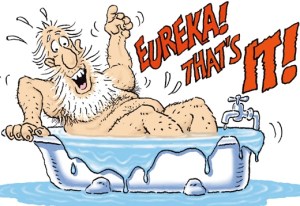
  6. Creativity is about inspired “eureka” moments. “Eureka” is Greek, and is said to have been uttered by Archimedes, “I have found it!”.   We all have moments of inspired insight. But in general, they are generated by deep persistent focused thought about a problem, mostly by our unconscious, and emerge after days weeks or months of work on a problem.  Without that long incubation, there would be no ‘eureka’ moments. 
  7. Creativity is a team sport, not an individual one.  Actually, ideas are born in single brains. (True, sometimes, the same idea occurs to several individual brains at the same time).    They become innovations in teams.  Find ways to listen carefully to individual ideas, before they drown in the pressure and noise of teamwork.
  8. Creative ideas emerge from brainstorming.  “Experimental research indicates that people in face-to-face brainstorming meetings are less efficient at generating ideas than when working alone”.  Sutton & Hargadon, “Brainstorming Groups in Context”, Administrative Science Quarterly, 41 (1996).
  9. Creativity cannot be effectively managed.  False.  There are proven systems for ‘harvesting’ ideas and implementing them.  For example: Find creative people, give them very very difficult problems, leave them alone, return in a set defined period of time and harvest the solutions.  Often, they are amazing.
  10.   Creativity flourishes under pressure.  In Tom Wujec’s ‘marshmallow’ exercise, teams build structures out of string, tape, spaghetti sticks and a marshmallow that sits on top, in 18 minutes.  When he offered teams $10,000 in software as a first prize, not one single team succeeded in designing a standing structure!  An atmosphere of fun, laughter and trial-and-error experimenting is far more productive and conducive to creativity than an obsessive tyrannical goal-driven manager. 

 European Disunion (ED)

By Shlomo  Maital  


 cat vs mouse


Northern vs. Southern Europe

European Union? Alas, it has become the ED European Disunion.  Don’t believe just me.  Here is what Clyde Prestowitz, Foreign Policy blogger and former chief trade negotiator for Ronald Reagan, observes:

I was wrong, and I have come to realize that my dream of a united Europe a la  the United States, is not the European dream. Indeed, with great disappointment I have at last concluded that there is no European dream because a las those whom we on the outside call Europeans are not and don’t want to be Europeans.

  What is going?  According to Prestowitz:

I spent part of last weekend with a group of leading intellectuals from various European countries. The Germans were firm in their conviction that the primary cause of the EU crisis is the laziness, profligacy, free rider attitude, and mendacity of the so called Peripheral Countries ( Spain, Portugal, Ireland, Italy, Greece, and even maybe France), especially Greece, Portugal, and Spain. They emphasized that Germans believe in paying their way, in spending prudently, saving, investing, producing, and maintaining sound money and strong currencies. They attributed Germany’s economic success of the past decade wholly to the dedicated pursuit of these virtues. Conversely the problems of the others were blamed largely on their failure adequately to observe the German virtues. Did they realize that Spain’s government budget deficit and debt as a percent of GDP had been less than Germany’s? Yes, in some cerebral way in their heads they did, but not in their gut. Did they realize that the German banks had been major lenders to and facilitators of the peripheral real estate bubbles whose collapse precipitated the crisis? Again, yes, but only in a kind of theoretical way. There was clearly no conviction that that was a primary cause of the problem or that keeping the German banks whole might have been an on-going drag on the recovery of the peripheral countries. Was there any understanding that for Germany the Euro is actually undervalued (compared to what a free standing Deutsch Mark would be valued at) and that much of Germany’s export success is due to that? Absolutely not. No, Germany’s success was seen as entirely due to hard work and financial virtue.

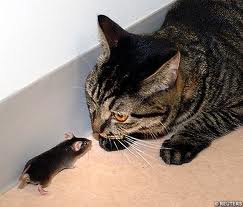
  The Northern European cats are treating the Southern European laggards as mice.  Not how a true Union should work.  The solution of the Northern Europeans to Europe’s problems is simple. More austerity for the bums in Southern Europe.

   My companions saw the solution very much in terms of continued enforcement of strict austerity and achievement by the peripheral countries of fiscal and trade surpluses by dint of reducing wages, employment, and costs. None of them were interested in achieving a European banking union or any other kind of arrangement that would result in German money being used to support Europe-wide obligations.

    I’m afraid it is time to write off the European Union.  No, the euro itself will survive, although in a slimmer form, as some of the 17 euro nations depart.  And many believe the UK itself will leave the EU in a couple of years.   But European Union?  A great opportunity has been lost.  A grand experiment has failed.  The world as a whole will lose greatly. 

 The Travesty of American College Football

By Shlomo  Maital

 Alabama


  Once, American colleges had football teams.  Today, American college football teams have, alas, attached colleges. And as always, it is all about money.

    A New York Times article on Nov. 28, by Jere Longman, reports, for example, about the Univ. of Tennessee, a great university, firing its football coach:

   After Tennessee fired its coach last week, the university’s chancellor said the athletic department would forgo $18 million in contributions it was to make to the university over the next three years for academic scholarships and fellowship programs. Instead, some of the money will be used to pay the severance packages of the coach, Derek Dooley, who is owed $5 million, and his staff, which is owed a reported $4 million if it is not retained. Dooley had four years remaining on his contract.

  Last Sunday Auburn Univ. fired its coach, paying him and his staff $11 m. in buyouts.  According to Longman, “The University of Houston forced its offensive coordinator to resign after one game. After two games, Wisconsin dumped its offensive line coach. “  The cost of buying out contracts is huge.  And all this, with no evidence that firing the coach brings better results.

Over the past decade, about 1 in 10 universities at the major college level replaced their head football coaches annually for performance-related reasons. But a recent study suggests that replacements do not tend to make underperforming teams much better in subsequent seasons and frequently make them worse.

    What is going on?   Huge billion-dollar TV contracts have made American college football a big business.  But those contracts depend on winning.  Moreover, alums give more money if their college’s football team brings them pride by winning. 

    Universities view football as a kind of front porch to their campuses, drawing attention in a way that no other endeavor can. Administrators are increasingly reliant on football to support other sports and try to spur donations at a time when the vast majority of universities lose money on athletics. Desperation to win has increased as universities chase the payouts from billion-dollar television contracts.

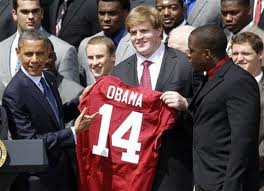
   Salaries for football head coaches have soared.  As Longman notes,  “Some football coaches have become the highest-paid employees of their states. The average salary for a head coach at a big-time university is $1.64 million, an increase of more than 70 percent since 2006, according to an analysis by USA Today.”   In search of a national title, University of Alabama hired Nick Saban, at a salary exceeding $5 m. a year!  

    At some point, this travesty will have to end.  Courageous college presidents will have to regain control of the football monster.      

 Happy Countries – and Unhappy Ones

By Shlomo  Maital


 A new study led by Jeffrey Sachs, called the World Happiness Report, based on a global Gallup survey, ranks countries according to self-evaluated happiness.  Here are the answers to the question,  how happy are countries and what underlies their happiness (or unhappiness)?

  * The happinest nations are, predictably, the Scandinavian countries Denmark, Finland and Norway, together with Netherlands and Canada.  All have high standards of living, and very very strong social safety nets, providing security and peace of mind to their citizens.  They also are in “good neighborhoods”, without border conflicts.

* United States, despite political gridlock, economic stagnation, and the housing bubble, ranks high (11th).  Americans are in general happy, despite the economy.

* Israel, despite wars, conflicts, threats, Iran and the bomb, ranks quite high, 14th, just behind the U.S., Costa Rica and Austria.  In general, Israelis are buoyant and contented. 

* Singapore is notably low on the list, 33rd, despite its wealth, stability and climate of security.  It falls well behind Spain, for instance, which despite everything, ranks 22nd, just ahead of France. 

*  Germany, despite its relatively strong economy, ranks 30th, just ahead of Singapore and well below France.

* The most unhappy nations are the failed states:  Sierra Leone, Central African Republic, Benin, Togo, as well as Haita, Congo (both of them); in general, the bottom third of the list is full of nations in Africa. 

     In general, there seems to be little correlation between national happiness and GDP per capita.  Guyana and Malta tie with Taiwan. Bolivia ties with South Korea.  Russia ties with Peru.  Moldova, a very poor nation, ranks just ahead of Russia. 

    What we conclude is obvious:  There is no true direct link between material resources and non-material happiness.  The happinest nations are those who make the best of what they have.   Happily, as Keynes once predicted in his essay “Economic Possibilities for our Grandchildren”,  economics has become ALMOST irrelevant.  But – there is still a way to go. 

 Pixar: What Innovators Can Learn

By Shlomo  Maital    

 Woody, in Toy Story

What can innovators learn from the brilliant creative animators and executives at Pixar (who created, among others, Toy Story 1, 2, 3,  Ant Story, The Incredibles and Ratatouille, my own personal favorite (about a rat who loved gourmet food and learned to cook it).  Recall that Steve Jobs was the founder and creative spirit at Pixar.

    McKinsey Quarterly has recirculated a 2008 article about this, including an interview with Brad Bird, a Pixar director and two-time Oscar winner. * 

   Here are some key lessons in Brad Bird’s own words:

1. FIGHT COMPLACENCY:  “One thing that was unbelievably different about this company was that they were worried about becoming complacent. When I came here, they had made three movies—Toy Story, A Bug’s Life, and Toy Story 2—that had all been big hits. I was coming off a film called The Iron Giant that was a highly regarded financial failure.  Steve Jobs, Ed Catmull, and John Lasseter said, in effect, “The only thing we’re afraid of is complacency—feeling like we have it all figured out. We want you to come shake things up. We will give you a good argument if we think what you’re doing doesn’t make sense, but if you can convince us, we’ll do things a different way.” For a company that has had nothing but success to invite a guy who had just come off a failure and say, “Go ahead, mess with our heads, shake it up”—when do you run into that? “

2.  FIND AND EMPOWER THE ‘BLACK SHEEP’:  “[I said, ]….Give us the black sheep. I want artists who are frustrated. I want the ones who have another way of doing things that nobody’s listening to. Give us all the guys who are probably headed out the door.” A lot of them were malcontents because they saw different ways of doing things, but there was little opportunity to try them, since the established way was working very, very well.

We gave the black sheep a chance to prove their theories, and we changed the way a number of things are done here. For less money per minute than was spent on the previous film, Finding Nemo, we did a movie that had three times the number of sets and had everything that was hard to do. All this because the heads of Pixar gave us leave to try crazy ideas.”

3.  SEEK PASSION AND INVOLVEMENT, ABOVE ALL, NOT ‘JOB SATISFACTION’: “I would say that involved people make for better innovation. Passionate involvement can make you happy, sometimes, and miserable other times. You want people to be involved and engaged. Involved people can be quiet, loud, or anything in-between—what they have in common is a restless, probing nature: “I want to get to the problem. There’s something I want to do.” If you had thermal glasses, you could see heat coming off them.”

4. TO SAVE MONEY BUILD MORALE:  “In my experience, the thing that has the most significant impact on a movie’s budget—but never shows up in a budget—is morale. If you have low morale, for every $1 you spend, you get about 25 cents of value. If you have high morale, for every $1 you spend, you get about $3 of value. Companies should pay much more attention to morale.”

 5. LEVERAGE SUCCESS BY REACHING MUCH HIGHER:  “The first step in achieving the impossible is believing that the impossible can be achieved. There was a point during the making of The Incredibles where we had a company meeting. We have them about twice a year, and anybody can bring up concerns. Somebody raised their hand and said, “Is The Incredibles too ambitious?” Ed Catmull said, “I don’t know” and looked over at me. I just said, “No! If there’s one studio that needs to be doing stuff that is ‘too ambitious,’ it’s this one. You guys have had nothing but success. What do you do with it? You don’t play it safe—you do something that scares you, that’s at the edge of your capabilities, where you might fail. That’s what gets you up in the morning.””

6. CUSTOMER INTIMACY STARTS WITH YOU! “….my goal is to make a movie I want to see. If I do it sincerely enough and well enough—if I’m hard on myself and not completely off base, not completely different from the rest of humanity—other people will also get engaged and find the film entertaining.”

7. MAKE THE PHYSICAL WORKPLACE ITSELF CREATIVE.  “If you walk around downstairs in the animation area, you’ll see that it is unhinged. People are allowed to create whatever front to their office they want. One guy might build a front that’s like a Western town. Someone else might do something that looks like Hawaii. Steve Jobs initially didn’t like this idea, but John Lasseter said, “We’ve got to let it go a little crazy where the animators are.” John believes that if you have a loose, free kind of atmosphere, it helps creativity.  Then there’s our building. Steve Jobs basically designed this building. In the center, he created this big atrium area, which seems initially like a waste of space. The reason he did it was that everybody goes off and works in their individual areas. People who work on software code are here, people who animate are there, and people who do designs are over there. Steve put the mailboxes, the meetings rooms, the cafeteria, and, most insidiously and brilliantly, the bathrooms in the center—which initially drove us crazy—so that you run into everybody during the course of a day. He realized that when people run into each other, when they make eye contact, things happen. So he made it impossible for you not to run into the rest of the company.”

8. CREATE A LEARNING ENVIRONMENT. “One thing Pixar does—which is a knockoff of old-school, Walt-era 1940s Disney—is to have all kinds of optional classes. They call it “PU,” or Pixar University. If you work in lighting but you want to learn how to animate, there’s a class to show you animation. There are classes in story structure, in Photoshop, even in Krav Maga, the Israeli self-defense system. Pixar basically encourages people to learn outside of their areas, which makes them more complete. Sometimes, people even move from one area to another.”

9. MAKE MONEY CREATIVITY’S HANDMAIDEN, NOT ITS TYRANT. “Walt Disney’s mantra was, “I don’t make movies to make money—I make money to make movies.” That’s a good way to sum up the difference between Disney at its height and Disney when it was lost. It’s also true of Pixar and a lot of other companies. It seems counterintuitive, but for imagination-based companies to succeed in the long run, making money can’t be the focus.

*   Hayagreeva Rao, Robert Sutton, and Allen P. Webb.  “Innovation lessons from Pixar: An interview with Oscar-winning director Brad Bird”. McKinsey Quarterly April 2008


Blog entries written by Prof. Shlomo Maital

Shlomo Maital

Pages