Helicopter Money:  Now…or Never!

By Shlomo Maital   
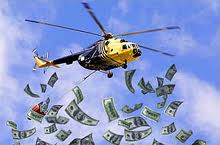
 

   Univ. of Chicago Prof. Milton Friedman, Nobel Laureate,  wrote famously that “that price inflation should be regulated with monetary deflation and price deflation with monetary inflation.”  He  quipped that price deflation can be fought by “dropping money out of a helicopter.” (Optimum Quantity of Money. Aldine Publishing Company. 1969. p. 4.)

   Well, it looks like the desperate central bankers, in America and Europe, are about to rent helicopters. Because the standard approach, pushing monetary reserves into the system so that banks can expand their lending (to one another and to businesses) simply has failed.  The banks are not lending the money, even though they can, because they don’t believe they will get it back.  They don’t trust one another, and they don’t trust other businesses.  Besides, they have such huge holes in their balance sheets, they need the money more than they need the interest on the loans they make. 

   It has been suggested, for a while, that central banks make loans directly to people, rather than to banks.  For a long while, this idea was rejected. Now, desperate, both the FED and the ECB are considering this wild idea.  Drop money out of helicopters, a la Friedman – i.e. lend directly. 

   How would this work?  Writing in the Wall Street Journal, Jonathan Lahart explains: 

  “With the Federal Reserve running out of options, maybe Fed Chairman Ben Bernanke will finally get the chance to live up to his “Helicopter Ben” moniker. But he’d have to get creative to do it.  Hey, you never know…The helicopter drop began as a thought experiment by Milton Friedman – what would happen if a helicopter flew over a community and dropped cash? – that economists have since tapped as a way a central bank could boost growth in an environment where interest rates are ultra low.   To engineer a helicopter drop, the Fed would have to not just print money, but print it and give it away to people without them providing anything (labor, stocks, etc.) in return. So absent using actual helicopters, the Fed would have to come up with some sort of method of getting the cash into people’s hands. The one Mr. Bernanke suggested in his famous 2002 helicopter speech was for Congress to pass a broad-based tax cut with the Fed buying the debt the government issued to fund the cut.    In today’s political climate, convincing a gridlocked Congress to go along with the idea Mr. Bernanke laid out is an obvious nonstarter. So here’s a modest proposal: The Fed should start buying trillions of dollars in lottery tickets.    Think of it. The Fed’s lottery purchases would boost the level of lottery payouts that winners received, boosting their spending power. If nobody won, the cash would go into the coffers of the 43 states that run lotteries, allowing them to cut taxes or increase spending. And on the off chance that the Fed won, it simply wouldn’t bother to collect. The only real question is what numbers the Fed should play. For symmetry’s sake, some combination of zeroes seems best.”

   There are better ways to engineer helicopter money.  And the idea is quite serious.  If banks won’t lend, well, let the Fed do it directly.  Against the Fed charter? Congress is opposed?  Desperate times require desperate measures. And looking at Ben Bernanke on TV recently, we are living in desperate times. 

Apple’s Secret Sauce: In Search of Cool

By Shlomo Maital


    The patent infringement suit by Apple against Samsung has provided some unexpected insights into Apple’s ‘secret sauce’.  Writing in the New York Times, blogger Nick Bilton quotes one of Apple’s leading designers: 

    “On the first day of the trial, Christopher Stringer, a longtime industrial designer at Apple with a flair for the theatrical — he wore an ice-cream-white suit — explained the process the company goes through to create these prototypes.  

   *  For example, 15 or 16 designers worked together around a kitchen table. When it came time to plan the devices, the company tried almost everything. There are iPads of various exaggerated shapes and sizes. They are white, black or metallic. One iPad has a strange stand that protrudes from the back. 

  *  Some of the early prototypes of the iPhone are bizarre. One, a long black rectangle, looks as if it is twice the size it should be. Others have beautifully curved glass screens. Another resembles an old silver iPod that just happens to be a phone, too. And there’s the strangest of all: an iPhone that looks like a stretched hexagon made of cheap black plastic.     

   *  While in court on Friday, Philip W. Schiller, Apple’s senior vice president for worldwide product marketing, pulled the curtain further back when he divulged the company’s advertising budgets — often more than $100 million a year for the iPhone alone.”

  So the recipe for Apple’s secret sauce is actually pretty simple.1. Hire scads of top industrial designers (most companies have only one or two).  2. Encourage them to create really wild ideas.  3. Actually build those wild ideas.  4. Then, take them and bring them down to earth, to make them feasible.  5. All the while, keep in mind who will make the final decision – Mr. Jobs, who wants products that are beautiful, simple, friendly, and above all else,  K O O O O O O O L.  “What will Jobs say?” is always in the room.   6. Finally, use an unlimited advertising budget, just to get people talking about the new product, just to establish “Koolness”. 

   Contrast this with Nokia, which studied 200,000 customers, sliced and diced them, shaped a dozen cell phones each to a specific well-defined market segment… but cool?  None in sight. 

   The secret sauce is not so secret now, and not so mysterious.  But the one ingredient that no longer exists is also the most crucial one: Steve Jobs’ innate sense for what is appealing and exciting.   Ever try baking bran muffins without bran? 

 * Disruptions: At Its Trial, Apple Spills Some Secrets, By NICK BILTON.  NYT Aug. 5.

What I Learned from Pixie

By Shlomo Maital

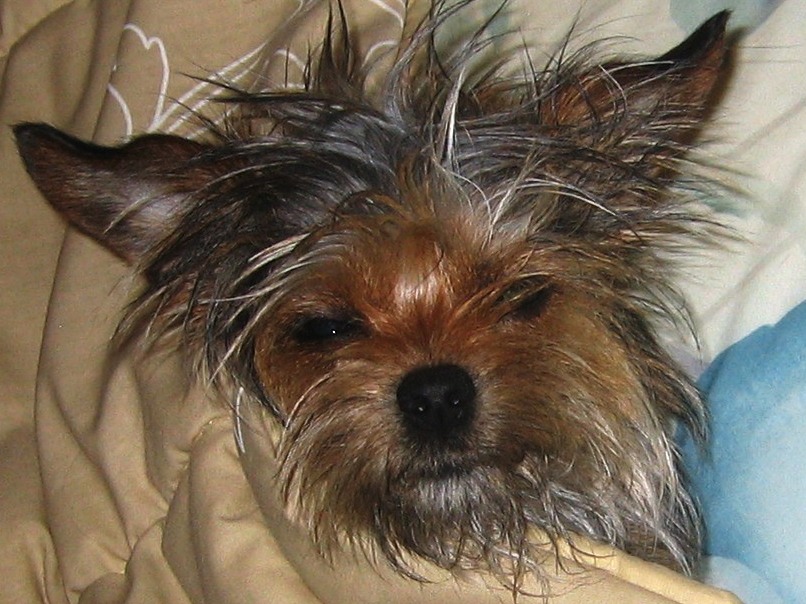
  We have a mixed-breed mainly-Yorkshire-Terrier dog named Pixie. She weighs 2.5 kg. (about 6 pounds).  Our daughter-in-law found her, as a puppy, abandoned in the streets of Tel Aviv, flee-ridden and hungry, brought her home, bathed her and posted her picture on the Web. We loved her at first sight.   She’s about a year old now and brings tons of laughter into our lives, a ton for every kilo of her body weight.

    What I’ve learned from Pixie, a little dog, is this.  Life is play.

    I’ve just come back from a long run and am sitting in the kitchen, resting and having a drink.  Pixie, of course, is right there.  She looks up at me, as she does always, and her expression says, let’s play!  Let’s play fetch (her favorite game).  When I fail to react, she solves the problem herself.  She finds a fragment of the bone she’s been chewing, grasps it in her teeth and with a toss of her head, flings it a few yards.  Then she chases it, and repeats the process.  She looks back at me, as if to say,  okay, lazy bum, if you don’t want to play, I’ll play anyway. 

   Pixie would be an adolescent, if she were human.  I am pretty sure she will remain playful for her whole life.  I hope so.   Let’s face it, life is work, mostly. But life is play, too – so, why do we adults (especially those of us approaching 70) forget how to play?  Why do young people think video games are actually play?  What IS play, anyway?  It’s just fooling around, with whatever is at hand (Pixie has been known to use pieces of leaves, anything available), imagining things, pretending, role playing, goofing off, doing things with no purpose other than to, well, just do them. 

       I sometimes watch a cable program called Dog Whisperer, with the amazing Mexican-American dog trainer Cesar Millan.  Millan says dogs need three things, in this order: Discipline, love, play.  That kind of sums up life for humans too, doesn’t it?  I confess – for Pixie, I provide, well, two of three.  Discipline?  Kind of hard for a dog no bigger than a teacup.  But play?  Pixie’s always ready to play. And increasingly, so am I. 

Curiosity: Is It Worth It?

By Shlomo Maital


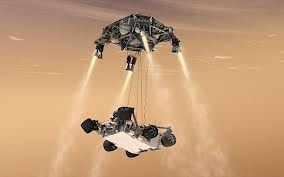
   The Mars explorer Curiosity landed successfully in the Gale Crater on Mars on August 6.   The project cost several billion dollars.  As expected, naysayers raised objections.  How can you justify spending so much money, when America has so many unemployed, poor, sick and uneducated people?  Why can’t we tackle the key problems we face on earth, rather than those on Mars?  

   There are important reasons why this project of NASA is different from previous ones, and why it is so worthy of praise.  First, it is a shoestring project.  NASA’s budget has been fiercely cut, owing to American budget deficits.  As former Curitiba Brazil mayor Jaime Lerner says, when you slash budgets you spur creativity, because creativity has to replace checks.  Second, it invents and extends several wonderful new technologies, and you never know how and where they will find powerful use on Earth.  (For instance – Curiosity can zap a rock with a laser, from a distance of 7-8 m., vaporize a small part, and then analyze the result to determine the rock’s composition.  This is neat, isn’t it?).  Third, and most important, Curiosity will help re-ignite the interest of young Americans in science and engineering, just as the Moon project of Kennedy did in the 1960’s.  

     Millions have watched NASA’s viral YouTube video “7 Minutes of Terror”.  Finally, NASA has succeeded in capturing the imagination of ordinary people, and instead of dull clips extolling technology, it explains how a dedicated team of NASA engineers feels, investing years of their lives in the project and then waiting in huge suspense until radio waves travel from Mars to Earth and say, “we did it!  We’re on the surface of Mars!”.  

       Whoever chose the name Curiosity was brilliant.  Yes, curiosity, the desire to know, can justify the Curiosity budget.  In the end, all human progress is driven by fierce curiosity, soaring imagination, and the ability to ‘land’ that imagination firmly on solid ground.  Head in the clouds, feet on the ground, is my recipe for impactful innovation —  but Curiosity’s ‘head’ is on Mars, not in the clouds, and that’s just amazing.  Go Curiosity!  You have 96 months, 8 full years, to tell us about the surface of Mars – and to show us what a planet is like that only has water in frozen ice at its poles.  If we don’t resolve global warming, Earth will begin to look like Mars – and parts of the U.S. Midwest already do.

Imagine: When is a Lie, a Lie?

By Shlomo Maital   


  Jonah Lehrer is a brilliant young science writer.  I am reading his latest book, Imagine: How Creativity Works, HMH New York, 2012.   The book shows how we can all learn to be more creative. It follows an earlier, also wonderful book, How We Decide.

   But don’t try to buy a copy. The publisher has withdrawn the book from sale, following a fierce controversy.  In a brief passage about the creative process used by Bob Dylan (p. 19-22), a wonderfully insightful passage, Lehrer quotes passages that Dylan allegedly said and wrote.  Dylan experts jumped on the section and claimed vociferously that Dylan never said those words Lehrer quotes.  This, despite the irony that Dylan himself, in his books and songs, freely borrowed words, sentences and passages from other writers, never citing the source, and freely invented things about his own life that never even remotely happened. 

    Lehrer was forced to apologize and the publisher withdraw the book from the book stores.  Lehrer also resigned from The New Yorker.

    So, let’s get this straight. A book called Imagine  imagines passages about Bob Dylan, to try to explain to us clearly Dylan’s creative process.  If you read this section, you get important insights into Dylan’s creativity. (Basically, he is unwilling to remain in his comfort zone and do the same thing repeatedly, even tough that is what people apparently want – a hugely important lesson for all innovators!).  Because the book is labeled ‘non-fiction’, Lehrer is vilified.  Apparently, you cannot be creative in a book about creativity. You cannot ‘imagine’ in a book about Imagine. 

    So, when is a lie a lie?  Do readers really believe that Dylan said those words Lehrer quotes? Or that he is simply trying to explain Dylan’s mindset?  

    I hope the nitpickers and the stupid publisher have not ruined Lehrer’s career.  When is a lie a lie?  When you deliberately try to deceive.  When is a lie, not a lie?  When you try to help people understand something, graphically and interestingly.  Believe me, we readers know the difference. 

 Why Leadership Starts with “Why!”

By Shlomo Maital


  There is an important ‘follow up’ to my previous blog on Simon Sinek’s ‘start with why’ tool.  It relates to leadership.

   What makes a leader great?   Charisma?  Eloquence?  None of the above. 

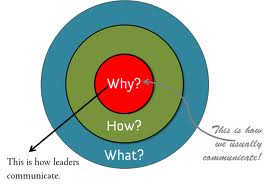
   Great leaders, like Martin Luther King, notes Sinek,  provide their followers with a rationale, an answer to the question, why?    Why is racial discrimination unjust and not to be tolerated? Martin Luther  King gave the answer, in a clear, simple, concrete and visual manner.   Why should America put a man on the moon by the end of the ‘60s?  Because America loves huge challenges and does best when tackling them.  Kennedy supplied the ‘why’, in 1962. 

    The primary task of a leader, any leader, whether it be President, Prime Minister, CEO, or the head of a business unit, or the head of a project team, is simple and clear.  Supply the ‘why’.  Why are we doing this? Why should we invest all our sweat, blood, brains, creativity and effort?   If you provide a powerful convincing and authentic ‘why’, they will executive.  If you don’t, they won’t.   Whether you lead the 2 million workers of Wal-Mart, or five people in your team, it is the same.  Start with why. Make sure you all have the same ‘why’.  Make sure you have one. 

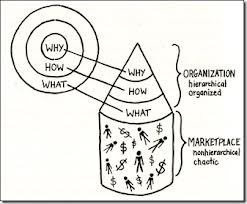
    The top person supplies the ‘why’.  The people under him or her supply the ‘how’ – they are the operations people.   And the people who work for the operations managers create the ‘what’.  This is about all the hierarchy an organization should have.  More than that is bureaucratic.  Three levels, with each level knowing what its goal is.  But the key is,  ALL levels need to be reminded constantly about the ‘why’.  That is why you, as leader, exist.  If you fail in that, you will not succeed in other endeavours, nor will your organization endure. 

  • Simon Sinek, START WITH WHY.  How Great Leaders Inspire Everyone to Take Action. Portfolio/Penguin, new edition 2011.    

 Innovator: Start with “Why!”

By Shlomo Maital        


  As a management educator, I teach a great many concepts, “tools”, methods, etc. to help my students be more effective at innovation.  I listen closely to their reactions, because the only real test of a ‘tool’ is whether it ‘resonates’ with students and leads them to effective action and creativity. 

   One of the tools that resonates most powerfully, among all groups – young, old, senior, junior, startups, established firms, high-tech, low-tech – is Simon Sinek’s “Start with Why”. *  Sinek has written a successful book and has done a viral TEDx 18-minute video that has been viewed by millions.  Here is his simple idea.

       Most innovation follows this sequence:  What shall I invent?  How will I do it?  Who will buy it? And..(sometimes) why am I doing this? 

      There is a better sequence.  It follows the structure of our brains, according to Sinek.  It goes as follows:

       Why?  (Why am I working on this innovation?  Why do people need and want it?).   The ‘why’ question also subsumes the ‘who’, because you cannot define a rationale without knowing clearly who is the focus.   After the ‘why’ is clearly established,  both for the innovator and those who he/she seeks as clients, comes the what:   What shall I innovate?  Then, how will I innovate it?  

      Start with why.

     Here is Sinek’s opening example.  Samuel Pierpoint Langley, distinguished former Harvard researcher and Smithsonian scholar,  set out, in the early 1900’s, to build the first airplane.  He had everything. He had a $50,000 grant (several million dollars in today’s dollars). He had powerful friends (Andrew Carnegie).  He had the press following him everywhere.  He had the top brains of his time on his team.

    A few hundred miles away, Orville and Wilbur Wright worked on the same project.  They had nothing. No college degree. No grant. No money.  No talented team. No press interest.  Nothing.  Yet on Dec. 17, 1903, on a cold winter day, Orville and Wilbur conquered manned flight for the first time.   And Langley quit and dismantled his project on that very same day.

    Why did the Wright Brothers win?  Because of ‘why’.  They were driven to conquer manned flight.  They crashed, rebuilt, crashed…  and never gave up.  They were driven by ‘why’ —  to change the world by enabling human beings to fly.  Langley, in contrast, sought fame and wealth.  He had to be first.  To be second, to help the Wright brothers, to build on their achievement, in order to achieve the goal of manned flight and change the world, that was not in his mind.  The day he heard of the Wright Bros’ achievement, he quit.  And today nobody remembers him at all. 

    Start with why.  People buy Apple products, claims Sinek, because of the why – people buy them because they’re cool, because they’re different, because they’re simple, beautifully designed…. And they’ll buy many different Apple products – tablets, smartphones, laptops, anything, for that reason.  Other firms sell the ‘what’ – ours is better, faster, stronger, cheaper.  Sell the ‘why’.  Tell people why they should buy your product or service.  But first, figure it out for yourself.   

   Figure out your own ‘why’.  What is YOUR why?  What is your deepest passion? Why will you invest all your energy, skill, brainpower, creativity, and passion, in some endeavor?  I meet all too many young people who lack a ‘why’.  Money alone is not an adequate why for anyone.  Too many people figure that out when it is too late. 

    As Guy Kawasaki counsels,   “make meaning, not money”.   

  • Simon Sinek, START WITH WHY.  How Great Leaders Inspire Everyone to Take Action. Portfolio/Penguin, new edition 2011.    

There ARE Creative Solutions to the Euro Saga

By Shlomo Maital     


  I know, it is hard to believe, but —  European leaders have had 21 summit meetings to discuss how to save the euro, since the crisis began.  Yet they are no closer to a creative solution than they were at the very first such meeting.  I wonder if those EU leaders, Cameron, Merkel, now Hollande, understand they are writing a new chapter in Barbara Tuchman’s March of Folly –   Brancusi’s “endless column’ has only 17 chain links, EU’s endless summits have 21….

   Today’s Global New York Times reports that three leading economists have each come up with a creative solution to the euro problem. 

  • ·         Graham Bishop:  “Set up a new euro zone fund, to raise money for individual governments, and with each government’s ability to borrow well defined and capped”.  A Euro bond avoids the problem ‘labelling’, where “Spain” or “Greece” brings exorbitant interest rates neither govt. can afford.
  • ·         Markus K. Brunnermeier, Princeton Univ.:  “Create a new European debt agency, that will buy govt. bonds (“troubled assets”) and finance the purchase by selling bonds, in two categories: low-interest debt with zero risk, ultra-safe (“you’ll always get your money back, guaranteed”; and high-interest debt carrying much higher risk (i.e. you may not get your money back).   
  • ·         Daniel Gros, European Policy Studies: “Make the ESM, European Stability Mechamism, into a bank, licensed, that could buy the distressed bonds of Spain and Italy, and hence reduce their borrowing costs.”

   Each of these plans could work.  ANY plan is better than the current no plan situation.  While Europe dithers, the world sinks into stagnation… only now, it is stagflation, because as happened in 1971,  food prices are rising right at the time when the world economy is slowing. So we get stagnation (low growth or zero growth) and inflation together, a lethal combination. 

     Let Europe take action. ANY action.  Any plan, provided it is big enough and sweeping enough, is better than having another 21 summits that lead nowhere.  George Bernard Shaw once said that if you lined up all the economists in the world in a straight line, they still would not reach a conclusion.  Alas, that is even more true of Europe’s leaders.  A few economists HAVE reached a conclusion. But none of the political leaders have. And you and I are paying the price. 

Can You Find A Ray of Light in the Darkness?

By Shlomo Maital  

  In my personal life, I truly believe in optimism and in being upbeat and hopeful. This perception alone is often enough to change reality. It dispels learned helplessness and spurs action instead of despair. 

  But this week, in reading the Financial Times, I cannot recall another time, in the past 40 years, where so much gloom gathered and so much doom threatened.  In fact, in just one issue, Thursday July 26, the FT reported on:  The futility of the Fed’s policy of creating money (nobody’s lending it, nobody’s borrowing it), the stupidity of American farm policy (using corn to feed thirsty cars with biofuel instead of hungry people, helping, together with drought, to make corn so expensive that beef, pork and poultry, which use corn for feed, may become unaffordable); the drought in India, threatening food price inflation; the drought in Russia, threatening to boost the price of bread; the imminent departure of Greece from the euro; China’s slumping economy and property bubble (if China joins the EU and America in stagnation, there is no growth left in the world economy).  We have deep recession in Britain, despite 8% budget deficits.  We have Syria massacring its citizens.  And this is just a start. Everywhere, there is a failure of political leadership.  Politicians do not know what to do. Economists don’t know what to advise.  At a time when economics, capital and technology are global, policy too must be global – but increasingly politics are local, and policy is made through politics. 

    There is comfort in the fact that we live our lives as families, not as countries. Most people are simply getting on with their lives, facing economic challenges and just getting on with life.  Babies continue to be born, couples continue to marry, and life goes on. 

     But, it would be nice if we could see a light at the end of the current dark tunnel of economic depression.  If you see one —   let me know.  

Americans Want Less Inequality..and Half Will Vote for Romney?

Dan Ariely on Wealth and Poverty

By Shlomo Maital   

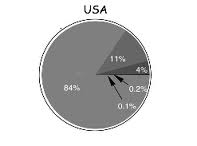
    America’s distribution of wealth is enormously unequal.  The bottom 40% of the population hold only 0.3 % of total wealth.  The next 40% of the population hold only 15% of the wealth.  The top 20% hold 84% of America’s wealth.   Is this what Americans want?  Is this fair?  No way.  Yet half are willing to vote for the multi-zillionaire Mitt Romney for President.  He says Americans like success.  Sure. But do they love a tilted playing field, where wealth gets passed on from parent to child, where Romney pays far less tax than a middle class working person, where Romney shelters money in the Cayman Islands? Why do half of Americans say they’ll vote for him?  What in the world????

   Here is what an American-Israeli behavioral researcher Dan Ariely found, along with Michael Norton,  as told to NPR’s Chris Lydon:

    “There is a  30 year trend in the U.S. to a society of rich and poor:  Big wealth at top, big debt in the middle, poverty at the bottom.   So, the starting point of our research was the debate, what is the right level of equality?  If everybody is equal: it’s socialistic. If there’s some inequality: People are motivated.  When inequality is too large:  It demotivates. But nobody knows what is the right level of inequality.  Michael Norton and I stepped back and said:  Let’s ask people what kind of wealth inequality they want. 

    “We first asked people what they think is the wealth inequality in the US.  We did a study of 30,000 Americans. A national random sample. Imagine there are five segments of people, bottom 20%, next 20%, next, next and richest 20%. How much wealth do you think is owned by the top 20%?  Bottom 40%? 

     “ On average people said 9% of the wealth  accrues to the bottom 40%.  The actual figure (see graph above):   0.3%.     Top 20%? It owns 84% of the wealth.    America is close to some African countries in equality.  People do not understand this. They think there is far more equality in wealth in America than there is in fact.

    “John Rawls was a famous philosopher.  He used the  “veil of ignorance” – What society would you want to wake up in?  Imagine a society, you knew everything about it…what society would you be willing to enter, in a random place?   If you’re wealthy, you want lots of rich people, if you’re poor, you want the poor to have less..but if you don’t know which you are,  you dissociate yourself from your own situation, because you could be anything.  Create an ideal wealth distribution.

    “We found something hopeful and distressing. People created an ideal wealth distribution behind the veil of ignorance that was very equal, more equal than any country in the world.    We gave them the US distribution of wealth and a distribution of wealth more equal than Sweden and asked:  Which would you choose?  92% chosed the ‘more equal than Sweden’.  Perfectly equal?  NOBODY wants that!  People have a different view of the level of inequality we should have.  But they want to create a society more equal than anything we have on the planet. 

“When we break this down by Republicans and Democrats,  we find almost no difference!   Sweden vs. U.S.?  92% prefer Sweden – both Republicans and Democrats want the same!  Women and men, too.   For Republicans, 90.5% want “Sweden”, Democrats, 93%.  There are tiny differences. But they are incredibly small.

“Harvard Business School?  They wanted the poor to have slightly less money..but even Harvard MBA’s wanted a society more equal than any in the world.

“How do we reconcile this?  We have high wealth inequality but people want much much less wealth inequality.  How come?  Politicians are there to obscure our view of reality.  They’re trying to prevent us from looking at society with fresh eyes.    Politicians are labeling things, “socialism”, anything that helps reduce inequality. In the end Americans want far more wealth equality and fairness than they are given.”    

Blog entries written by Prof. Shlomo Maital

Shlomo Maital

Pages