Innovation/Global Risk

Can You Fly A House?

By Shlomo  Maital


Art imitates life, but often, life imitates art.  Here is a wild example.

   In 2009 Pixar produced a wonderful animated movie, “Up”, about an elderly widower named Carl Fredricksen and a young Wilderness Explorer named Russell who fly to South America by floating in a house.  The house is ‘flown’ by attaching helium balloons to it.  The movie grossed $731 m., ranking it third for animated films, behind Finding Nemo and Toy Story 3.

   A team of experts/crackpots for the National Geographic cable channel decided to create a real “Up” house.  They built a 2,000-pound 16 ft. by 16 ft. two-story yellow house, attached 300 helium-filled weather balloons to it …and the 10-story structure took off from a private airfield near Los Angeles and ‘flew’ for an hour, reaching a height of 10,000 feet.  And yes, it was manned; two of the channel’s producers were on it, including Paul Carson.  The flight was an episode of an imaginative program, “How Hard Can It Be?”, e.g. how hard can it be to fly a house?  The answer?  Really hard.   It took the team two weeks of trial and error to do the job.
 

 Innovation/Global Risk

Belly Putters: Golf Innovation

By Shlomo  Maital   


  Modern golf originated in 15th C. Scotland.  Despite golf’s long white beard, there is still room for innovations.  Take, for instance, the ‘belly putter’.   Unlike the conventional putter, which ends at the wrist grip, the belly putter is longer and the end of the shaft  ‘anchors’ against the stomach.  The stomach, therefore, becomes the fulcrum, not the wrists.  Under the rules of golf, belly putters are legal. Pro golfer Paul Azinger made the belly putter popular when he began using it on the PGA Tour in 1999.  Now, top golfers Vijay Singh, David Love III and Fred Couples are using them.  The original patent for belly putters goes back to Richard T. Parmley and Phil Rogers, issued in 1965 and called a “body pivot putter”. 

   Azinger reinvented the belly putter in a golf pro shop.  There, he discovered a long putter that had been cut down for a shorter person. Azinger pressed it against his belly button – and started sinkins putts all over the pro shop carpet.   In 2003, belly putters won eight PGA events (four to Singh, two to Couples). 

   The basic idea of the belly putter is to take the wrists out of the play, because wrists are inherently unstable and inconsistent, especially when the golf player has the jitters.

   The cost?  Steep – upwards of $120 – $150.  Golf is still for the well-heeled.

   What do we learn about innovation from belly putters?  Azinger had an open mind, tried something, it worked – and he went with it.  But there is left brain logic and analysis, too, that accompanies the right-brain “this just feels right”.  A putter with a more solid fulcrum will achieve more consistent results than one with wobbly wrist actions. 

   And – one more thing.  Older golfers do develop bulging bellies, sometimes from beer.   The belly putter makes this an advantage, because the fat bellies offer a firm welcoming place to anchor the end of the shaft. 

    Apparently, even a game dating back to the 15th C. still leaves room for innovations, and within the rules.   

 Innovation/Global Risk

Alzheimer’s:  Major Progress

By Shlomo  Maital


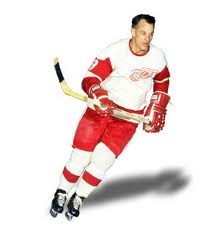
Gordie Howe


Major progress has been made in diagnosing and treating the form of dementia known as Alzheimer’s.   Some 26 m. people suffer from it today, worldwide, and according to Johns Hopkins Medical School, that number will rise to over 100 m. by 2050, as populations age. 

  The BBC, which covers Alzheimer’s research very well, just announced some major breakthroughs.

  First, diagnosis.  New developments in the use of MRI (magnetic resonance imaging) now enable doctors to pinpoint the presence of amyloid protein, which is thought to cause Alzheimer’s by short-circuiting the brain’s delicate wiring, years before dementia develops. 

  Second, disease.   Columbia U. and Harvard U. researchers may have discovered how the disease progresses – almost virally, with it spreading from one brain cell to another. 

    “Alzheimer’s disease appears to spread like a virus from one brain cell to another, a groundbreaking discovery that could help stop the debilitating disease in its tracks, researchers say.   Two independent studies by teams of Columbia and Harvard researchers looked at the brains of mice and found that the degenerative brain disease begins in one small part of the brain and spreads through an abnormal protein known as tau, which is seen in Alzheimer’s-affected brains.  It’s long been known that dying, tau-filled cells are an early sign of Alzheimer’s disease. They first appear in the entorhinal cortex, a small area of the brain behind the ears that controls memory and navigation and form tangles. The disease then spreads to other areas of the brain.”

  Third, treatment.  Work proceeds apace on developing a drug, or vaccine, which would produce antibodies that would suck the amyloid protein out of the brain, almost like a vacuum cleaner.   The leading candidate is a drug under development by Eli Lilly. 

    “Lilly’s latest contender, solanezumab, is designed to bind to and mop up a protein called amyloid beta, the main component of amyloid plaque deposits in the brains of patients with Alzheimer’s disease.  Anticipation over the drug has built up slowly. Lilly is expected to release as soon as this summer final data from two 18-month studies of the treatment. Earlier this week, the company said an independent safety monitor had given researchers the green light to continue with the late-stage trials.”  Pfizer, too, has an Alzheimer’s drug under development.

   The most touching news comes from my childhood idol, Saskatchewan-born hockey player Gordie Howe.  After his wife Colleen died of dementia, Howe has been raising money for a foundation that funds dementia research.  He makes 4-5 appearances a month. It is rumored Howe himself, now 84, may suffer from it, although he denies it.  Howe played hockey in an age when players did not wear helmets.  He must have taken many blows to the head. Yet, developing dementia at his advanced age cannot be directly attributed to his hockey-playing days.   Howe’s son Murray said:  “As your parents age, they will almost all deal with something along these lines.  It’s so important to get together as a family and have a plan to make sure your parents are taken care of. It’s really easy to ignore.”

 Innovation/Global Risk

IKEA: Can You Feel Small When You’re Really Big?

Anders Dahlvig Thinks You Can’t!

By Shlomo  Maital     


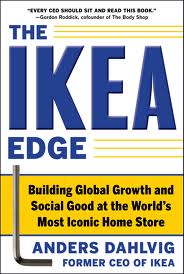
 Consider IKEA.   This Swedish company, founded by Inqvar Kamprad at his uncle Ernst’s table in 1943, has revolutionized the global furniture business.  It is the world’s largest furniture retailer, and its innovation is its business model, not its products.  We now have a new book, The IKEA Edge, by Anders Dahlvig, who rose from store manager to become Kamprad’s right-hand man.  Here is what Fortune magazine said about this book: 

 Dahlvig does give a brief history of Ikea’s evolution into the privately held retail giant that generated $31 billion in 2009,  with 125,000 employees (ran 300 stores, operated in 38 countries and was the 3rd largest buyer of wood in the world). But more often than not, the book is about management — motivating and inspiring employees, keeping an entrepreneurial streak as a company grows, creating loyalty and diversity, the role of a CEO. The book is rich in ideas about how to take a brand that has a strong regional culture and make it global. While some of these lessons are helpful and refreshing (Dahlvig suggests having numerous people report to you so you don’t have time to micromanage or hover), I wanted more of a personal story about his time at the company. Instead the book is written in the style of Ikea itself: practical and no-frills.

 What is IKEA’s secret of success?  Fierce supply-chain management, bulk buying and the creation of a unique customer experience.  Consider IKEA’s restaurants. Their real purpose?    

   “Take, for example, the fact that its restaurants generate $1.5 billion in sales. But the main reason behind those 15 Swedish meatballs for $3.99 is not to make a profit — it’s to highlight the store’s low prices and get the customer to shop longer.”

  Dahlvig knows clearly why IKEA and any company exists:  ” A company’s reason for existence should be to contribute to a better society.”   

    It’s hard to imagine these words coming out of the mouths of most U.S. CEOs, says FORTUNE.  But it might serve them well if they at least read the book.

    IKEA’s founder is now 85, and about to retire.  Dahlvig is worried.  He recently told BBC’s Business Daily:    “What will happen when the founder of IKEA is not around?  What will happen to IKEA?    The founder is 85, this transition is about to happen. He is less visible in the business.  Transition is on the way. My biggest worry for the company is, the loss of the values, he is the guardian of that. This is the soul of the company. The consequence of losing the values is, the loyalty of employees declines, and we become like every other company.   This is our first generational change.  That’s a worry.   The fact that IKEA is becoming bigger, a bureaucracy, the small company feel is declining, maybe inevitable, but,  I’m worried about that, and worried about the loss of the culture and the values.   And I don’t have a solution, how you can act like a small company when you are the size of IKEA.” 

 Innovation/Global Risk

Whom Do We Serve? The Asymmetry That Is Screwing American Workers

By Shlomo  Maital   


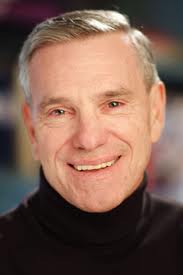
 Clyde Prestowitz

A recent column by NYT columnist Tom Friedman (Jan. 28), and a powerful blog by former Reagan trade negotiator Clyde Prestowitz (Foreign Affairs, Jan. 31),  focus on a bitter asymmetry in global markets that is screwing American workers. 

     American companies, and European ones too, operate as if there were no geographic borders in the world, and deploy their businesses wherever it is profitable to do so. As Victor Fung, chair of Li & Fung, Hong Kong’s oldest  textile makers, put it: “source everywhere, manufacture everywhere, sell everywhere”.  As a result, Apple generates about 40,000 jobs in America, and directly and indirectly, 700,000 jobs outside it.  

    But what about Chinese companies?   Do they, too, act as if they serve only their shareholders, and disregard the national interests of the Chinese people?  Do Japanese firms?  Russian firms?   Prestowitz notes, “…China, Japan, Germany, Korea, Brazil, Taiwan and Russia all engage in a significant degree of protectionism, and are also the ones presently enjoying the most success”.   Raw protection is the breakfast of champions, Prestowitz quotes an expert.  Yet America continues to trumpet “free markets”, even though global markets are far from free.    Globalization is not always win-win, Prestowitz notes, echoing a famous finding of MIT Economist the late Paul Samuelson.   The assumptions underlying the “free trade is always win-win” theorem simply don’t hold, not a single one of them.   

    America is capitalist. Much of the rest of the world is mercantilist (seeking export surpluses through overt and covert policies that punish imports and subsidize exports).  As a result, America’s workers and its middle class lose.  America’s capitalist, who pocket the profits, gain. 

    Whom do we serve?  America’s CEO’s answer: Money.  Only when they begin to answer, “the people of America”  will America’s job picture brighten. 

 Innovation/Global Risk

Managers: You Are Missing Opportunities Daily!  Unfreeze!

By Shlomo  Maital  


A common reaction to crisis, among ordinary people, is simply to freeze.  Facing danger, risk or threat,  many of us simply become incapable of doing anything. 

  Apparently, this is equally true of highly-paid executives.  A new study by the global consulting firm McKinsey, published in the September 2011 issue of McKinsey Quarterly, * reveals that “executives are foregoing opportunities that, despite today’s volatility and uncertainty, are probably worthwhile”.  

   According to McKinsey’s global survey of CEO’s,  two-thirds of the respondents believe that their companies are underinvesting in product development.   This, despite the well-known finding that recession and its aftermath are the times when competitive rankings within industries change the most, with the ‘bottom feeders’ tending to rise, and the ‘top teams’ tending to fall.  The firms that improve their market share and competitive position are those that seize opportunities inherent in global crises.

    Last year, together with my colleague D.V.R. Seshadri, I published the book Global Risk/Global Opportunity, showing how talented managers and entrepreneurs can transform global risk into massive opportunities.  Apparently, according to McKinsey, nobody read the book or is even interested.   Like us ordinary people, those who lead global businesses seem to be reacting to global crisis, volatility and uncertainty simply by ‘freezing’ – by avoiding any risky investments or product development programs.  In general, facing danger, ‘freezing’ is the worst thing we can do.  And it is also the worst thing our business leaders can do.  Nonetheless, that’s what they are doing. And so, incidentally, are our political leaders, especially in Europe.   

   I wonder how this damaging paralysis can be cured.

  • “A bias against investment”, Sept. 2011

 Innovation/Global Risk

If You’re Daydreaming, You’re In Trouble

By Shlomo  Maital

    Image TrackYourHappiness.org 

   Often, we associate creativity with ‘dreamers’.  Dare to dream, we say.  Dreaming is important. But new research shows that it both reflects, and causes, unhappiness.

   Writing in Science magazine, Harvard psychologists Matthew Killingsworth and Daniel Gilbert gathered 250,000 data points, using an iPhone app.  The data points study subjects’ thoughts, feelings and actions as they go about their daily life.  They are accurate because they are recorded as the events and emotions happen. 

   “A human mind is a wandering mind, and a wandering mind is an unhappy mind,” notes Killingsworth.  Apparently, people spend half their time thinking about something other than what they’re doing, and this mind-wandering makes them unhappy.

     “How often our minds leave the present and where they tend to go is a better predictor of our happiness,” Killingsworth claims, “than the activities in which we are engaged.”  They found that less than 5 per cent of a person’s happiness, at a given moment in time, was attributable to the specific activity he or she was doing. (People, apparently, are happiest when making love, exercising, or conversing. They are least happy when resting, working, or using their computer). 

   “Our mental lives are pervaded, to a remarkable degree, by the non-present,” Killingsworth notes.

    I think these results confirm another important aspect of creativity.  We daydream when we are bored, irritated or displeased with what we are doing, with the reality as we experience it.  A great deal of creativity arises out of such unhappiness. Many wonderful works of art and literature were created by unhappy individuals.  Happiness by definition means living in a comfort zone, which rarely spawns creativity.  So, dream on, innovators!  But hey —  don’t just dream, pick a few of those fantastic dreams and make them come true.  That is the key. 

    If you want to join the study with the iPhone app, go to http://www.trackyourhappiness.org

 Innovation/Global Risk

Make Meaning: When Tragedy Becomes Triumph (2)

By Shlomo  Maital  


 Daniel Yuval

On Feb. 6, 2010, tragedy struck a family from central Israel, hiking in the snow in the Golan Heights.  The snow obscured signs warning of land mines.  As a result, one of the three children in the family stepped on a mine.  “We threw snowballs and played around for five minutes,” 11-year-old Daniel Yuval said.  “Then I remember taking a step forward and I heard the explosion. For a few minutes I don’t remember much.  My father picked me up.”  Daniel’s leg had been severed by a landmine.   It emerges that there are some 260,000 more landmines in the area. 

   Daniel is a tough, brave kid.  Within a month he walked his first steps.  He allowed his dressings to be changed, painfully, without painkiller.  And he quickly made up the time he lost in school.   After his leg was blown off, he asked his father Guy (who was carefully retracing his steps with Daniel in his arms, to avoid other mines) to stop and re-attach his lost leg.  

   Daniel wrote a letter to all 120 members of  Israel’s Parliament, and launched a high-profile campaign to clean up land mines.  He spoke to Parliament, to the Foreign Affairs and Defense Committee.  A bill is now being promoted, costing $89.4 m., to clean up the land mines.  

   According to anti-mine campaigner Jerry White, founder of the anti-landmine organization Survivor Corps (White himself lost his leg while hiking in the Golan),  “Daniel Yuval is the tipping point where Israelis woke up.” 

   If an 11-year-old can overcome losing his leg, and find meaning in the incident, to work to keep others from the same fate,  surely the rest of us can find meaning in far less painful circumstances. 

   “When I awoke from the surgery at the hospital and saw my amputated right leg,”  he wrote in his letter to Israel’s Knesset members, “I told my mum that I wanted no one else to ever be hurt by a landmine, and that I meant to do something about that.”  And he did. 

    Transforming adversity and depression into meaning is often simply about acting, rather than complaining.  Daniel Yuval did.  We can all learn from him.   And Daniel?  He follows artificial limb technology closely and still dreams of playing football, his main passion.   

 Innovation/Global Risk

Make Meaning: When the Ref Is the Story (1)

By Shlomo  Maital  


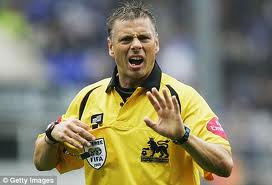
 Mark Halsey

Football writer Rob Hughes (Global New York Times) covers his beat like a blanket. He is the only sports writer I know who finds the main story behind a fierce FA Cup rivalry in England, between Liverpool and Manchester,  in the referee, Mark Halsey.

    Halsey refereed Saturday’s match between Liverpool and Manchester, when Liverpool defeated nearby Manchester 2-1 and knocked United out of the FA Cup running.  This was an explosive match, scheduled to be played mid-day under heavy police surveillance. The reason: A complaint by Manchester captain Patrice Evra, that Liverpool’s Uruguayan striker Luis Suarez used a racial epithet against him (related to the Spanish word for ‘black’), brought Suarez and 8-game suspension.  As a result, Liverpudlian fans booed Evra each time he handled the ball.  Suarez himself claims the epithet is widely used in Latin America, as a fond nickname. 

    “Mark Halsey gave a near-faultless display in a match of the kind that often unsettles the best of arbiters. He controlled the fierce exchanges, he ignored the baying fans, he called every contentious issue accurately,” wrote Hughes.

    This is amazing, for two reasons. First, Halsey is 50 years old.  In a top-level professional soccer match, players run an average of 7-10 kms.  Referees run far more, because they need to be where the play is, at both ends.  Halsey is fit as a fiddle.  Second, Halsey learned in 2009 that he had throat cancer.  He underwent chemotherapy and got thousands of letters from all over the world. (Ill referees are beloved; active ones are universally hated, that’s life). 

    Halsey found meaning in life in what he does – referee games with skill, professionalism, fairness and quick decisiveness.  His refereeing  helped make the game a memorable one, with United holding the upper hand, but Liverpool stealing a late goal to win.  I’m certain the fact he aspired to return to the field helped his recovery from cancer. 

    It is a fact that people who are optimistic live longer and live better.  Finding meaning – the answer to the question, why were we placed here on earth? – powerfully enables us to overcome the worst of times, and make the most of the best of times.   With incredibly highly paid athletes on the pitch, Hughes writes, “transcending all the sport and all the foreboding (about the game) was the performance of one man” – not the striker, or goalie, or defender, but the referee!   Kudos to Mark Halsey. And kudos to Rob Hughes, who finds great stories about meaning in dark corners.    

 Innovation/Global Risk

Team Sports: No, It’s NOT Always the Money!

By Shlomo  Maital

  

 Hans Weisweiler (young and old)

If you’re a sports fan, like me, and if you are old enough to remember the ‘50s and ‘60s, you may long for  the age when baseball, basketball, American football and soccer stars got tiny salaries, and when “major market” TV contracts did not enable teams to buy trophies. 

    Blissfully, and perhaps accidentally, that era has returned, in Britain, Germany and Israel, this year.

   In Israel, the premier soccer league is led by a team from the farthest periphery of Israel, Kiryat Shmoneh, with a total budget of NIS 17 m. ($4.4 m. or 3.4 m. euros). This budget is less than one-fifth the budget of top-spending Maccabi Tel Aviv, against whom Kiryat Shmoneh plays tomorrow.  Yet with brilliant coaching and team spirit, Kiryat Shmoneh leads the league with 51 points, after 22 games, while Maccabi Tel Aviv languishes in seventh place, with only 33 points. Kiryat Shmoneh has already won the League Cup, for the second year in a row. 

    In Britain, four teams from small-spending periphery clubs are in the top 10 of the Premier League:  Newcastle (#6), Stoke City (#8), Norwitch City (#9) and Sunderland (#10), while Fulham and Swansea follow in #12 and #13 positions.  Norwitch has risen through three divisions in three seasons.  Norwitch’s captain Grant Holt cost his team 1/125 (yes, that is less than one per cent) than Fernando Torres, star Spanish striker, cost Chelsea – yet Holt regularly outplays Torres.

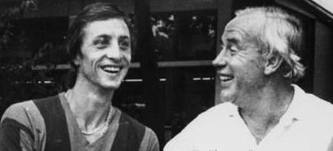
   In Germany Munchengladbach, and Schalke, small budget teams, are tied for first with deep-pocketed Bayern, while Dortmund trails the leaders by only a single point.  Munchengladbach, in its heyday, was coached by Hans (Hennes) Weisweiler, in the 1960s and 1970s.  Weisweiler ran a dozen youth sides (the “Bokelberg Colts”), building such incredible players as Gunter Netzer, Rainer Bonhof, Berti Vogts, Uli Stielike, and Jupp Heynckes.  You cannot tell me that fan loyalty is as strong for players from, say, Ghana and Algeria, as it is for local players who grew up in town and played for youth teams.  Weisweiler, notes Rob Huges, Global New York Times’ wonderful soccer writer, had a simple secret:  He taught, with simplicity and repetition, attacking football and technical skill.  These are both things fans love to watch. 

   Before I wax too euphoric, let’s recall what Deloitte’s annual Money League statistics show:  “Money League clubs (those with the top 20 budgets) [in big-league soccer] have won 43 of 50 domestic league titles available in the big five countries (England, spain, Italy, Germany, France) over the past five years.”  In the past 10 years, only one club outside the Big 20, Porto (Portugal) has won the Champions League.

   So, yes, money does buy the best players, and the best players tend to win games, cups and championships.  But here and there, a well-coached team with young ambitious players and no money can embarrass the big spenders.  (Ever heard of  baseball’s New York Yankees?)  And happily, this is happening in my country, as well as in England and in Germany, this year.      

Blog entries written by Prof. Shlomo Maital

Shlomo Maital

Pages