Innovation/Global Risk

Apple:  “No obligation to solve America’s problems”

By Shlomo  Maital

 

 Apple’s jobs: in China


A hard-hitting blog by Clyde Prestowitz, former chief trade negotiator under President Ronald Reagan, highlights a key dilemma facing America.  Global companies based in America feel no duty to take into account the interests of their country; rather, they seek to maximize profits, often at the expense of American workers. 

   In a previous blog, (July 1, 2011: “iPod not Apple of America’s Eye”), I noted how most of the iPod jobs are in China.  In last Sunday’s New York Times, a top Apple executive was quoted as saying: “We [Apple] don’t have an obligation to solve America’s problems”.

    Comments Prestowitz: “Apple’s products still have a large U.S. government R&D content and I’ll bet that the guy who says Apple has no obligation to help Uncle Sam does strongly believe that Uncle Sam has an obligation to stop foreign pirating of Apple’s intellectual property and to maintain the deployments of the U.S. Seventh Fleet and of the 100,000 U.S. troops in the Asia-Pacific region that make it safe for Apple to use supply chains that stretch through a number of countries such as China and Japan between which there are long standing and bitter animosities.”

   Prestowitz concludes:  “Apple is not the pinnacle of capitalism. It’s the pinnacle of the marriage of Silicon Valley innovation with strategic Asian mercantilism.”  

    Prestowitz recalls:  “In the 1981-86 period I was one of the U.S. government’s top trade negotiators, especially with Japan. At that time, Apple was trying to crack the Japanese market for personal computers and getting nowhere. Steve Jobs and other Apple executives had the funny notion that the U.S. government had an obligation to help them and asked me and other negotiators at the Commerce Department and the Office of the U.S. Trade Representative to help them get on the shelf in Japan. We did all we could and in doing so came to learn that virtually everything Apple had for sale, from the memory chips to the cute pointer mouse, had had its origins in some program wholly or partially supported by U.S. government money.”

    Perhaps Apple has slightly modified JFK’s dictum to read: “Ask not what we should do for our country, ask only what our country can do to fatten our own profits”.  There is a massive asymmetry here, as Prestowitz notes.  America’s trade deficit with China has grown in recent years, even under Obama.  It will stay huge, until attitudes of global American companies like Apple completely change.
 Innovation/Global Risk

Joe Paterno 1926-2012: Can Football Build Research and Academics?

By Shlomo Maital 


 Joe Paterno 1926-2012


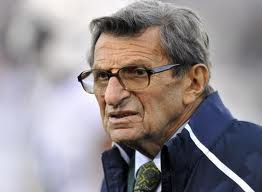
 Joe Paterno coached Penn State U. football for 62 years, and was head coach since 1966.  He passed away on Jan. 22 from lung cancer, after his family honored his wishes and asked that life support be removed. 

  His eulogies focus on his record of most  college football wins.  Paterno, nicknamed “JoePa”,   holds the record for the most victories by an NCAA Division I  football coach  and is the only Division One coach to reach 400 victories (his total is 409, which will never be equalled).  He coached five undefeated teams that won major bowl games and had 23 finishes in the top 10.

    I think the real story is very different.  U.S. college football is an enormous and utterly unfair business.   A study by Drexel Univ. shows “TV revenues from five major athletic conferences     have soared to $1.8 billion per year.”   Current and past spending patterns indicate that colleges are likely to spend all of the new revenue on luxury athletic facilities and salary increases for coaches and athletic directors.  Many coaches get salaries of $1.5 m. or more.  At the same time, the athletes who fuel this revenue (many of them African-Americans from very poor backgrounds) are strictly prohibited from taking any share of this windfall.  They get scholarships but they and their families remain poor, until they leave college and turn pro. Because of this, many top athletes do not finish their degrees but enter the pro draft early.  Many big colleges pay athletes under the table, and some get into trouble when they’re caught. 

    Penn State U. is in State College, Pa., in rural Pennsylvania.  When Paterno  began coaching, Penn State had 9,500 students; today it has 45,000 and is recognized as a major research university. Penn State’s football achievements spurred major alumni/ae donations and helped President Graham Spanier build excellence.  Paterno recruited players by speaking first about Penn State’s academic excellence, and his players had higher graduation rates than other schools.  His integrity kept Penn State out of scandals that afflicted many other football universities.  Paterno himself gave money, supporting (for instance) a penniless program in classics and Mediterranean studies.  Paterno was a graduate of Brown Univ., an Ivy League school, and stressed the importance of education to his players.  It is the ultimate irony that he was fired for ethical breaches, after 62 years of sterling behavior.  “I should have done more”, he said, summarizing his actions in the Jerry Sandusky pedophile scandal.  It is ironic that Penn State is now a pariah, when many other football universities have blatantly violated NCAA rules for years.

   I believe Paterno’s model is catching on. Great academic schools like Stanford U. and Northwestern U., which used to lose in football regularly, now have strong teams that compete against powerhouses like Ohio State and U. of Southern California.  Stanford’s team was 11-2 this year;  Northwestern finished 6-7 (7-6 last year) but play in their conference against schools with huge football budgets.   They recruit, like Paterno, by stressing academics, and fund-raise, like Paterno (indirectly), by leveraging football achievements. 

   The enormous hypocrisy of that $1.8 b. in college sports revenues, mainly from TV, must end. The players who create it, with their bodies, energies and skill, must be given immediate need-based help, to keep them in school and to avoid terrible injustices when, for instance,  U. of Michigan basketball player Chris Webber took money while playing in college, denied it to a federal jury, and got into deep trouble.  Four top Michigan players borrowed a total of $616,000 from a rich supporter. Webber’s contract with the NBA  team Sacramento Kings is valued at $122 m.  Players with such immense human capital should be given financial assistance above board, provided they stay in school and complete their education.

    Paterno’s record at Penn State showed his players had far higher graduation rates than most other schools.  According to a 2011 study:

   The Penn State football team is tied with Stanford for the top Graduation Success Rate (GSR) among teams ranked in the Oct. 30 Bowl Championship Series and AP Top 25 rankings, according to data recently released by the NCAA.   Penn State football student-athletes that enrolled in the University from 2001-04 earned a superlative Graduation Success Rate of 87 percent, tied with Stanford for No. 10 overall among the nation’s 120 Football Bowl Subdivision (FBS) institutions. Penn State’s 87 percent GSR was significantly higher than the 67 percent FBS average and was second to Northwestern (94) among Big Ten Conference institutions, according to the NCAA.

 This is the lesson we should learn, I believe, from his life and work.   It is his legacy. The question is, will anyone pay attention, while focusing solely on his 409 football victories. 

 Innovation/Global Risk

The Fuel of Persistence

By Shlomo Maital  


 Philippe Petit

Leadership educator John C. Maxwell writes a blog, Leadership Wired, which includes this amazing story about young Philippe Petit.   It was sent to me by a young woman who heard my talk on “Creativity + Character = Change the World” at Univ. of Toronto’s Rotman School of Management.  The theme of my talk was the crucial importance of strong character, especially stubborn persistence and resilience, in creating world-changing innovations. 

   According to Maxwell,  in his essay “Passion: The Fuel of Persistence”, Philippe was an 18-year-old French street performer. While searching for venues for his high-wire balancing act, he read about the World Trade Twin Towers in a magazine in a dentist’s office in Paris.  He decided he would walk a tightrope between them.

   He worked on his dream for the next six years. He practiced his high wire act endlessly and saved money for a ticket to America. Petit ascended the Tower on a Tuesday night. With a bow and arrow, they fired a line from the north to the south tower and spent the night securing it.  Early Wednesday morning, petit mounted the high wire.  As thousands watched, the cops gathered to arrest him. Petit focused fiercely on his act, and made eight trips back and forth between the towers.  Then he turned himself in. 

   Your reaction?  Insanity? Madness?  What possible value did Petit bring to the world with his stubborn persistence?  A wasted six years of his life? 

    The value he brought to the world was to create a powerful narrative about the fuel of persistence and passion.  We can only imagine how many powerful arguments were made to dissuade him, to make him give up.  He never did.  In French ‘petit’ means small. But Philippe was anything but.  His dream was huge and his persistence to fulfill it was even bigger.  A great many successful innovators will strongly identify with Petit’s story. 

   As I told my Rotman audience, a survey I did once among Israeli microchip designers found that the two most important factors in successful innovation, according to them, were these:  resilience and stubborn persistence.   These are qualities we do not teach in MBA classes. And like our biceps, they become stronger with practice.  Practice them daily.  If you give up with small things, you will likely give up on big things as well. 

Innovation/Global Risk

Drucker’s Five Basic Business Sins 

By Shlomo Maital  


 George Fisher

 Writing in Bloomberg Business Week, Rick Wartzman reminds us of Peter Drucker’s 1993 essay, on a quintet of “avoidable mistakes that will harm the mightiest business.”   He does this in the context of Kodak’s Chapter 11 bankruptcy, noting that Kodak committed two of these five basic blunders.

   They are:

  • preoccupation with high profit margins.  Kodak’s near-monopoly position in silver-iodide film generated very high profit margins.  It led Kodak to ignore disruptive technologies that began, as always, with low profit margins.

“About 10 years ago, Kodak did try to move more forcefully into digital cameras. It couldn’t figure out how to make money on them, even as it became the leader in U.S. sales. Kodak’s frustrated chief executive officer, Antonio Perez, wound up calling it a “crappy business”… “  It WAS crappy. You don’t need to buy film to make digital photos, only a camera.  But, that’s life. Adapt. Live with it.  Otherwise, you’re a dinosaur.

  • “slaughtering tomorrow’s opportunity on the altar of yesterday.”

“ … In the mid-1980s, a consulting firm called the Index Group predicted in a report to Kodak’s marketing division that digital technology would take over film by 2000.  “They rejected our work and told us it would not happen until after 2020,” says Adam Crescenzi, who helped prepare the Index analysis. “They laughed it off.” “  Disruptive technologies disrupt earlier, rather than later – and even if they don’t, always ASSUME they will…

 The remaining three business sins, according to Drucker, are:

  • “mispricing a new product by charging ‘what the market will bear’;
  • “cost-driven pricing” in which you merely add up your expenses and then stick a profit margin on top.. (always price by value, not by cost),  and
  •  * “feeding problems” while “starving opportunities.”

  I’m quite certain Kodak committed those three, too.  And a few more. Recall how Kodak bought a drug company, Sterling, for a huge price, incurring massive debt, because…its CEO believes its stable of 500,000 chemicals might somehow turn up a winning medicine!  And when it did find itself in trouble, Kodak focused on them, rather than doing as Drucker said, beginning innovation by abandonment (the creative destruction Schumpeter spoke about) before embarking on anything new. 

    It’s always easy in hindsight to run post-mortem autopsies on failed companies. At the same time, it is hard to understand why smart highly-paid executives, including the brilliant George Fisher, who was CEO and Chair of Kodak from 1993 (the year Drucker wrote his essay) through 2000, made several basic mistakes, over a period of years.  As always, ordinary working people pay the price, as their jobs disappear.


Innovation/Global Risk 


The World Is Still Drowning in Debt!


By Shlomo Maital  


    The good news? America is halfway through its deleveraging (debt reduction) process.  The bad news?  The rest of the world is still piling up debt and hasn’t even begun.

  A report in McKinsey Quarterly by three McKinsey scholars * provides a useful summary regarding where the world stands in its deleveraging process.  This is crucial, because until households and businesses feel comfortable with the existing level of debt, they are unlikely to resume their spending and investment and economic growth and job creation are unlikely to resume.  Here are the results:   


  •          Although the debt ratio of US households remains high, they may be halfway through the deleveraging process.
  •        In the United States, household deleveraging may have only a few more years to go, while in Spain and the United Kingdom it has just begun.
  •         … up to 14 percent of UK mortgages could be in difficulty—identical to the percentage of US mortgages in difficulty today.
  •        Significant public-sector deleveraging typically occurs after GDP growth rebounds.  (The World Bank says developed country GDP growth this year will be very weak, only 1.4 per cent). 
  •        The deleveraging process that began in 2008 is proving to be long and painful.   The unwinding of debt—or deleveraging—has barely begun. Since 2008, debt ratios have grown rapidly in France, Japan, and Spain and have edged downward only in Australia, South Korea, and the United States. Overall, the ratio of debt to GDP has grown in the world’s ten largest economies.      


Fasten your seat belts.  More lean years are ahead, as the massive amount of debt continues to grow in most countries.


 * Working out of debt . McKinsey Quarterly, JANUARY 2012 . Karen Croxson, Susan Lund, and Charles Roxburgh .

Innovation/Global Risk

A New “Kodak Moment” – Going Bust!

By Shlomo Maital  

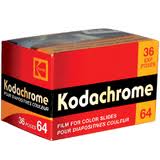
Kodachrome, they give us those nice bright colours

They give us the greens of summers

Makes you think all the world’s a sunny day, oh yeah

I got a Nikon camera, I love to take a photograph

So mama don’t take my Kodachrome away

– Simon and Garfunkel

  Remember the “Kodak moments”?  Remember when Eastman Kodak sold nine out of every 10 rolls of film in the United States?  Remember when Kodak was a generic term for camera, and when its gross margins were 70 per cent?  Yesterday, Kodak filed for Chapter 11 bankruptcy.  It will continue to operate while trying to pay off its massive debts. Kodak does have strong revenues, from its digital imaging and printer business, but its losses over the years have created a mountain of debt that it can no longer service.

   What is the lesson we can learn from Kodak – and from other giants before it, who ‘owned’ their industry (AT&T, Xerox, NCR)?   Strategic agility!  Kodak actually invested huge amounts in digital photography.  According to The Economist, “extensive R&D contributed to Kodak’s undoing,  since the firm ended up pioneering the very digital cameras that went on to kill its core business.”  Kodak did not miss the digital camera trend. It simply flopped at riding the wave.  Why? Silver-iodide photograph is chemistry. Eastman Kodak was tops in chemistry, and even had a huge chemicals business.  Digital photography is electronics. Kodak never did build the key core competency in electronics, and perhaps never really could match the capabilities of true electronics firms like Japan’s Canon and Sony.

   So, yes, Simon & Garfunkel, they have indeed taken away our Kodachrome.  And it was not inevitable.  Kodak should have acquired an electronics company, realizing this was the key core competency it lacked.  It could have done so when it dominated its industry. It should have done so, had it been strategically agile.  But Kodak, like so many elephants, never did learn to dance.  It never did ask the late C.K. Prahalad’s core question: What is the core competency we need at this moment? Do we have it?  How can we get it, fastest? 

    Good bye, Kodak.  Perhaps other huge companies will learn from your demise.  But I doubt it.

Innovation/Global Risk 

Nature’s Resilience: Bacteria “Eat” the Gulf Oil Spill

By Shlomo Maital  


 oil-eating bacteria


According to the BBC World Service program “Science in Action”,  the disastrous oil spill in the Gulf of Mexico, caused by a massive ‘leak’ in a British Petroleum oil well “Macondo 252”, has been effectively battled – not so much by cleanup crews as by Nature itself.  At times, 53,000 bbl. of oil a day spilled into the lovely waters of the Gulf.   But the oil sounded a ‘dinner bell’ for Nature —  Hey, lunch is served, come and get it!  And the bacteria came. 

    As their food supply expanded,  the bacteria themselves ‘bloomed’, meaning they reproduced very quickly and grew huge colonies around and in the oil.  Nature very quickly assembled bacteria for whom hydrocarbons were tasty.   The cleanup crews used chemicals to break up the oil, and at times the chemicals themselves were worse pollutants than the crude oil. 

   According to reporters, there are still clumps of tar on the beaches along the Gulf Coast, which makes its living from both oil wells and from tourism.  But for the most part, Nature has been far faster and far more effective in cleaning up the mess than anyone expected.  Some 800 m. liters of hydrocarbons spilled into the Gulf. Around one quarter was cleaned up by humans.  The rest?  Leave it to Nature.  According to the Scientific American, as much as half of these 800 m. liters have already been eaten up by bacteria.  Many of the bacteria are new forms, not familiar to scientists, that perhaps have evolved in response to the huge and unexpected ‘feast’.  And yes, the tar balls ARE a big problem, as they spread across beaches and the world’s oceans. 

   But again, Nature has proven that it is not only humans who are resilient, but Nature itself.   If only we humans could help miraculous Nature protect itself, rather than dump ever-larger messes on it and test the innovative power of natural evolution.

Innovation/Global Risk

Fight Groupthink – Demand Space & Time – or Chats

By Shlomo Maital  


  Steve Wozniak 


Writing in the Global New York Times, Jan. 13, Susan Cain observes that “Research strongly suggests that people are more creative when they enjoy privacy and freedom from interruption.”  Wow, amazing.  But she does have a serious point:

   “…the most spectacularly creative people in many fields are often introverted, according to studies by the psychologists Mihaly Csikszentmihalyi and Gregory Feist. They’re extroverted enough to exchange and advance ideas, but see themselves as independent and individualistic. They’re not joiners by nature.”

  For innovators, this can be a huge problem, especially within large organizations. Much R&D is done in teams, with hierarchical organizations.  Truly creative people, introverted ones, often don’t function well in such environments. 

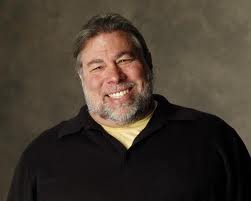
   But as with all issues related to creativity, there are no hard and fast rules. Cain herself, in a recent book, gives Jobs partner Steve Wozniak some well-deserved credit:

   “Before Mr. Wozniak started Apple, he designed calculators at Hewlett-Packard, a job he loved partly because HP made it easy to chat with his colleagues. Every day at 10 a.m. and 2 p.m., management wheeled in doughnuts and coffee, and people could socialize and swap ideas. What distinguished these interactions was how low-key they were. For Mr. Wozniak, collaboration meant the ability to share a doughnut and a brainwave with his laid-back, poorly dressed colleagues — who minded not a whit when he disappeared into his cubicle to get the real work done.”

  Steve Jobs was a loner. Steve Wozniak was a collaborator and socializer. Both were exceedingly creative. 

   The message here is: Innovator, who are you really?  Need solitude?  Create it. Need socializing?  Find it.  Find your own unique creative style, and create your environment to optimize it. 

Innovation/Global Risk 

 Friday the 13th: S&P, Euro & a True Horror Movie 

By Shlomo Maital   


On Friday Jan. 13, the latest sequel in Europe’s ongoing horror movie played out.  The bond-rating agency Standard & Poor did the following:

  … S&P lowered the top ratings of France and Austria one level to AA+, with “negative” outlooks, while affirming the ratings of countries including Germany, Belgium and the Netherlands. The company also downgraded Italy, Portugal, Spain and Cyprus by two steps and cut Malta, Slovakia and Slovenia by one level.  The EFSF, the euro-region’s bailout fund needed to tap markets to finance aid for Greece, Ireland and Portugal, may lose its top rating if any of the bailout fund’s guarantors face a downgrade, S&P said.

    Friday the 13th is a 1980 American horror film directed by Sean S. Cunningham and written by Victor Miller. The film is about a group of teenagers who are murdered one-by-one while attempting to re-open an abandoned campsite.  European leaders are doing a brilliant rewrite. Drop by drop, one by one, their waffling, indecision, egoism and selfishness are driving the value of the euro down (to a new 11 year low re the yen) and making a disorderly Greek default  even more likely. 

    You thought there was agreement on a 2nd Greek bailout?  What was agreed, we now learn, was a 50 per cent ‘haircut’ (reduction in the face value of Greek bonds) by the banks. What was NOT agreed was the interest to be paid in the interim, nor the maturity (when the 50 per cent would be paid).  There is now deadlock on these key issues.  Great work, Europe!  You had us fooled. We actually thought you had hammered out a deal.  Well, dumb us! 

     S&P has been hammered by the French PM Francois Fillon, claiming its decision is “political”.  Wrong, Fillon!  S&P has at last told the truth! In its statement, S&P questioned whether Europe can “austerity” itself out of the crisis, noting that only economic growth will generate the tax revenues needed to pay outstanding debts. And there is no European growth policy in place at present, only austerity. 

   I think that in the wake of Friday the 13th (Europe’s version of the horror movie), disorderly Greek default has become virtually certain, and the world knows it. Europe continues to drag the global economy down with it, as one by one debt-ridden European countries fall, like the teens in the 1980 movie. 

   Perhaps some of us can bring European leaders to the International Court of Justice, on the grounds of committing crimes against humanity?

Innovation/Global Risk 

Johnny Cash: How His Career Began in Folsom Prison 

By Shlomo Maital  


 Johnny Cash  & June Carter

 Johnny Cash was one of America’s greatest country music singers, popular far beyond country fans.  His career took off in large part because of a bold risk he took – he appeared before inmates in Folsom Prison, sang the song he wrote about Folsom, and then issued an album based on his live performance.  It is regarded as one of the greatest albums ever. 

I hear the train a comin’, It’s rollin’ ’round the bend,

And I ain’t seen the sunshine, Since, I don’t know when,

I’m stuck in Folsom Prison, And time keeps draggin’ on,

But that train keeps a-rollin’, On down to San Antone. 

   According to Wikipedia, Cash was inspired to write this song after seeing the movie Inside the Walls of Folsom Prison (1951) while serving in West Germany in the United States Air Force. Cash recounted how he came up with the “Reno” line: “I sat with my pen in my hand, trying to think up the worst reason a person could have for killing another person, and that’s what came to mind.”

 When I was just a baby, My Mama told me, “Son,

Always be a good boy,  Don’t ever play with guns,”

But I shot a man in Reno, Just to watch him die,

When I hear that whistle blowin’, I hang my head and cry.

Cash brought along his girlfriend June Carter, also a country singer. Her performance is also on the album.  Cash got a great reception; Carter, as one can imagine, got a roof-raising one. 

 I bet there’s rich folks eatin’,  In a fancy dining car,

They’re probably drinkin’ coffee,  And smokin’ big cigars,

But I know I had it comin’,  I know I can’t be free,

But those people keep a-movin’, And that’s what tortures me.
  

     What I learn from this episode is this:  In a career, the shortest distance between two innovative points is almost never a straight line.  In Cash’s case, it was a crooked line (literally), that ran through Folsom Prison.   Cash had a rapport with the inmates and you can hear it in the album.  It showed he was not a spoiled country star but a real person, a working class singer who understood those he sang for and sang about.    Innovator:  In your career, innovate not just products or services. Innovate your career.  Take crooked paths to your destination. Take risks.  Go where others don’t dare.  You won’t regret it .

    Cash performed  at Folsom Prison itself on January 13, 1968 and the At Folsom Prison album was released the same year.  His career took off, and lasted several decades.   


     Folsom State Prison is  located in the city of Folsom, California. Opened in 1880, it is the second-oldest prison in the state of California after San Quentin. Folsom was one of the first maximum security prisons, and as such did the execution of 93 condemned prisoners over a 42-year period.


Blog entries written by Prof. Shlomo Maital

Shlomo Maital

Pages