Global Crisis/Innovation Blog

Greece, The Movie:  If You Liked Lehman Bros., You’ll LOVE This One!

By Shlomo Maital

  If you enjoyed the dramatic movie featuring Lehman Bros.’ failed rescue and bankruptcy, starring Barclay’s, Treasury Secretary Paulson, Fed expert Geitner, and a cast of thousands, you must not miss the latest version. It’s called Greece – the Latest Bailout.   Here are the details, according to the New York Times ‘systemic risk’ reviewer Liz Alderman (June 5/2011):

   “A year after providing an aid package of 110 billion euros, or $161 billion at current exchange rates, officials are considering whether to lend Greece an additional 50 billion or 60 billion euros as the country struggles with a deep economic downturn.  Even if Greece is pulled from immediate danger again, economists say, European leaders face the prospect of providing still more aid over the next several years if Greece cannot revive its economy.  “I don’t see how Greece can eventually avoid some kind of default,” said Martin N. Baily, a senior fellow at the Brookings Institution, who served as chairman of Council of Economic Advisers under the Clinton administration. “It’s hard to see how you can avoid the need to finance this over the next five to 10 years.”  ”  (NYT

   Greece can’t redeem its bonds without new borrowing and without extra tax revenues. Taxes are down, because the economy is down, because there is deep distrust of the government’s ability to manage the country.  New borrowing is tough, because markets are becoming increasingly fearful.  And interest rates are rising, increasing the debt burden even more.  Greece is heading toward a debt burden of 160 per cent of its GDP, which is unsustainable.

   But here is what nobody is saying openly.  If Greece falls, like Lehman Bros. it will take down many other players far away from Greek shores.  American and Chinese banks apparently have very large exposure to Greek debt and will lose heavily in the event of a Greek debt default, even a partial one. (The word used is “restructuring”, which in simple language means, wiping out a major part of the debt).  This is partly why there is heavy external pressure on Europe to bail Greece out again..and again, and again.  There is serious systemic risk here, because a Greek default would shake the system and cause severe shock waves, just like Lehman Bros.

    The rescue of Greece depends on Germany’s OK, and for the moment Germany is not cooperating.  Germany is fed up with bailing out those incompetent Greeks, as they see it. 

   I’m certain Greece will eventually leave the euro and restore its currency, the drachma. There will be a major short-term crisis, because Greece’s euro debt will largely be in default. There will be inflation, a serious devaluation – and a new beginning for Greece.  This may be the model for Portugal and Ireland as well.  The question is, how long will it take before serious leaders bite the bullet and do the inevitable?  How much systemic risk will we have to endure, until someone steps up to the plate and takes charge and tells the truth?  And how many more times will American banks have to be bailed out, at the expense of ordinary working people?  The people of Greece deserve better.   

Global Crisis/Innovation Blog

1937 – 2011:  Does History Repeat Itself? 

 By Shlomo Maital 

   Santayana’s famous statement, those who forget history are doomed to repeat it, is generally untrue, because history rarely repeats itself, but rather finds new and creative ways to take its revenge on stupidity, greed, and amnesia. 

     Take for instance, the 2007-9 global crisis, which is now becoming the 2011-13 global crisis.  Why?

      In 1929 a stock market crash and then repeated crop failures signaled the onset of the Great Depression in America and then the world.  By 1936-7, the U.S. economy showed signs of recovering.  But in his New York Times column (International Herald Tribune, Sunday June 5), Paul Krugman quotes a Fed expert, who suggests America may be doing in 2011 what it did in 1937 – “pivot”, shift its attention away from the key issue, jobs and job creation, toward other issues.   When it did so, America’s economy again dipped into recession – one that ended only when World War II broke out and led to massive government spending. 

    In the same newspaper, a headline recounts, “US hiring brakes abruptly, stoking worries about recovery”.  In May, after months of job growth, unemployment rose to 9.1 per cent, and only 54,000 non-farm jobs were added, compared with the average of 220,000 in each of the previous three months. 

    The situation is even worse than the data suggest.  Many of those new jobs are low-paying Wal-Mart service jobs.  Very few are well-paying manufacturing jobs.  As we speak, the Fed is ending its quantitative easing program (buying bonds) and is under pressure to raise interest rates, like the European Central Bank.  Krugman says America has repeated a version of the 1937 mistake – withdrawing fiscal support too early and thus perpetuating high unemployment. And, he warns, it may get worse, with Republicans demanding more spending cuts.   The result is a very weak recovery that is rapidly losing steam – and as people realize it, the gloom this creates, and the panic, will make things worse.  Nor is there strong political leadership to take the helm and tell the people hard things.

     No, history does not repeat itself.  But it takes revenge on those who fail to learn from it. 

 Innovation Management

 We Missed Towel Day! So – Reread the Hitchhiker’s Guide to the Galaxy!

By Shlomo Maital


 Adams’ favorite phrase on his book’s cover: Don’t Panic!

Yikes! Innovators! We missed Towel Day in this blog!  Towel Day is May 25. It was launched by fans of Douglas Adams, author of the wildly imaginative five-book trilogy, The Hitchhiker’s Guide to the Galaxy, by Douglas Adams.  Adams died suddenly of a heart attack on May 11, 2001.  Once he stayed at a friend’s
beach house. He realized each day that he could never remember where he had
left his towel, the day before. One of his friends then came up with  a saying to define competent people: “someone who knows where his towel is”.  Adam uses
this phrase in his first book.

Adams believed in an aleatoric (random) universe.  In one of the most creative passages, you may recall, a super-super computer Deep Thought (a la Deep Throat) works for 7.5 million years (far longer than it took to produce humans) to find the Ultimate Answer (to an Ultimate Question, which remains forever unknown).  At least Deep Thought gets it!  The answer is…  42.    Adams was utterly uninhibited in all of the five Hitchhiker books.  He was fearless.  He wrote whatever he felt like, he never wrote for critics, he never feared ridicule, he never sought fame, fortune and bestseller-dom, he never wrote to a formula, and he never repeated himself in any of the five books.  All are wildly imaginative, in different ways, inventing characters so impossible they are believable. For instance, the Babel fish, a tiny leech thing that you put in your ear, that translates the brain-wave words of any creature in the Galaxy directly into your brain,  undoing the punishment G-d gave us for the Tower of Babel. 
This creature, Adams writes, by facilitating seamless communication between different races and cultures, “caused more and bloodier wars than anything else in the history of creation.”   Imagine if our enemies and foes could know instantly what we thought of them. Or, for that matter, our significant others….!?

Innovator, if you feel the creative juices  ebbing, pick up one of the Hitchhiker books at random, read a few passages, anywhere in the book – and then take chances, like Adams.  And keep a towel around, a small one, as a reminder.   But on second thought – don’t bother, you’ll probably forget where you put it.    

Innovation Management 

The Best Way to Predict the Future: Read The Dynamics 

By Shlomo Maital


EURO ECG terminal doom loop

Peter Drucker’s famous quote, the best way to predict the future is to create it, has become a worn cliché.  And it’s probably one of his least pragmatic sayings – very few of us can truly create the future, or even shape it significantly.

    Yet, we still can predict the future – by ‘reading’ its dynamics.  Here is what I mean.

    Europe, led by Germany, has been doing a long and futile dance with debt-ridden countries like Ireland, Greece, Portugal, even Spain.  Greece and Ireland got bail-outs that really bailed out major EU banks and put ordinary citizens into deeper debt.  Where is this heading?  What is the future of the euro?

     Let us ask, what is the key dynamic at work here? It is this.  Interest rates all over the world are rising. They have to, after years at rock-bottom, and as inflation gains.  Against the background of rising rates, bond markets are becoming more and more panicky about Greece’s ability to avoid defaulting on its bonds as they mature.  When this happens, the interest rate on Greek borrowing rises.   This, in turn, makes it even harder for Greece to pay back bondholders by borrowing new money – which is the only way Greece can avoid default.  So this makes the bond market even more nervous.  …and so on.  In system dynamics, this is known as a doom loop.  And it is driving events as we speak.  Higher interest rates increase fears of default, leading to higher interest rates, leading to more fears of default, leading to even higher interest rates…and so on. 

    Ireland’s Transport Minister let the cat out of the bag, by saying Ireland would probably need another bailout.  (The Finance Minister quickly denied it, but it was too late – Ireland’s doom loop was set in play).  Greece obviously needs a second bailout – and then a third.   At some point, Germany is going to say, enough!  And at last, when Greece restores its drachma and its sanity, the doom loop will end.  When Ireland stops scalping its citizens to reward greedy bankers, the doom loop will end. 

     When we read its dynamics clearly, the future can tell us now, in the present, where it is heading, or at least where it is heading if current trends persist.  Ask, what is the dominant driving dynamic ‘loop’ now at play?  Is it doom or boom? If boom, is it sustainable?  If gloom, how does it end? 

     These words are turning my hair white, because the driving ‘loop’ here in the Mideast is definitely not a serene one. 

Innovation Management 

New Way to Keep Warm:  Love Those Penguins!

Collaborating Beats Competing 

By Shlomo Maital 


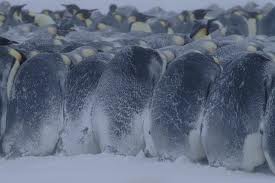
 Emperor Penguins huddling in a fierce blizzard

ABC On-line and BBC World Service both report on an amazing new study of Emperor penguins and how they stay warm in frigid tornado-speed winds.  A team of scientists set up cameras that took pictures of them every 1.3 seconds.  We all know the penguins huddle together to save energy.  But what about the losers on the outside?  Isn’t it “survival of the fittest”?  The weakest get shoved to the outside and don’t survive, thus ensuring that the gene pool sorts itself out on strength and ‘sharp elbows’?  This is how things work in capitalism, right?  That’s how Wall St. works. 

    Well, apparently not.  That’s not how these penguins think.

    Problem is, explains Daniel Zitterbart, from the Univ. of Erlangen-Nuremberg, Germany, “if the huddle is too loose, the penguins freeze. If the huddle is too tight, you can’t move at all.”

    Solution?  Collaborate. 

  “The cameras revealed that every 30 to 60 seconds, a penguin or group of penguins would start to move a little. This sets off a chain reaction, with surrounding penguins moving as well. The movement spreads quickly, much like a wave, Zitterbart was quoted as saying. The wave is nigh-on invisible to the naked eye in real-time, but allows smaller groups to merge into larger huddles. The cameras also revealed that as the wave hit the front of the colony, a few penguins there would work their way to the back of the pack. As a result, the warmth would be shared as the penguins travel through the colony.” 

   Now, here is the major question.  If a group of  relatively dumb Emperor penguins can find an ingenious way to collaborate and keep everyone warm and alive in impossibly frigid conditions – why can we genius human beings not do the same?  

   What about putting a group of the Wall Street maniacs who destroyed the world in 2007-8 out on an Antarctic ice flow and see what their massive brains come up with, in the 30 seconds before their toes and fingers freeze?     

Global Crisis/Innovation Management

When Management Becomes Feminine:  Lessons from Medicine

By Shlomo Maital


Meg Whitman who as CEO built eBay, 1998-2008

This blog space has often made the case, supported by evidence, that women are more suited to become business leaders and entrepreneurs than men, because evolution has given them superior skills in communication and collaboration. I’ve even proposed launching an investment fund that invests in businesses led principally by women. 

   Today a modest, page 5 Global New York Times article * gives me added fuel.  Apparently, more and more doctors are women, in the U.S., especially among young doctors; “half of all younger doctors are women and that share is likely to grow”, notes the author, Gardiner Harris.    Why?  Having a private practice in medicine in the U.S. has become a huge hassle, with enormous medical liability insurance bills, endless paperwork and other obstacles.  Little time is left to practice real medicine. Moreover, running a practice is like running a demanding business, and saps energy and time that should be spent with the family.  Women skip this from the outset, so they can be mothers and wives as well as doctors.  The result has been to greatly strengthen hospitals and health care providers (HMO’s), where more and more women doctors choose to work.  For the first time, the powerful AMA American Medical Association supported the Obama health care reforms, when in the past the AMA has fiercely opposed any such reform.   Women seem to be the reason.

    Let us hope that the same phenomenon revitalizes entrepreneurship and management. Let’s hope more women are promoted to become senior managers.  As this happens, working hours will become normal, as women choose to balance work and family.  This will benefit male managers, too.  And we will also see more women entrepreneurs, as female role models show how it is entirely possible to start a business and start a family, at the same time.  This, in turn, will have an echo effect, permitting more men to balance work and life. 

     Generation Y is reluctant to follow in the ruts created by the baby-boomers, who sought wealth at all cost and were left, in many cases, without friends or family.  Generation Y wants to have a life, not just a job.  That creates opportunities for women.  Now, all that is needed is the recognition among the dominant men that women are a key resource. 

      Women are different from men.  Vive la différence.  It’s time we stopped wasting the valuable resources that difference embodies.

* Gardiner Harris, “As doctors’ jobs change, their priorities do as well”.  Global NYT May 31, p. 5.

Global Crisis Blog 

Is the Arab “Spring” Headed for a Fall?  Why Political Democracy Needs Money

By Shlomo Maital

  A lot of romantic ink has been spilled on the Arab Spring, the incredible outpouring of popular democracy in Tunisia, Egypt, Yemen, Syria, Libya and elsewhere, that has toppled or will topple despots, led by idealistic non-violent young people using social networks.  Here in Israel, there are deep fears that this process will destabilize the whole Mideast and lead to consequences no-one can predict.  But in general, over the long run, the culture of democracy, if it takes root in Arab nations, will be a far more fertile seedbed for peace than despotism and dictators, who use Israel as a distraction for the ruinous way they run their economies, or Islamic fundamentalism, which substitutes religious fanaticism for modern technology and progress. 

   However, there is reason for concern that the Arab Spring may be headed for a fall.  Speaking on BBC, a young Egyptian woman who helped lead the Tahrir Square uprising said forcefully, we do not want American money or interference of any kind.  I’m afraid she reflects general thinking of these young revolutionaries.  They do not understand that in order for political democracy to survive, it will have to be supported by large amounts of foreign investment, to create dynamic growing economies with jobs for educated young people.  Egypt, Tunisia, Syria, Libya, Yemen, these countries cannot even begin to fund the huge infrastructure investments that they need. The World Bank has promised some aid, but it is hugely inadequate.  The G8 leaders meeting in Deauville, France, make promises, but they are usually empty and hollow. 

     The best-case scenario is that the new Arab political democracy will be supported by savvy businesspersons, who will find ways to attract foreign investment.  In Egypt this is unlikely, because the oligarch businesspersons were in bed with Mubarak and have been discredited.  In Yemen it is possible – the main opposition to Yemen’s dictator is its wealthiest businessman.  In Libya, Gaddafi has stowed away billions, which could be used to rebuild the country, but will the Libyan reformers manage to get their hands on them? 

     Somehow, the West must find a way to tell the young Arab revolutionaries that it is time to come down from the clouds, to earth, and find practical ways to build new modern economies.  This will take enormous amounts of money. Where will it come from?

   And by the way – don’t count on the oil-soaked Saudis, Qataris, Bahreinis and other oil-rich nations.  They’re too busy buying English Premier League teams and building useless skyscrapers and artificial islands.   Why would the rich Arab nations even think of investing their huge resources into building new lives for the poorer Arab nations?     

Innovation Management

Are We Crippling Our Kids’ Creativity?  The Dilemma and a Solution

By Shlomo Maital

  Everybody knows the most creative nation in the world is the nation of five-year-olds.  Small children have not yet learned the ‘rules’, what is possible and real, and what is not. So in their world, everything is real, everything is possible. As a result, their imaginations run wild.  Then we send them to Grade One – and methodically we stamp out their imaginative powers. And we buy them games and toys and show them TV shows and movies where everything is incredibly real, in each detail, leaving no room for the imagination.

    Here is what one of my blog readers, Anne Marie, from Singapore, notes about her own childhood:

    I actually grew up in the Philippines, and growing up with just the basics, as a child I didn’t have the privilege to have so many toys and technology before in a third world country is not even starting. But I am glad I did (and not even spoiled by my parents with all these toys) – it is because, I could clearly recall that I was only given a ball, a stick and some elastic bands, and from these three I was able to create hundreds of games with my   playmates. I remember my childhood was so much fun. Now, I can see my nieces and nephews stuck in their computers, playing in a virtual world, but not an ounce of creativity at all! I sometimes shut their computers to test, and give them the basics… but how very minimum is the number of games that they can think of! But I am not giving up. A young mind is easier to train, so we will wait and see….

Thanks Anne Marie! There is a solution.  Purposefully choose your children’s toys and games and spare-time
activities, to foster imagination.  There are still many such games available.  If you wish, make your own toys, out of cardboard and paper and sticks.  Challenge them to create things, rather than prefer things that are already created.  And when your child comes home and says he or she solves an arithmetic problem in an unusual way, and got a big red X on it from a rigid teacher – tear a strip off the teacher and the teacher’s principal, and tell them about why you think children should be encouraged to be creative, rather than have their creativity doused by thoughtless in-the-box taskmasters.

    It is not inevitable that kids should lose their creativity in school.  This process can be stopped. But to do so it not easy.  Take up your responsibility as a parent, and spring into action, before it is too late. 

Innovation Blog

Rewarding Entrepreneurs Who Leave School:  Why “Stopping Out” Beats “Dropping Out”

By Shlomo Maital


 Goethe:  ..but doing is best of all

 College student:  Do you have a business idea that can change the world?  Want to get to work and tackle it?  But, wait, you have a pressing exam in Medieval Shoelaces 101 and then another in Philosophy of
Navel-Staring in Ming Dynasty China?   Oh well…you’ll have your degree in another two years of desperate boredom.

   But wait!  There is a solution.  Facebook investor Peter Thiel has a foundation that gives grants of $100,000 to innovators – provided they leave school!   Well, not exactly ‘leave school’ – that’s not a great idea.  But ‘stop out’,
leave temporarily, for two years, to build a business idea, rather than ‘drop out’, forever.    The story about Thiel
appears in Douglas  MacMillan’s ‘top story’ in Bloomberg Business Week, May 25 issue. 

Last fall, Princeton University sophomore Eden Full began to consider taking a break from school to turn her side project—a solar panel that rotates without using electricity—into a business.  In April, Full got all the motivation she needed when she was told she had won a $100,000 grant. The catch: She has to leave school for at least two years. “It’s time for me to go out and try things in the real world and make mistakes and learn from those mistakes,” says 19-year-old Full.  Full is one of two dozen young entrepreneurs named today to the 20 Under 20 Fellowship. 

Naturally, educators hate the idea.  Says Brian Rosenberg, President of Macalester College in Minnesota,  “Mr. Thiel’s program seems not unlike luring college athletes out of degree completion with the promise of a career
in the NFL or NBA.”     Ever heard of Lebron James, Mr. Rosenberg? 

   Among the grant recipients: 

  • Eden Full,   “who will use her grant money to move to SanFrancisco in August and speed up the process of patenting and licensing her solar panel technology. Years of tinkering in science had led her to come up with a contraption for increasing solar panel energy collection by up to 40 percent, partly by removing the electricity commonly used to rotate panels toward the sun.”
  • Gary Kurek, “a 19-year-old in Alberta, Canada, who was awarded a Thiel Foundation grant. “After
    graduating from high school last year, Kurek was offered a full engineeringscholarship at the University of Calgary. Instead, he decided to take a year off and build his business, a maker of motorized walkers for the elderly called GET Mobility Solutions.   Kurek plans to move to San Francisco in September and invest some of the $100,000 in testing and refining his walker product. Then he hopes to begin selling models to hospitals and assisted-care facilities.”

 I like to think of Thiel’s program not as ‘stopping out’ but enrolling in Innovation University, a school where you learn hands-on, by doing innovation, where the lessons are sometimes tough and bitter, the rewards huge, and the learning?  Well, which is a richer learning environment, a classroom, or the real world?  Which is better, thinking, memorizing, or doing?  As Goethe said:  Thinking is  better than knowing – but doing is best of all.

Global Crisis Blog

The European Central Bank is a Logic-Free Zone: A EUlogy for the EUro

By Shlomo Maital


Writing in today’s New York Times (May 22), Nobel Laureate Paul Krugman, whose creative thinking made all of us rethink trade and geography, tears a strip off the European Central Bank (ECB) and its retiringhead Jean-Claude Trichet.  

   Krugman notes how in the U.S., a fierce debate rages between those who think government spending should be maintained,as the only prop under a flagging economy characterized by uncertain consumers who fear for their jobs,  and those who think government spending should be slashed, to halt the implacable rise in stifling debt.  But in Europe?  It’s all about austerity:

In Europe … the pain caucus has been in control for more than a year, insisting that sound money and balanced budgets are the answer to all problems. Underlying this insistence have been economic
fantasies, in particular belief in the confidence fairy — that is, belief that slashing spending will actually create jobs, because fiscal austerity will improve private-sector confidence.

   Despite a total lack of evidence on behalf of the “pain caucus”, Trichet continues to back it.  The result is catastrophic for Greece,  as well as Portugal, Ireland, and perhaps Spain.  Greece desperately needs debt
relief.  But under Trichet, backed by Merkel and Germany, it will never get it.

….. the E.C.B. is acting as if it is determined to provoke a financial crisis. It has started to raise interest rates despite the terrible state of many European economies. And E.C.B. officials have been warning against any form of debt relief — in fact, last week one member of the governing council suggested that even a mild
restructuring of Greek bonds would cause the E.C.B. to stop accepting those bonds as collateral for loans to Greek banks. This amounted to a declaration that if Greece seeks debt relief, the E.C.B. will pull the plug on the Greek banking system, which is crucially dependent on those loans.

  I believe Greece has no alternative. Faced with a stubborn, unyielding Central Bank (remember, the ECB is also Greece’s Central Bank, not just Germany’s),  Greece has no choice but to withdraw from the euro system, return to the drachma, devalue the drachma by half, and relaunch its economy, while restructuring its debt burden unilaterally, with the government assuming much of the bank debt and repaying it over an extended period.
This will involve much short-term pain, but long-term gain.  There is no time to lose; the longer Greece waits, the harder it will be.  And don’t count on Trichet’s replacement to be any different;  he too will be a pro-pain pro-austerity advocate. 

   Krugman concludes:

    If Greek banks collapse, that might well force Greece out of the euro area — and it’s all too easy to see how it could start financial dominoes falling across much of Europe. So what is the E.C.B. thinking?  My
guess is that it’s just not willing to face up to the failure of its fantasies. And if this sounds incredibly foolish, well, who ever said that wisdom rules the world?

   When a central bank makes a region with some 380 million people a “logic-free zone”, the whole world is put at risk.   Prepare your EUlogy for the EUro.

Blog entries written by Prof. Shlomo Maital

Shlomo Maital

Pages