Innovation Blog

Can Intel Innovate?   Toward 3D Chips

By Shlomo Maital

Celebrating My 500th Blog!



 Intel 3D Transistor


 Can Intel innovate? Of course they can – they develop new microprocessors and chipsets every year.

  But again – can they really innovate?

  On a visit to an Intel building here in Haifa, I once chose to take the stairs instead of the elevator.  In the staircase was a prominent sign:  Hold On to the Handrail!  And I thought – how in the world can an organization foster innovation and risk-taking, when it cautions its workers to hold on to the handrail?  In innovation, there are no handrails – only chasms. 

   According to PCMag.com,

  “Intel will begin high-volume manufacturing of chips featuring the world’s first three-dimensional transistor, the company said Wednesday.   “The gains these transistors provide are really unprecedented,” said Bill Holt, senior vice president and general manager of Intel’s technology Manufacturing Group at a press conference in San Francisco.   Intel will introduce its 3D transistor design, called Tri-Gate, as it transitions to its next-generation, 22-nanometer silicon manufacturing process at the end of this year and through 2012, Holt said. Tri-Gate transistors will be used in all of Intel’s product lines, from high-end server chips to the tiny, low-power processors that go into mobile devices like smartphones and tablets, including the Atom embedded processor. The 3D transistor will be a standard part of Intel’s 22-nm process, and its factories will be upgraded to support the new technology, executives said. “

    What does all this mean in simple language?  According to Intel Architecture Group Senior VP David (Dadi) Perlmutter,  with the new 3D technology,  the electrons go “up, left, and down.”  Previously, they just went left or right.   According to PCmag.com, “Perlmutter said that the improved transistor will result in improved processor performance, although he declined to say whether clock frequency would be increased as a consequence. Users should also expect Intel’s notebook chips to run at even lower power consumption at the same clock speed, potentially extending battery life further.”

   Perlmutter has led two previous Intel revolutions.  He and two friends, as relatively junior Intel engineers in Israel, persuaded Andy Grove to reverse a key decision and instead of going with RISC technology, remain with SISC and develop the Pentium, continuing backward compatibility with previous Intel microprocessors. Later, Pentium led development of the Centrino chipset, which reversed a cherished Intel business design by giving up some power for longer battery life and cooler chips (“Unwire your world”).  Now, Perlmutter seems to be taking Intel toward 3D technology, trying to regain lost ground in the smartphone market in particular. 

    Can Intel innovate?  Let’s watch carefully whether the 3D adventure yields bottom-line results. 
Innovation Blog

Putting Capitalism Into Orbit: Can Private Enterprise Put Americans Back Into Space?

By Shlomo Maital

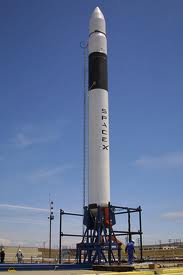
   Falcon 1 Rocket (SpaceX)

A decision by President Barack Obama, desperately strapped for cash, has ended the NASA space shuttle program.  The flight of Discovery this month , and a last flight in June, will mark the last time Americans will go into orbit in an American space vehicle. From now on, Americans will reach the ISS (International Space Station) on Russian Soyuz rockets.  Last month, the U.S. House and Senate  approved a spending plan for the remainder of the 2011 fiscal year that cuts NASA’s total budget by $241 million from 2010 levels, to $18.48 billion.  Meanwhile, America continues to build costly aircraft carriers, at $6 b. a pop.  Why does America need more aircraft carriers?  Is this truly a good use of America’s now-scarce resources?   Are Americans pleased that they need Russian help to get their astronauts onto the Space Station?

   The theory is that the gap will be filled by private enterprise and innovation, driven by the profit motive.  But it is an open question whether space can truly be profitable, in the near term.  Many believe space is a public good – one governments must provide, because the spillover benefits, hard to capture by private capital, are very large. 

    One of the most interesting private initiatives is that of Elon Musk, PayPal entrepreneur, who is using his billions earned from PayPal (on-line payment by credit card) to launch SpaceX, a startup that is building space rockets.  The launch of Falcon 1 last year was a big success, and showed Musk’s ability to put half a ton into space orbit.  Eventually, Falcon 9 will be ready, and it will be capable of putting 25 tons into orbit!  The key, it turns out, is saving weight.  This is done by using carbon composite material, a kind of papier mache process that provides more than the strength of steel or aluminum with a fraction of the weight.    

    Meanwhile, Richard Branson’s Virgin Galactic is testing a vehicle aimed at putting people into space (not into orbit).  It launches from a plane, at 45,000 feet, thus solving the high-risk stage of ground-based rocket launch.  Already, some 400 people (including Elon Musk) have signed up for a ride into space, at $200,000 per person.  Some have paid in advance, to ensure a ride on one of the earliest rockets. 

      Will private enterprise, capitalism and entrepreneurship keep America in space?  Time will tell.  Space is an expensive technology.  The question is, can governments who want their nation to remain a technology leader afford not to invest in it? 

Innovation Blog

 How the Chocolate Chip Cookie Crumbles: How Ruth Wakefield’s Experiment Changed the World

By Shlomo Maital


One of the greatest inventions of all time is without doubt the chocolate chip cookie.  Ever wonder where they came from?  From an accident..like so many good things in this world.

  An American woman named Ruth Wakefield opened a roadside lodge, in 1930, in an old tollhouse in Whitman, Massachusetts, on the highway between Boston and New Bedford.   They served delicious Butter Drop Do cookies to their guests.  But one morning, Ruth went into the kitchen to make the butter cookies – and discovered she was out of baker’s chocolate!

  What to do?

  Improvise.  She found a bar of semi-sweet chocolate in the pantry and decided to use that instead. But to her surprise, the chopped-up chocolate chunks retained their original shape instead of melting into the batter, creating the famous soft and chewy Toll House Cookie.   

   According to Haaretz (Israeli daily newspaper), “the name of the game [for chocolate chip cookies] is freshness and good chocolate. Quality chocolate with at least 50% cocoa will balance out the dough’s sweetness and give the cookie its character.  ..Refrain as much as possible from overworking the dough”. 

   Much of the world’s cocoa comes from Ivory Coast, a nation troubled until recently by civil strife.  Let us chocolate chip cookie lovers rejoice that the dispute is settled,  Allasane  Ouattara has won, and hopefully Cote d’Ivoire’s great cocoa will soon resume its trip to the palates of us chocolate lovers.

Global Crisis/Innovation Blog

Commodity Price Collapse: Why Commodity Prices Are Becoming the New Las Vegas

By Shlomo Maital


 Silver: Definitely not a gold mine for investors  


On Thursday May 5, a startling decline occurred in the prices of commodities, fulfilling a short-term prophecy made by Goldman Sachs last month.  Goldman Sachs’ chief commodity trader closed out long positions in April, causing ridicule and laughter. Turns out he was right, showing the huge advantages of strong independent thinking.

      The price of oil plunged, with Brent crude losing $12 yesterday, or 10 per cent, to trade at around $109 a barrel.    Silver, just a few days ago trading at around $50, is now back down to $35, having suffered its steepest crash since the 1980s. (Since 29 April, silver has crashed 23.3 per cent).   London Mercantile Exchange tin is down 9.8 per cent, palladium has lost 10.4 per cent, gold lost 4.5 per cent and brent crude 9.1 per cent.  In the US last night, the price of a barrel of oil was back below $100.  

 What in the world is going on?  The explanation seems fairly straightforward.  US and global economies are slowing.  And commodity prices, which are always a play on excess liquidity (money) and future inflation, have suddenly done a U-turn, when that inflation seems unlikely to occur.  According to Pulitzer Prize winning columnist Dave Leonhardt (NYT):

     For the second straight year, the recovery seems to be at risk of stalling. The economy grew at an annual rate of only 1.8 percent last quarter — eerily similar to the 1.7 percent growth last spring, just when job growth started slowing down. Fully 80 percent of people say the economy is in fairly bad or very bad shape, according to a New York Times/CBS Poll last month. More people say it’s getting worse than getting better, the opposite of a few months ago.   …The typical financial crisis has caused unemployment to rise for almost five years, according to historical work by the economists Carmen Reinhart and Kenneth Rogoff.  We are well ahead of that timetable, thanks to aggressive action by the Fed, the Obama administration and, in its final months, the Bush administration. But our working assumption should be that this recovery will remain at risk for a long time.

    In the American and global economies, we are going to be riding a seesaw for years to come.  News will alternate between optimism (inflation) and pessimism (deflation), and commodity prices will become highly variable.  Ironically, this variability itself will attract new players, because potential profit (and loss) rises in direct proportion with variance.  In the Black-Scholes option pricing equation, the higher the variance of the asset price, the higher the option price.  Look for commodity prices to become the new Las Vegas.   

Innovation Blog

Back to the Future II —  Jason Pontin: Futuristic Renewable Energy is Here!

By Shlomo Maital


Jason Pontin is editor and publisher of MIT Technology Review, a magazine that tracks new technologies and has some 2.6 m. readers worldwide.  Here is his take on near-future advances in renewable energy, as presented to the MIT Enterprise Forum of Israel annual event, May 5, Tel Aviv:

    “Carbon is the current product of the energy industry.  Heat and light are byproducts.  This will stop.  Each year, 1,366 watts of solar energy strike every squ. meter on the earth.  Yet today solar energy supplies only 1 % of US energy needs.  The largest solar project in the U.S. is Exelon Solar City in Chicago. (Sunny Chicago? Related to the fact it is President Obama’s city, and the project was funded by stimulus package money, or 80% of the total $60 m. cost).  There are 32,292 solar panels, covering 41 acres, generating 10 megawatts, enough for 1,500 homes.  It costs $6/kilowatt to build – far too high to be profitable. All such solar energy programs are heavily subsidized.

    “We need breakthroughs!  Here are five blue-sky energy technologies that could provide such breakthroughs.  They focus on new ways to generate, transport and store solar or nuclear energy:

  • Plasmonic Solar:  These are thin-film solar panels, developed by Harry Atwater at Caltech (California Institute of Technology).  [According to Wikipedia:  Plasmonic solar cells (PSC) are a class of photovoltaic devices that convert light into electricity by using plasmons. PSCs are a type of thin-film SC which are typically 1-2μm thick. They can use substrates which are cheaper than silicon, such as glass, plastic or steel. The biggest problem for thin film solar cells is that they don’t absorb as much light as the current solar cells. ]
  • Artificial photosynthesis [Dan Nocera, MIT]:   Research is being done into finding catalysts that can convert water, carbon dioxide, and sunlight to carbohydrates.  This is a way of storing energy, a crucial element of capturing solar power.  Nature does this with ease – it is called photosynthesis.  Inventors are trying to replicate it.  The cobalt catalyst from MIT’s  Dr. Dan Nocera of MIT is  “providing strong results.”
  • Software defined Thermal Solar.  In this technology, towers collect energy from mirrors. The mirrors are costly. Bill Gross (inventor of the original Google ad  interest-related model) is the pioneer of this method; “his eSolar’s proprietary sun-tracking software coordinates the movement of 24,000  1 meter-square mirrors per 1 tower using optical sensors to adjust and calibrate the mirrors in real time. This allows for a high density of reflective material which enables the development of modular concentrating solar thermal (CSP) power plants in 46 megawatt (MW) units on   parcels of land, resulting in a land-to-power ratio of 4 acres (16,000 m2) per 1 megawatt”.  [This implies that 62.5 sq. miles (or a desert area of 8 miles by 8 miles) of reflectors could supply all of Israel’s electricity needs. ]
  • Liquid Batteries:  [Don Sadoway, MIT];  One of the biggest challenges currently facing large-scale solar energy technology is finding an effective way to store the energy, which is essential for using the electricity at night or on cloudy days.  The primitive storage method today is to pump water up a hill during the daylight hours.  In 2009, Sadoway proposed a liquid metal battery that could be used in stationary energy storage systems.   “No one had been able to get their arms around the problem of energy storage on a massive scale for the power grid,” says Sadoway. “We’re literally looking at a battery capable of storing the grid.”
  • Superconducting DC transmission:   [Phil Harris, Tres Amigas].  Thomas Edison once observed that electricity is a way of TRANSPORTING energy, not creating it.  How can solar power be easily and quickly transported? Tres Amigas has the answer.  “The Tres Amigas renewable energy market hub will be a multi-mile, triangular electricity pathway of Superconductor Electricity Pipelines capable of transferring and balancing many gigawatts of renewable power between the three Interconnections.  Similar to highway rotaries used for traffic flow control, multiple power transmission lines from each of the Interconnections will feed power into and out of the Tres Amigas SuperStation through multiple AC/DC converters, each connected by DC superconductor cables.  Tres Amigas, which will be a balancing authority, will help ensure the efficient and reliable flow of power from multiple renewable generation sources in all three power grids to customers across a wide area of the U.S., Canada and Mexico.”
  • And: a sixth, still-distant but amazing dream:  Nathan Myrhvold’s Travelling Wave Reactor:  from wiki: “A traveling-wave reactor, or TWR, is a type of conceptual nuclear reactor that can convert fertile material into fissile fuel as it runs using the process of nuclear transmutation.   Once started, TWR’s reach a state after which they can achieve very high fuel utilization while using no enriched uranium and no reprocessing, instead burning fuel made from depleted uranium, natural uranium, thorium, spent fuel removed from light water reactors, or some combination of these materials.   TWRs could theoretically run, self-sustained, for decades without refueling or removing any used fuel from the reactor.” Former Microsoft guru Myrhvold is putting his own fortune into this, and plans to build a TWR in China.

Innovation Blog

Back to the Future:   “Where we’re going, we don’t need roads”

By Shlomo Maital


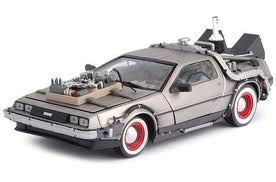
Doc’s Back to the Future DELOREAN car


              Marty McFly: Doc, we better back up. We don’t have enough road to get up to 88 (mph).

             Dr. Emmett Brown: Roads? Where we’re going, we don’t need roads.

     In the hit movie Back to the Future (1985), Marty McFly (Michael J. Fox) goes back to the future with Doc and sees flying taxis, 3D ads (a shark), and many other inventions. Some have come true. Some have not.  President Ronald Reagan adopted Doc Brown’s statement about roads. 

  At the annual event of the MIT Enterprise Forum of Israel, titled  Back to the Future 2015, held today, May 5, several farsighted experts gave their vision of the near-term future. Here are excerpts of what they said:

   The first speaker was Zeev Efrat, CEO, Frost & Sullivan (Israel branch), a global business  consulting firm.  He identified four key megatrends that experts defined a decade ago, in 2000:  Emerging China; the Internet explosion; Information Revolution; and Outsourcing.  All powerfully affected the decade 2000-2009.   The megatrends that will dominate the near-term future, according to Efrat, are:

* urbanization: A megacity is a city with over 10 m. people; a mega-region has over 15 m. people;  By 2025, half of all megacities will be in developing countries.  Life in cities will be dominated by an integration of smart+energy+plan.  Smart: ICT will be everywhere in cities, making them ‘smart’ (traffic management, power management, etc.).  Energy will be green. And planning will be highly sophisticated. Some 40 global mega-cities will be “smart”, in this sense, by 2020; over half of them will be in Europe and in North America.

* convergence:  In the late 1970’s, MIT Professor Nicholas Negroponte identified three converging industries: entertainment, publishing, computers.  Now Efrat identifies another three converging industries:  Energy, IT and automation.  This convergence will lead to a wave of mergers, as companies seek to build competencies in all three disparate technologies. 

* social trends: Gen Y.   There will be growing personalization of all goods and services.  Generation Y, the dominant generation, will seek goods that cater to values, beliefs, interest and lifestyle.  This generation, aged 15-34, will dominate – there will be 2.56 b. people in this age bracket, out of a total global population of 7.56 b. people by 2020, and 61 per cent, six of every 10, will be from Asia!  The middle class will also dominate.  By 2020  52 percent of the global 7.56 b. population will be defined as ‘middle class’. 

    Some other trends Efrat identified, in only 20 minutes!:

  • Technology: some 900 satellites will be launched in 2011-20. 
  • World War III will be an information cyberwar; it has already begun.
  • 2020 will be a virtual world, where reality and virtual unite; this will feature in shopping, surgery (practice), entertainment, business conferences, and others. The interface between real and virtual will be highly fluid.
  •  Innovation to zero: There will be zero waste, with 100% recycling, and no emissions, in cars, factories, homes.
  • E-mobility: 40 m. electric vehicles will be sold worldwide in 2020 (in one year), 30 m. cars and 10 m. two-wheelers.  The related industry will have new components: new OEM’s, along with utilities, integrators, charging stations, govt. and battery manufacturers.  Commercial vehicles will also become E-mobile, with 300,000 such vehicles by 2020. 
  • From illness to wellness:  Focus shifts from curing illness to preserving wellness. Without this trend, health costs will soar by 2050 to 20-30 per cent of GDP (13 per cent already in the U.S.).  The theme becomes: Live well, stay health.  From fat to fit.

    Innovators, identify the megatrend that excites and energizes you.  Then, identify a micro need (a well-defined group with an unmet need) within this megatrend. Finally, build your innovation around it. 

      In the next blog, I will report on another speaker, Jason Portin (editor and publisher of MIT Technology Review), who reviewed startling futuristic developments in the realm of renewable energy.

Innovation Blog

From “Made in China” to  “Owned by China”: Or What Can You Buy with Two Trillion Dollars?

By Shlomo Maital


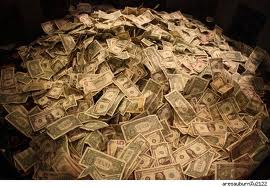
 $1 b. in cash: now picture 2,000 piles


You have to hand it to the Chinese.  They have a multi-stage long-run business strategy for China Inc. that is working to perfection.  It is amazing that a group of former Communists have applied ‘modified free market’ strategy far better than the American blueblood capitalists, and have created an economy whose size will overtake America’s far sooner than we believed or expected. 

   Here is the simple version of the two-stage strategy ‘rocket’ China created.

   Stage One.  Attract huge resources from abroad, to create enormous state-of-the-art manufacturing capability, to generate a huge export surplus.  Use the export surplus to accumulate enormous financial assets (mainly US Treasuries).

  Stage Two.  Use the pile of American dollars (growing daily, now equal to $2.5 trillion) to buy equity interests in companies and real productive assets around the world, to acquire control of resources, brands, and competitive advantage.  Note: For only $1.5 b., Lenovo bought IBM’s Think Pad and leveraged it into near-market leadership in laptops.  The transition from Think Pad to Lenovo branding was flawless and powerful. 

   Writing in the Global NYT,  David Barboza says “flush with capital from its trade surpluses, China is spreading its newfound riches to every corner of the world..over the next decade, China could invest as much as $2 trillion to acquire overseas companies, plants or property”.  The shift is amazing, Barboza says; a decade ago, China’s yearly equity investments abroad averaged only $2 b. a year, an inconsequential sum.

    Just as we saw an almost panicky rush by global companies to shift production to China, we will now see a similar stampede by nations to vie for China’s money, by selling off national assets.

   How much of that equity investment abroad will go to America?  Very little, Barboza thinks.  The study he cites suggests that because of political rivalry, America will benefit little from the Chinese direct investment.   I hear a note of regret – alas, America will not ‘benefit’ from selling off its assets to China.   For a nation that chants “USA USA, We’re Number One”, President Obama’s declared passion for welcoming Chinese equity investment, implicitly accepting “We’re #2—and we don’t even try harder” is impossible to understand. 

    As a business, China is exceptionally well run. Can’t say the same for America.

* David Barboza, “China’s cash goes global, but maybe not to US”, Global NYT May 4/011, p. 14.

Manny Pacquiao:  What Innovators Learn from One of the Greatest Boxers in History

By Shlomo Maital


 Pacquiao, in the Philippine Legislature


 Manny Pacquiao, Philippine fighter,  is arguably the greatest boxer in history.  His achievements?  He is an eight-division world champion, the first boxer in history to win ten world titles, the first to win in eight weight divisions, and the first to win the championship in four different weight classes.

 I believe the wins in four weight classes are astounding. While gaining weight, Pacquiao somehow managed to maintain his speed and quickness.  How? He reinvented how fighters box.  Here is what boxing writer Greg Bishop says: *

    Pacquiao’s trainer Freddie Roach said, ‘speed is the greatest asset [for a boxer] (and for an innovator) in the world’. [In the past] boxers mostly engaged straight on. [But Pacquiao created angles].  If Pacquiao shifted left, outside the right foot of his opponents, their natural instinct was to follow –into his left hand!  If they chose not to engage, they had one option, to back away.  Pacquiao improves his position with each angle created and makes it more difficult to counterpunch.

   Pacquiao has extremely quick feet, feet that could qualify him for Riverdance.  His style is “part performance art, part technical wizardry, unique to Pacquiao”. 

   Remember that innovation is intelligently breaking the rules.  The unwritten assumption for boxes is that you square off and meet the opponent directly.  Why?  Why not step aside, create an angle, dance, do the surprising and unexpected, fight in ways opponents are unaccustomed?  Pacquiao says his model is martial arts expert Bruce Lee, whose movies he watched endlessly as a child. 

   Pacquiao is now an elected official.  But he continues to fight.  He inspires his countrymen, and though many innovators are not fond of boxing, they can learn much from him.

  • Channeling his inner Bruce Lee,  Greg Bishop, NYT Global Edition, May 3, 2011, p. 15

Global Crisis Blog

If You Were America, When Would You Have Sounded the Alarm?

By Shlomo Maital


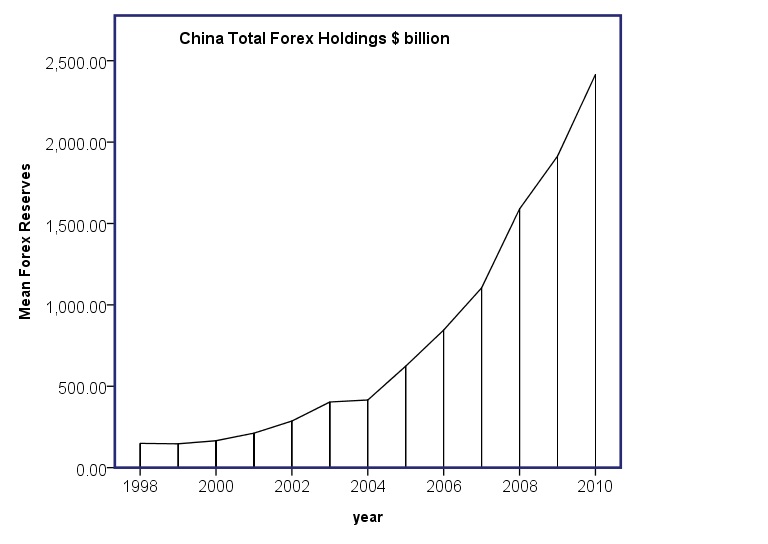
China: Total Forex Reserve $ Holdings

Suppose you, Joe Citizen, were in charge of America,  USA Ltd.  You are trading with a growing emerging nation, China.  You become aware that the Chinese are manipulating their currency, by massive purchases of U.S. dollars, to keep their renminbi exchange rate undervalued, making their exports very cheap for Americans paying in dollars and your, America’s, exports, very expensive for them.   

   Now, the Chinese do this openly.  You cannot buy huge amounts of U.S. Treasury bonds in secret.  And unlike many other things, they openly disclose their holdings of U.S. dollar assets, every month.  The above graph shows  China’s U.S. dollar reserve holdings, dating back to 1994.

Now, here is the $64 trillion question.  Viewing this graph, which you Joe Citizen religiously track, monthly,  when would you become alarmed that China was screwing you, USA Ltd.?  When would you sense that they are manipulating the exchange rate?  In 2004?  2006?  2008, when reserves reached $1.5 trillion? 

   When did America itself raise the alarm?  Indeed, have they?   When would an ordinary person, seeing this graph, raise hell about currency manipulation?  And why indeed is Clyde Prestowitz absolutely correct, when he titled his latest book The Betrayal of American Prosperity?

Global Crisis Blog

How China Taxes Its Workers Without Taxing Them: New Insight on the Downsized Yuan

By Shlomo Maital

 ..

  Reuters global editor Christia Freeland has made a brilliant observation in her NYT column (Capitalism in China: Irony is gone), Friday April 29, p. 2.   China’s policy of consistently undervaluing its currency, the yuan (renminbi, or in Mandarin, ‘money of the people’) is simply a subtle way to tax the workers.  She bases her observation on a talk by George Soros, who said at a conference,

   “the undervalued currency was a form of transferring purchasing power (wealth) from the citizens to the government without imposing taxation”.

 How does this work? 

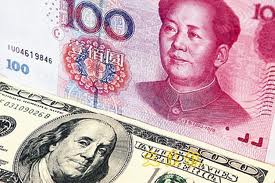
  Today one yuan is worth about 15 U.S. cents, or 6.49 yuan per dollar.  Its true, purchasing-power value, is about 30 cents, or 3.33 yuan per dollar. How do we know?  If you bought items on a shopping list in Beijing, for 1,000 yuan,  in America those same items would cost about $300.   So China has a permanent half-price sale (if you pay in dollars).  To maintain this exchange rate, the Chinese government has to buy billions in U.S. dollar assets, to support the dollar.  It already has accumulated some $2.5 trillion! 

   But why?  It is not solely to sustain China’s export-driven growth model.  As Soros explains, when the yuan is undervalued, Chinese imports cost twice what they should, so ordinary people pay double for imported goods.  Who gains?  The government.  Why?  Because the government accumulates huge amounts of wealth, in buying up cheap dollars, and some of this wealth supports the top government officials.   The undervalued yuan is a huge tax, hidden, on the workers of China, justified as a pro-export policy, but probably sustained by the fact that it further strengthens, enriches and entrenches the central government and its officials. 

    Chinese workers’ standard of living would rise dramatically if the yuan rose to 3.33 per dollar.  But the governments’ wealth accumulation, and hidden tax, would disappear.  So don’t hold your breath waiting for a rapid yuan appreciation. It won’t happen.  As Adam Smith, noted, there are passions and there are interests. The interest of China’s officials and leaders is to sustain their hidden tax.  Until that interest changes, China’s yuan will remain overvalued. 

  Renminbi “money of the people”,  it turns out, is anything but.  Like many things in China, the word renminbi is a bitter irony.

Blog entries written by Prof. Shlomo Maital

Shlomo Maital

Pages